





INDIAN EDUCATION
SYSTEM
CHARACTERISTICS
CHANGE FOR A
BETTER
TOMORROW
.
GROUP MEMBERS
SURAJ BHUSAL (LEADER)
JATIN THAKUR
MONIKA THAKUR
VINAY GABA
AKANKSHA MEHTA
ABHILASH SHARMA
RIA GUPTA
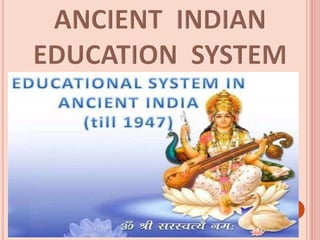
Gurukula
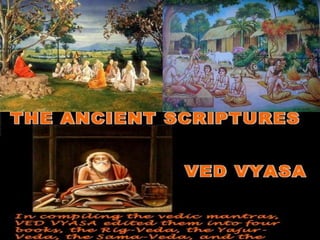
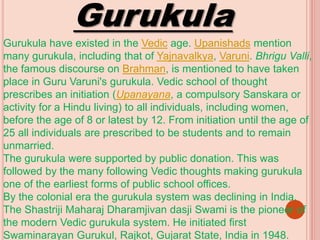
Gurukula have existed in the Vedic age. Upanishads mention
many gurukula, including that of Yajnavalkya, Varuni. Bhrigu Valli,
the famous discourse on Brahman, is mentioned to have taken
place in Guru Varuni's gurukula. Vedic school of thought
prescribes an initiation (Upanayana, a compulsory Sanskara or
activity for a Hindu living) to all individuals, including women,
before the age of 8 or latest by 12. From initiation until the age of
25 all individuals are prescribed to be students and to remain
unmarried.
The gurukula were supported by public donation. This was
followed by the many following Vedic thoughts making gurukula
one of the earliest forms of public school offices.
By the colonial era the gurukula system was declining in India.
The Shastriji Maharaj Dharamjivan dasji Swami is the pioneer of
the modern Vedic gurukula system. He initiated first
Swaminarayan Gurukul, Rajkot, Gujarat State, India in 1948.
Types of Teachers
•Acharya was a type of teacher who taught his pupil Vedas without charging
fee from the pupils.
•Upadhyaya was the one who adopted teaching as a profession to earn his
livelihood and taught only a portion of the Veda or Vedangas.
•Charakas or wandering scholars toured the country in quest of higher
knowledge. Thought not normally competent as teachers they were regarded
as possible source of knowledge by Satapatha Brahmana. Hiuen Tsang was
struck with the knowledge gained by some of the wandering teachers (called
Bhikkhus and Sadhus during his times) and who had accumulated a treasure
of knowledge by constant travel and who used to gladly impart it to others.
•Guru was the one who used to lead a gruhasta life and earn his livelihood
after imparting education to his disciples and maintain his family.
•Yaujanasatika were teachers famous for their profound scholarship that
students from distant places, as far as from a distance of hundreds of miles
would come to seek their guidance.
•Sikshaka was a teacher who gave instruction in arts like dancing.
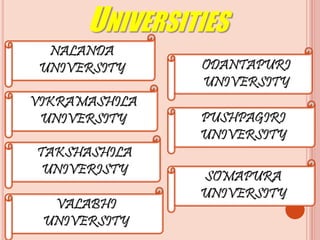
UNIVERSITIES
SOMAPURA
UNIVERSITY
PUSHPAGIRI
UNIVERSITY
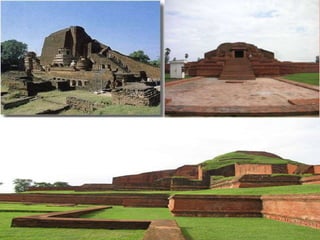
NALANDA
UNIVERSITY
VIKRAMASHILA
UNIVERSITY
TAKSHASHILA
UNIVERISTY
VALABHI
UNIVERSITY
ODANTAPURI
UNIVERSITY
CHANGE IN EDUCATION SYSTEM DUE
TO BRITISH IMPACT
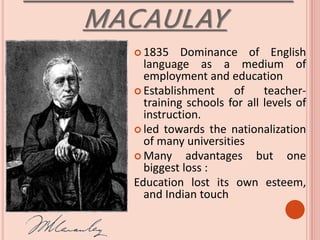
MACAULAY
 1835 Dominance of English
language as a medium of
employment and education
 Establishment of teacher-
training schools for all levels of
instruction.
 led towards the nationalization
of many universities
 Many advantages but one
biggest loss :
Education lost its own esteem,
and Indian touch
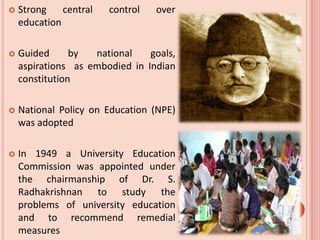
 Strong central control over
education
 Guided by national goals,
aspirations as embodied in Indian
constitution
 National Policy on Education (NPE)
was adopted
 In 1949 a University Education
Commission was appointed under
the chairmanship of Dr. S.
Radhakrishnan to study the
problems of university education
and to recommend remedial
measures
INDIAN EDUCATION SYSTEM
‘PRESENT SCENARIO &
CHARACTERISTICS’
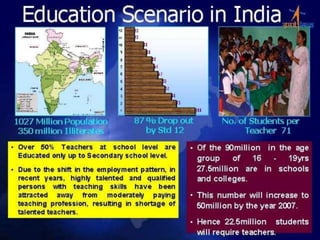
Now-a-days it is very frequently observed that students sign up for
higher studies with less interest or take is casually. Moreover,
there are very few institutions in India who are giving quality
inputs so as to inculcate the learning skills amongst students.
Higher Education System in India compare to developing /
developed countries needs substantial improvement. The
percentage of students taking higher education is hardly about 13
% whereas the same is varying between 28 to 90 %, across the
world. The lowest % being 28 % and the same is as high as
90 % in developed countries.
At one end we claim that India would rank 3rd among all countries
by 2020 in education. If we observe overall ranking of relevant
institutions it’s seen that in the year 2000, out of 500 there were 2
Indian Universities / Institutes were featured in the list, and 1
institution from China.
Now almost after a decade in 2010 the tables have changed with
only 1 institution from India being featured and 32 institutions are
featured from China!!
Special emphasis must be given to communication and
presentation skills, especially for students coming from rural
background / remote locations and that for students studies in
vernacular languages.., so that they can perform well in the
corporate world, across the globe.
Institutions should also inculcate multitasking abilities amongst
students, foreign languages, advanced IT knowledge so that
they can perform better in the chosen field. Student exchange,
cultural exchange should be encouraged and various ways and
means should be found to enhance students interest level &
participation.
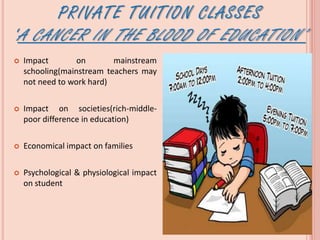
PRIVATE TUITION CLASSES
‘A CANCER IN THE BLOOD OF EDUCATION’
 Impact on mainstream
schooling(mainstream teachers may
not need to work hard)
 Impact on societies(rich-middle-
poor difference in education)
 Economical impact on families
 Psychological & physiological impact
on student
ONLY EXAM ORIENTED STUDY
‘THOUSANDS OF CHATURS OF INDIAN
EDUCATION’
 Bitter though the fact is, but it
has to be accepted that recent
Indian education system is only
exam oriented , we all have to
‘memorize’ the facts and ‘vomit’
it in the answer sheets.
 Less practical approach
 Hard work of 1 year(or 1 sem)
checked in 5 min
 Should test logical and
analytical skills regarding
particular subject
EDUCATION SYSTEM:
KILLING CREATIVITY?
‘GIVE ME SOME SUNSHINE..’
 Present education system –only
deals with the ‘GYAN’ between
two covers of the book only.
 Knowingly or unknowingly ,
other extra curricular activities
like dance, sports, arts, music
have been buried under the
coffin –partially or totally.
CORRUPTION IN EDUCATION
SYSTEM:
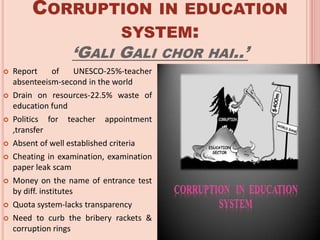
‘GALI GALI CHOR HAI..’
 Report of UNESCO-25%-teacher
absenteeism-second in the world
 Drain on resources-22.5% waste of
education fund
 Politics for teacher appointment
,transfer
 Absent of well established criteria
 Cheating in examination, examination
paper leak scam
 Money on the name of entrance test
by diff. institutes
 Quota system-lacks transparency
 Need to curb the bribery rackets &
corruption rings
CAREER CHOICE ON PARENTS/ PUBLIC/TEACHER ADVICE :
‘KUCHH TO LOG KAHENGE..’
 Indian education system has a particular
characteristic that in it, the career of a student is
decided by a parents /public / teacher’s suggestion.
 Their suggestion should be taken into consideration
while thinking, but the final decision should be our-
SELF DECISION.
 Career choice should be based on interest, hobby, &
self desire.
 This type of careers have more success rate &
satisfaction level
Parents serve as a major influence in their children’s career
development and career decision- making. Parents want their
children to find happiness and success in life and one factor which
influences happiness and success is career choice. Research
also indicates that when students feel supported and loved by
their parents, they have more confidence in their own ability to
research careers and to choose a career that would be interesting
and exciting. This is important because studies show that
adolescents who feel competent regarding career decision-
making, tend to make more satisfying career choices later in life.
Parents influence the level of education or training that their
children achieve; the knowledge they have about work and
different occupations; the beliefs and attitudes they have to
working; and the motivation they have to succeed. Most of this is
learned unconsciously – children and teenagers absorb their
parents attitudes and expectations of them as they grow up.
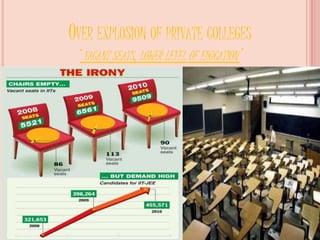
OVER EXPLOSION OF PRIVATE COLLEGES
‘VACANT SEATS, LOWER LEVEL OF EDUCATION’
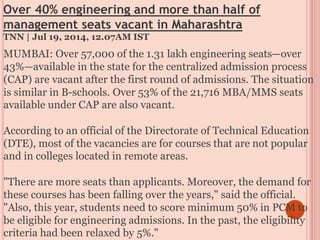
Over 40% engineering and more than half of
management seats vacant in Maharashtra
TNN | Jul 19, 2014, 12.07AM IST
MUMBAI: Over 57,000 of the 1.31 lakh engineering seats—over
43%—available in the state for the centralized admission process
(CAP) are vacant after the first round of admissions. The situation
is similar in B-schools. Over 53% of the 21,716 MBA/MMS seats
available under CAP are also vacant.
According to an official of the Directorate of Technical Education
(DTE), most of the vacancies are for courses that are not popular
and in colleges located in remote areas.
"There are more seats than applicants. Moreover, the demand for
these courses has been falling over the years," said the official.
"Also, this year, students need to score minimum 50% in PCM to
be eligible for engineering admissions. In the past, the eligibility
criteria had been relaxed by 5%."
‘OLD IS NOT GOLD..’
Growing mismatch between the needs &
education received
Poor quality, outdated undergraduate education
– created a shortage of trained personal
This has driven in company's training cost high
Needed change in curriculum but we can’t
accept a sudden change-basics will remain same
& utmost necessary
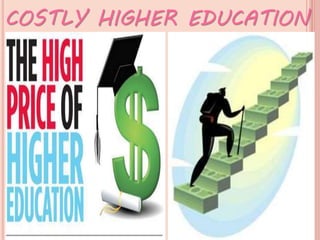
COSTLY HIGHER EDUCATION
COSTLY HIGHER EDUCATION :
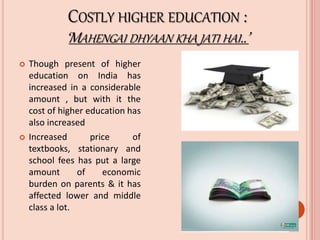
‘MAHENGAI DHYAAN KHA JATI HAI..’
 Though present of higher
education on India has
increased in a considerable
amount , but with it the
cost of higher education has
also increased
 Increased price of
textbooks, stationary and
school fees has put a large
amount of economic
burden on parents & it has
affected lower and middle
class a lot.
LACK OF INTERACTIVE CLASS –BORING
ATMOSPHERE
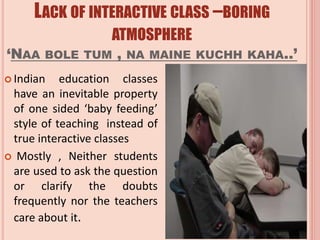
‘NAA BOLE TUM , NA MAINE KUCHH KAHA..’
 Indian education classes
have an inevitable property
of one sided ‘baby feeding’
style of teaching instead of
true interactive classes
 Mostly , Neither students
are used to ask the question
or clarify the doubts
frequently nor the teachers
care about it.
MOTHER TONGUE OR ENGLISH?
‘MEDIUM MYSTERY..’
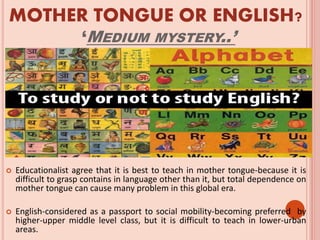
 Educationalist agree that it is best to teach in mother tongue-because it is
difficult to grasp contains in language other than it, but total dependence on
mother tongue can cause many problem in this global era.
 English-considered as a passport to social mobility-becoming preferred by
higher-upper middle level class, but it is difficult to teach in lower-urban
areas.
INCREASING RATE OF
SUICIDE
‘I QUIT..’
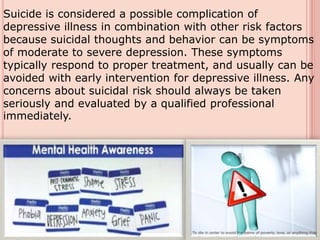
Suicide is considered a possible complication of
depressive illness in combination with other risk factors
because suicidal thoughts and behavior can be symptoms
of moderate to severe depression. These symptoms
typically respond to proper treatment, and usually can be
avoided with early intervention for depressive illness. Any
concerns about suicidal risk should always be taken
seriously and evaluated by a qualified professional
immediately.
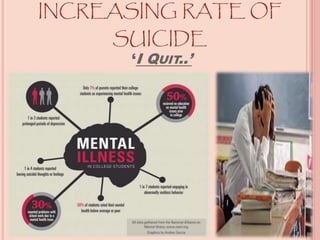
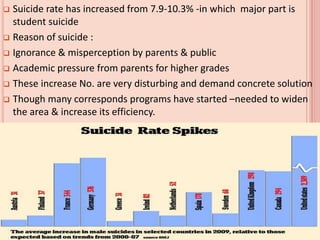
 Suicide rate has increased from 7.9-10.3% -in which major part is
student suicide
 Reason of suicide :
 Ignorance & misperception by parents & public
 Academic pressure from parents for higher grades
 These increase No. are very disturbing and demand concrete solution
 Though many corresponds programs have started –needed to widen
the area & increase its efficiency.
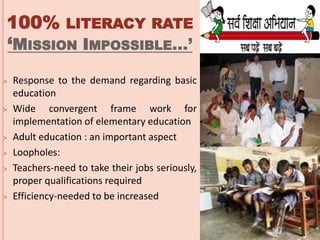
100% LITERACY RATE
‘MISSION IMPOSSIBLE…’
˃ Response to the demand regarding basic
education
˃ Wide convergent frame work for
implementation of elementary education
˃ Adult education : an important aspect
˃ Loopholes:
˃ Teachers-need to take their jobs seriously,
proper qualifications required
˃ Efficiency-needed to be increased
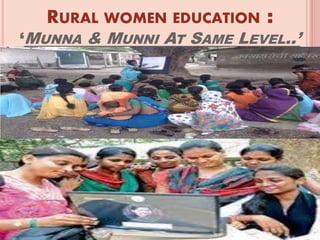
RURAL WOMEN EDUCATION :
‘MUNNA & MUNNI AT SAME LEVEL..’
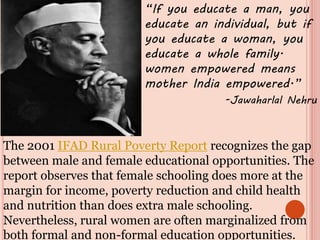
“If you educate a man, you
educate an individual, but if
you educate a woman, you
educate a whole family.
women empowered means
mother India empowered.”
-Jawaharlal Nehru
The 2001 IFAD Rural Poverty Report recognizes the gap
between male and female educational opportunities. The
report observes that female schooling does more at the
margin for income, poverty reduction and child health
and nutrition than does extra male schooling.
Nevertheless, rural women are often marginalized from
both formal and non-formal education opportunities.
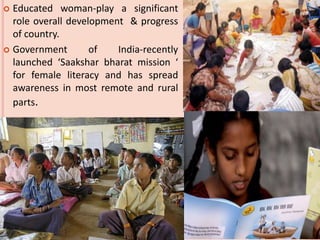
 Educated woman-play a significant
role overall development & progress
of country.
 Government of India-recently
launched ‘Saakshar bharat mission ‘
for female literacy and has spread
awareness in most remote and rural
parts.
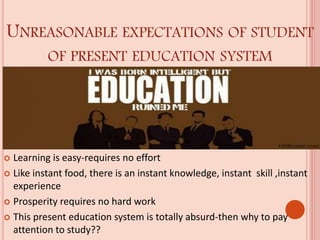
UNREASONABLE EXPECTATIONS OF STUDENT
OF PRESENT EDUCATION SYSTEM
 Learning is easy-requires no effort
 Like instant food, there is an instant knowledge, instant skill ,instant
experience
 Prosperity requires no hard work
 This present education system is totally absurd-then why to pay
attention to study??
CHANGE IS NEEDED, BE THE CHANGE…
PAST REQUIREMENTS
 Knowledge
 Exam oriented study
 Product-centric
 Graduate
 Passive participation
 Just-in-case
 Static content
 Mandated
 Instructor led courses
FUTURE REQUIREMENTS
 Knowledge with skills
 Concept oriented study
 learner centric
 life long learning
 active participation
 Just-in-time
 Customized content
 Self directed
 library of learning courses
REDEFINED GOALS OF
EDUCATIONS
 Appropriate field of education
 Emerging demands of the profession
 Professional ethics & human values
 All round development : including moral and cultural education
 Changing & emerging roles of :
 Leadership, governance
 Faculty, teaching, mentoring, assessment
 Redefined goals of technical education :
 Quality, excellence
 National relevance
 Social & societal responsibility
 Environmental & ecological responsibility
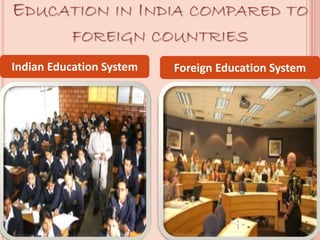
EDUCATION IN INDIA COMPARED TO
FOREIGN COUNTRIES
Indian Education System Foreign Education System
COMPARISON
 INDIAN Government provide a lots of facilities for all the students
whether rich or poor family but some improvement is most required
because facilities are not provided by all students.
 INDIAN Education system is peculiar. Because in foreign countries
people concentrate on one subject, so they know only the things
which they focus but we study everything.
 INDIA is lagging in practical knowledge. If we improve practical
knowledge India will became one of the best country in the world.
 INDIAN children are making their mind hard disk of computer. They
cram books and write on the answer book. This is the education
system of INDIA.
 INDIAN students wants to get good percentage instead of getting
extra knowledge. So for improving GK. Must be a compulsory subject.
10 FUNDAMENTAL PROBLEMS
WITH EDUCATION SYSTEM IN
INDIA» Education System promotes RAT RACE.
» Education does not builds PERSONA of
Child
» No Critical Analysis, only FOLLOWING the
Establishment
» Too much PAROCHIALISM rather Global
outlook
» Teachers themselves are NOT Trained and
Efficient
» Medium of Language of OUR Studies
» Education given is Irrelevant to JOB-
MARKET
» Missing INNOVATION and CREATIVITY
because only Aping West
» Students happy in Getting HIGHLY PAID
SLARY JOB but lacks ambition to become
ENTERPRENUER
» Gross FAILURE of our Education System to
end SOCIAL DISPARITY
NATIONAL COUNCIL OF
EDUCATIONAL RESEARCH AND
TRAINING (NCERT)
 It is the apex body for school
education in India. The NCERT
provides support and technical
assistance to a number of
schools in India and oversees
many aspects or enforcement
of education policies.
NCERT has comprehensive extension programme in which
departments of the National Institute of Education (NIE),
Regional Institute of Education (RIE), Central Institute of
Vocational Education (CIVE) and offices of the Field Advisers
in the states are engaged in activities. Several programmes
are organized in rural and backward areas to reach out to
functionaries in these areas.
It acts as the Secretariat of the National Development Group
(NDG) for Educational Innovations. The NCERT has been
offering training facilities, usually through attachment
programmes and participation in workshops, to education
workers of other countries. The NCERT publishes textbooks
for school subjects from Classes I to XII. NCERT publishes
books & provides Sample Question Papers. that are used in
government and private schools across India that follow the
CBSE curriculum.
CONTINUOUS AND
COMPREHENSIVE EVALUATION
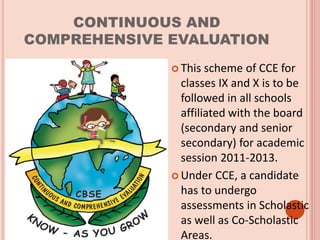
 This scheme of CCE for
classes IX and X is to be
followed in all schools
affiliated with the board
(secondary and senior
secondary) for academic
session 2011-2013.
 Under CCE, a candidate
has to undergo
assessments in Scholastic
as well as Co-Scholastic
Areas.
SALIENT FEATURES OF THE
CCE
 Each academic year has been divided into 2 terms.
 All the students shall be required to undergo various
school based assessments in Co-Scholastic Areas.
 Syllabus is also divided in 2 part.
 Grades where given by board after calculating IX and X
Assessments of all Scholastic as well as Co-Scholastic
Areas.
 At the end of X, all candidates shall be issued the same
‘Grade Sheet Cum Certificate of Performance’ prepared,
printed and signed by the board.
CCE helps in reducing stress of students by-
o Identifying learning progress of students at regular
time intervals on small portion of content.
o Employing a variety of remedial measures of
teaching based on learning needs and potential of
different students.
o Desisting from using negative comments on the
learner’s performance.
o Involving learners actively in the learning process.
o Recognizing and encouraging specific abilities of
students who do not excel in academics but perform
well in other co-curricular area.
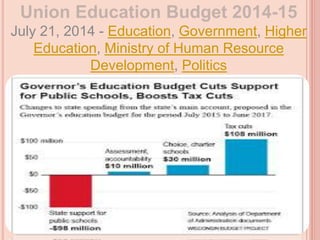
Union Education Budget 2014-15
July 21, 2014 - Education, Government, Higher
Education, Ministry of Human Resource
Development, Politics
The union budget 2014-15 presented in the parliament on
July 10 has given Rs 83,771 crore for HRD ministry (an
increase of 12.3% from last year), The Sarva Shiksha
Abhiyan, which is the programme for the implementation of
the Right to Education Act, got an allocation of Rs 28,635
crore, an increase of Rs 1,000 crore, Rashtriya Madhyamik
Shiksha Abhiyan got Rs 4,966 crore, while the Mid-Day Meal
Programme has been allocated Rs 13,215 crore. A Rs 500
crore teachers training program named after BHU founder
and legendary educationist Pundit Madan Mohan Malviya, Rs
100 crore Communication Linked Interface for Cultivating
Knowledge (CLICK) and online courses for spreading virtual
classroom, Rs.30 crore for School Assessment Programme
are some other highlights. In higher education, new 5 IITS
and 5 IIMs have been announced besides two agriculture
universities in Andhra Pradesh and Rajasthan, two
horticulture universities in Telangana and Haryana.
PRIMARY EDUCATION
 The govt. lays emphasis to primary education up to the
age of 14years.
 The District Primary Education Programme (DPEP) was
launched in 1994 which had opened 1,60,000 new
schools and supported by UNICEF.
 85% of DPEP is funded by the Central govt. and the
remaining 15% is funded by the state.
 govt. has also banned child labour in order to ensure that
the children do not enter unsafe working condition.
 Education has also been made free for children under the
Right of children to Free and Compulsory Education.
SECONDARY EDUCATION
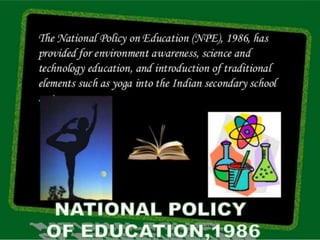
 The national policy on Education (NPE), 1986, has
provided for environment awareness, science and
technology Education, and introduction of traditional
elements such as yoga into the secondary school system.
 Emphasis on profession based vocational training to help
student attain skills for finding a vocation of his/her
choosing.
 A special integrated education for disabled children (IEDC)
program was started in 1974.
 The Kendriya Vidyalaya project, was started in 1956 for
the employees of the central govt. of India, who are
distributed through out the country.
TERTIARY EDUCATION
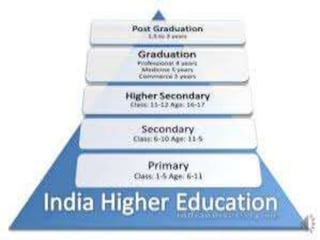
 India’s higher education system is the third largest in the
world, after china and united states. The main governing
body at the tertiary level is the university grants
commission (India), which enforces its standards, advices
the govt. and helps to coordinate between the centre and
the state.
 As of 2009 India has 20 central universities, 215 state
universities, 100 deemed universities, 5 institutions
established and functioning under the state act, and 13
institutes which are of national importance.
 Other institutions include 16000 colleges, including 1800
exclusive women’s colleges, functioning under these
universities and institutions.
TECHNICAL EDUCATION
 National policy on education (NPE) provisioned for an
apex body for regulation and development of higher
technical education, which came into being as the all
India council for technical education (AICTE) in 1987
through an act of the parliament.
 At the level of centre the institutes of technology are
deemed of national importance .The IIMs are also among
the nation’s premier education facilities . Several regional
engineering colleges(REC)have been converted into
national institutes of technology. The UGC has inter
university centers at a number of locations throughout
India to promote common research.
PRIVATE EDUCATION
 Because of poor quality of public education ,27% of
Indian children are privately educated.
 Private schools cover the entire curriculum and offer
extra curriculum activities such as science fairs, general
knowledge, sports, music and drama .
 Even the poorest often go to private schools despite the
fact that govt. schools are free. A study found that 65% of
school children in Hyderabad’s slums attend private
schools .
RURAL EDUCATION
 The administrative control was effectively initiated in
the1950s, when, in 1952, the govt. grouped villages
under a community development block –an authority
under national program which could control education
in up to 100 villages .
 A block development officer oversees a geographical
area of 150sq.miles which could contain a population of
as many as 70000 people .
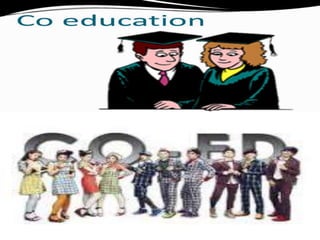
CO-EDUCATION SYSTEM
 Co-Education is a system of educating boys and girl
together. In ancient times it was prevalent in Greece now
this system of education is there in almost all the
countries of the world.
 The problem of shortage of trained teachers can be dealt
easily as boys overcome their curiosity and girls with
their shyness.
 It generates harmonious relationship, a sense of Co-
operation and thus helps in the progress of nation.
 It contributes to the balanced development to the
personality of boys and girls.
ADVANTAGES OF CO-
EDUCATION SYSTEM
 This system helps to remove shyness to each other,
remove hesitation.
 It provide such environment where both male and
female can share their problems And it will give the way
to share the ideas.
 It improves communication skills in front of opposite
gender and increased confidence level.
 It helps a student not only to grow morally but also
mentally.
NATIONAL POLICY ON EDUCATIONAL
 The national policy on education (NPE) is a policy
formulated by the govt. India to promote education
amongst India’s people .It covers elementary education
to collages in doth rural and urban India .
 The first NPE was promulgated in 1968 by the Govt. of
Prime Minister Indira Gandhi and the second by Pime
Minister Rajiv Gandhi in 1986.
 It emphasis three aspects:
1. Universal access and enrollment .
2. Universal retention of children up to 14yrs is of age and
a substantial improvement in the quality of education
to enable all children to achieve.
RECENT DEVELOPMENTS
 SARVA SHIKSHA ABHIYAN (The education for all
movement)
 NATIONAL PROGRAMME FOR EDUCATION OF GIRLS AT
ELEMENTARY LEVEL (NPEGEL)
 RASHTRIYA MADHYAMIK SHIKSHA ABHIYAN (National
mission for secondary education)
 INCLUSIVE EDUCATION FOR THE DISABLED AT
SECONDARY STAGE (IEDSS)
 SAAKSHAR BHARAT
 RASHTRIYA UCHCHATAR SHIKSHA ABHIYAN (RUSA)
RASHTRIYA UCHCHATAR
SHIKSHA ABHIYAN
(NATIONAL HIGHER EDUCATION MISSION)
 RUSA emphasizes to promote reforms in the state higher
education system by creating a facilitating institutional
structure for planning and monitoring at the state level.
 One of the goal is to ensure academic examination reform
in higher education institutions and enable conversation
of some of the universities into research universities at
par with the best in world.
 The project was recently launched in 8th June 2013, it was
implemented by HRD Ministry as a centrally sponsored
scheme with matching contribution from state govt. and
Union Territories.
OBJECTIVES :
 RUSA aims to provide equal development to all higher
institution and rectify weaknesses in the higher education
system. Its target achievement is to raise the gross
enrolment ratio to 32% by the end of XII Plan in 2017.
 The major objectives are:
o Improve the overall quality of existing state institutions
by ensuring that all institutions confirm to prescribed
norms and standard and adopt accreditation as a
mandatory quality assurance frame work.
o Ensure academic and examination reforms in the higher
education institutions .
o Ensure adequate availability of quality faculty in all
higher educational institutions and ensure capacity
building at all level of employment.
o Create and enabling atmosphere in the higher
educational institutions to devote themselves to
research and innovations.
o Expand the institutional base by creating additional
capacity in existing institutions and establishing new
institutions in order to achieve enrolment targets.
o Improved equity by providing adequate opportunities of
higher education to SC/STs and socially and
educationally backward classes, promote inclusion of
women, minorities, and differently abled persons .
INTERNET IN FIELD OF
EDUCATION
 The internet is the largest set of computer networks that
use the internet protocol. The invention and development
of the internet was the biggest discovery by mankind in
20th century that led to a resolution.
 Today , the internet is used by more than 50% of the
world population as its application are found in nearly
every field of life, be it communication knowledge, news,
shopping, education etc.
USE OF INTERNET IN
EDUCATION
 The fast and relatively low cost access is one of the major
benefits of internet to people and student all over the
world.
 Communication and information are the two basic uses of
internet.
 Information available on web sites can be updated and or
modified at any time and for any no. of times, which
helps in learning and better understanding.
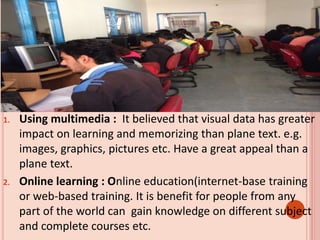
1. Using multimedia : It believed that visual data has greater
impact on learning and memorizing than plane text. e.g.
images, graphics, pictures etc. Have a great appeal than a
plane text.
2. Online learning : Online education(internet-base training
or web-based training. It is benefit for people from any
part of the world can gain knowledge on different subject
and complete courses etc.
3. Easy contact : Student and teacher can contact easily if
they have queries about any information can be easily
carried out using the internet.
4. School/college projects : As the internet is an ocean of
information, covering nearly all subjects required for
one’s projects.
5. Easy education system : Not only gaining knowledge,
but every part of education system is simplified because
of the internet.
6. No age bracket for education : You are now never too
old or too busy to learn something new.
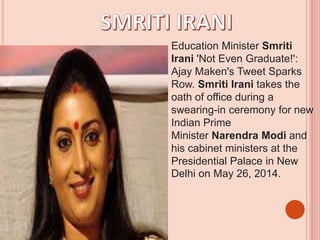
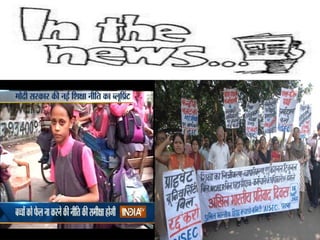
Education Minister Smriti
Irani 'Not Even Graduate!':
Ajay Maken's Tweet Sparks
Row. Smriti Irani takes the
oath of office during a
swearing-in ceremony for new
Indian Prime
Minister Narendra Modi and
his cabinet ministers at the
Presidential Palace in New
Delhi on May 26, 2014.
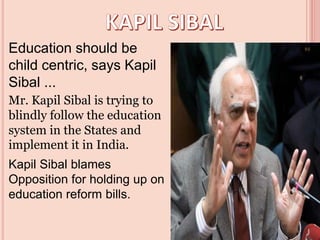
Education should be
child centric, says Kapil
Sibal ...
Mr. Kapil Sibal is trying to
blindly follow the education
system in the States and
implement it in India.
Kapil Sibal blames
Opposition for holding up on
education reform bills.
DRAW BACKS OF PRESENT
EDUCATION SYSTEM
 Present education system focuses more on scores rather
than knowledge .
 Its having 90% theoretical subjects. Even remaining 10%
practical subjects are of limited experiments and of
expected output.
 There is no scope for students to do experiments on
their own.
 Some colleges are not conducting practical. Instead, they
are giving full marks and allotting that time to mug up
theoretical subjects.
 In the end, students are coming out of schools and
colleges only having bookish knowledge.
 There is s much meaningless pressure on students
because of too much competitive spirit in between
private institutions .
 Many schools are not concentrating on extra curricula
activities.
 Some teacher are giving marks based on the no. of
people rather than the content.
 There are some cases that student are giving up their
lives as they are unable to cope up with too much
pressure.
SOLUTIONS
 Teachers must say the purpose of education to the
children of school level.
 Teacher must encourage the children to understand the
concept and to write it in their own words in exam.
 Every theoretical subject must have practical if possible.
 Communication skills and reasoning must be a subject
from school level.
 There must be seminars and project from schooling to
make student understand the subjects rather than
mugging up.
 Personality development classes and extra curricular
activities must be compulsory .
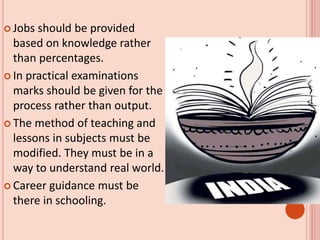
 Jobs should be provided
based on knowledge rather
than percentages.
 In practical examinations
marks should be given for the
process rather than output.
 The method of teaching and
lessons in subjects must be
modified. They must be in a
way to understand real world.
 Career guidance must be
there in schooling.
Money borrowed to finance education or school
related expenses. Payments are often deferred while
in school and for a six-month grace period after
graduation. Sallie Mae is the largest source of
education loans and handles the two major types, the
Stafford loan and the Perkins loan. One of the major
benefits of these types of loans is that they come with
low interest rates and do not require collateral or a
credit check.
CONCLUSION
 Government must concentrate on modifying the
education system to give wonderful life for students.
 There is a role of educational institutional too to improve
the method of teaching.
 A good education system leads to a good society.
Education is Simply the Soul of a Society
as it Passes from One Generation
to Another…
Education system
Education system

Education system

  • 2.
  • 3.
    GROUP MEMBERS SURAJ BHUSAL(LEADER) JATIN THAKUR MONIKA THAKUR VINAY GABA AKANKSHA MEHTA ABHILASH SHARMA RIA GUPTA
  • 6.
    Gurukula Gurukula have existedin the Vedic age. Upanishads mention many gurukula, including that of Yajnavalkya, Varuni. Bhrigu Valli, the famous discourse on Brahman, is mentioned to have taken place in Guru Varuni's gurukula. Vedic school of thought prescribes an initiation (Upanayana, a compulsory Sanskara or activity for a Hindu living) to all individuals, including women, before the age of 8 or latest by 12. From initiation until the age of 25 all individuals are prescribed to be students and to remain unmarried. The gurukula were supported by public donation. This was followed by the many following Vedic thoughts making gurukula one of the earliest forms of public school offices. By the colonial era the gurukula system was declining in India. The Shastriji Maharaj Dharamjivan dasji Swami is the pioneer of the modern Vedic gurukula system. He initiated first Swaminarayan Gurukul, Rajkot, Gujarat State, India in 1948.
  • 7.
    Types of Teachers •Acharyawas a type of teacher who taught his pupil Vedas without charging fee from the pupils. •Upadhyaya was the one who adopted teaching as a profession to earn his livelihood and taught only a portion of the Veda or Vedangas. •Charakas or wandering scholars toured the country in quest of higher knowledge. Thought not normally competent as teachers they were regarded as possible source of knowledge by Satapatha Brahmana. Hiuen Tsang was struck with the knowledge gained by some of the wandering teachers (called Bhikkhus and Sadhus during his times) and who had accumulated a treasure of knowledge by constant travel and who used to gladly impart it to others. •Guru was the one who used to lead a gruhasta life and earn his livelihood after imparting education to his disciples and maintain his family. •Yaujanasatika were teachers famous for their profound scholarship that students from distant places, as far as from a distance of hundreds of miles would come to seek their guidance. •Sikshaka was a teacher who gave instruction in arts like dancing.
  • 9.
  • 10.
    CHANGE IN EDUCATIONSYSTEM DUE TO BRITISH IMPACT
  • 11.
    MACAULAY  1835 Dominanceof English language as a medium of employment and education  Establishment of teacher- training schools for all levels of instruction.  led towards the nationalization of many universities  Many advantages but one biggest loss : Education lost its own esteem, and Indian touch
  • 13.
     Strong centralcontrol over education  Guided by national goals, aspirations as embodied in Indian constitution  National Policy on Education (NPE) was adopted  In 1949 a University Education Commission was appointed under the chairmanship of Dr. S. Radhakrishnan to study the problems of university education and to recommend remedial measures
  • 14.
    INDIAN EDUCATION SYSTEM ‘PRESENTSCENARIO & CHARACTERISTICS’
  • 16.
    Now-a-days it isvery frequently observed that students sign up for higher studies with less interest or take is casually. Moreover, there are very few institutions in India who are giving quality inputs so as to inculcate the learning skills amongst students. Higher Education System in India compare to developing / developed countries needs substantial improvement. The percentage of students taking higher education is hardly about 13 % whereas the same is varying between 28 to 90 %, across the world. The lowest % being 28 % and the same is as high as 90 % in developed countries. At one end we claim that India would rank 3rd among all countries by 2020 in education. If we observe overall ranking of relevant institutions it’s seen that in the year 2000, out of 500 there were 2 Indian Universities / Institutes were featured in the list, and 1 institution from China. Now almost after a decade in 2010 the tables have changed with only 1 institution from India being featured and 32 institutions are featured from China!!
  • 17.
    Special emphasis mustbe given to communication and presentation skills, especially for students coming from rural background / remote locations and that for students studies in vernacular languages.., so that they can perform well in the corporate world, across the globe. Institutions should also inculcate multitasking abilities amongst students, foreign languages, advanced IT knowledge so that they can perform better in the chosen field. Student exchange, cultural exchange should be encouraged and various ways and means should be found to enhance students interest level & participation.
  • 19.
    PRIVATE TUITION CLASSES ‘ACANCER IN THE BLOOD OF EDUCATION’  Impact on mainstream schooling(mainstream teachers may not need to work hard)  Impact on societies(rich-middle- poor difference in education)  Economical impact on families  Psychological & physiological impact on student
  • 20.
    ONLY EXAM ORIENTEDSTUDY ‘THOUSANDS OF CHATURS OF INDIAN EDUCATION’  Bitter though the fact is, but it has to be accepted that recent Indian education system is only exam oriented , we all have to ‘memorize’ the facts and ‘vomit’ it in the answer sheets.  Less practical approach  Hard work of 1 year(or 1 sem) checked in 5 min  Should test logical and analytical skills regarding particular subject
  • 21.
    EDUCATION SYSTEM: KILLING CREATIVITY? ‘GIVEME SOME SUNSHINE..’  Present education system –only deals with the ‘GYAN’ between two covers of the book only.  Knowingly or unknowingly , other extra curricular activities like dance, sports, arts, music have been buried under the coffin –partially or totally.
  • 22.
    CORRUPTION IN EDUCATION SYSTEM: ‘GALIGALI CHOR HAI..’  Report of UNESCO-25%-teacher absenteeism-second in the world  Drain on resources-22.5% waste of education fund  Politics for teacher appointment ,transfer  Absent of well established criteria  Cheating in examination, examination paper leak scam  Money on the name of entrance test by diff. institutes  Quota system-lacks transparency  Need to curb the bribery rackets & corruption rings
  • 24.
    CAREER CHOICE ONPARENTS/ PUBLIC/TEACHER ADVICE : ‘KUCHH TO LOG KAHENGE..’  Indian education system has a particular characteristic that in it, the career of a student is decided by a parents /public / teacher’s suggestion.  Their suggestion should be taken into consideration while thinking, but the final decision should be our- SELF DECISION.  Career choice should be based on interest, hobby, & self desire.  This type of careers have more success rate & satisfaction level
  • 25.
    Parents serve asa major influence in their children’s career development and career decision- making. Parents want their children to find happiness and success in life and one factor which influences happiness and success is career choice. Research also indicates that when students feel supported and loved by their parents, they have more confidence in their own ability to research careers and to choose a career that would be interesting and exciting. This is important because studies show that adolescents who feel competent regarding career decision- making, tend to make more satisfying career choices later in life. Parents influence the level of education or training that their children achieve; the knowledge they have about work and different occupations; the beliefs and attitudes they have to working; and the motivation they have to succeed. Most of this is learned unconsciously – children and teenagers absorb their parents attitudes and expectations of them as they grow up.
  • 26.
    OVER EXPLOSION OFPRIVATE COLLEGES ‘VACANT SEATS, LOWER LEVEL OF EDUCATION’
  • 27.
    Over 40% engineeringand more than half of management seats vacant in Maharashtra TNN | Jul 19, 2014, 12.07AM IST MUMBAI: Over 57,000 of the 1.31 lakh engineering seats—over 43%—available in the state for the centralized admission process (CAP) are vacant after the first round of admissions. The situation is similar in B-schools. Over 53% of the 21,716 MBA/MMS seats available under CAP are also vacant. According to an official of the Directorate of Technical Education (DTE), most of the vacancies are for courses that are not popular and in colleges located in remote areas. "There are more seats than applicants. Moreover, the demand for these courses has been falling over the years," said the official. "Also, this year, students need to score minimum 50% in PCM to be eligible for engineering admissions. In the past, the eligibility criteria had been relaxed by 5%."
  • 29.
    ‘OLD IS NOTGOLD..’ Growing mismatch between the needs & education received Poor quality, outdated undergraduate education – created a shortage of trained personal This has driven in company's training cost high Needed change in curriculum but we can’t accept a sudden change-basics will remain same & utmost necessary
  • 30.
  • 32.
    COSTLY HIGHER EDUCATION: ‘MAHENGAI DHYAAN KHA JATI HAI..’  Though present of higher education on India has increased in a considerable amount , but with it the cost of higher education has also increased  Increased price of textbooks, stationary and school fees has put a large amount of economic burden on parents & it has affected lower and middle class a lot.
  • 33.
    LACK OF INTERACTIVECLASS –BORING ATMOSPHERE ‘NAA BOLE TUM , NA MAINE KUCHH KAHA..’  Indian education classes have an inevitable property of one sided ‘baby feeding’ style of teaching instead of true interactive classes  Mostly , Neither students are used to ask the question or clarify the doubts frequently nor the teachers care about it.
  • 34.
    MOTHER TONGUE ORENGLISH? ‘MEDIUM MYSTERY..’  Educationalist agree that it is best to teach in mother tongue-because it is difficult to grasp contains in language other than it, but total dependence on mother tongue can cause many problem in this global era.  English-considered as a passport to social mobility-becoming preferred by higher-upper middle level class, but it is difficult to teach in lower-urban areas.
  • 35.
  • 36.
    Suicide is considereda possible complication of depressive illness in combination with other risk factors because suicidal thoughts and behavior can be symptoms of moderate to severe depression. These symptoms typically respond to proper treatment, and usually can be avoided with early intervention for depressive illness. Any concerns about suicidal risk should always be taken seriously and evaluated by a qualified professional immediately.
  • 37.
     Suicide ratehas increased from 7.9-10.3% -in which major part is student suicide  Reason of suicide :  Ignorance & misperception by parents & public  Academic pressure from parents for higher grades  These increase No. are very disturbing and demand concrete solution  Though many corresponds programs have started –needed to widen the area & increase its efficiency.
  • 38.
    100% LITERACY RATE ‘MISSIONIMPOSSIBLE…’ ˃ Response to the demand regarding basic education ˃ Wide convergent frame work for implementation of elementary education ˃ Adult education : an important aspect ˃ Loopholes: ˃ Teachers-need to take their jobs seriously, proper qualifications required ˃ Efficiency-needed to be increased
  • 39.
    RURAL WOMEN EDUCATION: ‘MUNNA & MUNNI AT SAME LEVEL..’
  • 40.
    “If you educatea man, you educate an individual, but if you educate a woman, you educate a whole family. women empowered means mother India empowered.” -Jawaharlal Nehru The 2001 IFAD Rural Poverty Report recognizes the gap between male and female educational opportunities. The report observes that female schooling does more at the margin for income, poverty reduction and child health and nutrition than does extra male schooling. Nevertheless, rural women are often marginalized from both formal and non-formal education opportunities.
  • 41.
     Educated woman-playa significant role overall development & progress of country.  Government of India-recently launched ‘Saakshar bharat mission ‘ for female literacy and has spread awareness in most remote and rural parts.
  • 42.
    UNREASONABLE EXPECTATIONS OFSTUDENT OF PRESENT EDUCATION SYSTEM  Learning is easy-requires no effort  Like instant food, there is an instant knowledge, instant skill ,instant experience  Prosperity requires no hard work  This present education system is totally absurd-then why to pay attention to study??
  • 43.
    CHANGE IS NEEDED,BE THE CHANGE… PAST REQUIREMENTS  Knowledge  Exam oriented study  Product-centric  Graduate  Passive participation  Just-in-case  Static content  Mandated  Instructor led courses FUTURE REQUIREMENTS  Knowledge with skills  Concept oriented study  learner centric  life long learning  active participation  Just-in-time  Customized content  Self directed  library of learning courses
  • 44.
    REDEFINED GOALS OF EDUCATIONS Appropriate field of education  Emerging demands of the profession  Professional ethics & human values  All round development : including moral and cultural education  Changing & emerging roles of :  Leadership, governance  Faculty, teaching, mentoring, assessment  Redefined goals of technical education :  Quality, excellence  National relevance  Social & societal responsibility  Environmental & ecological responsibility
  • 45.
    EDUCATION IN INDIACOMPARED TO FOREIGN COUNTRIES Indian Education System Foreign Education System
  • 46.
    COMPARISON  INDIAN Governmentprovide a lots of facilities for all the students whether rich or poor family but some improvement is most required because facilities are not provided by all students.  INDIAN Education system is peculiar. Because in foreign countries people concentrate on one subject, so they know only the things which they focus but we study everything.  INDIA is lagging in practical knowledge. If we improve practical knowledge India will became one of the best country in the world.  INDIAN children are making their mind hard disk of computer. They cram books and write on the answer book. This is the education system of INDIA.  INDIAN students wants to get good percentage instead of getting extra knowledge. So for improving GK. Must be a compulsory subject.
  • 47.
    10 FUNDAMENTAL PROBLEMS WITHEDUCATION SYSTEM IN INDIA» Education System promotes RAT RACE. » Education does not builds PERSONA of Child » No Critical Analysis, only FOLLOWING the Establishment » Too much PAROCHIALISM rather Global outlook » Teachers themselves are NOT Trained and Efficient
  • 48.
    » Medium ofLanguage of OUR Studies » Education given is Irrelevant to JOB- MARKET » Missing INNOVATION and CREATIVITY because only Aping West » Students happy in Getting HIGHLY PAID SLARY JOB but lacks ambition to become ENTERPRENUER » Gross FAILURE of our Education System to end SOCIAL DISPARITY
  • 49.
    NATIONAL COUNCIL OF EDUCATIONALRESEARCH AND TRAINING (NCERT)  It is the apex body for school education in India. The NCERT provides support and technical assistance to a number of schools in India and oversees many aspects or enforcement of education policies.
  • 50.
    NCERT has comprehensiveextension programme in which departments of the National Institute of Education (NIE), Regional Institute of Education (RIE), Central Institute of Vocational Education (CIVE) and offices of the Field Advisers in the states are engaged in activities. Several programmes are organized in rural and backward areas to reach out to functionaries in these areas. It acts as the Secretariat of the National Development Group (NDG) for Educational Innovations. The NCERT has been offering training facilities, usually through attachment programmes and participation in workshops, to education workers of other countries. The NCERT publishes textbooks for school subjects from Classes I to XII. NCERT publishes books & provides Sample Question Papers. that are used in government and private schools across India that follow the CBSE curriculum.
  • 51.
    CONTINUOUS AND COMPREHENSIVE EVALUATION This scheme of CCE for classes IX and X is to be followed in all schools affiliated with the board (secondary and senior secondary) for academic session 2011-2013.  Under CCE, a candidate has to undergo assessments in Scholastic as well as Co-Scholastic Areas.
  • 52.
    SALIENT FEATURES OFTHE CCE  Each academic year has been divided into 2 terms.  All the students shall be required to undergo various school based assessments in Co-Scholastic Areas.  Syllabus is also divided in 2 part.  Grades where given by board after calculating IX and X Assessments of all Scholastic as well as Co-Scholastic Areas.  At the end of X, all candidates shall be issued the same ‘Grade Sheet Cum Certificate of Performance’ prepared, printed and signed by the board.
  • 54.
    CCE helps inreducing stress of students by- o Identifying learning progress of students at regular time intervals on small portion of content. o Employing a variety of remedial measures of teaching based on learning needs and potential of different students. o Desisting from using negative comments on the learner’s performance. o Involving learners actively in the learning process. o Recognizing and encouraging specific abilities of students who do not excel in academics but perform well in other co-curricular area.
  • 55.
    Union Education Budget2014-15 July 21, 2014 - Education, Government, Higher Education, Ministry of Human Resource Development, Politics
  • 56.
    The union budget2014-15 presented in the parliament on July 10 has given Rs 83,771 crore for HRD ministry (an increase of 12.3% from last year), The Sarva Shiksha Abhiyan, which is the programme for the implementation of the Right to Education Act, got an allocation of Rs 28,635 crore, an increase of Rs 1,000 crore, Rashtriya Madhyamik Shiksha Abhiyan got Rs 4,966 crore, while the Mid-Day Meal Programme has been allocated Rs 13,215 crore. A Rs 500 crore teachers training program named after BHU founder and legendary educationist Pundit Madan Mohan Malviya, Rs 100 crore Communication Linked Interface for Cultivating Knowledge (CLICK) and online courses for spreading virtual classroom, Rs.30 crore for School Assessment Programme are some other highlights. In higher education, new 5 IITS and 5 IIMs have been announced besides two agriculture universities in Andhra Pradesh and Rajasthan, two horticulture universities in Telangana and Haryana.
  • 58.
    PRIMARY EDUCATION  Thegovt. lays emphasis to primary education up to the age of 14years.  The District Primary Education Programme (DPEP) was launched in 1994 which had opened 1,60,000 new schools and supported by UNICEF.  85% of DPEP is funded by the Central govt. and the remaining 15% is funded by the state.  govt. has also banned child labour in order to ensure that the children do not enter unsafe working condition.  Education has also been made free for children under the Right of children to Free and Compulsory Education.
  • 59.
    SECONDARY EDUCATION  Thenational policy on Education (NPE), 1986, has provided for environment awareness, science and technology Education, and introduction of traditional elements such as yoga into the secondary school system.  Emphasis on profession based vocational training to help student attain skills for finding a vocation of his/her choosing.  A special integrated education for disabled children (IEDC) program was started in 1974.  The Kendriya Vidyalaya project, was started in 1956 for the employees of the central govt. of India, who are distributed through out the country.
  • 60.
    TERTIARY EDUCATION  India’shigher education system is the third largest in the world, after china and united states. The main governing body at the tertiary level is the university grants commission (India), which enforces its standards, advices the govt. and helps to coordinate between the centre and the state.  As of 2009 India has 20 central universities, 215 state universities, 100 deemed universities, 5 institutions established and functioning under the state act, and 13 institutes which are of national importance.  Other institutions include 16000 colleges, including 1800 exclusive women’s colleges, functioning under these universities and institutions.
  • 61.
    TECHNICAL EDUCATION  Nationalpolicy on education (NPE) provisioned for an apex body for regulation and development of higher technical education, which came into being as the all India council for technical education (AICTE) in 1987 through an act of the parliament.  At the level of centre the institutes of technology are deemed of national importance .The IIMs are also among the nation’s premier education facilities . Several regional engineering colleges(REC)have been converted into national institutes of technology. The UGC has inter university centers at a number of locations throughout India to promote common research.
  • 62.
    PRIVATE EDUCATION  Becauseof poor quality of public education ,27% of Indian children are privately educated.  Private schools cover the entire curriculum and offer extra curriculum activities such as science fairs, general knowledge, sports, music and drama .  Even the poorest often go to private schools despite the fact that govt. schools are free. A study found that 65% of school children in Hyderabad’s slums attend private schools .
  • 63.
    RURAL EDUCATION  Theadministrative control was effectively initiated in the1950s, when, in 1952, the govt. grouped villages under a community development block –an authority under national program which could control education in up to 100 villages .  A block development officer oversees a geographical area of 150sq.miles which could contain a population of as many as 70000 people .
  • 65.
    CO-EDUCATION SYSTEM  Co-Educationis a system of educating boys and girl together. In ancient times it was prevalent in Greece now this system of education is there in almost all the countries of the world.  The problem of shortage of trained teachers can be dealt easily as boys overcome their curiosity and girls with their shyness.  It generates harmonious relationship, a sense of Co- operation and thus helps in the progress of nation.  It contributes to the balanced development to the personality of boys and girls.
  • 66.
    ADVANTAGES OF CO- EDUCATIONSYSTEM  This system helps to remove shyness to each other, remove hesitation.  It provide such environment where both male and female can share their problems And it will give the way to share the ideas.  It improves communication skills in front of opposite gender and increased confidence level.  It helps a student not only to grow morally but also mentally.
  • 68.
    NATIONAL POLICY ONEDUCATIONAL  The national policy on education (NPE) is a policy formulated by the govt. India to promote education amongst India’s people .It covers elementary education to collages in doth rural and urban India .  The first NPE was promulgated in 1968 by the Govt. of Prime Minister Indira Gandhi and the second by Pime Minister Rajiv Gandhi in 1986.  It emphasis three aspects: 1. Universal access and enrollment . 2. Universal retention of children up to 14yrs is of age and a substantial improvement in the quality of education to enable all children to achieve.
  • 69.
    RECENT DEVELOPMENTS  SARVASHIKSHA ABHIYAN (The education for all movement)  NATIONAL PROGRAMME FOR EDUCATION OF GIRLS AT ELEMENTARY LEVEL (NPEGEL)  RASHTRIYA MADHYAMIK SHIKSHA ABHIYAN (National mission for secondary education)  INCLUSIVE EDUCATION FOR THE DISABLED AT SECONDARY STAGE (IEDSS)  SAAKSHAR BHARAT  RASHTRIYA UCHCHATAR SHIKSHA ABHIYAN (RUSA)
  • 71.
    RASHTRIYA UCHCHATAR SHIKSHA ABHIYAN (NATIONALHIGHER EDUCATION MISSION)  RUSA emphasizes to promote reforms in the state higher education system by creating a facilitating institutional structure for planning and monitoring at the state level.  One of the goal is to ensure academic examination reform in higher education institutions and enable conversation of some of the universities into research universities at par with the best in world.  The project was recently launched in 8th June 2013, it was implemented by HRD Ministry as a centrally sponsored scheme with matching contribution from state govt. and Union Territories.
  • 72.
    OBJECTIVES :  RUSAaims to provide equal development to all higher institution and rectify weaknesses in the higher education system. Its target achievement is to raise the gross enrolment ratio to 32% by the end of XII Plan in 2017.  The major objectives are: o Improve the overall quality of existing state institutions by ensuring that all institutions confirm to prescribed norms and standard and adopt accreditation as a mandatory quality assurance frame work. o Ensure academic and examination reforms in the higher education institutions .
  • 73.
    o Ensure adequateavailability of quality faculty in all higher educational institutions and ensure capacity building at all level of employment. o Create and enabling atmosphere in the higher educational institutions to devote themselves to research and innovations. o Expand the institutional base by creating additional capacity in existing institutions and establishing new institutions in order to achieve enrolment targets. o Improved equity by providing adequate opportunities of higher education to SC/STs and socially and educationally backward classes, promote inclusion of women, minorities, and differently abled persons .
  • 75.
    INTERNET IN FIELDOF EDUCATION  The internet is the largest set of computer networks that use the internet protocol. The invention and development of the internet was the biggest discovery by mankind in 20th century that led to a resolution.  Today , the internet is used by more than 50% of the world population as its application are found in nearly every field of life, be it communication knowledge, news, shopping, education etc.
  • 76.
    USE OF INTERNETIN EDUCATION  The fast and relatively low cost access is one of the major benefits of internet to people and student all over the world.  Communication and information are the two basic uses of internet.  Information available on web sites can be updated and or modified at any time and for any no. of times, which helps in learning and better understanding.
  • 77.
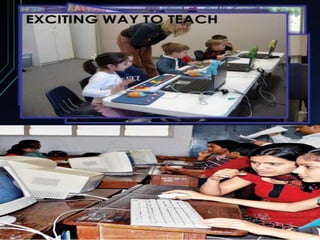
    1. Using multimedia: It believed that visual data has greater impact on learning and memorizing than plane text. e.g. images, graphics, pictures etc. Have a great appeal than a plane text. 2. Online learning : Online education(internet-base training or web-based training. It is benefit for people from any part of the world can gain knowledge on different subject and complete courses etc.
  • 78.
    3. Easy contact: Student and teacher can contact easily if they have queries about any information can be easily carried out using the internet. 4. School/college projects : As the internet is an ocean of information, covering nearly all subjects required for one’s projects. 5. Easy education system : Not only gaining knowledge, but every part of education system is simplified because of the internet. 6. No age bracket for education : You are now never too old or too busy to learn something new.
  • 79.
    Education Minister Smriti Irani'Not Even Graduate!': Ajay Maken's Tweet Sparks Row. Smriti Irani takes the oath of office during a swearing-in ceremony for new Indian Prime Minister Narendra Modi and his cabinet ministers at the Presidential Palace in New Delhi on May 26, 2014.
  • 80.
    Education should be childcentric, says Kapil Sibal ... Mr. Kapil Sibal is trying to blindly follow the education system in the States and implement it in India. Kapil Sibal blames Opposition for holding up on education reform bills.
  • 81.
    DRAW BACKS OFPRESENT EDUCATION SYSTEM
  • 82.
     Present educationsystem focuses more on scores rather than knowledge .  Its having 90% theoretical subjects. Even remaining 10% practical subjects are of limited experiments and of expected output.  There is no scope for students to do experiments on their own.  Some colleges are not conducting practical. Instead, they are giving full marks and allotting that time to mug up theoretical subjects.  In the end, students are coming out of schools and colleges only having bookish knowledge.
  • 83.
     There iss much meaningless pressure on students because of too much competitive spirit in between private institutions .  Many schools are not concentrating on extra curricula activities.  Some teacher are giving marks based on the no. of people rather than the content.  There are some cases that student are giving up their lives as they are unable to cope up with too much pressure.
  • 85.
    SOLUTIONS  Teachers mustsay the purpose of education to the children of school level.  Teacher must encourage the children to understand the concept and to write it in their own words in exam.  Every theoretical subject must have practical if possible.  Communication skills and reasoning must be a subject from school level.  There must be seminars and project from schooling to make student understand the subjects rather than mugging up.  Personality development classes and extra curricular activities must be compulsory .
  • 86.
     Jobs shouldbe provided based on knowledge rather than percentages.  In practical examinations marks should be given for the process rather than output.  The method of teaching and lessons in subjects must be modified. They must be in a way to understand real world.  Career guidance must be there in schooling.
  • 88.
    Money borrowed tofinance education or school related expenses. Payments are often deferred while in school and for a six-month grace period after graduation. Sallie Mae is the largest source of education loans and handles the two major types, the Stafford loan and the Perkins loan. One of the major benefits of these types of loans is that they come with low interest rates and do not require collateral or a credit check.
  • 93.
    CONCLUSION  Government mustconcentrate on modifying the education system to give wonderful life for students.  There is a role of educational institutional too to improve the method of teaching.  A good education system leads to a good society. Education is Simply the Soul of a Society as it Passes from One Generation to Another…

Editor's Notes

  • #9 Education in Ancient India began around the 3rd century BC
  • #12 Free printing of english books More funds to english schools Discount on english books
  • #20 Gradual decrease in efficiency at mainstream schooling
  • #30 Technical funda we learnt at college – rarely useful at further career application
  • #35 With diversity of language in india, the medium of education remains a topic of impassioned debate
  • #39 Sarva Siksha Abhiyan-an effort to universalize elementary education