Education system of India
Muhammad Ayoob Babar & Irshad Hussain
Reg. No. 140-FSS/PHDEDU/F17
Department Of Education
International Islamic University, Islamabad
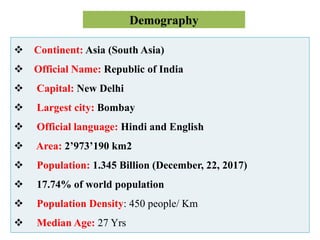
Geography
Demography
 Continent: Asia (South Asia)
 Official Name: Republic of India
 Capital: New Delhi
 Largest city: Bombay
 Official language: Hindi and English
 Area: 2’973’190 km2
 Population: 1.345 Billion (December, 22, 2017)
 17.74% of world population
 Population Density: 450 people/ Km
 Median Age: 27 Yrs
 India was part of the British Empire from the second
half of the 19th century until the first half of the 20th
century.
Under the leadership of Mohandas (Mahatma) Ghandi,
India was declared independent in 1947
The country is divided into 28 states and seven territories.
Cont..
Cont..
 Of India’s population of one billion people, 80% are
Hindu, 14% are Muslim and 3% are Christian
 Hindi is the official language of India, but English is
used the most in higher education, politics, and trade and
industry.
Education in India
 Education in India is provided by the public sector as well
as the private sector, with control and funding coming from
three levels: central, state and local.
 Under various articles of the Indian Constitution, free and
compulsory education is provided as a fundamental right to
children between the ages of 6 and 14.
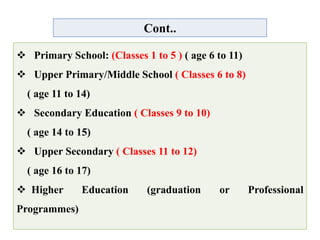
Cont..
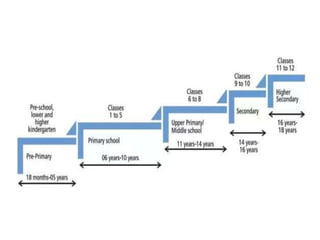
 Primary School: (Classes 1 to 5 ) ( age 6 to 11)
 Upper Primary/Middle School ( Classes 6 to 8)
( age 11 to 14)
 Secondary Education ( Classes 9 to 10)
( age 14 to 15)
 Upper Secondary ( Classes 11 to 12)
( age 16 to 17)
 Higher Education (graduation or Professional
Programmes)
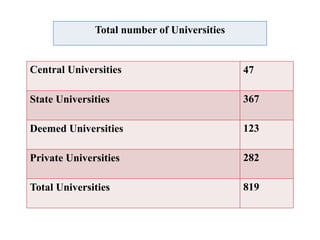
Total number of Universities
Central Universities 47
State Universities 367
Deemed Universities 123
Private Universities 282
Total Universities 819
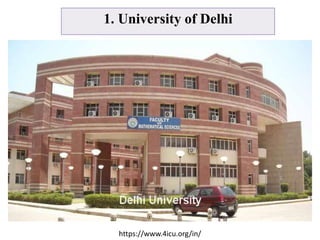
1. University of Delhi
https://www.4icu.org/in/
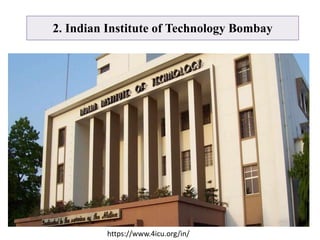
2. Indian Institute of Technology Bombay
https://www.4icu.org/in/
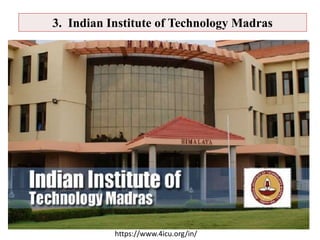
3. Indian Institute of Technology Madras
https://www.4icu.org/in/
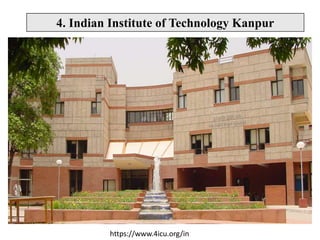
4. Indian Institute of Technology Kanpur
https://www.4icu.org/in
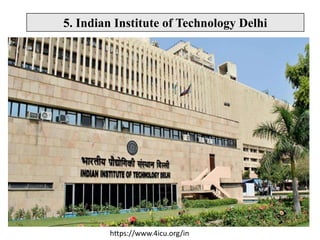
5. Indian Institute of Technology Delhi
https://www.4icu.org/in
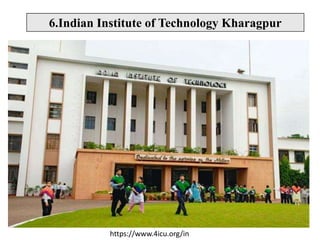
6.Indian Institute of Technology Kharagpur
https://www.4icu.org/in
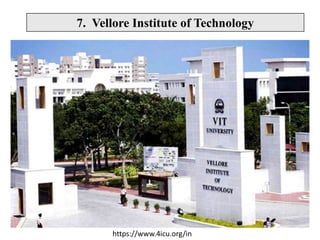
7. Vellore Institute of Technology
https://www.4icu.org/in
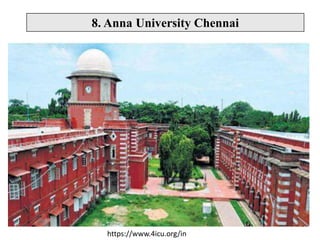
8. Anna University Chennai
https://www.4icu.org/in
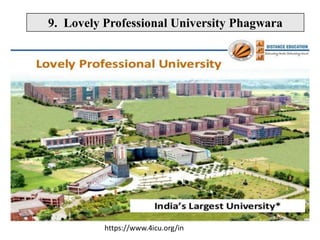
9. Lovely Professional University Phagwara
https://www.4icu.org/in
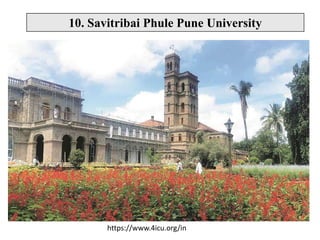
10. Savitribai Phule Pune University
Campus tour to Delhi University
Aim, Goal and Objectives
 To promote national progress
 A sense of common citizenship and culture
 To strengthen national integration.
 To develop skillful pupil, formation of high character,
development of personality
 Development of civic and social values
 Promotion of social efficiency, spread of national culture.
 Improvement of vocational efficiency.
Cont..
 To promote values such as India’s common cultural
heritage, social equality, democracy and secularism
 Removal of social barriers and observance of small
family norms.
 Development of leadership which means training pupils
to fulfill their duties efficiently.
Curriculum
 The Indian school system follows the British structure
 Primary school consists of grades 1-5 (ages 6-11)
 Middle school consists of grades 6-8 (ages 11-14)
 States determine the curriculum used in schools
 The quality of teaching varies tremendously school to
school and State to State
Cont..
Primary Stage (5 years)
The curriculum includes:
 Grades 1 and 2
1. One Language —
2. the mother tongue/the regional language
2. Mathematics
3. Art of Healthy and Productive Living
 Grades 3 to 5
1. One language — the mother tongue/the regional language
2. Mathematics
3. Environmental Studies
4. Art of Healthy and Productive Living
Upper Primary/Middle Stage (3 years)
The Grade 6-8 curriculum includes:
1.Three Languages — the mother tongue/the regional language,
Hindi and English
2. Mathematics
3. Science and Technology
4. Social Sciences
5. Work Education
6. Art Education (fine arts: Visual and Performing)
7. Health and Physical Education
Cont..
Cont..
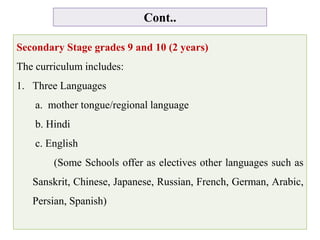
Secondary Stage grades 9 and 10 (2 years)
The curriculum includes:
1. Three Languages
a. mother tongue/regional language
b. Hindi
c. English
(Some Schools offer as electives other languages such as
Sanskrit, Chinese, Japanese, Russian, French, German, Arabic,
Persian, Spanish)
Cont..
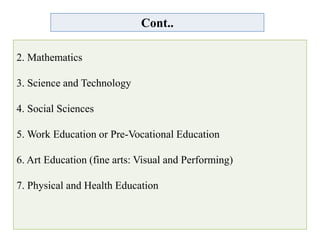
2. Mathematics
3. Science and Technology
4. Social Sciences
5. Work Education or Pre-Vocational Education
6. Art Education (fine arts: Visual and Performing)
7. Physical and Health Education
Cont..
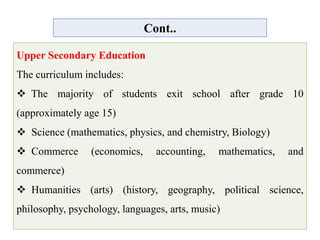
Upper Secondary Education
The curriculum includes:
 The majority of students exit school after grade 10
(approximately age 15)
 Science (mathematics, physics, and chemistry, Biology)
 Commerce (economics, accounting, mathematics, and
commerce)
 Humanities (arts) (history, geography, political science,
philosophy, psychology, languages, arts, music)
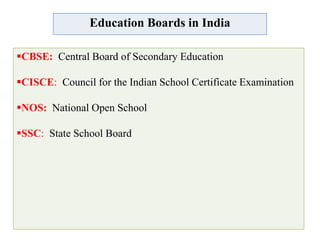
Education Boards in India
CBSE: Central Board of Secondary Education
CISCE: Council for the Indian School Certificate Examination
NOS: National Open School
SSC: State School Board
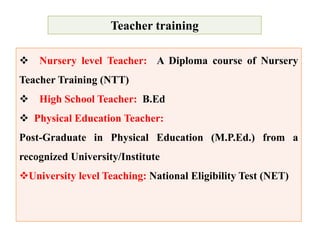
Teacher training
 Nursery level Teacher: A Diploma course of Nursery
Teacher Training (NTT)
 High School Teacher: B.Ed
 Physical Education Teacher:
Post-Graduate in Physical Education (M.P.Ed.) from a
recognized University/Institute
University level Teaching: National Eligibility Test (NET)
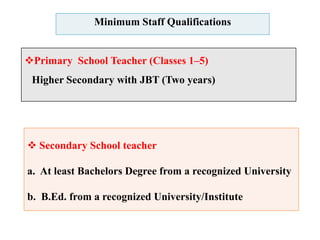
Minimum Staff Qualifications
Primary School Teacher (Classes 1–5)
Higher Secondary with JBT (Two years)
 Secondary School teacher
a. At least Bachelors Degree from a recognized University
b. B.Ed. from a recognized University/Institute
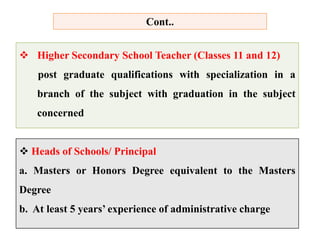
Cont..
 Higher Secondary School Teacher (Classes 11 and 12)
post graduate qualifications with specialization in a
branch of the subject with graduation in the subject
concerned
 Heads of Schools/ Principal
a. Masters or Honors Degree equivalent to the Masters
Degree
b. At least 5 years’ experience of administrative charge
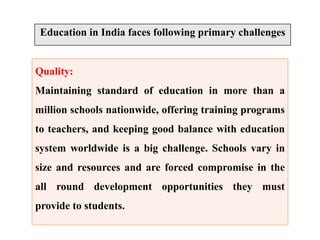
Education in India faces following primary challenges
Quality:
Maintaining standard of education in more than a
million schools nationwide, offering training programs
to teachers, and keeping good balance with education
system worldwide is a big challenge. Schools vary in
size and resources and are forced compromise in the
all round development opportunities they must
provide to students.
Access
Having infrastructural constraints and social issues, it
becomes harder to make education accessible to all
segments of the society (women, minorities, poor).
Cost
The cost of education is very high even for the people and
places where it is accessible. E.g. the competitive pressure
on students & parents forces them to opt for private
tuitions & trainings to supplement the school education.
Social & Cultural:
The ethnic diversity in India poses challenges to
implement consistent education nationwide. There are
more than 300 languages spoken in the country and
makes it difficult to offer education tailored to specific
social segment.
Educating women in some societies is a big issue.
Children of poor families are forced to work and miss out
the learning opportunities.
CHALLENGES FACED
 No practical knowledge:
a. Lots of attention is given to theory and books and
practical knowledge is completely ignored
b. In India, parents and teachers expect their students to
score high in the exam (rather than acquiring the quality
knowledge) and thus the education becomes a rat race.
 Lack of Research or critical analysis:
In India, despite the fact that we have the
highest number of engineering graduates, still we
lack technological innovation
Schools and colleges must pay attention to case
studies, research based assignment and problem
solving project so that students can get the fresh
ideas about their surroundings and can easily solve
the problem they face.
Cont..
 Outdated syllabus:
There is an urgent need to change the present system of
higher education in the country
Students are getting the knowledge from outdated
syllabus. Lots of technological and scientific improvements
are taking place in India and therefore the courses must be
updated as per the industrial and technological
development.
Cont..
 Cast reservation and paid seat:
In Indian education system, seats are reserved for
reserved cast and rich students. The education system
should give equal chance to all students irrespective of
their cast and creed.
The government data discloses the better reality that
only one child out of 7(that takes birth in India) goes to
school.
Cont..
 Absence of Entrepreneurship development scheme:
The absence of Entrepreneurship abilities is halting the
progress of our country in several fields.
Our education system should be such that it should
generate enthusiasm to become a business person and it
should also produce scientist, writers, thinkers, designers
etc only that India can be knowledge based
Cont..
Other Challenges to Education system
1) Expenditure in our universities are as high as 50%
2) Many schools and colleges use foreign languages as the
medium of instruction which hampers the natural
educational growth of millions of students who are not at
home in foreign languages
4) Rapid increase of irrelevant college and universities
and absence of library, laboratory and other facilities in
schools and colleges
Cont..
3) Too much importance to examination and Political
interference in schools and colleges
References
 Afridi, F. (2015), “The Impact of School Meals on School Participation: Evidence from Rural
India”, Indian Statistical Institute Discussion Papers, No. 10-02.
 Altbach, P. (2009), “The Giants Awake: The Present and Future of Higher Education Systems in
China and India”, in OECD, Higher Education to 2030, Volume 2: Globalisation, OECD, Paris.
 ASER (2016), Annual Status of Education Report (Rural) 2010, Provisional, Pratham Resource
Centre, Mumbai.
 Banerji, R. and A. Mukherjee (2008), “Achieving Universal Elementary Education in India: Future
Strategies for Ensuring Access, Quality and Finance”, Journal of Applied Economic Research, Vol. 2, No.
2.
 Baruch, Y., S. P.S. Budhwar and N. Khatri (2007), “Brain Drain: Inclination to Stay Abroad After
Studies”, Journal of World Business, Vol. 42, No. 1.
 Carnoy, M., R. Dossani and J. Tilak (2010), “Understanding the Expansion and Quality of
Engineering Education in India”, Stanford University and NUEPA, Working Draft, September.
 Chadha, G.K., S. Bhushan and V. Murlidhar (2008), “Teachers in Universities and Colleges-Current
Status Regarding Availability and Service Conditions”, in UGC, Higher Education in India: Issues Related
to Expansion, Inclusiveness, Quality and Finance, UGC, New Delhi.
 French, R. and G. Kingdon (2013), “The Relative Effectiveness of Private and Government
Schools in Rural India: Evidence From ASER Data”, Institute of Education University of London
DOQSS Working Papers, No. 10-03.
 Goyal, S. (2012), “Inside the House of Learning: the Relative Performance of Public and
Private Schools in Orissa, Education Economics, Vol. 17, No. 3.
 Hanushek, E. and L. Woessmann (2015), “The Role of Cognitive Skills in Economic
Development”, Journal of Economic Literature, Vol. 46, No. 3.
 Hanushek, E. and L. Woessmann (2010), “The Economics of International Differences in
Educational Achievement”, NBER Working Papers, No. 15949.
 IOM (2008), World Migration 2008, International Organisation for Migration, Geneva.
 Jayaraman, R., D. Simroth and F. de Véricourt (2014), “The Impact of School Lunches on
Primary School Enrolment: Evidence from India’s Midday Meal Scheme”, Presentation
delivered to CESifo Conference Centre, Munich, September.
 Kapur, D. (2016), “Indian Higher Education”, in C.T. Clotfelter (ed.), American Universities
in a Global Market, University of Chicago Press, Chicago.
Cont..
Thanks