SocialInequalities
â—Ź Social inequality refers to the unequal access to social,
political, and symbolic capital of individuals in society
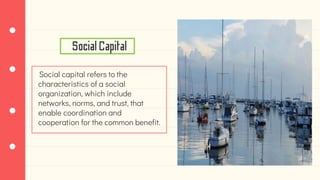
Social capital refers to the
characteristics of a social
organization, which include
networks, norms, and trust, that
enable coordination and
cooperation for the common benefit.
SocialCapital
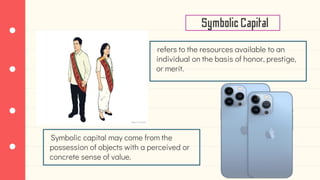
refers to the resources available to an
individual on the basis of honor, prestige,
or merit.
SymbolicCapital
Symbolic capital may come from the
possession of objects with a perceived or
concrete sense of value.
PoliticalCapital
â—Ź Political capital refers to the benevolence or goodwill of a
politician or political policy which can build up with the public
through the implementation of popular policies.
â—Ź This goodwill can then be mobilized to achieve other objectives
such as the passing of unpopular policies.
â—Ź This means that politicians may use their power to help their
constituents through favorable policies and at the same time
implement policies that will protect their self-interest.
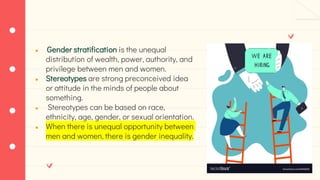
â—Ź Gender stratification is the unequal
distribution of wealth, power, authority, and
privilege between men and women.
â—Ź Stereotypes are strong preconceived idea
or attitude in the minds of people about
something.
â—Ź Stereotypes can be based on race,
ethnicity, age, gender, or sexual orientation.
â—Ź When there is unequal opportunity between
men and women, there is gender inequality.
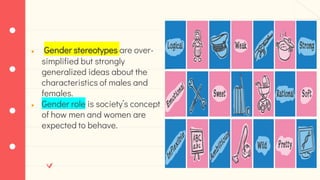
â—Ź Gender stereotypes are over-
simplified but strongly
generalized ideas about the
characteristics of males and
females.
● Gender role is society’s concept
of how men and women are
expected to behave.
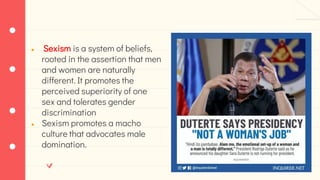
â—Ź Sexism is a system of beliefs,
rooted in the assertion that men
and women are naturally
different. It promotes the
perceived superiority of one
sex and tolerates gender
discrimination
â—Ź Sexism promotes a macho
culture that advocates male
domination.
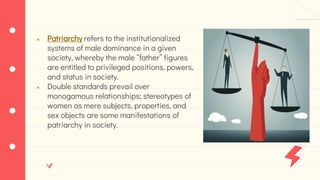
â—Ź Patriarchy refers to the institutionalized
systems of male dominance in a given
society, whereby the male “father” figures
are entitled to privileged positions, powers,
and status in society.
â—Ź Double standards prevail over
monogamous relationships; stereotypes of
women as mere subjects, properties, and
sex objects are some manifestations of
patriarchy in society.
Homophobia
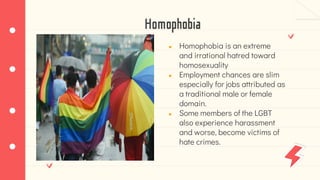
â—Ź Homophobia is an extreme
and irrational hatred toward
homosexuality
â—Ź Employment chances are slim
especially for jobs attributed as
a traditional male or female
domain.
â—Ź Some members of the LGBT
also experience harassment
and worse, become victims of
hate crimes.
Race refers to the physical
differences between people
brought about by biological
characteristics of genetic origin.
Race Ethnicity
Ethnicity refers to the grouping
of people based on common
identity according to their
language, culture, and history.
Ethnicity pertains to a shared
cultural tradition of the people.
Race pertains to one’s biological characteristics while
ethnicity refers to one’s cultural heritage.
â—Ź Discrimination is defined as an unequal treatment for the
various types of people according to race and ethnicity.
â—Ź Prejudice is defined as a rigid and unfair generalization
about an entire category of people. It also refers to beliefs,
thoughts, feelings, and attitudes that someone holds about
a group.
â—Ź An example of prejudice is the distinctive smell often
associated with the Arabs and Indians which reflects bias
thinking and prejudgment of another race.
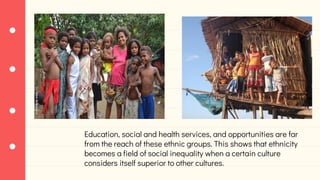
Education, social and health services, and opportunities are far
from the reach of these ethnic groups. This shows that ethnicity
becomes a field of social inequality when a certain culture
considers itself superior to other cultures.
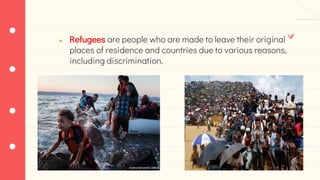
â—Ź Refugees are people who are made to leave their original
places of residence and countries due to various reasons,
including discrimination.
â—Ź Racism is a belief that humans are categorized into
distinct groups in which they can be ranked as superior or
inferior. This belief ignores the social behavior and mental
and physical capacities of an individual.
â—Ź Racism is an example of a prejudice that is used to justify
the belief that one race is somehow superior or inferior to
others.
â—Ź Discrimination based on race or ethnicity can take many
forms such as genocide and segregation.
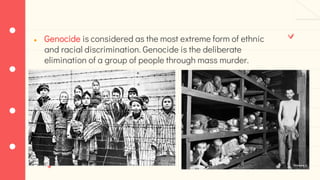
â—Ź Genocide is considered as the most extreme form of ethnic
and racial discrimination. Genocide is the deliberate
elimination of a group of people through mass murder.
â—Ź Segregation refers to the physical
separation of two groups, particularly in
residence, workplace, and social
functions.
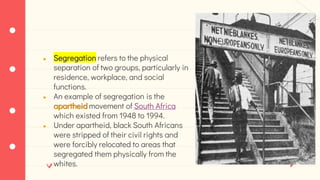
â—Ź An example of segregation is the
apartheid movement of South Africa
which existed from 1948 to 1994.
â—Ź Under apartheid, black South Africans
were stripped of their civil rights and
were forcibly relocated to areas that
segregated them physically from the
whites.
â—Ź Disability is a long-term physical, mental, intellectual, or sensory
impairment of a person which in interaction with various barriers may
hinder his/her full and effective participation in society on an equal
basis with others.
â—Ź Persons with disabilities do not just suffer inequality because they are
handicapped. They further experience inequality because some
societies do not provide for their needs. Stereotyping of people with
disabilities as useless also limits their opportunities in society.
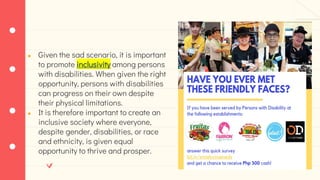
â—Ź Given the sad scenario, it is important
to promote inclusivity among persons
with disabilities. When given the right
opportunity, persons with disabilities
can progress on their own despite
their physical limitations.
â—Ź It is therefore important to create an
inclusive society where everyone,
despite gender, disabilities, or race
and ethnicity, is given equal
opportunity to thrive and prosper.
GlobalInequality
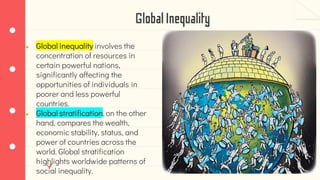
â—Ź Global inequality involves the
concentration of resources in
certain powerful nations,
significantly affecting the
opportunities of individuals in
poorer and less powerful
countries.
â—Ź Global stratification, on the other
hand, compares the wealth,
economic stability, status, and
power of countries across the
world. Global stratification
highlights worldwide patterns of
social inequality.
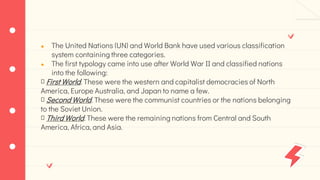
â—Ź The United Nations (UN) and World Bank have used various classification
system containing three categories.
â—Ź The first typology came into use after World War II and classified nations
into the following:
First World. These were the western and capitalist democracies of North
America, Europe Australia, and Japan to name a few.
Second World. These were the communist countries or the nations belonging
to the Soviet Union.
Third World. These were the remaining nations from Central and South
America, Africa, and Asia.
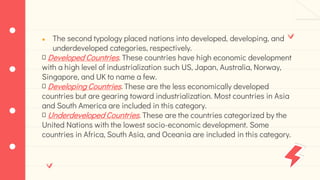
â—Ź The second typology placed nations into developed, developing, and
underdeveloped categories, respectively.
Developed Countries. These countries have high economic development
with a high level of industrialization such US, Japan, Australia, Norway,
Singapore, and UK to name a few.
Developing Countries. These are the less economically developed
countries but are gearing toward industrialization. Most countries in Asia
and South America are included in this category.
Underdeveloped Countries. These are the countries categorized by the
United Nations with the lowest socio-economic development. Some
countries in Africa, South Asia, and Oceania are included in this category.
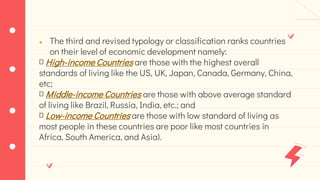
â—Ź The third and revised typology or classification ranks countries
on their level of economic development namely:
High-income Countries are those with the highest overall
standards of living like the US, UK, Japan, Canada, Germany, China,
etc;
Middle-income Countries are those with above average standard
of living like Brazil, Russia, India, etc.; and
Low-income Countries are those with low standard of living as
most people in these countries are poor like most countries in
Africa, South America, and Asia).
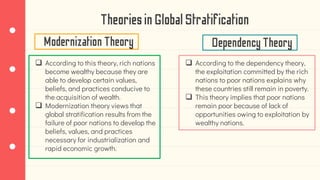
TheoriesinGlobalStratification
âť‘ According to this theory, rich nations
become wealthy because they are
able to develop certain values,
beliefs, and practices conducive to
the acquisition of wealth.
âť‘ Modernization theory views that
global stratification results from the
failure of poor nations to develop the
beliefs, values, and practices
necessary for industrialization and
rapid economic growth.
ModernizationTheory
âť‘ According to the dependency theory,
the exploitation committed by the rich
nations to poor nations explains why
these countries still remain in poverty.
âť‘ This theory implies that poor nations
remain poor because of lack of
opportunities owing to exploitation by
wealthy nations.
DependencyTheory
Measuresorprogramstoreduceinequality
1. Invest in education- Education for the longest time has been
proven as a great equalizer. Education is the best security for the
future.
2. Intensify the conditional cash transfer or the Pantawid Pamilyang
Pilipino Program (4Ps) to the poor communities at the same time
provide them skills training so they will not become dependent on
the government.
3. Create more job opportunities.
4. Invest in human capital - It is important to provide trainings that
will generate jobs and employment.
5. Show strong political will on the part of the government to
implement genuine reforms and programs.

Lesson 14- Social Inequalities - Lecture.pdf

  • 2.
    SocialInequalities â—Ź Social inequalityrefers to the unequal access to social, political, and symbolic capital of individuals in society
  • 3.
    Social capital refersto the characteristics of a social organization, which include networks, norms, and trust, that enable coordination and cooperation for the common benefit. SocialCapital
  • 4.
    refers to theresources available to an individual on the basis of honor, prestige, or merit. SymbolicCapital Symbolic capital may come from the possession of objects with a perceived or concrete sense of value.
  • 5.
    PoliticalCapital â—Ź Political capitalrefers to the benevolence or goodwill of a politician or political policy which can build up with the public through the implementation of popular policies. â—Ź This goodwill can then be mobilized to achieve other objectives such as the passing of unpopular policies. â—Ź This means that politicians may use their power to help their constituents through favorable policies and at the same time implement policies that will protect their self-interest.
  • 7.
    â—Ź Gender stratificationis the unequal distribution of wealth, power, authority, and privilege between men and women. â—Ź Stereotypes are strong preconceived idea or attitude in the minds of people about something. â—Ź Stereotypes can be based on race, ethnicity, age, gender, or sexual orientation. â—Ź When there is unequal opportunity between men and women, there is gender inequality.
  • 8.
    ● Gender stereotypesare over- simplified but strongly generalized ideas about the characteristics of males and females. ● Gender role is society’s concept of how men and women are expected to behave.
  • 9.
    â—Ź Sexism isa system of beliefs, rooted in the assertion that men and women are naturally different. It promotes the perceived superiority of one sex and tolerates gender discrimination â—Ź Sexism promotes a macho culture that advocates male domination.
  • 10.
    ● Patriarchy refersto the institutionalized systems of male dominance in a given society, whereby the male “father” figures are entitled to privileged positions, powers, and status in society. ● Double standards prevail over monogamous relationships; stereotypes of women as mere subjects, properties, and sex objects are some manifestations of patriarchy in society.
  • 11.
    Homophobia â—Ź Homophobia isan extreme and irrational hatred toward homosexuality â—Ź Employment chances are slim especially for jobs attributed as a traditional male or female domain. â—Ź Some members of the LGBT also experience harassment and worse, become victims of hate crimes.
  • 13.
    Race refers tothe physical differences between people brought about by biological characteristics of genetic origin. Race Ethnicity Ethnicity refers to the grouping of people based on common identity according to their language, culture, and history. Ethnicity pertains to a shared cultural tradition of the people. Race pertains to one’s biological characteristics while ethnicity refers to one’s cultural heritage.
  • 14.
    â—Ź Discrimination isdefined as an unequal treatment for the various types of people according to race and ethnicity. â—Ź Prejudice is defined as a rigid and unfair generalization about an entire category of people. It also refers to beliefs, thoughts, feelings, and attitudes that someone holds about a group. â—Ź An example of prejudice is the distinctive smell often associated with the Arabs and Indians which reflects bias thinking and prejudgment of another race.
  • 15.
    Education, social andhealth services, and opportunities are far from the reach of these ethnic groups. This shows that ethnicity becomes a field of social inequality when a certain culture considers itself superior to other cultures.
  • 16.
    â—Ź Refugees arepeople who are made to leave their original places of residence and countries due to various reasons, including discrimination.
  • 17.
    â—Ź Racism isa belief that humans are categorized into distinct groups in which they can be ranked as superior or inferior. This belief ignores the social behavior and mental and physical capacities of an individual. â—Ź Racism is an example of a prejudice that is used to justify the belief that one race is somehow superior or inferior to others. â—Ź Discrimination based on race or ethnicity can take many forms such as genocide and segregation.
  • 18.
    â—Ź Genocide isconsidered as the most extreme form of ethnic and racial discrimination. Genocide is the deliberate elimination of a group of people through mass murder.
  • 19.
    â—Ź Segregation refersto the physical separation of two groups, particularly in residence, workplace, and social functions. â—Ź An example of segregation is the apartheid movement of South Africa which existed from 1948 to 1994. â—Ź Under apartheid, black South Africans were stripped of their civil rights and were forcibly relocated to areas that segregated them physically from the whites.
  • 20.
    â—Ź Disability isa long-term physical, mental, intellectual, or sensory impairment of a person which in interaction with various barriers may hinder his/her full and effective participation in society on an equal basis with others. â—Ź Persons with disabilities do not just suffer inequality because they are handicapped. They further experience inequality because some societies do not provide for their needs. Stereotyping of people with disabilities as useless also limits their opportunities in society.
  • 21.
    â—Ź Given thesad scenario, it is important to promote inclusivity among persons with disabilities. When given the right opportunity, persons with disabilities can progress on their own despite their physical limitations. â—Ź It is therefore important to create an inclusive society where everyone, despite gender, disabilities, or race and ethnicity, is given equal opportunity to thrive and prosper.
  • 23.
    GlobalInequality â—Ź Global inequalityinvolves the concentration of resources in certain powerful nations, significantly affecting the opportunities of individuals in poorer and less powerful countries. â—Ź Global stratification, on the other hand, compares the wealth, economic stability, status, and power of countries across the world. Global stratification highlights worldwide patterns of social inequality.
  • 24.
    â—Ź The UnitedNations (UN) and World Bank have used various classification system containing three categories. â—Ź The first typology came into use after World War II and classified nations into the following: First World. These were the western and capitalist democracies of North America, Europe Australia, and Japan to name a few. Second World. These were the communist countries or the nations belonging to the Soviet Union. Third World. These were the remaining nations from Central and South America, Africa, and Asia.
  • 25.
    â—Ź The secondtypology placed nations into developed, developing, and underdeveloped categories, respectively. Developed Countries. These countries have high economic development with a high level of industrialization such US, Japan, Australia, Norway, Singapore, and UK to name a few. Developing Countries. These are the less economically developed countries but are gearing toward industrialization. Most countries in Asia and South America are included in this category. Underdeveloped Countries. These are the countries categorized by the United Nations with the lowest socio-economic development. Some countries in Africa, South Asia, and Oceania are included in this category.
  • 26.
    â—Ź The thirdand revised typology or classification ranks countries on their level of economic development namely: High-income Countries are those with the highest overall standards of living like the US, UK, Japan, Canada, Germany, China, etc; Middle-income Countries are those with above average standard of living like Brazil, Russia, India, etc.; and Low-income Countries are those with low standard of living as most people in these countries are poor like most countries in Africa, South America, and Asia).
  • 27.
    TheoriesinGlobalStratification âť‘ According tothis theory, rich nations become wealthy because they are able to develop certain values, beliefs, and practices conducive to the acquisition of wealth. âť‘ Modernization theory views that global stratification results from the failure of poor nations to develop the beliefs, values, and practices necessary for industrialization and rapid economic growth. ModernizationTheory âť‘ According to the dependency theory, the exploitation committed by the rich nations to poor nations explains why these countries still remain in poverty. âť‘ This theory implies that poor nations remain poor because of lack of opportunities owing to exploitation by wealthy nations. DependencyTheory
  • 28.
    Measuresorprogramstoreduceinequality 1. Invest ineducation- Education for the longest time has been proven as a great equalizer. Education is the best security for the future. 2. Intensify the conditional cash transfer or the Pantawid Pamilyang Pilipino Program (4Ps) to the poor communities at the same time provide them skills training so they will not become dependent on the government. 3. Create more job opportunities. 4. Invest in human capital - It is important to provide trainings that will generate jobs and employment. 5. Show strong political will on the part of the government to implement genuine reforms and programs.