Widening Student Participation –
Does the Funding Approach Matter?
  A Case for Botswana, Zambia,
       Malawi and Zimbabwe

         Handsen Tibugari
       handsentibugari@gmail.com


 IAU 14th General Conference, 11/30/2012
INTRODUCTION


& the          agenda
INTRODUCTION
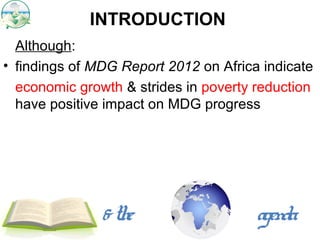
  Although:
• findings of MDG Report 2012 on Africa indicate
  economic growth & strides in poverty reduction
  have positive impact on MDG progress


               & the                   agenda
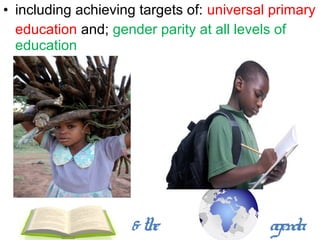
• including achieving targets of: universal primary
  education and; gender parity at all levels of
  education


                    & the                  agenda
• And though enrolments increased 20-fold from
  0.2 million in 1970 to 4.5 million in 2008
  (SARUA, 2012)
• HE in southern Africa faces serious challenges
• Access and equity to HE in SADCC are
  unacceptably low (SARUA, 2008)


                & the                 agenda
• Changes in financing HE worldwide in the last
  decades of 20th & 1st decade of 21st centuries
  (Johnstone & Marcucci, 2007)
• HE costs rising higher than available revenues
• Funding strategies must consider that
  instructional costs of disadvantaged students
  may be higher (OECD, 2012)


                & the                 agenda
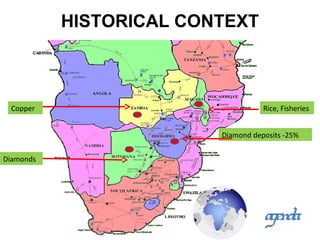
HISTORICAL CONTEXT


 Copper                             Rice, Fisheries


                         Diamond deposits -25%


Diamonds


                                    agenda
• Independence, HE in Africa - a priority
  development strategy (Sayed et al., 2008)
• Provided high-level manpower – research,
  social & economic development
• Funding from former colonizing powers
• Fruitful links with universities in the north
  (Mohamedbhai, 2008)
• Economic & political crises - neglect


                 & the                   agenda
• Zambia, Malawi, Zimbabwe - formerly ruled as
  a Federation

• Salisbury (Harare) capital city

• Resources, including educational channelled to
  Zimbabwe


                & the                   agenda
FUNDING STRATEGIES


    & the        agenda
Government Funding & Support
• Predominantly funded by governments
• Zimbabwe - 95%
• Ultimate goal - protecting students – institutions
  may be less responsive (Mahoney, 2006)


                 & the                   agenda
Challenges
• Dwindling budgets in support of HE
• Funding not sufficient to cater for effects of
  massification (Mohamedbhai, 2008)
     • e.g.. high student to computer ratios
• Overwhelmed Internet bandwidths – slow
  connectivity
• Poor staff remuneration – staff exodus
• Inexperienced lecturers – quality of graduates?

                & the                 agenda
Research Funding
• Global research indicators - sub Saharan Africa
  poor research output (Mohamedbhai, 2011)
• Lowest scholarly scientific publications
• Least investment in R & D
• R & D dominated by external support –
  development partners


                & the                 agenda
Challenges
• Requires active partners
• At times there may be no willing external
  partners
• Strained relations with the donor community
  can scare funders


                & the                 agenda
Cost Sharing
• Practised mainly by private institutions
• Do not receive government subventions
• At times run as business enterprises


                & the                  agenda
Challenges

• May not focus importance of HE in the context
  of sustainable development (wa Kariuki, 2009)

• Sometimes not responsive to (potential)
  students from poor family backgrounds
• Student drop-out and repeat rates can be high
• Low graduation rates


                & the                 agenda
Recommendations
• Governments invest to make universities self-
  sufficient
• Strategic alliances; networks
  – development partners
  – other HE institutions
• Entrepreneurship – income generating projects
  e.g. Zambia – University Teaching Hospital


                 & the                agenda
Innovation
• Engage in research that is relevant to business,
  industry
• Scientific & technological breakthroughs


                                              18
ACKNOWLEDGEMENTS
Muchas Gracias

CS III.2 - H. Tibugari

  • 1.
    Widening Student Participation– Does the Funding Approach Matter? A Case for Botswana, Zambia, Malawi and Zimbabwe Handsen Tibugari handsentibugari@gmail.com IAU 14th General Conference, 11/30/2012
  • 2.
  • 3.
    INTRODUCTION Although: •findings of MDG Report 2012 on Africa indicate economic growth & strides in poverty reduction have positive impact on MDG progress & the agenda
  • 4.
    • including achievingtargets of: universal primary education and; gender parity at all levels of education & the agenda
  • 5.
    • And thoughenrolments increased 20-fold from 0.2 million in 1970 to 4.5 million in 2008 (SARUA, 2012) • HE in southern Africa faces serious challenges • Access and equity to HE in SADCC are unacceptably low (SARUA, 2008) & the agenda
  • 6.
    • Changes infinancing HE worldwide in the last decades of 20th & 1st decade of 21st centuries (Johnstone & Marcucci, 2007) • HE costs rising higher than available revenues • Funding strategies must consider that instructional costs of disadvantaged students may be higher (OECD, 2012) & the agenda
  • 7.
    HISTORICAL CONTEXT Copper Rice, Fisheries Diamond deposits -25% Diamonds agenda
  • 8.
    • Independence, HEin Africa - a priority development strategy (Sayed et al., 2008) • Provided high-level manpower – research, social & economic development • Funding from former colonizing powers • Fruitful links with universities in the north (Mohamedbhai, 2008) • Economic & political crises - neglect & the agenda
  • 9.
    • Zambia, Malawi,Zimbabwe - formerly ruled as a Federation • Salisbury (Harare) capital city • Resources, including educational channelled to Zimbabwe & the agenda
  • 10.
    FUNDING STRATEGIES & the agenda
  • 11.
    Government Funding &Support • Predominantly funded by governments • Zimbabwe - 95% • Ultimate goal - protecting students – institutions may be less responsive (Mahoney, 2006) & the agenda
  • 12.
    Challenges • Dwindling budgetsin support of HE • Funding not sufficient to cater for effects of massification (Mohamedbhai, 2008) • e.g.. high student to computer ratios • Overwhelmed Internet bandwidths – slow connectivity • Poor staff remuneration – staff exodus • Inexperienced lecturers – quality of graduates? & the agenda
  • 13.
    Research Funding • Globalresearch indicators - sub Saharan Africa poor research output (Mohamedbhai, 2011) • Lowest scholarly scientific publications • Least investment in R & D • R & D dominated by external support – development partners & the agenda
  • 14.
    Challenges • Requires activepartners • At times there may be no willing external partners • Strained relations with the donor community can scare funders & the agenda
  • 15.
    Cost Sharing • Practisedmainly by private institutions • Do not receive government subventions • At times run as business enterprises & the agenda
  • 16.
    Challenges • May notfocus importance of HE in the context of sustainable development (wa Kariuki, 2009) • Sometimes not responsive to (potential) students from poor family backgrounds • Student drop-out and repeat rates can be high • Low graduation rates & the agenda
  • 17.
    Recommendations • Governments investto make universities self- sufficient • Strategic alliances; networks – development partners – other HE institutions • Entrepreneurship – income generating projects e.g. Zambia – University Teaching Hospital & the agenda
  • 18.
    Innovation • Engage inresearch that is relevant to business, industry • Scientific & technological breakthroughs 18
  • 19.
  • 20.