Collaboration in doctoral education
and in common
research
Dr Thomas Jorgensen
European University Association
29 March 2017
UNIMED Week
…3…
Brief Profile of EUA
• Established in 2001
• Non-governmental membership
organisation
• 750 individual university
members
• 34 National Rectors’ Conferences
Members
• 47 countries
• Independent voice for the
university sector
Long-term trends in international research
• Technological possibilities
 Revolution in gathering and sharing data
 Ease of communication (email, Skype, teleconferences)
 Ease of physical mobility
• Large investment in research and development in
emerging economies in the 2000s
 China, India and Brazil prominent
 Large increases in doctoral education – Brazil 100 %
increase 2000-2009, China 400 % (!) 1998-2008
• Beginnings of a more multipolar research landscape?
• Global convergences?
…4…
Convergence I - Discourse
• The language of the knowledge society has become
global
 Challenges are to be met with new knowledge and innovation
 CODOC survey responses:
• “[Doctoral education] is key. It is the basis of innovative
and research interventions in society’s problems” (South
Africa)
• “Doctoral education is very important since it is the driving
force towards societal and economic development.
Additionally, societal and economic development require
knowledge societies that are based on high skilled human
resources” (Malaysia)
• ”Extremely important in the current world of global
knowledge society, where the complexities of world and
local problems require people with high level education to
solve them” (Tanzania)
…5…
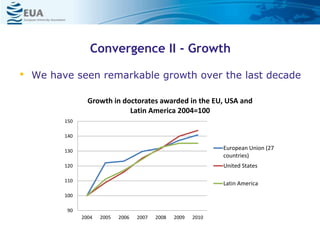
Convergence II - Growth
• We have seen remarkable growth over the last decade
…6…
90
100
110
120
130
140
150
2004 2005 2006 2007 2008 2009 2010
Growth in doctorates awarded in the EU, USA and
Latin America 2004=100
European Union (27
countries)
United States
Latin America
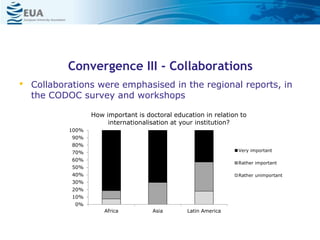
Convergence III - Collaborations
• Collaborations were emphasised in the regional reports, in
the CODOC survey and workshops
…7…
0%
10%
20%
30%
40%
50%
60%
70%
80%
90%
100%
Africa Asia Latin America
How important is doctoral education in relation to
internationalisation at your institution?
Very important
Rather important
Rather unimportant
Multipolar or inclusive global research
community?
• Particularly the rise of Asia has made global research
multipolar, but
• The share of highly cited publications have not
changed between the big players
 About half are produced in the US, UK, and Germany
 China less than 10 %
• Multipolar has meant adding a few more,
concentrated hubs
 Shanghai, Sao Paulo, Seoul
• Few indications that it has made the global
community more inclusive
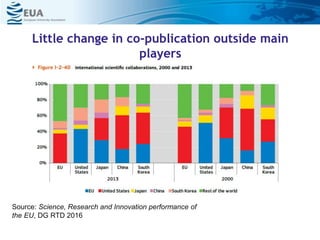
Source: Science, Research and Innovation performance of
the EU, DG RTD 2016
Little change in co-publication outside main
players
How can we approach an inclusive research
community
• Creating a more level playing field
 Having more countries and institutions to work as equal partners
 Including research perspectives from across the world
 Allowing local talent to develop
• Building capacity
 On the system level – autonomy, quality assurance, funding, governance
 On the institutional level – management capacity, know-how
 Concrete research projects
Attaining capacity through collaborations
• Self-sustainable research at an international level is
increasingly difficult
 Some disciplines are too expensive to be run in one institution (high-
energy physics)
 Researchers are increasingly sharing work across institutional
boundaries (Open science/Science 2.0)
 Financing tends to favour the strong (excellence schemes)
• Rankings are enforcing hierarchies, competition and
collaboration
 Universities seek allies to strengthen their ‘brand’
 International research is a factor in rankings (and in performance-
based funding)
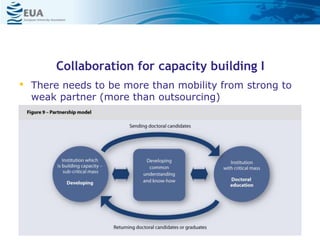
Collaboration for capacity building I
• There needs to be more than mobility from strong to
weak partner (more than outsourcing)
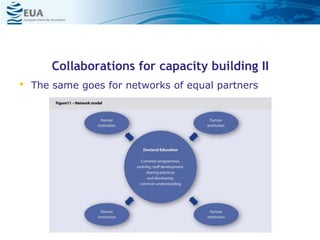
Collaborations for capacity building II
• The same goes for networks of equal partners
Sharing in partnerships can work...
• Ideally, they could lead towards self-sustainability
• ... but there are pitfalls
 The temptation of ‘outsourcing’_ research is accredited to the sending
institution, but produced at the host institution
 No creation of self-sustainability
 The collaboration is dominated by the strong institution (and the
funder)
• ... and it does not happen by itself
 The sending institution must assess if it is ready for the partnership
 There needs to be local investment in institutions
 There needs to be an awareness of what is needed
 ... and the capacity to achieve this locally
 It must be attractive to do research with both partners – otherwise
there is risk of brain drain
Fitness for purpose
• What is international collaboration for?
• Where do we want to go?
• How do we get there?
• How do we know that it is working?
• The new discussion about internationalisation is
trending away from mobility
• ... and towards institutional development and
governance questions
…16…
Thank you for your attention

EUA Presentation

  • 2.
    Collaboration in doctoraleducation and in common research Dr Thomas Jorgensen European University Association 29 March 2017 UNIMED Week
  • 3.
    …3… Brief Profile ofEUA • Established in 2001 • Non-governmental membership organisation • 750 individual university members • 34 National Rectors’ Conferences Members • 47 countries • Independent voice for the university sector
  • 4.
    Long-term trends ininternational research • Technological possibilities  Revolution in gathering and sharing data  Ease of communication (email, Skype, teleconferences)  Ease of physical mobility • Large investment in research and development in emerging economies in the 2000s  China, India and Brazil prominent  Large increases in doctoral education – Brazil 100 % increase 2000-2009, China 400 % (!) 1998-2008 • Beginnings of a more multipolar research landscape? • Global convergences? …4…
  • 5.
    Convergence I -Discourse • The language of the knowledge society has become global  Challenges are to be met with new knowledge and innovation  CODOC survey responses: • “[Doctoral education] is key. It is the basis of innovative and research interventions in society’s problems” (South Africa) • “Doctoral education is very important since it is the driving force towards societal and economic development. Additionally, societal and economic development require knowledge societies that are based on high skilled human resources” (Malaysia) • ”Extremely important in the current world of global knowledge society, where the complexities of world and local problems require people with high level education to solve them” (Tanzania) …5…
  • 6.
    Convergence II -Growth • We have seen remarkable growth over the last decade …6… 90 100 110 120 130 140 150 2004 2005 2006 2007 2008 2009 2010 Growth in doctorates awarded in the EU, USA and Latin America 2004=100 European Union (27 countries) United States Latin America
  • 7.
    Convergence III -Collaborations • Collaborations were emphasised in the regional reports, in the CODOC survey and workshops …7… 0% 10% 20% 30% 40% 50% 60% 70% 80% 90% 100% Africa Asia Latin America How important is doctoral education in relation to internationalisation at your institution? Very important Rather important Rather unimportant
  • 8.
    Multipolar or inclusiveglobal research community? • Particularly the rise of Asia has made global research multipolar, but • The share of highly cited publications have not changed between the big players  About half are produced in the US, UK, and Germany  China less than 10 % • Multipolar has meant adding a few more, concentrated hubs  Shanghai, Sao Paulo, Seoul • Few indications that it has made the global community more inclusive
  • 9.
    Source: Science, Researchand Innovation performance of the EU, DG RTD 2016 Little change in co-publication outside main players
  • 10.
    How can weapproach an inclusive research community • Creating a more level playing field  Having more countries and institutions to work as equal partners  Including research perspectives from across the world  Allowing local talent to develop • Building capacity  On the system level – autonomy, quality assurance, funding, governance  On the institutional level – management capacity, know-how  Concrete research projects
  • 11.
    Attaining capacity throughcollaborations • Self-sustainable research at an international level is increasingly difficult  Some disciplines are too expensive to be run in one institution (high- energy physics)  Researchers are increasingly sharing work across institutional boundaries (Open science/Science 2.0)  Financing tends to favour the strong (excellence schemes) • Rankings are enforcing hierarchies, competition and collaboration  Universities seek allies to strengthen their ‘brand’  International research is a factor in rankings (and in performance- based funding)
  • 12.
    Collaboration for capacitybuilding I • There needs to be more than mobility from strong to weak partner (more than outsourcing)
  • 13.
    Collaborations for capacitybuilding II • The same goes for networks of equal partners
  • 14.
    Sharing in partnershipscan work... • Ideally, they could lead towards self-sustainability • ... but there are pitfalls  The temptation of ‘outsourcing’_ research is accredited to the sending institution, but produced at the host institution  No creation of self-sustainability  The collaboration is dominated by the strong institution (and the funder) • ... and it does not happen by itself  The sending institution must assess if it is ready for the partnership  There needs to be local investment in institutions  There needs to be an awareness of what is needed  ... and the capacity to achieve this locally  It must be attractive to do research with both partners – otherwise there is risk of brain drain
  • 15.
    Fitness for purpose •What is international collaboration for? • Where do we want to go? • How do we get there? • How do we know that it is working? • The new discussion about internationalisation is trending away from mobility • ... and towards institutional development and governance questions
  • 16.
    …16… Thank you foryour attention