Welcome Workshop, 18-21 Nov 2013, Cape Town S.A.The Youth Economic Participation Initiative
Youth Economic
Participation Initiative
Welcome Workshop, 18-21 Nov 2013, Cape Town S.A.The Youth Economic Participation Initiative
Global Youth Employment Crisis
The global unemployment rate among 15- to 24-year-olds is estimated at 12.6% in 2013,
with 73 million young people jobless worldwide
(International Labour Organization)
University graduates are encountering:
1. A lack of job opportunities
2. A lack of skills and abilities necessary to access and succeed in the opportunities that are
available
• For example: South Africa – 600,000 unemployed university graduates and 800,000
unfilled vacancies in 2012 (The Economist 2012).
3. A university degree is no guarantee of employment
• Tunisia – 40% of university graduates are unemployed, compared with 24% of non-
graduates (World Economic Forum 2013)
Welcome Workshop, 18-21 Nov 2013, Cape Town S.A.The Youth Economic Participation Initiative
The Talloires Network envisions universities around the world as vibrant and dynamic
forces in their societies, incorporating social responsibility into their research and teaching
mission.
From a long time, the TN has been hearing from universities around the world that are
already implementing innovative and creative programs that engage students in their
communities and prepare them to succeed in the workplace.
To date, very few of these current initiatives have evaluated, documented and disseminated
their learning in a way that would allow knowledge from individual programs to benefit a
wider, global audience.
Welcome Workshop, 18-21 Nov 2013, Cape Town S.A.The Youth Economic Participation Initiative
Planning Phase - 2011
1 year exploration with youth
consultancy firm DECODE
www.decode.net
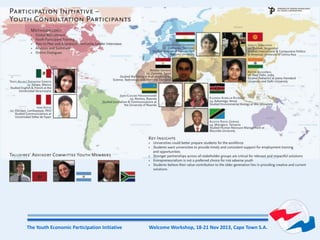
90 peer-to-peer interviews with
students in 9 countries
International advisory committee
6 week online learning
community
Origins of YEPI
YEPI Launched in July 2012 with support from
The MasterCard Foundation
Mission: The MasterCard Foundation advances
youth learning and promotes financial inclusion
to catalyze prosperity in developing countries.
Serves 5 million people in 49 developing
countries, particularly in Africa
The Youth Learning Program Life Skills
(Report in your binder)
• Digital Literacy
• Agribusiness
• Manufacturing
• Retail and Hospitality
• Construction
Welcome Workshop, 18-21 Nov 2013, Cape Town S.A.The Youth Economic Participation Initiative
Some Findings
• Consensus among students, graduates and business/community leaders that universities
could better prepare young people for the workforce:
– Students lack technical skills and soft skills (including verbal communication, team work , presentation skills)
– Access to networks and guidance from mentors is crucial
• Stronger partnerships across all stakeholder groups in the community (i.e. large and small
businesses, civil servants, policy makers, NGOs, NFPs, universities and student
representatives) are seen as critical for developing the most relevant and impactful solutions
for preparing educated young people for the workforce.
• Entrepreneurialism is a complex but critical component to the solution of “educated
unemployables” in the developing world, BUT Entrepreneurialism is not a preferred choice
for many risk-averse youth, although under difference circumstances many would pursue this
option as a means to serve their communities and, in turn, grow personally and
professionally.
Welcome Workshop, 18-21 Nov 2013, Cape Town S.A.The Youth Economic Participation Initiative
Focus on programs with:
• Strong university-community partnerships
• Soft Skills – Communications, teamwork, problem-solving, public-speaking, leadership,
negotiation, and creativity.
• Networks – Providing contacts, mentorships, guidance and exposure to the business
environment.
• Curricula reform – Collaborating with businesses and communities to bring offerings of
university in line with knowledge and skill needs of the market.
• Entrepreneurship – Teaching skills required to think creatively, launch a business,
providing resources to support enterprise, lower risks of entrepreneurship.
Why your programs?
Welcome Workshop, 18-21 Nov 2013, Cape Town S.A.The Youth Economic Participation Initiative
Selection Criteria
1. Strength of Program Design – with a focus on curricula reform, new pedagogies, multiple
complementary approaches, collaboration within and across the university.
1. Institutional Commitment and Capabilities – high level of expertise and experience with
collaborating, teaching and learning.
1. Partnerships, Collaboration with the Community – strong university-community
partnerships, strong networks providing contacts, mentorships and experience of the
business environment.
2. Youth Participation and leadership – young leaders and large numbers of students
participating in and shaping your programs.
1. Multiple complementary strategies - combination of multiple intersecting approaches;
strong mix of hands on experience, practical training and academic instruction
Welcome Workshop, 18-21 Nov 2013, Cape Town S.A.The Youth Economic Participation Initiative
The YEPI goals and activities
1. Support universities to expand innovative models enabling upper-year students
and recent alumni to accelerate their transition to the work force.
1. Facilitate a global Community of Practice to promote the exchange of knowledge.
• Award 8 Demonstration Grants
• Create an online space for discussion and the exchange of knowledge about best practices
and brokering joint projects through the Community of Practice.
• Collaborate with the YEPI Learning Partners from the University of Minnesota to capture and
document learning
• Timeframe: 2013 – 2016
Welcome Workshop, 18-21 Nov 2013, Cape Town S.A.The Youth Economic Participation Initiative
Discussion
(Your ideas)
What can we create together?
What is YEPI to you?
Why does it matter?
Welcome Workshop, 18-21 Nov 2013, Cape Town S.A.The Youth Economic Participation Initiative
The Model Virtual discussions
Webinars
In-person convenings
Progress reports
Monitoring and
Evaluation
 Peer-reviewed
publications
 Conference
presentations
 Final reports
 Online trainings
and webinars
 Exemplars
 University
exchanges
 Future funding
YEPI Partner
Universities
YEPI
Community
of Practice

Youth Economic Participation Initiative

  • 1.
    Welcome Workshop, 18-21Nov 2013, Cape Town S.A.The Youth Economic Participation Initiative Youth Economic Participation Initiative
  • 2.
    Welcome Workshop, 18-21Nov 2013, Cape Town S.A.The Youth Economic Participation Initiative Global Youth Employment Crisis The global unemployment rate among 15- to 24-year-olds is estimated at 12.6% in 2013, with 73 million young people jobless worldwide (International Labour Organization) University graduates are encountering: 1. A lack of job opportunities 2. A lack of skills and abilities necessary to access and succeed in the opportunities that are available • For example: South Africa – 600,000 unemployed university graduates and 800,000 unfilled vacancies in 2012 (The Economist 2012). 3. A university degree is no guarantee of employment • Tunisia – 40% of university graduates are unemployed, compared with 24% of non- graduates (World Economic Forum 2013)
  • 3.
    Welcome Workshop, 18-21Nov 2013, Cape Town S.A.The Youth Economic Participation Initiative The Talloires Network envisions universities around the world as vibrant and dynamic forces in their societies, incorporating social responsibility into their research and teaching mission. From a long time, the TN has been hearing from universities around the world that are already implementing innovative and creative programs that engage students in their communities and prepare them to succeed in the workplace. To date, very few of these current initiatives have evaluated, documented and disseminated their learning in a way that would allow knowledge from individual programs to benefit a wider, global audience.
  • 4.
    Welcome Workshop, 18-21Nov 2013, Cape Town S.A.The Youth Economic Participation Initiative Planning Phase - 2011 1 year exploration with youth consultancy firm DECODE www.decode.net 90 peer-to-peer interviews with students in 9 countries International advisory committee 6 week online learning community Origins of YEPI YEPI Launched in July 2012 with support from The MasterCard Foundation Mission: The MasterCard Foundation advances youth learning and promotes financial inclusion to catalyze prosperity in developing countries. Serves 5 million people in 49 developing countries, particularly in Africa The Youth Learning Program Life Skills (Report in your binder) • Digital Literacy • Agribusiness • Manufacturing • Retail and Hospitality • Construction
  • 5.
    Welcome Workshop, 18-21Nov 2013, Cape Town S.A.The Youth Economic Participation Initiative
  • 6.
    Welcome Workshop, 18-21Nov 2013, Cape Town S.A.The Youth Economic Participation Initiative Some Findings • Consensus among students, graduates and business/community leaders that universities could better prepare young people for the workforce: – Students lack technical skills and soft skills (including verbal communication, team work , presentation skills) – Access to networks and guidance from mentors is crucial • Stronger partnerships across all stakeholder groups in the community (i.e. large and small businesses, civil servants, policy makers, NGOs, NFPs, universities and student representatives) are seen as critical for developing the most relevant and impactful solutions for preparing educated young people for the workforce. • Entrepreneurialism is a complex but critical component to the solution of “educated unemployables” in the developing world, BUT Entrepreneurialism is not a preferred choice for many risk-averse youth, although under difference circumstances many would pursue this option as a means to serve their communities and, in turn, grow personally and professionally.
  • 7.
    Welcome Workshop, 18-21Nov 2013, Cape Town S.A.The Youth Economic Participation Initiative Focus on programs with: • Strong university-community partnerships • Soft Skills – Communications, teamwork, problem-solving, public-speaking, leadership, negotiation, and creativity. • Networks – Providing contacts, mentorships, guidance and exposure to the business environment. • Curricula reform – Collaborating with businesses and communities to bring offerings of university in line with knowledge and skill needs of the market. • Entrepreneurship – Teaching skills required to think creatively, launch a business, providing resources to support enterprise, lower risks of entrepreneurship. Why your programs?
  • 8.
    Welcome Workshop, 18-21Nov 2013, Cape Town S.A.The Youth Economic Participation Initiative Selection Criteria 1. Strength of Program Design – with a focus on curricula reform, new pedagogies, multiple complementary approaches, collaboration within and across the university. 1. Institutional Commitment and Capabilities – high level of expertise and experience with collaborating, teaching and learning. 1. Partnerships, Collaboration with the Community – strong university-community partnerships, strong networks providing contacts, mentorships and experience of the business environment. 2. Youth Participation and leadership – young leaders and large numbers of students participating in and shaping your programs. 1. Multiple complementary strategies - combination of multiple intersecting approaches; strong mix of hands on experience, practical training and academic instruction
  • 9.
    Welcome Workshop, 18-21Nov 2013, Cape Town S.A.The Youth Economic Participation Initiative The YEPI goals and activities 1. Support universities to expand innovative models enabling upper-year students and recent alumni to accelerate their transition to the work force. 1. Facilitate a global Community of Practice to promote the exchange of knowledge. • Award 8 Demonstration Grants • Create an online space for discussion and the exchange of knowledge about best practices and brokering joint projects through the Community of Practice. • Collaborate with the YEPI Learning Partners from the University of Minnesota to capture and document learning • Timeframe: 2013 – 2016
  • 10.
    Welcome Workshop, 18-21Nov 2013, Cape Town S.A.The Youth Economic Participation Initiative Discussion (Your ideas) What can we create together? What is YEPI to you? Why does it matter?
  • 11.
    Welcome Workshop, 18-21Nov 2013, Cape Town S.A.The Youth Economic Participation Initiative The Model Virtual discussions Webinars In-person convenings Progress reports Monitoring and Evaluation  Peer-reviewed publications  Conference presentations  Final reports  Online trainings and webinars  Exemplars  University exchanges  Future funding YEPI Partner Universities YEPI Community of Practice

Editor's Notes

  • #3 Global youth unemployment is over 12%, more than three times adult unemployment This are only some of the findings:Gaps between curricula and industry needs Lack of understanding of the job-search process Scarcity of practical resources such as computer access, local transportation for students Training for Business and Entrepreneurial Skills Need for technical assistance to small enterprises Need for new dialogues between employers and universities Need for increased internships and apprenticeshipsNeed for comprehensive community planning and development
  • #4 Why is the YEPI a good fit for the Talloires Network?In the next presentation, we learn more about the TN history and programs.
  • #9 Strength of Program DesignCompetitive programs will draw on the full resources of the university (including strong interdepartmental collaboration) to design programs that are based on a thorough and nuanced understanding of the local labor market and the reasons for youth unemployment. The scoring will prioritize demand-driven programs that clearly connect proposed programmatic objectives and activities with a well-researched analysis of the skill requirements of the economy and the wider socio-economic context.Expressions of Interest will be further evaluated according to the clarity and specificity of program goals, objectives and activities; the clarity and persuasiveness of the theory of change; the adequacy and quality of the budget; the thoroughness of gender analysis; and the strength of attention to ensuring gender equity in program planning and activities.Institutional Commitment and Capabilities:Competitive programs will have the full institutional support of university leadership, including the president, vice chancellor or CEO of their university. Applicants must further be able to demonstrate a sufficient level of institutional capacity to make any institutional changes that will be required in order to successfully implement the proposed program. Finalist applicants must submit a letter of support from their university president or equivalent with the full proposal. Host institutions are expected to make a tangible commitment to the program, as evidenced by monetary support or the contribution of significant in-kind resources, equal to roughly 5 – 10% of the total proposed program cost. Examples of in-kind resources include staff time, office space, institutional administrative support, and faculty advising. Proposed programs will be evaluated according to both the volume and potential efficacy of the donated resources in relation to the needs of the program.Implementing departments or teams should have a demonstrated track record of success in developing and managing programs. Expressions of Interest will additionally be evaluated according to the capabilities of project leaders; reasonably equitable representation of gender among project leaders and staff; and strength of the university’s mechanisms for implementing the proposed programs.Partnerships, Collaboration with the CommunityUniversities are highly encouraged to apply collaboratively with local community, private sector or government partners in the implementation of their programs. Expressions of Interest will be evaluated according to the centrality of community-university collaboration to the strategies and activities of the proposed program; the strength of working relationships with employers, community organizations, NGOs and government agencies; the clear and efficient delineation of roles and responsibilities between partners; and the involvement of partner organizations in program planning.Youth ParticipationApplicant universities must involve youth in the process of planning, implementing and evaluating the proposed programs. Program designs should include substantial inclusion of youth in both program implementation and decision-making roles. Expressions of interest will be evaluated according to the accuracy and depth of analysis of the realities of young people’s lives, experience and potential; the degree and range of involvement of youth in decision- making; and the creativity and innovativeness of strategies to involve youth.