Daniel Kratochvil


University of Wollongong in Dubai
   Highlights of the U.A.E. Government Strategy 2011-2013
    contains 7 priorities including Education (“Improve the quality
    of higher education and ensure accessibility”) and a
    Competitive Knowledge Economy (“Promote and enhance
    innovation, research and development”).
   Higher education provision by the UAE government through
    UAE University, Zayed University and the 17 campus HCT
    system.
   The Ministry of Higher Education and Scientific Research
    overseas accreditation of private universities and the National
    Research Foundation. Also, the Centre of Excellence for
    Applied Research and Training (CERT) is a commercial arm of
    HCT.
   The largest, most populated, and wealthiest of the emirates.
   Current plans are the Policy Agenda 2007-2008: The Emirate of
    Abu Dhabi and the Abu Dhabi Economic Vision 2030 (2009).
   “Abu Dhabi is seeking to attract some of the world’s best
    academics and other educational specialists through the
    development of an attractive living environment and world-
    class research facilities and research endowments” (Abu Dhabi
    Economic Vision 2030, p. 118).
   Strategy to create “an effective programme to stimulate
    research and development, and local innovation, and to
    facilitate the integration with global innovation centres.” (Abu
    Dhabi Economic Vision 2030, p. 7).
   Mission: to lay the foundation for an Innovation-based,
    knowledge producing society by:
§ Elevating the quality of Higher Education to international
   standards through partnerships with world class universities, high
   licensing and accreditation standards, requirements and
   incentives for continuous improvement
§ Promoting and incentivizing innovation, scholarship and discovery
  through major research funding in areas of strategic importance
  to Abu Dhabi, thereby building a strong community of scientists
  and scholars
§ Carefully aligning Higher Education with labor market and socio-
   economic needs, guided by the Abu Dhabi Economic Vision 2030
   and Abu Dhabi’s Policy Agenda
   Khalifa University of Science, Technology and Research
    (KUSTAR)
   Masdar Institute of Science and Technology (MIST)
   NYU- Abu Dhabi
   The Institut Européen d’Administration des Affaires
    (INSEAD)
   Paris-Sorbonne University Abu Dhabi (PSUAD)
   Emirates College for Advanced Education (ECAE)
   Closed market for higher education providers – institutions
    that predated creation of ADEC remain operating while new
    institutions are limited to those invited by the government
   Planning analyses not followed – there is a disconnect
    between the needs of the emirate and the strategies
    pursued in terms of discipline
   Focus on attracting most prestigious international
    universities is expensive and sets education level above the
    current level of potential students
   Top-down R&D collaborations – industry-university
    cooperation is limited to relations designed by government
   Direct and indirect development of higher education –
    Khalifa University and partnerships with international
    providers of private education
   Tying higher education market to strategic plan
   Granting research autonomy to international universities
    NYU – Abu Dhabi is permitted to use their own expertise to
    develop and deliver programs
   Modification of existing institutions – KUSTAR
   Embedding universities in a larger R & D infrastructure – the
    Masdar Institute is only one of five components within the
    larger Masdar project
   Guide research and development through strategic planning
    while keeping in mind the overall economy and regional
    relevance;
   Limit public investment to subsidize where it is needed to
    ensure filling of gaps or to direct investment towards long-term
    goals;
   Plan in anticipation of very long term pay-off but ensure careful
    short term implementation;
   Be creative about public-private and industry-university
    combinations;
   Use regulations in the higher education sector to pursue long-
    term strategies including those related to research and
    development;
   Carefully align development of the higher education sector
    with the pace of development of the labor market;
   Ambitiously partner with institutions in other countries to
    reduce isolation; and,
   Take full advantage of the benefits that a world class institution
    can provide by granting it autonomy in its area of expertise.


Daniel Kratochvil                            UOW Dubai                          dk32@columbia.edu

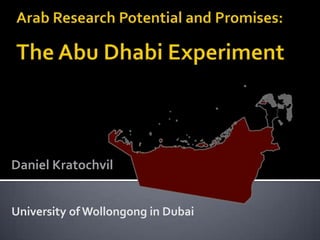
First slide map: http://en.wikipedia.org/wiki/File:H1N1_UAE_map.svg#filelinks

Arab Research Potential and Promises: The Abu Dhabi Experiment - Daniel Kratochvil

  • 1.
  • 2.
    Highlights of the U.A.E. Government Strategy 2011-2013 contains 7 priorities including Education (“Improve the quality of higher education and ensure accessibility”) and a Competitive Knowledge Economy (“Promote and enhance innovation, research and development”).  Higher education provision by the UAE government through UAE University, Zayed University and the 17 campus HCT system.  The Ministry of Higher Education and Scientific Research overseas accreditation of private universities and the National Research Foundation. Also, the Centre of Excellence for Applied Research and Training (CERT) is a commercial arm of HCT.
  • 3.
    The largest, most populated, and wealthiest of the emirates.  Current plans are the Policy Agenda 2007-2008: The Emirate of Abu Dhabi and the Abu Dhabi Economic Vision 2030 (2009).  “Abu Dhabi is seeking to attract some of the world’s best academics and other educational specialists through the development of an attractive living environment and world- class research facilities and research endowments” (Abu Dhabi Economic Vision 2030, p. 118).  Strategy to create “an effective programme to stimulate research and development, and local innovation, and to facilitate the integration with global innovation centres.” (Abu Dhabi Economic Vision 2030, p. 7).
  • 4.
    Mission: to lay the foundation for an Innovation-based, knowledge producing society by: § Elevating the quality of Higher Education to international standards through partnerships with world class universities, high licensing and accreditation standards, requirements and incentives for continuous improvement § Promoting and incentivizing innovation, scholarship and discovery through major research funding in areas of strategic importance to Abu Dhabi, thereby building a strong community of scientists and scholars § Carefully aligning Higher Education with labor market and socio- economic needs, guided by the Abu Dhabi Economic Vision 2030 and Abu Dhabi’s Policy Agenda
  • 5.
    Khalifa University of Science, Technology and Research (KUSTAR)  Masdar Institute of Science and Technology (MIST)  NYU- Abu Dhabi  The Institut Européen d’Administration des Affaires (INSEAD)  Paris-Sorbonne University Abu Dhabi (PSUAD)  Emirates College for Advanced Education (ECAE)
  • 7.
    Closed market for higher education providers – institutions that predated creation of ADEC remain operating while new institutions are limited to those invited by the government  Planning analyses not followed – there is a disconnect between the needs of the emirate and the strategies pursued in terms of discipline  Focus on attracting most prestigious international universities is expensive and sets education level above the current level of potential students  Top-down R&D collaborations – industry-university cooperation is limited to relations designed by government
  • 8.
    Direct and indirect development of higher education – Khalifa University and partnerships with international providers of private education  Tying higher education market to strategic plan  Granting research autonomy to international universities NYU – Abu Dhabi is permitted to use their own expertise to develop and deliver programs  Modification of existing institutions – KUSTAR  Embedding universities in a larger R & D infrastructure – the Masdar Institute is only one of five components within the larger Masdar project
  • 9.
    Guide research and development through strategic planning while keeping in mind the overall economy and regional relevance;  Limit public investment to subsidize where it is needed to ensure filling of gaps or to direct investment towards long-term goals;  Plan in anticipation of very long term pay-off but ensure careful short term implementation;  Be creative about public-private and industry-university combinations;
  • 10.
    Use regulations in the higher education sector to pursue long- term strategies including those related to research and development;  Carefully align development of the higher education sector with the pace of development of the labor market;  Ambitiously partner with institutions in other countries to reduce isolation; and,  Take full advantage of the benefits that a world class institution can provide by granting it autonomy in its area of expertise. Daniel Kratochvil UOW Dubai dk32@columbia.edu First slide map: http://en.wikipedia.org/wiki/File:H1N1_UAE_map.svg#filelinks