Open Training Program: UNESCO Information  clearinghouse / collaborative access to resources Capacity building through ICT
Objectives: To provide an open and collaborative space for local people and specialized communities ( Trainers, educators, decision makers etc.) Central access to non-formal educational resources
Open Training Platform The Open Training Platform (OTP) is an  initiative to facilitate access to training materials and resources developed by development stakeholders at a global level with an objective of having training and capacity-building resources openly available to local communities, development stakeholders at grassroots level in order to foster local development.
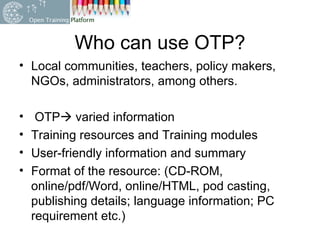
Who can use OTP? Local communities, teachers, policy makers, NGOs, administrators, among others. OTP   varied information Training resources and Training modules User-friendly information and summary  Format of the resource: ( CD-ROM, online/pdf/Word, online/HTML, pod casting, publishing details; language information; PC requirement etc.)
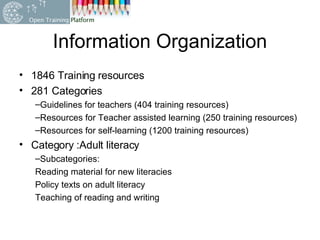
Information Organization  1846 Training resources  281 Categories  Guidelines for teachers (404 training resources) Resources for Teacher assisted learning (250 training resources) Resources for self-learning (1200 training resources) Category :Adult literacy Subcategories: Reading material for new literacies Policy texts on adult literacy Teaching of reading and writing
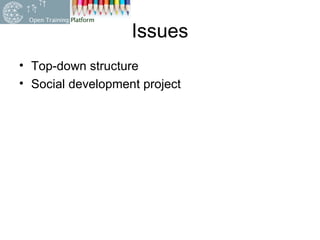
Issues Top-down structure Social development project
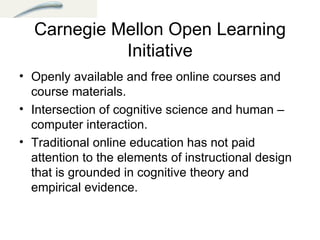
Carnegie Mellon Open Learning Initiative Openly available and free online courses and course materials.  Intersection of cognitive science and human –computer interaction.  Traditional online education has not paid attention to the elements of instructional design that is grounded in cognitive theory and empirical evidence.
Building a community of use Primary Objective: to build a community of use for online courses.  Course development in a modular fashion allowing for faculty from various institutions to develop/modify/deliver the course contents. Dissemination of these courses to individual students at no cost.
Initial courses and instructional components The first courses developed through OLI are introductory courses intended to replace large lecture format courses in Economics, Statistics, Causal Reasoning and Logic. cognitive tutors  virtual laboratories  group experiments  simulations
approach Cognitively informed education 3 step approach: encoding of declarative knowledge (e.g., facts and principles)  application of procedural knowledge to achieve goals in problem solving  contextual knowledge that helps apply learning to broader contexts.
Assessment and Evaluation assessment and evaluation are built into all courses.  Continuous evaluation of class performance gives faculty the information they need to effectively modify or supplement instruction to meet learning objectives
Two versions Open and Free version:  No credit awarded.  access to the online course workbooks used in the full semester course. Academic Version: educational institutions for credit awarded by the student's home institution  access to the same course material as the students in the Open & Free Version

Open Training Program

  • 1.
    Open Training Program:UNESCO Information clearinghouse / collaborative access to resources Capacity building through ICT
  • 2.
    Objectives: To providean open and collaborative space for local people and specialized communities ( Trainers, educators, decision makers etc.) Central access to non-formal educational resources
  • 3.
    Open Training PlatformThe Open Training Platform (OTP) is an initiative to facilitate access to training materials and resources developed by development stakeholders at a global level with an objective of having training and capacity-building resources openly available to local communities, development stakeholders at grassroots level in order to foster local development.
  • 4.
    Who can useOTP? Local communities, teachers, policy makers, NGOs, administrators, among others. OTP  varied information Training resources and Training modules User-friendly information and summary Format of the resource: ( CD-ROM, online/pdf/Word, online/HTML, pod casting, publishing details; language information; PC requirement etc.)
  • 5.
    Information Organization 1846 Training resources 281 Categories Guidelines for teachers (404 training resources) Resources for Teacher assisted learning (250 training resources) Resources for self-learning (1200 training resources) Category :Adult literacy Subcategories: Reading material for new literacies Policy texts on adult literacy Teaching of reading and writing
  • 6.
    Issues Top-down structureSocial development project
  • 7.
    Carnegie Mellon OpenLearning Initiative Openly available and free online courses and course materials. Intersection of cognitive science and human –computer interaction. Traditional online education has not paid attention to the elements of instructional design that is grounded in cognitive theory and empirical evidence.
  • 8.
    Building a communityof use Primary Objective: to build a community of use for online courses. Course development in a modular fashion allowing for faculty from various institutions to develop/modify/deliver the course contents. Dissemination of these courses to individual students at no cost.
  • 9.
    Initial courses andinstructional components The first courses developed through OLI are introductory courses intended to replace large lecture format courses in Economics, Statistics, Causal Reasoning and Logic. cognitive tutors virtual laboratories group experiments simulations
  • 10.
    approach Cognitively informededucation 3 step approach: encoding of declarative knowledge (e.g., facts and principles) application of procedural knowledge to achieve goals in problem solving contextual knowledge that helps apply learning to broader contexts.
  • 11.
    Assessment and Evaluationassessment and evaluation are built into all courses. Continuous evaluation of class performance gives faculty the information they need to effectively modify or supplement instruction to meet learning objectives
  • 12.
    Two versions Openand Free version: No credit awarded. access to the online course workbooks used in the full semester course. Academic Version: educational institutions for credit awarded by the student's home institution access to the same course material as the students in the Open & Free Version