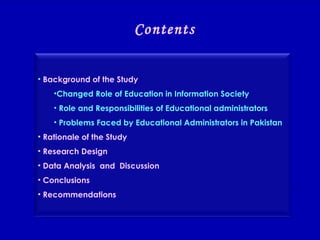
Contents Background of the Study Changed Role of Education in Information Society Role and Responsibilities of Educational administrators  Problems Faced by Educational Administrators in Pakistan Rationale of the Study Research Design Data Analysis  and  Discussion Conclusions Recommendations
Background of the Study
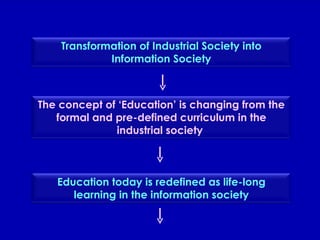
Transformation of Industrial Society into Information Society The concept of ‘Education’ is changing from the formal and pre-defined curriculum in the industrial society  Education today is redefined as life-long learning in the information society
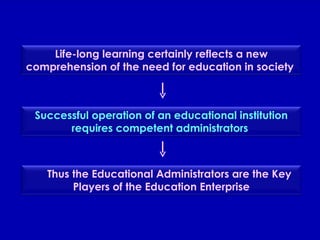
Successful operation of an educational institution requires competent administrators  Thus the Educational Administrators are the Key Players of the Education Enterprise Life-long learning certainly reflects a new comprehension of the need for education in society
Roles And Responsibilities of Educational Administrators Manage the day-to-day activities in schools, preschools, colleges and universities Provide instructional leadership Set educational standards and goals  Establish the policies and procedures to achieve them Supervise managers, support staff, teachers, librarians, coaches, and other employees
Cont… Develop academic programs Monitor students’ educational progress Train and motivate teachers and other staff Manage student services Administer recordkeeping Prepare budgets Handle relations with parents, students, employers, and the community
Educational Administrators: The Key Players of the Education Enterprise Review of the related literature has highlighted many problems which are being faced by the educational administrators in Pakistan
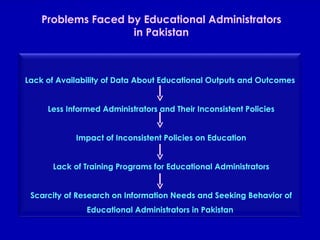
Problems Faced by Educational Administrators in Pakistan Lack of Availability of Data About Educational Outputs and Outcomes Less Informed Administrators and Their Inconsistent Policies Impact of Inconsistent Policies on Education Lack of Training Programs for Educational Administrators Scarcity of Research on Information Needs and Seeking Behavior of Educational Administrators in Pakistan
Rationale of the Study Keeping this fact in view that successful operation of an educational enterprise requires competent and well informed administrators, this study aims at finding the information needs and seeking behavior of educational administrators.
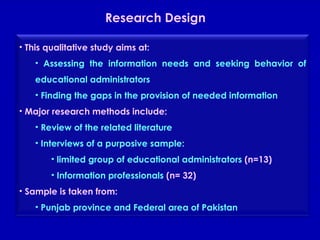
Research Design  This qualitative study aims at: Assessing the information needs and seeking behavior of educational administrators Finding the gaps in the provision of needed information Major research methods include: Review of the related literature Interviews of a purposive sample: limited group of educational administrators  (n=13) Information professionals  (n= 32) Sample is taken from: Punjab province and Federal area of Pakistan
Data Analysis  and  Discussion
Roles and Responsibilities of Educational Administrators Define Their Information Needs
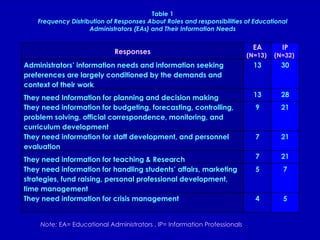
Table 1 Frequency Distribution of Responses About Roles and responsibilities of Educational Administrators (EAs) and Their Information Needs Note:  EA= Educational Administrators , IP= Information Professionals Responses EA  (N=13)  IP (N=32)  Administrators’ information needs and information seeking preferences are largely conditioned by the demands and context of their work 13 30 They need Information for planning and decision making 13 28 They need information for budgeting, forecasting, controlling, problem solving, official correspondence, monitoring, and curriculum development  9 21 They need information for staff development, and personnel evaluation 7 21 They need information for teaching & Research 7 21 They need information for handling students’ affairs, marketing strategies, fund raising, personal professional development, time management  5 7 They need information for crisis management 4 5
Sources Used for Information Seeking
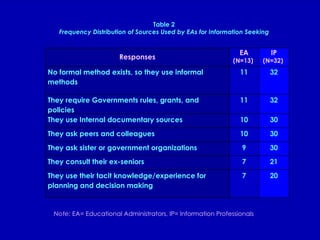
Table 2 Frequency Distribution of Sources Used by EAs for Information Seeking Note:  EA= Educational Administrators, IP= Information Professionals  Responses EA  (N=13)  IP (N=32)  No formal method exists, so they use informal methods 11 32 They require Governments rules, grants, and policies 11 32 They use Internal documentary sources 10 30 They ask peers and colleagues 10 30 They ask sister or government organizations 9 30 They consult their ex-seniors 7 21 They use their tacit knowledge/experience for planning and decision making 7 20
Use of Libraries
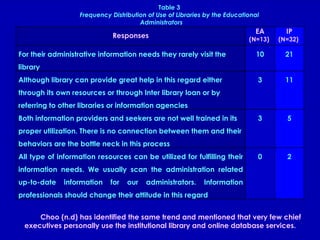
Table 3 Frequency Distribution of Use of Libraries by the Educational Administrators Choo (n.d) has identified the same trend and mentioned that very few chief executives personally use the institutional library and online database services. Responses EA  (N=13)  IP (N=32)  For their administrative information needs they rarely visit the library 10 21 Although library can provide great help in this regard either through its own resources or through Inter library loan or by referring to other libraries or information agencies  3 11 Both information providers and seekers are not well trained in its proper utilization. There is no connection between them and their behaviors are the bottle neck in this process  3 5 All type of information resources can be utilized for fulfilling their information needs. We usually scan the administration related up-to-date information for our administrators. Information professionals should change their attitude in this regard 0 2
Impact of ICT on Information Seeking Behavior of Educational Administrators
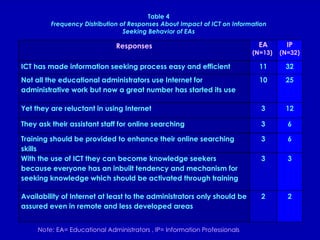
Table 4 Frequency Distribution of Responses About Impact of ICT on Information Seeking Behavior of   EAs Note:  EA= Educational Administrators , IP= Information Professionals   Responses EA  (N=13)  IP (N=32)  ICT has made information seeking process easy and efficient 11 32 Not all the educational administrators use Internet for administrative work but now a great number has started its use 10 25 Yet they are reluctant in using Internet 3 12 They ask their assistant staff for online searching 3 6 Training should be provided to enhance their online searching skills 3 6 With the use of ICT they can become knowledge seekers because everyone has an inbuilt tendency and mechanism for seeking knowledge which should be activated through training 3 3 Availability of Internet at least to the administrators only should be assured even in remote and less developed areas  2 2
Gaps in the Provision of Needed Information
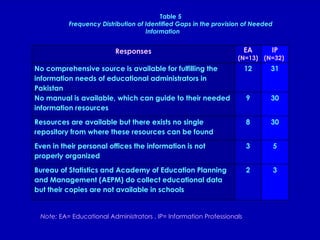
Table 5 Frequency Distribution of Identified Gaps in the provision of Needed Information Note:  EA= Educational Administrators , IP= Information Professionals   Responses EA  (N=13)  IP (N=32)  No comprehensive source is available for fulfilling the information needs of educational administrators in Pakistan 12 31 No manual is available, which can guide to their needed information resources 9 30 Resources are available but there exists no single repository from where these resources can be found 8 30 Even in their personal offices the information is not properly organized 3 5 Bureau of Statistics and Academy of Education Planning and Management (AEPM) do collect educational data but their copies are not available in schools  2 3
Need of a National Information System to Fill the Gap
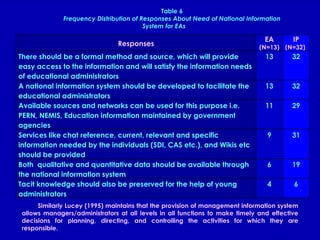
Table 6 Frequency Distribution of Responses About Need of National Information System for EAs Similarly Lucey (1995) maintains that the provision of management information system allows managers/administrators at all levels in all functions to make timely and effective decisions for planning, directing, and controlling the activities for which they are responsible. Responses EA  (N=13)  IP (N=32)  There should be a formal method and source, which will provide easy access to the information and will satisfy the information needs of educational administrators 13 32 A national information system should be developed to facilitate the educational administrators 13 32 Available sources and networks can be used for this purpose i.e. PERN, NEMIS, Education information maintained by government agencies 11 29 Services like chat reference, current, relevant and specific information needed by the individuals (SDI, CAS etc.), and Wikis etc should be provided  9 31 Both  qualitative and quantitative data should be available through the national information system  6 19 Tacit knowledge should also be preserved for the help of young administrators 4 6
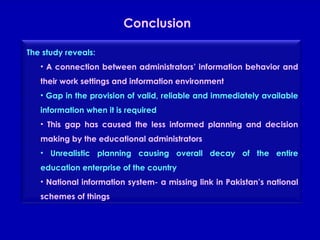
Conclusion The study reveals: A connection between administrators’ information behavior and their work settings and information environment Gap in the provision of valid, reliable and immediately available information when it is required This gap has caused the less informed planning and decision making by the educational administrators Unrealistic planning causing overall decay of the entire education enterprise of the country National information system- a missing link in Pakistan’s national schemes of things
Recommendations Need of a comprehensive survey to find out the information needs and seeking behavior of educational administrators in Pakistan Replication of this study on a large sample National information system to fulfill the information needs of educational administrators in Pakistan Need of attention by Government authorities on filling the identified gap
Thank You

Education enterprise

  • 1.
  • 2.
    Contents Background ofthe Study Changed Role of Education in Information Society Role and Responsibilities of Educational administrators Problems Faced by Educational Administrators in Pakistan Rationale of the Study Research Design Data Analysis and Discussion Conclusions Recommendations
  • 3.
  • 4.
    Transformation of IndustrialSociety into Information Society The concept of ‘Education’ is changing from the formal and pre-defined curriculum in the industrial society Education today is redefined as life-long learning in the information society
  • 5.
    Successful operation ofan educational institution requires competent administrators Thus the Educational Administrators are the Key Players of the Education Enterprise Life-long learning certainly reflects a new comprehension of the need for education in society
  • 6.
    Roles And Responsibilitiesof Educational Administrators Manage the day-to-day activities in schools, preschools, colleges and universities Provide instructional leadership Set educational standards and goals Establish the policies and procedures to achieve them Supervise managers, support staff, teachers, librarians, coaches, and other employees
  • 7.
    Cont… Develop academicprograms Monitor students’ educational progress Train and motivate teachers and other staff Manage student services Administer recordkeeping Prepare budgets Handle relations with parents, students, employers, and the community
  • 8.
    Educational Administrators: TheKey Players of the Education Enterprise Review of the related literature has highlighted many problems which are being faced by the educational administrators in Pakistan
  • 9.
    Problems Faced byEducational Administrators in Pakistan Lack of Availability of Data About Educational Outputs and Outcomes Less Informed Administrators and Their Inconsistent Policies Impact of Inconsistent Policies on Education Lack of Training Programs for Educational Administrators Scarcity of Research on Information Needs and Seeking Behavior of Educational Administrators in Pakistan
  • 10.
    Rationale of theStudy Keeping this fact in view that successful operation of an educational enterprise requires competent and well informed administrators, this study aims at finding the information needs and seeking behavior of educational administrators.
  • 11.
    Research Design This qualitative study aims at: Assessing the information needs and seeking behavior of educational administrators Finding the gaps in the provision of needed information Major research methods include: Review of the related literature Interviews of a purposive sample: limited group of educational administrators (n=13) Information professionals (n= 32) Sample is taken from: Punjab province and Federal area of Pakistan
  • 12.
    Data Analysis and Discussion
  • 13.
    Roles and Responsibilitiesof Educational Administrators Define Their Information Needs
  • 14.
    Table 1 FrequencyDistribution of Responses About Roles and responsibilities of Educational Administrators (EAs) and Their Information Needs Note: EA= Educational Administrators , IP= Information Professionals Responses EA (N=13) IP (N=32) Administrators’ information needs and information seeking preferences are largely conditioned by the demands and context of their work 13 30 They need Information for planning and decision making 13 28 They need information for budgeting, forecasting, controlling, problem solving, official correspondence, monitoring, and curriculum development 9 21 They need information for staff development, and personnel evaluation 7 21 They need information for teaching & Research 7 21 They need information for handling students’ affairs, marketing strategies, fund raising, personal professional development, time management 5 7 They need information for crisis management 4 5
  • 15.
    Sources Used forInformation Seeking
  • 16.
    Table 2 FrequencyDistribution of Sources Used by EAs for Information Seeking Note: EA= Educational Administrators, IP= Information Professionals Responses EA (N=13) IP (N=32) No formal method exists, so they use informal methods 11 32 They require Governments rules, grants, and policies 11 32 They use Internal documentary sources 10 30 They ask peers and colleagues 10 30 They ask sister or government organizations 9 30 They consult their ex-seniors 7 21 They use their tacit knowledge/experience for planning and decision making 7 20
  • 17.
  • 18.
    Table 3 FrequencyDistribution of Use of Libraries by the Educational Administrators Choo (n.d) has identified the same trend and mentioned that very few chief executives personally use the institutional library and online database services. Responses EA (N=13) IP (N=32) For their administrative information needs they rarely visit the library 10 21 Although library can provide great help in this regard either through its own resources or through Inter library loan or by referring to other libraries or information agencies 3 11 Both information providers and seekers are not well trained in its proper utilization. There is no connection between them and their behaviors are the bottle neck in this process 3 5 All type of information resources can be utilized for fulfilling their information needs. We usually scan the administration related up-to-date information for our administrators. Information professionals should change their attitude in this regard 0 2
  • 19.
    Impact of ICTon Information Seeking Behavior of Educational Administrators
  • 20.
    Table 4 FrequencyDistribution of Responses About Impact of ICT on Information Seeking Behavior of EAs Note: EA= Educational Administrators , IP= Information Professionals Responses EA (N=13) IP (N=32) ICT has made information seeking process easy and efficient 11 32 Not all the educational administrators use Internet for administrative work but now a great number has started its use 10 25 Yet they are reluctant in using Internet 3 12 They ask their assistant staff for online searching 3 6 Training should be provided to enhance their online searching skills 3 6 With the use of ICT they can become knowledge seekers because everyone has an inbuilt tendency and mechanism for seeking knowledge which should be activated through training 3 3 Availability of Internet at least to the administrators only should be assured even in remote and less developed areas 2 2
  • 21.
    Gaps in theProvision of Needed Information
  • 22.
    Table 5 FrequencyDistribution of Identified Gaps in the provision of Needed Information Note: EA= Educational Administrators , IP= Information Professionals Responses EA (N=13) IP (N=32) No comprehensive source is available for fulfilling the information needs of educational administrators in Pakistan 12 31 No manual is available, which can guide to their needed information resources 9 30 Resources are available but there exists no single repository from where these resources can be found 8 30 Even in their personal offices the information is not properly organized 3 5 Bureau of Statistics and Academy of Education Planning and Management (AEPM) do collect educational data but their copies are not available in schools 2 3
  • 23.
    Need of aNational Information System to Fill the Gap
  • 24.
    Table 6 FrequencyDistribution of Responses About Need of National Information System for EAs Similarly Lucey (1995) maintains that the provision of management information system allows managers/administrators at all levels in all functions to make timely and effective decisions for planning, directing, and controlling the activities for which they are responsible. Responses EA (N=13) IP (N=32) There should be a formal method and source, which will provide easy access to the information and will satisfy the information needs of educational administrators 13 32 A national information system should be developed to facilitate the educational administrators 13 32 Available sources and networks can be used for this purpose i.e. PERN, NEMIS, Education information maintained by government agencies 11 29 Services like chat reference, current, relevant and specific information needed by the individuals (SDI, CAS etc.), and Wikis etc should be provided 9 31 Both qualitative and quantitative data should be available through the national information system 6 19 Tacit knowledge should also be preserved for the help of young administrators 4 6
  • 25.
    Conclusion The studyreveals: A connection between administrators’ information behavior and their work settings and information environment Gap in the provision of valid, reliable and immediately available information when it is required This gap has caused the less informed planning and decision making by the educational administrators Unrealistic planning causing overall decay of the entire education enterprise of the country National information system- a missing link in Pakistan’s national schemes of things
  • 26.
    Recommendations Need ofa comprehensive survey to find out the information needs and seeking behavior of educational administrators in Pakistan Replication of this study on a large sample National information system to fulfill the information needs of educational administrators in Pakistan Need of attention by Government authorities on filling the identified gap
  • 27.

Editor's Notes

  • #7 Perform many other duties
  • #10 Few problems are highlighted here.
  • #13 Here is the analysis of Interviews of educational administrators (N=13) and Information professionals (N= 32)
  • #14 It was found that …
  • #15 Many researchers have discussed that information needs of educational administrators are different according to the level at which information users are operating (national or sub-national) and the type of decision they take (Auster & Choo, 1994; Lucey, 1995).
  • #26 Revise-make headings
  • #27 Heading asurveyy of inf need sek of edu adm in pk-