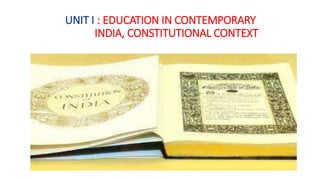
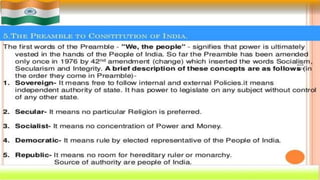
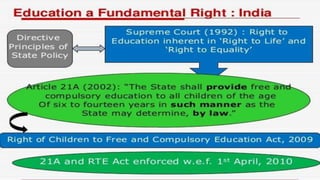
IDENTIFY THE PICTURE
&
TELL THE RELATED TOPIC
SEMESTER - I
COURSE – 2
CONTEMPORARY INDIA AND EDUCATION
Prepared by
Mrs. DHANALAKSHMI B
Asst. Professor in Commerce
Lisieux College of Education
Saravanampatti,
Coimbatore.
UNIT I : EDUCATION IN CONTEMPORARY
INDIA, CONSTITUTIONAL CONTEXT
AIMS OF EDUCATION
General Aim
Individual aim
Social Aim
Specific Aim
Knowledge aim
Vocational aim
Moral aim
The complete the living aim
Harmonious development
of personality
Leisure aim
LEVELS OF EDUCATION
Pre-Primary
Primary
Secondary
Senior Secondary
Higher
Professional
Distance and Optional
DEVELOPMENT OF PRIMARY EDUCATION
• In 1944, CABE (Central Advisory Board of Education) issued the
plan for the Indian education development. According to this
free, compulsory education should be given to children within
forty years.
• In1948, All India educational conference was held and it was
decided to give the free, compulsory education within sixteen
years.
• In 1960-61, Tamilnadu government executed the compulsory
education to all the 6 to 11 years old children in a planned
manner.
• In 1965-66 compulsory education was given to children in
remote villages.
Continue….
•Tamilnadu is in the forefront in giving free and compulsory
education to the children below 14 years among all the
states in India.
•According to the New Educational Policy of 1986 it was
assured that before the beginning of the 21st century, free
and compulsory, quality education would be given to each
and every child below 14 years.
•Since 1989 education for all has been functioning as a great
people’s movement.
PEOBLEMS IN IMPLEMENTING FREE COMPULSORY PRIMARY
EDUCATION FOR ALL
Though the number of primary schools and number of
children have increased, the quality of education has not
improved up to the expected level. The reasons for this are:
1. Population Growth
2. Equal educational opportunities.
3. Enrollment of children
4. Family circumstances
5. Poverty school age children – Child labour
6. Wastage and Stagnation
Continue…
7. Negative thoughts about girl’s education
8. School timings are not suitable for the village
people.
9. Parents do not realize the importance of
education.
10. In village there is deficiency of teachers
separately for boys and girls.
• Town planning is the process of managing land resources. It involves
the control of existing and new developments, as well as strategy
preparation to ensure manage future requirements. It is a dynamic
process that changes in response to policy, development proposals
and local needs
Education, constitution& articles  b.ed

Education, constitution& articles b.ed

  • 1.
    IDENTIFY THE PICTURE & TELLTHE RELATED TOPIC
  • 2.
    SEMESTER - I COURSE– 2 CONTEMPORARY INDIA AND EDUCATION Prepared by Mrs. DHANALAKSHMI B Asst. Professor in Commerce Lisieux College of Education Saravanampatti, Coimbatore.
  • 3.
    UNIT I :EDUCATION IN CONTEMPORARY INDIA, CONSTITUTIONAL CONTEXT
  • 13.
    AIMS OF EDUCATION GeneralAim Individual aim Social Aim Specific Aim Knowledge aim Vocational aim Moral aim The complete the living aim Harmonious development of personality Leisure aim
  • 33.
    LEVELS OF EDUCATION Pre-Primary Primary Secondary SeniorSecondary Higher Professional Distance and Optional
  • 41.
    DEVELOPMENT OF PRIMARYEDUCATION • In 1944, CABE (Central Advisory Board of Education) issued the plan for the Indian education development. According to this free, compulsory education should be given to children within forty years. • In1948, All India educational conference was held and it was decided to give the free, compulsory education within sixteen years. • In 1960-61, Tamilnadu government executed the compulsory education to all the 6 to 11 years old children in a planned manner. • In 1965-66 compulsory education was given to children in remote villages.
  • 42.
    Continue…. •Tamilnadu is inthe forefront in giving free and compulsory education to the children below 14 years among all the states in India. •According to the New Educational Policy of 1986 it was assured that before the beginning of the 21st century, free and compulsory, quality education would be given to each and every child below 14 years. •Since 1989 education for all has been functioning as a great people’s movement.
  • 43.
    PEOBLEMS IN IMPLEMENTINGFREE COMPULSORY PRIMARY EDUCATION FOR ALL Though the number of primary schools and number of children have increased, the quality of education has not improved up to the expected level. The reasons for this are: 1. Population Growth 2. Equal educational opportunities. 3. Enrollment of children 4. Family circumstances 5. Poverty school age children – Child labour 6. Wastage and Stagnation
  • 44.
    Continue… 7. Negative thoughtsabout girl’s education 8. School timings are not suitable for the village people. 9. Parents do not realize the importance of education. 10. In village there is deficiency of teachers separately for boys and girls.
  • 85.
    • Town planningis the process of managing land resources. It involves the control of existing and new developments, as well as strategy preparation to ensure manage future requirements. It is a dynamic process that changes in response to policy, development proposals and local needs