digitaltechnologies
in adult education
Group A
(6-7:20 pm ET)
Agenda:
• Check-In
• Designing for the Elephant – Goals and
Attention
• Using Digital Technologies for Learning: Key
Points
• Trello Demonstration
• Lesson Planning with BOPPPS Q & A
DIGITAL TECHNOLOGIES IN ADULT EDUCATION
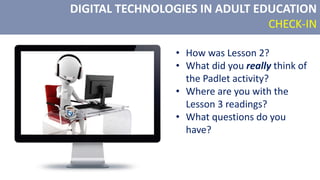
CHECK-IN
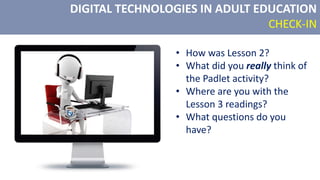
• How was Lesson 2?
• What did you really think of
the Padlet activity?
• Where are you with the
Lesson 3 readings?
• What questions do you
have?
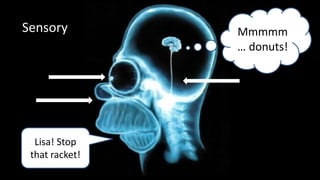
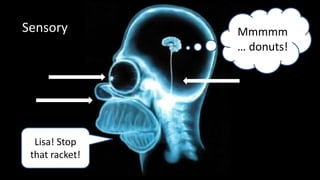
Sensory Mmmmm
… donuts!
Lisa! Stop
that racket!
Short-term
Memory
Long-term
Memory
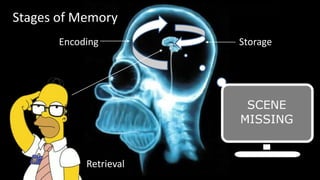
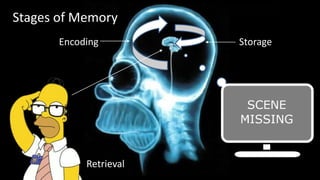
Stages of Memory
Encoding Storage
Retrieval
Let’s Play!
https://kahoot.it/
DIGITAL TECHNOLOGIES IN ADULT EDUCATION
USING TECHNOLOGIES FOR LEARNING
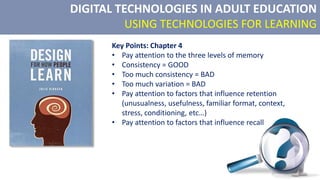
Key Points: Chapter 4
• Pay attention to the three levels of memory
• Consistency = GOOD
• Too much consistency = BAD
• Too much variation = BAD
• Pay attention to factors that influence retention
(unusualness, usefulness, familiar format, context,
stress, conditioning, etc…)
• Pay attention to factors that influence recall
DIGITAL TECHNOLOGIES IN ADULT EDUCATION
USING TECHNOLOGIES FOR LEARNING
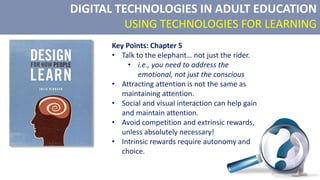
Key Points: Chapter 5
• Talk to the elephant… not just the rider.
• i.e., you need to address the
emotional, not just the conscious
• Attracting attention is not the same as
maintaining attention.
• Social and visual interaction can help gain
and maintain attention.
• Avoid competition and extrinsic rewards,
unless absolutely necessary!
• Intrinsic rewards require autonomy and
choice.
DIGITAL TECHNOLOGIES IN ADULT EDUCATION
USING TECHNOLOGIES FOR LEARNING
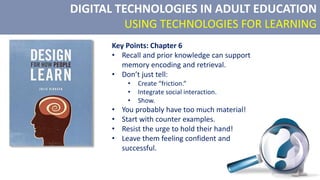
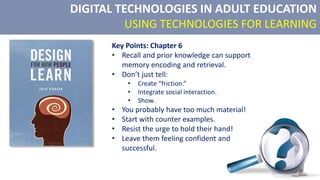
Key Points: Chapter 6
• Recall and prior knowledge can support
memory encoding and retrieval.
• Don’t just tell:
• Create “friction.”
• Integrate social interaction.
• Show.
• You probably have too much material!
• Start with counter examples.
• Resist the urge to hold their hand!
• Leave them feeling confident and
successful.
Community of Inquiry Framework
DIGITAL TECHNOLOGIES IN ADULT EDUCATION
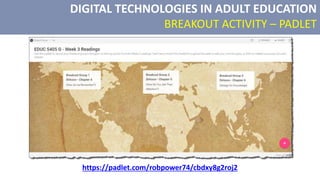
BREAKOUT ACTIVITY – PADLET
https://padlet.com/robpower74/cbdxy8g2roj2
DIGITAL TECHNOLOGIES IN ADULT EDUCATION
TO DO
• Finish Lesson 3 readings.
• Share your thoughts on the Week 3 readings using Padlet / Forum / Blog.
• Week 3 EdTech Exploration – Try out Trello with your Group for Assignment 3
• Don’t forget… Minimum of 2 Blog posts due by Sunday, May 30th!
Break Time!
…back to start the session with Group B at 7:40 pm ET…
digitaltechnologies
in adult education
Group B
(7:40-9 pm ET)
Agenda:
• Check-In
• Social Learning Theories:
• CoI
• TDT
• ZPD
• Social-Constructivism & Activity Theory
• Connectivism
• Using Digital Technologies for Learning: Key
Points
• Breakout Activity
DIGITAL TECHNOLOGIES IN ADULT EDUCATION
CHECK-IN
• How was Lesson 2?
• What did you really think of
the Padlet activity?
• Where are you with the
Lesson 3 readings?
• What questions do you
have?
Sensory Mmmmm
… donuts!
Lisa! Stop
that racket!
Short-term
Memory
Long-term
Memory
Stages of Memory
Encoding Storage
Retrieval
Let’s Play!
https://kahoot.it/
DIGITAL TECHNOLOGIES IN ADULT EDUCATION
USING TECHNOLOGIES FOR LEARNING
Key Points: Chapter 4
• Pay attention to the three levels of memory
• Consistency = GOOD
• Too much consistency = BAD
• Too much variation = BAD
• Pay attention to factors that influence retention
(unusualness, usefulness, familiar format, context,
stress, conditioning, etc…)
• Pay attention to factors that influence recall
DIGITAL TECHNOLOGIES IN ADULT EDUCATION
USING TECHNOLOGIES FOR LEARNING
Key Points: Chapter 5
• Talk to the elephant… not just the rider.
• i.e., you need to address the
emotional, not just the conscious
• Attracting attention is not the same as
maintaining attention.
• Social and visual interaction can help gain
and maintain attention.
• Avoid competition and extrinsic rewards,
unless absolutely necessary!
• Intrinsic rewards require autonomy and
choice.
DIGITAL TECHNOLOGIES IN ADULT EDUCATION
USING TECHNOLOGIES FOR LEARNING
Key Points: Chapter 6
• Recall and prior knowledge can support
memory encoding and retrieval.
• Don’t just tell:
• Create “friction.”
• Integrate social interaction.
• Show.
• You probably have too much material!
• Start with counter examples.
• Resist the urge to hold their hand!
• Leave them feeling confident and
successful.
Community of Inquiry Framework
DIGITAL TECHNOLOGIES IN ADULT EDUCATION
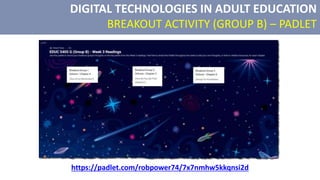
BREAKOUT ACTIVITY (GROUP B) – PADLET
https://padlet.com/robpower74/7x7nmhw5kkqnsi2d
DIGITAL TECHNOLOGIES IN ADULT EDUCATION
TO DO
• Finish Lesson 3 readings.
• Share your thoughts on the Week 3 readings using Padlet / Forum / Blog.
• Week 3 EdTech Exploration – Try out Trello with your Group for Assignment 3
• Don’t forget… Minimum of 2 Blog posts due by Sunday, May 30th!

EDUC5405 Lesson 3 s21

  • 1.
    digitaltechnologies in adult education GroupA (6-7:20 pm ET) Agenda: • Check-In • Designing for the Elephant – Goals and Attention • Using Digital Technologies for Learning: Key Points • Trello Demonstration • Lesson Planning with BOPPPS Q & A
  • 2.
    DIGITAL TECHNOLOGIES INADULT EDUCATION CHECK-IN • How was Lesson 2? • What did you really think of the Padlet activity? • Where are you with the Lesson 3 readings? • What questions do you have?
  • 3.
  • 4.
  • 5.
  • 6.
    Stages of Memory EncodingStorage Retrieval
  • 7.
  • 8.
    DIGITAL TECHNOLOGIES INADULT EDUCATION USING TECHNOLOGIES FOR LEARNING Key Points: Chapter 4 • Pay attention to the three levels of memory • Consistency = GOOD • Too much consistency = BAD • Too much variation = BAD • Pay attention to factors that influence retention (unusualness, usefulness, familiar format, context, stress, conditioning, etc…) • Pay attention to factors that influence recall
  • 9.
    DIGITAL TECHNOLOGIES INADULT EDUCATION USING TECHNOLOGIES FOR LEARNING Key Points: Chapter 5 • Talk to the elephant… not just the rider. • i.e., you need to address the emotional, not just the conscious • Attracting attention is not the same as maintaining attention. • Social and visual interaction can help gain and maintain attention. • Avoid competition and extrinsic rewards, unless absolutely necessary! • Intrinsic rewards require autonomy and choice.
  • 10.
    DIGITAL TECHNOLOGIES INADULT EDUCATION USING TECHNOLOGIES FOR LEARNING Key Points: Chapter 6 • Recall and prior knowledge can support memory encoding and retrieval. • Don’t just tell: • Create “friction.” • Integrate social interaction. • Show. • You probably have too much material! • Start with counter examples. • Resist the urge to hold their hand! • Leave them feeling confident and successful.
  • 11.
  • 12.
    DIGITAL TECHNOLOGIES INADULT EDUCATION BREAKOUT ACTIVITY – PADLET https://padlet.com/robpower74/cbdxy8g2roj2
  • 14.
    DIGITAL TECHNOLOGIES INADULT EDUCATION TO DO • Finish Lesson 3 readings. • Share your thoughts on the Week 3 readings using Padlet / Forum / Blog. • Week 3 EdTech Exploration – Try out Trello with your Group for Assignment 3 • Don’t forget… Minimum of 2 Blog posts due by Sunday, May 30th!
  • 15.
    Break Time! …back tostart the session with Group B at 7:40 pm ET…
  • 16.
    digitaltechnologies in adult education GroupB (7:40-9 pm ET) Agenda: • Check-In • Social Learning Theories: • CoI • TDT • ZPD • Social-Constructivism & Activity Theory • Connectivism • Using Digital Technologies for Learning: Key Points • Breakout Activity
  • 17.
    DIGITAL TECHNOLOGIES INADULT EDUCATION CHECK-IN • How was Lesson 2? • What did you really think of the Padlet activity? • Where are you with the Lesson 3 readings? • What questions do you have?
  • 18.
  • 19.
  • 20.
  • 21.
    Stages of Memory EncodingStorage Retrieval
  • 22.
  • 23.
    DIGITAL TECHNOLOGIES INADULT EDUCATION USING TECHNOLOGIES FOR LEARNING Key Points: Chapter 4 • Pay attention to the three levels of memory • Consistency = GOOD • Too much consistency = BAD • Too much variation = BAD • Pay attention to factors that influence retention (unusualness, usefulness, familiar format, context, stress, conditioning, etc…) • Pay attention to factors that influence recall
  • 24.
    DIGITAL TECHNOLOGIES INADULT EDUCATION USING TECHNOLOGIES FOR LEARNING Key Points: Chapter 5 • Talk to the elephant… not just the rider. • i.e., you need to address the emotional, not just the conscious • Attracting attention is not the same as maintaining attention. • Social and visual interaction can help gain and maintain attention. • Avoid competition and extrinsic rewards, unless absolutely necessary! • Intrinsic rewards require autonomy and choice.
  • 25.
    DIGITAL TECHNOLOGIES INADULT EDUCATION USING TECHNOLOGIES FOR LEARNING Key Points: Chapter 6 • Recall and prior knowledge can support memory encoding and retrieval. • Don’t just tell: • Create “friction.” • Integrate social interaction. • Show. • You probably have too much material! • Start with counter examples. • Resist the urge to hold their hand! • Leave them feeling confident and successful.
  • 26.
  • 27.
    DIGITAL TECHNOLOGIES INADULT EDUCATION BREAKOUT ACTIVITY (GROUP B) – PADLET https://padlet.com/robpower74/7x7nmhw5kkqnsi2d
  • 29.
    DIGITAL TECHNOLOGIES INADULT EDUCATION TO DO • Finish Lesson 3 readings. • Share your thoughts on the Week 3 readings using Padlet / Forum / Blog. • Week 3 EdTech Exploration – Try out Trello with your Group for Assignment 3 • Don’t forget… Minimum of 2 Blog posts due by Sunday, May 30th!