CURRICULUM
EVALUATION AND
THETEACHERS
PRESENTED BY: JAYMARK D. CANTIL
OBJECTIVES:
ATTHE END OFTHIS LESSONTHE STUDENTWILL BE ABLETO;
• Acquired a clear understanding of what is curriculum evaluation
• Explained the need to evaluate the curriculum and how its being done
• Expanded knowledge about different curriculum evaluation models.
CURRICULUM EVALUATION
- measuring and judging the extent to which the planned courses,
programmes, learning activities and opportunities as expected results.
Answer two big questions;
1. Do planned, courses, programs and activities as written and
implemented actually produce desired results?
2. How can these school curricula be improved?
TWO WAYS OF LOOKING AT CURRICULUM
EVALUATION
1. Curriculum Program Evaluation
- focus on the overall aspects of curriculum or the curriculum itself.
• K – 12 Curriculum
• Mother tongue Curriculum
• Teacher’s approach in Mathematics Curriculum
TWO WAYS OF LOOKING AT CURRICULUM
EVALUATION
2. Curriculum Program Component Evaluation
- Include separate evaluation of a curriculum.
• achieved learning outcomes
• curriculum process ( teaching-learning methods/strategies)
• Instructional materials (i.e books, modules)
CURRICULUM EVALUATION IS BOTH A
PROCESS AND A TOOL
• As a Process
- because it follows a step and procedure based on models and frameworks to
get the desired results.
• As aTool
- help teacher and program implementers to judge the worth and merit of
the program and innovation of curricular change.
For both process and a tool, the results of evaluation will be the basis to IMPROVE
curriculum
CURRICULARIST DEFINESTHAT…
Curriculum Evaluation is a process done in order to gather data that enables one to decide
whether to accept, change, eliminate the whole curriculum of textbook.
- Ornestein,A and Hunkins F. (1998)
1. Do planned learning opportunities, programmes, courses and activities as developed and
organized actually produce desired results?
2. How can a curriculum best be improved?
- McNeil J. (1977)
CURRICULARIST DEFINESTHAT…
• Curriculum Evaluation identify the weaknesses and strengths as well as problems
encountered in the implementation to improve the curriculum development process
- Gay L. (1985)
• It is a process of delineating, obtaining and providing useful information for judging
alternatives for purposes of modifying or eliminating the curriculum.
- Oliva P. (1988)
REASONS FOR
CURRICULUM
EVALUATION
WHY ISTHERE A NEEDTO EVALUATE A
CURRICULUM?
• Identifies the strengths and weaknesses (Needs assessments)
• It will tell if the designed or implemented curriculum can produce or is
producing desired results. (Monitoring)
• Curriculum evaluation will guide whether the results have equaled or
exceeded the standards. (terminal assessment)
• Curriculum evaluation provides information necessary for teachers, school
managers, curriculum specialist for policy recommendations. (decision making)
BRADLEY’S
EFFECTIVE MODEL
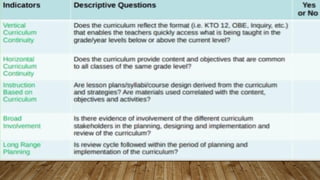
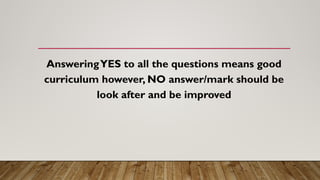
AnsweringYES to all the questions means good
curriculum however, NO answer/mark should be
look after and be improved
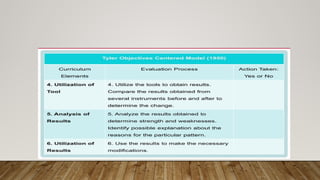
TYLER’S
OBJECTIVE
CENTERED MODEL
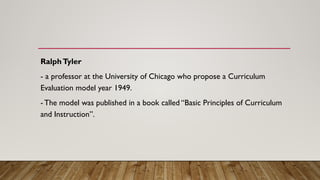
RalphTyler
- a professor at the University of Chicago who propose a Curriculum
Evaluation model year 1949.
- The model was published in a book called “Basic Principles of Curriculum
and Instruction”.
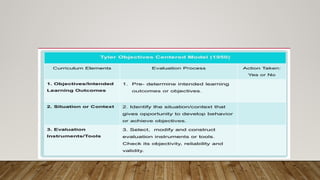
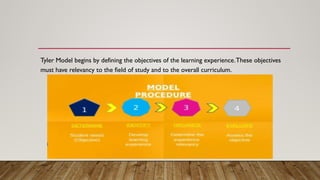
Tyler Model begins by defining the objectives of the learning experience.These objectives
must have relevancy to the field of study and to the overall curriculum.
DANIEL
STUFFLEBEAMS CIPP
MODEL
Daniel Stufflebeam
• Founder and director, Ohio State University Education Center (1963-
1973)
• Created the innovative CIPP Evaluation Model
• Director of Western Michigan University
CIPP MODEL
• It is based on planning, structuring, implementing, reviewing, and revising
decisions each examined through evaluation of context, input, process and
product evaluation
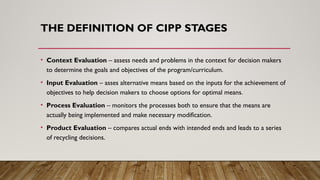
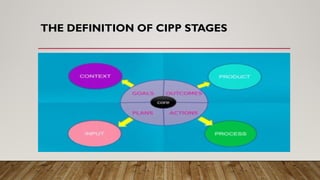
THE DEFINITION OF CIPP STAGES
• Context Evaluation – assess needs and problems in the context for decision makers
to determine the goals and objectives of the program/curriculum.
• Input Evaluation – asses alternative means based on the inputs for the achievement of
objectives to help decision makers to choose options for optimal means.
• Process Evaluation – monitors the processes both to ensure that the means are
actually being implemented and make necessary modification.
• Product Evaluation – compares actual ends with intended ends and leads to a series
of recycling decisions.
THE DEFINITION OF CIPP STAGES
STAKES RESPONSIVE
EVALUATION MODEL
ROBERT E. STAKE
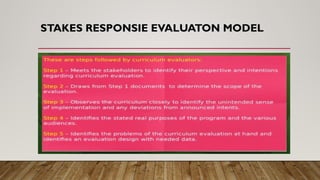
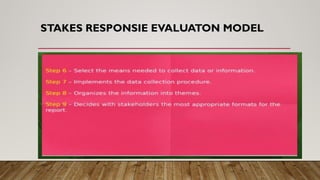
STAKES RESPONSIE EVALUATON MODEL
• Enables to evaluate the educational and other programs by comparing the
program activity, the program uniqueness, and the social diversity of the
people.
STAKES RESPONSIE EVALUATON MODEL
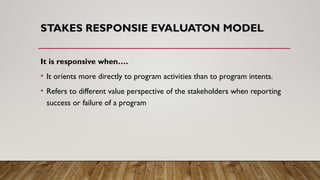
It is responsive when….
• It orients more directly to program activities than to program intents.
• Refers to different value perspective of the stakeholders when reporting
success or failure of a program
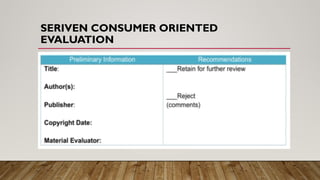
SERIVEN CONSUMER
ORIENTED
EVALUATION
Michael Seriven
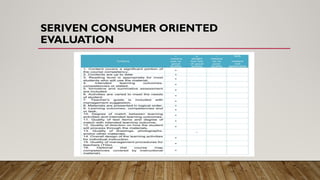
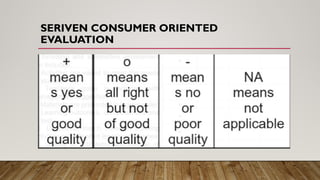
• Micheal Seriven in 1987 introduced this evaluation among many other
when evaluation products flooded the market
• Includes textbook, modules, educational technology like software and
other instructional materials.
SERIVEN CONSUMER ORIENTED
EVALUATION
SERIVEN CONSUMER ORIENTED
EVALUATION
SERIVEN CONSUMER ORIENTED
EVALUATION
END OF MY
PRESENTATION.

CURRICULUM EVALUATION AND THE TEACHERS.pptx

  • 1.
  • 2.
    OBJECTIVES: ATTHE END OFTHISLESSONTHE STUDENTWILL BE ABLETO; • Acquired a clear understanding of what is curriculum evaluation • Explained the need to evaluate the curriculum and how its being done • Expanded knowledge about different curriculum evaluation models.
  • 3.
    CURRICULUM EVALUATION - measuringand judging the extent to which the planned courses, programmes, learning activities and opportunities as expected results. Answer two big questions; 1. Do planned, courses, programs and activities as written and implemented actually produce desired results? 2. How can these school curricula be improved?
  • 4.
    TWO WAYS OFLOOKING AT CURRICULUM EVALUATION 1. Curriculum Program Evaluation - focus on the overall aspects of curriculum or the curriculum itself. • K – 12 Curriculum • Mother tongue Curriculum • Teacher’s approach in Mathematics Curriculum
  • 5.
    TWO WAYS OFLOOKING AT CURRICULUM EVALUATION 2. Curriculum Program Component Evaluation - Include separate evaluation of a curriculum. • achieved learning outcomes • curriculum process ( teaching-learning methods/strategies) • Instructional materials (i.e books, modules)
  • 6.
    CURRICULUM EVALUATION ISBOTH A PROCESS AND A TOOL • As a Process - because it follows a step and procedure based on models and frameworks to get the desired results. • As aTool - help teacher and program implementers to judge the worth and merit of the program and innovation of curricular change. For both process and a tool, the results of evaluation will be the basis to IMPROVE curriculum
  • 7.
    CURRICULARIST DEFINESTHAT… Curriculum Evaluationis a process done in order to gather data that enables one to decide whether to accept, change, eliminate the whole curriculum of textbook. - Ornestein,A and Hunkins F. (1998) 1. Do planned learning opportunities, programmes, courses and activities as developed and organized actually produce desired results? 2. How can a curriculum best be improved? - McNeil J. (1977)
  • 8.
    CURRICULARIST DEFINESTHAT… • CurriculumEvaluation identify the weaknesses and strengths as well as problems encountered in the implementation to improve the curriculum development process - Gay L. (1985) • It is a process of delineating, obtaining and providing useful information for judging alternatives for purposes of modifying or eliminating the curriculum. - Oliva P. (1988)
  • 9.
  • 10.
    WHY ISTHERE ANEEDTO EVALUATE A CURRICULUM? • Identifies the strengths and weaknesses (Needs assessments) • It will tell if the designed or implemented curriculum can produce or is producing desired results. (Monitoring) • Curriculum evaluation will guide whether the results have equaled or exceeded the standards. (terminal assessment) • Curriculum evaluation provides information necessary for teachers, school managers, curriculum specialist for policy recommendations. (decision making)
  • 11.
  • 13.
    AnsweringYES to allthe questions means good curriculum however, NO answer/mark should be look after and be improved
  • 14.
  • 15.
    RalphTyler - a professorat the University of Chicago who propose a Curriculum Evaluation model year 1949. - The model was published in a book called “Basic Principles of Curriculum and Instruction”.
  • 18.
    Tyler Model beginsby defining the objectives of the learning experience.These objectives must have relevancy to the field of study and to the overall curriculum.
  • 19.
  • 20.
    Daniel Stufflebeam • Founderand director, Ohio State University Education Center (1963- 1973) • Created the innovative CIPP Evaluation Model • Director of Western Michigan University
  • 21.
    CIPP MODEL • Itis based on planning, structuring, implementing, reviewing, and revising decisions each examined through evaluation of context, input, process and product evaluation
  • 22.
    THE DEFINITION OFCIPP STAGES • Context Evaluation – assess needs and problems in the context for decision makers to determine the goals and objectives of the program/curriculum. • Input Evaluation – asses alternative means based on the inputs for the achievement of objectives to help decision makers to choose options for optimal means. • Process Evaluation – monitors the processes both to ensure that the means are actually being implemented and make necessary modification. • Product Evaluation – compares actual ends with intended ends and leads to a series of recycling decisions.
  • 23.
    THE DEFINITION OFCIPP STAGES
  • 24.
  • 25.
    STAKES RESPONSIE EVALUATONMODEL • Enables to evaluate the educational and other programs by comparing the program activity, the program uniqueness, and the social diversity of the people.
  • 26.
  • 27.
  • 28.
    STAKES RESPONSIE EVALUATONMODEL It is responsive when…. • It orients more directly to program activities than to program intents. • Refers to different value perspective of the stakeholders when reporting success or failure of a program
  • 29.
  • 30.
    Michael Seriven • MichealSeriven in 1987 introduced this evaluation among many other when evaluation products flooded the market • Includes textbook, modules, educational technology like software and other instructional materials.
  • 31.
  • 32.
  • 33.
  • 34.