
Part I The Beginnings - Introduction Chapter One Defining Development Zooming In and Zooming Out Applying the Scientific Method Cautions from Science
The Beginnings
“ The science of human development   seeks to understand how and why people– all kinds of people, everywhere, of every age– change or remain the same over time.”  Defining Development
First Element:  Developmental study is a science… theories data analysis  critical thinking sound methodology Understanding How and Why empirical  is based on data empirical evidence  is followed by applications… not theoretical
scientific method:   begins with curiosity develop a hypothesis test the hypothesis draw conclusions   The   scientific method  is a way to answer questions that requires empirical research and data-based conclusions.
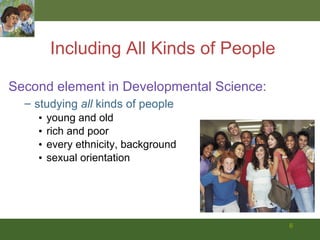
Including All Kinds of People Second element in Developmental Science:  studying  all  kinds of people young and old rich and poor every ethnicity, background sexual orientation
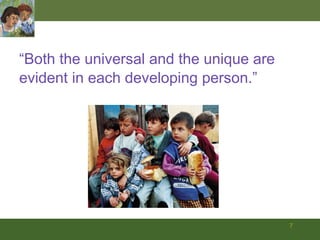
“Both the universal and the unique are evident in each developing person.”
The Nature-Nurture Controversy Nature  refers to the influence of genes that people inherit. Nurture  refers to environmental influences that affect development after an individual is conceived.
The Nature-Nurture Controversy has many other names: heredity versus environment maturation versus learning … the basic question… “ How much of any characteristic, behavior, or pattern of development is the result of genes and how much is the result of experience?”
Difference Is Not Necessarily Deficit difference-equals-deficit error the mistaken belief that a deviation from some nor is necessary inferior to behavioral or characteristics that meet the standard
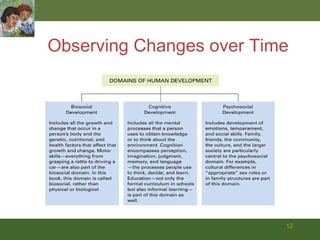
Observing Changes over Time Third Element in Developmental Science:   Are individuals changing or remaining the same over time? transformations consistencies of human life beginning to end understanding each segment of life
Observing Changes over Time
Dynamic Systems The  dynamic-systems approach   is a view of human development as an ongoing, every changing interaction between the physical and emotional being and between the person and every aspect of his or her environment, including the family and society.
Dynamic Systems stresses the fluctuations and transitions throughout life the dynamic synthesis of multiple levels of analysis the interaction between people and within each person parent and child prenatal and postnatal life between ages 2 and 102
Five Characteristics of Development Multidirectional  - changes in direction; development is dynamic, not static each fraction of a second years are analyzed, revealing unexpected twist and turns
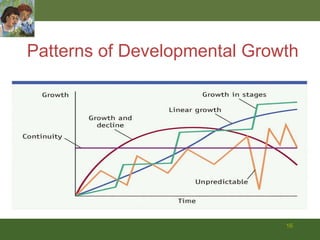
Patterns of Developmental Growth
Development follows many paths, and one way to express the variability…. continuity  refers to characteristics that are stable over time (e.g., biological sex). discontinuity  refers to characteristics unlike those than came before (e.g., speaking a new language, quitting a drug).
A  critical period  refers to a time when a particular type of developmental growth (in the body or behavior) must happen. A fetus develops leg and arms between 21 and 50 days after conception.
A  sensitive period  refers to a time when a certain type of development is most likely to happen and happens most easily.  early  childhood is considered a sensitive   period for language learning.
Diagnostic and Statistical Manual of  Mental Disorder (DMS) The American Psychiatric Association’s official guide to the diagnosis  (not treatment)  of mental disorders. Developmentalists are delving deeper into  persons and looking more broadly at their contexts.
Five Characteristics of Development 2. Multidisciplinary Scientists from many academic disciplines, each with their unique perspective contributing to the study of human development—together their contributions providing a full view of the whole person
The  ecological-systems approach   is   the view that in the study of human development, the person should be considered in all the contexts and interactions that constitute a life.
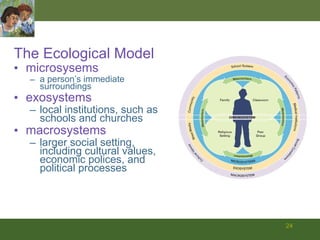
Urie Bronfenbrenner  a leader in understanding the ecological systems approach ,  he believed that developmentalists need to examine all systems surrounding the development of each person microsysems exosystems macrosystems
The Ecological Model microsysems a person’s immediate surroundings exosystems local institutions, such as schools and churches macrosystems larger social setting, including cultural values, economic polices, and political processes
3. Multicontextual  “… humans develop in dozens of contexts that profoundly affect their development…” Family Historical Economical Five Characteristics of Development
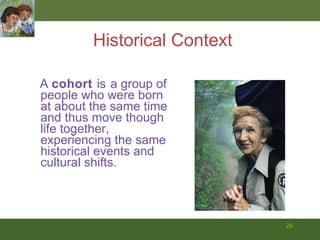
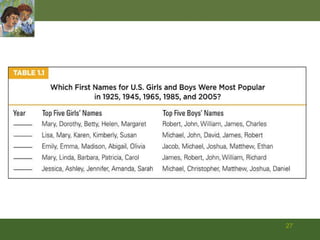
Historical Context A  cohort  is   a group of people who were born at about the same time and thus move though life together, experiencing the same historical events and cultural shifts.
 
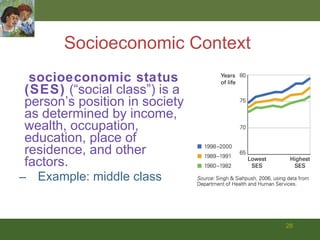
Socioeconomic Context socioeconomic status (SES)  (“social class”) is a person’s position in society as determined by income, wealth, occupation, education, place of residence, and other factors. Example: middle class
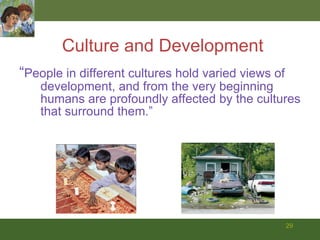
Culture and Development “ People in different cultures hold varied views of development, and from the very beginning humans are profoundly affected by the cultures that surround them.”
4. Multicultural the patterns of behavior that are passed from one generation to the next any group may have its own culture— values customs clothes dwellings cuisine assumptions people are influenced by more than one culture Five Characteristics of Development
Ethnicity and Race An  ethnic group  is a group whose ancestors were born in the same region and who often share a  language, culture, and religion.  Race  refers to a group of people who are regarded by  themselves or by others as genetically distinct from other groups on the basis of physical appearance. Social Construction  is an idea that is built more on shared perceptions than on objective reality. Examples.. Yuppie Senior citizen childhood
Ethnicity and Race Ethnic categories arise from history, sociology, and psychology,  not from biology. ethnic groups share certain attributes: ancestral heritage national origin Religion Culture language
Ethnicity and Race Race is used to categorize groups of people based on appearance. 95% of the genetic differences between one person and another occur within, not between, supposed racial groups. race is misleading as a biological category race = social construction an idea created by society perceived racial differences lead to discrimination  affect cognition
Genetic Codes and Brain Activity Genes  affect everything, including most psychological disorders. So does the individual’s environment. zooming out  – developmental researchers can shed light on the effects of nurture zooming in  – researchers can add to our understanding of nature
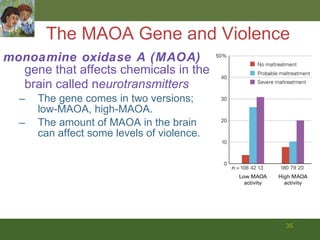
The MAOA Gene and Violence monoamine oxidase A (MAOA)  gene that affects chemicals in the brain called n eurotransmitters The gene comes in two versions; low-MAOA, high-MAOA. The amount of MAOA in the brain can affect some levels of violence.
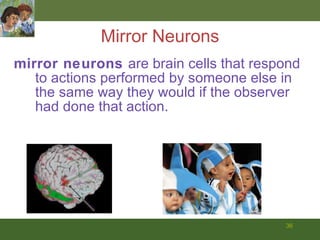
Mirror Neurons mirror neurons   are brain cells that respond to actions performed by someone else in the same way they would if the observer had done that action.
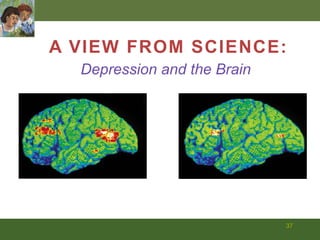
A VIEW FROM SCIENCE: Depression and the Brain
Five Characteristics of Development 5. Plasticity   is the idea that abilities, personality, and other human traits can change over time. Plasticity is particularly evident during childhood, but even older adults are not always “set in their ways”.
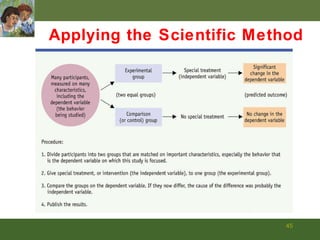
Testing Hypotheses Applying the Scientific Method Once  an individual poses a question or issue to study, the next step is to form a hypothesis. An  hypothesis  is an explicit idea to be tested.  Tests may either confirm or refute the hypotheses.
Testing Hypotheses Four common ways to test hypotheses: Observation The Experiment The Survey The Case Study
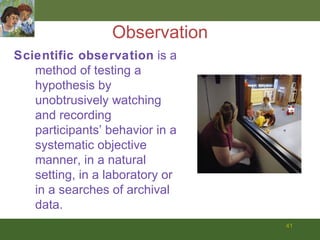
Observation Scientific observation  is a method of testing a hypothesis by unobtrusively watching and recording participants’ behavior in a systematic objective manner, in a natural setting, in a laboratory or in a searches of archival data.
The Experiment Experiment :  a research method in which the researcher tries to determine the cause-and-effect relationships between two variables by manipulating one (called the  independent variable ) and then observing and recording the resulting changes in the other (called the  dependent variable ).
The Experiment independent variable:  the variable that is introduced to see what effect it has on the dependent variable (Also called  experimental variable )  dependent variable:  the variable in an experiment that may change as a result of whatever new condition or situation the experimenter ads.  In other words, the dependent variable  depends  on the independent variable.
The Experiment experimental group:  is a group of participants in a research study who experience some special treatment or condition (the independent variable). control group:  a group of participants in a research study who are similar to the experimental group in all relevant ways  but  they do not experience the experimental condition (the independent variable).
Applying the Scientific Method
A  survey  is a research method in which information is collected from a large number of people by interviews, written questionnaires, or some other means. A  case study  is a research method in which one individual is studied intensively.
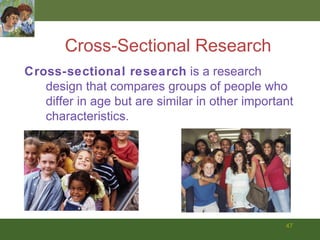
Cross-Sectional Research Cross-sectional research  is a research design that compares groups of people who differ in age but are similar in other important characteristics.
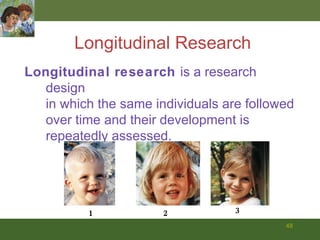
Longitudinal Research Longitudinal research  is a research design in which the same individuals are followed over time and their development is repeatedly assessed. 1 2 3
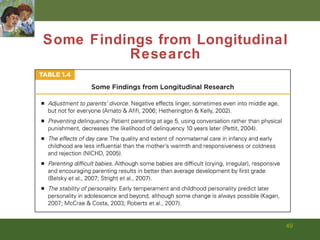
Some Findings from Longitudinal Research
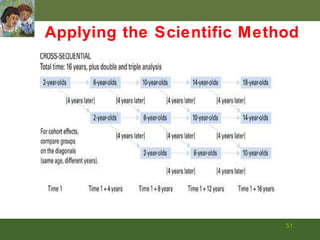
Cross-Sequential Research Cross-sequential research  is a hybrid research method in which researchers first study several groups of people of different ages (a cross-sectional groups over the years (a longitudinal approach).  Allows researchers to disentangle differences related to age and to the historic period.
Applying the Scientific Method
Correlation and Causation Correlation  the relationship between two variables, if one is more (or less) likely to occur when the other variable does.  Positive= both variables increase or decrease Negative= one variable increases while the other decreases Zero= if no correlation is evident
Quantity and Quality Quantitative research  provides data that can be expressed with numbers, such as ranks or scales. Qualitative research  considers qualities instead of quantities.  Descriptions of particular conditions and participants’ expressed ideas are often part of qualitative studies.
Ethics in Research Code of ethics  is a   set of moral principles that members of a profession or group are expected to follow. Meeting ethical standards is very important, especially when working with children.
Protection of Research Participants Researchers must ensure that participation is voluntary, confidential, and harmless.  Scientists are obligated to report research as accurately and complete as possible. cannot distort the results to support any political, economic, or cultural position.

Berger ca8e lecch1

  • 1.
    Part I TheBeginnings - Introduction Chapter One Defining Development Zooming In and Zooming Out Applying the Scientific Method Cautions from Science
  • 2.
  • 3.
    “ The scienceof human development seeks to understand how and why people– all kinds of people, everywhere, of every age– change or remain the same over time.” Defining Development
  • 4.
    First Element: Developmental study is a science… theories data analysis critical thinking sound methodology Understanding How and Why empirical is based on data empirical evidence is followed by applications… not theoretical
  • 5.
    scientific method: begins with curiosity develop a hypothesis test the hypothesis draw conclusions The scientific method is a way to answer questions that requires empirical research and data-based conclusions.
  • 6.
    Including All Kindsof People Second element in Developmental Science: studying all kinds of people young and old rich and poor every ethnicity, background sexual orientation
  • 7.
    “Both the universaland the unique are evident in each developing person.”
  • 8.
    The Nature-Nurture ControversyNature refers to the influence of genes that people inherit. Nurture refers to environmental influences that affect development after an individual is conceived.
  • 9.
    The Nature-Nurture Controversyhas many other names: heredity versus environment maturation versus learning … the basic question… “ How much of any characteristic, behavior, or pattern of development is the result of genes and how much is the result of experience?”
  • 10.
    Difference Is NotNecessarily Deficit difference-equals-deficit error the mistaken belief that a deviation from some nor is necessary inferior to behavioral or characteristics that meet the standard
  • 11.
    Observing Changes overTime Third Element in Developmental Science: Are individuals changing or remaining the same over time? transformations consistencies of human life beginning to end understanding each segment of life
  • 12.
  • 13.
    Dynamic Systems The dynamic-systems approach is a view of human development as an ongoing, every changing interaction between the physical and emotional being and between the person and every aspect of his or her environment, including the family and society.
  • 14.
    Dynamic Systems stressesthe fluctuations and transitions throughout life the dynamic synthesis of multiple levels of analysis the interaction between people and within each person parent and child prenatal and postnatal life between ages 2 and 102
  • 15.
    Five Characteristics ofDevelopment Multidirectional - changes in direction; development is dynamic, not static each fraction of a second years are analyzed, revealing unexpected twist and turns
  • 16.
  • 17.
    Development follows manypaths, and one way to express the variability…. continuity refers to characteristics that are stable over time (e.g., biological sex). discontinuity refers to characteristics unlike those than came before (e.g., speaking a new language, quitting a drug).
  • 18.
    A criticalperiod refers to a time when a particular type of developmental growth (in the body or behavior) must happen. A fetus develops leg and arms between 21 and 50 days after conception.
  • 19.
    A sensitiveperiod refers to a time when a certain type of development is most likely to happen and happens most easily. early childhood is considered a sensitive period for language learning.
  • 20.
    Diagnostic and StatisticalManual of Mental Disorder (DMS) The American Psychiatric Association’s official guide to the diagnosis (not treatment) of mental disorders. Developmentalists are delving deeper into persons and looking more broadly at their contexts.
  • 21.
    Five Characteristics ofDevelopment 2. Multidisciplinary Scientists from many academic disciplines, each with their unique perspective contributing to the study of human development—together their contributions providing a full view of the whole person
  • 22.
    The ecological-systemsapproach is the view that in the study of human development, the person should be considered in all the contexts and interactions that constitute a life.
  • 23.
    Urie Bronfenbrenner a leader in understanding the ecological systems approach , he believed that developmentalists need to examine all systems surrounding the development of each person microsysems exosystems macrosystems
  • 24.
    The Ecological Modelmicrosysems a person’s immediate surroundings exosystems local institutions, such as schools and churches macrosystems larger social setting, including cultural values, economic polices, and political processes
  • 25.
    3. Multicontextual “… humans develop in dozens of contexts that profoundly affect their development…” Family Historical Economical Five Characteristics of Development
  • 26.
    Historical Context A cohort is a group of people who were born at about the same time and thus move though life together, experiencing the same historical events and cultural shifts.
  • 27.
  • 28.
    Socioeconomic Context socioeconomicstatus (SES) (“social class”) is a person’s position in society as determined by income, wealth, occupation, education, place of residence, and other factors. Example: middle class
  • 29.
    Culture and Development“ People in different cultures hold varied views of development, and from the very beginning humans are profoundly affected by the cultures that surround them.”
  • 30.
    4. Multicultural thepatterns of behavior that are passed from one generation to the next any group may have its own culture— values customs clothes dwellings cuisine assumptions people are influenced by more than one culture Five Characteristics of Development
  • 31.
    Ethnicity and RaceAn ethnic group is a group whose ancestors were born in the same region and who often share a language, culture, and religion. Race refers to a group of people who are regarded by themselves or by others as genetically distinct from other groups on the basis of physical appearance. Social Construction is an idea that is built more on shared perceptions than on objective reality. Examples.. Yuppie Senior citizen childhood
  • 32.
    Ethnicity and RaceEthnic categories arise from history, sociology, and psychology, not from biology. ethnic groups share certain attributes: ancestral heritage national origin Religion Culture language
  • 33.
    Ethnicity and RaceRace is used to categorize groups of people based on appearance. 95% of the genetic differences between one person and another occur within, not between, supposed racial groups. race is misleading as a biological category race = social construction an idea created by society perceived racial differences lead to discrimination affect cognition
  • 34.
    Genetic Codes andBrain Activity Genes affect everything, including most psychological disorders. So does the individual’s environment. zooming out – developmental researchers can shed light on the effects of nurture zooming in – researchers can add to our understanding of nature
  • 35.
    The MAOA Geneand Violence monoamine oxidase A (MAOA) gene that affects chemicals in the brain called n eurotransmitters The gene comes in two versions; low-MAOA, high-MAOA. The amount of MAOA in the brain can affect some levels of violence.
  • 36.
    Mirror Neurons mirrorneurons are brain cells that respond to actions performed by someone else in the same way they would if the observer had done that action.
  • 37.
    A VIEW FROMSCIENCE: Depression and the Brain
  • 38.
    Five Characteristics ofDevelopment 5. Plasticity is the idea that abilities, personality, and other human traits can change over time. Plasticity is particularly evident during childhood, but even older adults are not always “set in their ways”.
  • 39.
    Testing Hypotheses Applyingthe Scientific Method Once an individual poses a question or issue to study, the next step is to form a hypothesis. An hypothesis is an explicit idea to be tested. Tests may either confirm or refute the hypotheses.
  • 40.
    Testing Hypotheses Fourcommon ways to test hypotheses: Observation The Experiment The Survey The Case Study
  • 41.
    Observation Scientific observation is a method of testing a hypothesis by unobtrusively watching and recording participants’ behavior in a systematic objective manner, in a natural setting, in a laboratory or in a searches of archival data.
  • 42.
    The Experiment Experiment: a research method in which the researcher tries to determine the cause-and-effect relationships between two variables by manipulating one (called the independent variable ) and then observing and recording the resulting changes in the other (called the dependent variable ).
  • 43.
    The Experiment independentvariable: the variable that is introduced to see what effect it has on the dependent variable (Also called experimental variable ) dependent variable: the variable in an experiment that may change as a result of whatever new condition or situation the experimenter ads. In other words, the dependent variable depends on the independent variable.
  • 44.
    The Experiment experimentalgroup: is a group of participants in a research study who experience some special treatment or condition (the independent variable). control group: a group of participants in a research study who are similar to the experimental group in all relevant ways but they do not experience the experimental condition (the independent variable).
  • 45.
  • 46.
    A survey is a research method in which information is collected from a large number of people by interviews, written questionnaires, or some other means. A case study is a research method in which one individual is studied intensively.
  • 47.
    Cross-Sectional Research Cross-sectionalresearch is a research design that compares groups of people who differ in age but are similar in other important characteristics.
  • 48.
    Longitudinal Research Longitudinalresearch is a research design in which the same individuals are followed over time and their development is repeatedly assessed. 1 2 3
  • 49.
    Some Findings fromLongitudinal Research
  • 50.
    Cross-Sequential Research Cross-sequentialresearch is a hybrid research method in which researchers first study several groups of people of different ages (a cross-sectional groups over the years (a longitudinal approach). Allows researchers to disentangle differences related to age and to the historic period.
  • 51.
  • 52.
    Correlation and CausationCorrelation the relationship between two variables, if one is more (or less) likely to occur when the other variable does. Positive= both variables increase or decrease Negative= one variable increases while the other decreases Zero= if no correlation is evident
  • 53.
    Quantity and QualityQuantitative research provides data that can be expressed with numbers, such as ranks or scales. Qualitative research considers qualities instead of quantities. Descriptions of particular conditions and participants’ expressed ideas are often part of qualitative studies.
  • 54.
    Ethics in ResearchCode of ethics is a set of moral principles that members of a profession or group are expected to follow. Meeting ethical standards is very important, especially when working with children.
  • 55.
    Protection of ResearchParticipants Researchers must ensure that participation is voluntary, confidential, and harmless. Scientists are obligated to report research as accurately and complete as possible. cannot distort the results to support any political, economic, or cultural position.