Differentiation
A Special Note........
Differentiation is a very popular, not to mention broad, topic in today’s
educational arena. It should be noted that this presentation is only
intended to be a brief overview of this encompassing topic. There is an
enormous amount of information about differentiated instruction and
the related concepts that are intertwined with differentiated
instruction, which could not be included within this format. To learn
more about differentiated instruction, please refer to the “Websites”
and “Resources” slides at the end of this power point, or contact your
Florida Inclusion Network facilitator at:
www.FloridaInclusionNetwork.com
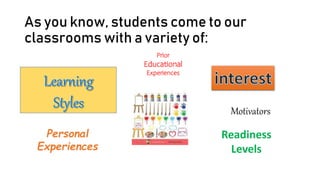
As you know, students come to our
classrooms with a variety of:
Prior
Educational
Experiences
Motivators
Readiness
Levels
Personal
Experiences
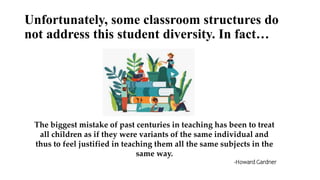
Unfortunately, some classroom structures do
not address this student diversity. In fact…
The biggest mistake of past centuries in teaching has been to treat
all children as if they were variants of the same individual and
thus to feel justified in teaching them all the same subjects in the
same way.
-Howard Gardner
So now you have a classroom of diverse
learners… and you know that some of
our past teaching strategies are not
going to be effective with them…So,
the million dollar question is…
Howdoyousuccessfullymeettheneeds
ofthediverselearnersinyour
classroom?
Let’s take a look at the instructional strategies we
typically use in our classrooms and see how they
effect our students’ memory retention rates.
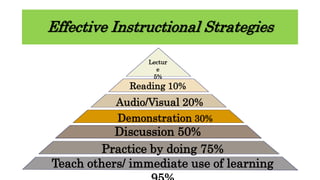
Effective Instructional Strategies
Lectur
e
5%
Reading 10%
Audio/Visual 20%
Demonstration 30%
Discussion 50%
Practice by doing 75%
Teach others/ immediate use of learning
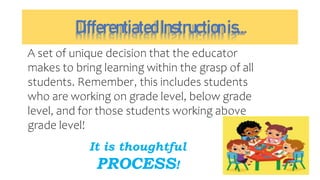
DifferentiatedInstructionis…
A set of unique decision that the educator
makes to bring learning within the grasp of all
students. Remember, this includes students

who are working on grade level, below grade
level, and for those students working above
grade level!
It is thoughtful
PROCESS!
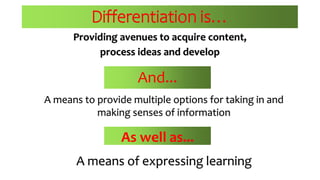
Differentiation is…
Providing avenues to acquire content,
process ideas and develop
And...
A means to provide multiple options for taking in and
making senses of information
As well as...
A means of expressing learning
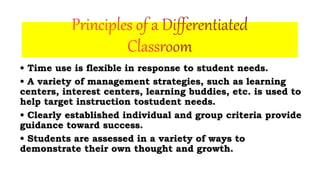
Principles of a Differentiated
Classroom
• All students participate in respectful work.
• Teacher and students work together to ensure
continual engagement & challenge for each
learner.
• The teacher coordinates use of time, space, and
activities.
• Flexible grouping, which includes whole class
learning, pairs, student-selected groups, teacherselected groups, and
random groups.
• Time use is flexible in response to student needs.
• A variety of management strategies, such as learning
centers, interest centers, learning buddies, etc. is used to
help target instruction tostudent needs.
• Clearly established individual and group criteria provide
guidance toward success.
• Students are assessed in a variety of ways to
demonstrate their own thought and growth.
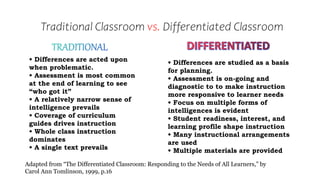
Traditional Classroom vs. Differentiated Classroom
• Differences are acted upon
when problematic.
• Assessment is most common
at the end of learning to see
“who got it”
• A relatively narrow sense of
intelligence prevails
• Coverage of curriculum
guides drives instruction
• Whole class instruction
dominates
• A single text prevails
• Differences are studied as a basis
for planning.
• Assessment is on-going and
diagnostic to to make instruction
more responsive to learner needs
• Focus on multiple forms of
intelligences is evident
• Student readiness, interest, and
learning profile shape instruction
• Many instructional arrangements
are used
• Multiple materials are provided
Adapted from “The Differentiated Classroom: Responding to the Needs of All Learners,” by
Carol Ann Tomlinson, 1999, p.16
Differentiation of Instruction
is a teacher’s response to learners’ needs
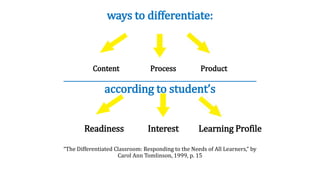
ways to differentiate:
Content Process Product
__________________________________________________________________
according to student’s
Readiness Interest Learning Profile
“The Differentiated Classroom: Responding to the Needs of All Learners,” by
Carol Ann Tomlinson, 1999, p. 15
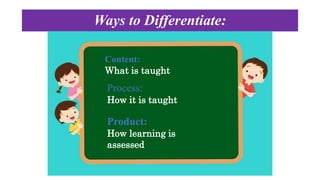
Ways to Differentiate:
Content:
What is taught
Process:
How it is taught
Product:
How learning is
assessed
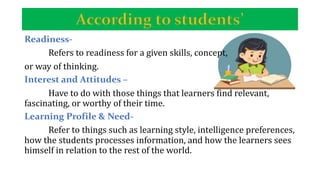
Readiness-
Refers to readiness for a given skills, concept,
or way of thinking.
Interest and Attitudes –
Have to do with those things that learners find relevant,
fascinating, or worthy of their time.
Learning Profile & Need-
Refer to things such as learning style, intelligence preferences,
how the students processes information, and how the learners sees
himself in relation to the rest of the world.
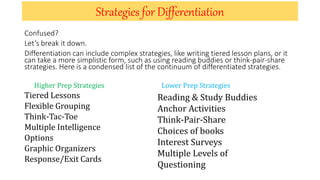
Strategies for Differentiation
Confused?
Let’s break it down.
Differentiation can include complex strategies, like writing tiered lesson plans, or it
can take a more simplistic form, such as using reading buddies or think-pair-share
strategies. Here is a condensed list of the continuum of differentiated strategies.
Higher Prep Strategies Lower Prep Strategies
Tiered Lessons
Flexible Grouping
Think-Tac-Toe
Multiple Intelligence
Options
Graphic Organizers
Response/Exit Cards
Reading & Study Buddies
Anchor Activities
Think-Pair-Share
Choices of books
Interest Surveys
Multiple Levels of
Questioning
A Closer Look
Within the next few slides, you will be introduced to a few
differentiated instructional strategies such as tiered lessons, exit
cards, flexible grouping, anchor activities, response cards, think-
tac-toe boards, cubing, graphic organizers, and mind maps.
Remember, these are just some of the many examples of
differentiated instructional strategies.
As you progress through your FOR-PD modules,
you will also encounter classroom friendly examples
of these and other differentiated strategies that you may
want to implement in your classroom.
Tiered Instruction
• Provides teachers with a means of assigning
different tasks within the same lesson or unit.
• The tasks will vary according to the students’:
Readiness
Interest
Learning Profile
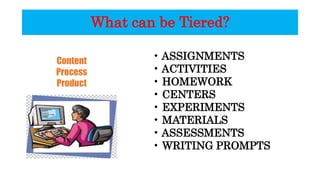
What can be Tiered?
Content
Process
Product
• ASSIGNMENTS
• ACTIVITIES
• HOMEWORK
• CENTERS
• EXPERIMENTS
• MATERIALS
• ASSESSMENTS
• WRITING PROMPTS
Flexible Grouping
Flexible grouping is an opportunity for students to work with a variety of
students, through whole group or in many different forms of small groups. The
key to flexible grouping is in the name…FLEXIBLE.
Students have an opportunity to be in different groups depending on the activity.
• Initially use whole group for instruction
• Divide group for practice or enrichment
• Not used as a permanent arrangement
• Use groups for one activity, a day, a week, etc.
Flexible grouping is the cornerstone of successful differentiated instruction – Carol Ann Tomlinson
Group Membership
Can be determined by:
Readiness
Interest
Reading Level
Skill Level
Background Knowledge
Social Skills
Anchor Activities
Anchor activities are
ongoing assignments
that students can work
on independently
throughout a unit, a
grading period, or longer.
The Purpose of an Anchor Activity
Provide meaningful work for students when
they finish an assignment or project, when
they first enter the class, or when they are
“stumped.”
Provide ongoing task that tie to the content and instruction
Free up the classroom teacher to work with other groups of students
or individuals
Exit Cards
Exit Cards (AKA “Tickets Out The
Door”) are used to gather information
on student readiness levels, interests,
and/or learning profiles. They can be
used as quick assessments to see if
the students are “getting it.”
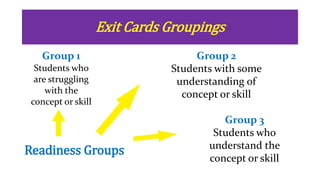
Exit Cards Groupings
Readiness Groups
Group 1
Students who
are struggling
with the
concept or skill
Group 2
Students with some
understanding of
concept or skill
Group 3
Students who
understand the
concept or skill
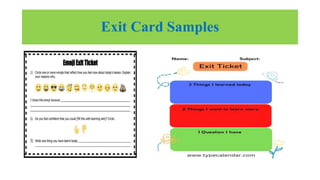
Exit Card Samples
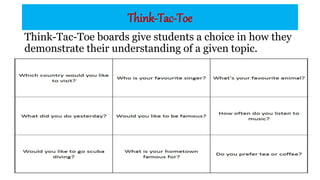
Think-Tac-Toe
Think-Tac-Toe boards give students a choice in how they
demonstrate their understanding of a given topic.
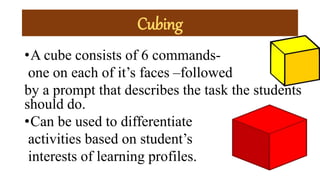
Cubing
•A cube consists of 6 commands-
one on each of it’s faces –followed
by a prompt that describes the task the students
should do.
•Can be used to differentiate
activities based on student’s
interests of learning profiles.
Cubing
• Designed to help
students think about a
topic from different
angles
• Game-like—motivates
children
• Recognizes large
reservoir of knowledge
and skills of some
learners
• Satisfies hunger to do
something different
• Eliminates boredom and
lethargy resulting from
unnecessary drill and
practice.
• Often used to reinforce,
extend or demonstrate
learning
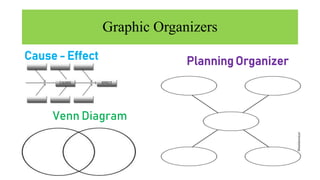
Graphic Organizers
• Aides comprehension, concept development
and learning
• Highlights key vocabulary
• Provides an organized, visual display of
knowledge
• Focuses attention on key elements
• Helps integrate prior knowledge with new
knowledge
Graphic Organizers
Cause - Effect Planning Organizer
Venn Diagram
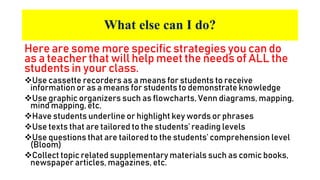
What else can I do?
Here are some more specific strategies you can do
as a teacher that will help meet the needs of ALL the
students in your class.
Use cassette recorders as a means for students to receive
information or as a means for students to demonstrate knowledge
Use graphic organizers such as flowcharts, Venn diagrams, mapping,
mind mapping, etc.
Have students underline or highlight key words or phrases
Use texts that are tailored to the students’ reading levels
Use questions that are tailored to the students’ comprehension level
(Bloom)
Collect topic related supplementary materials such as comic books,
newspaper articles, magazines, etc.
Continued…
Provide word walls for students to reference while
reading/writing
Encourage different forms of expressing learning such as
drawing, acting, poetry, etc.
Use flexible grouping, peer tutoring, learning buddies, etc.
Use ongoing assessment of students progress so that
intervention can occur quickly (exit cards, response
cards…)
Use student diaries, learning logs, journals, prediction logs
Shorten or lengthen assignments while still maintaining
the objective of the lesson
Rewrite problems using less/more complex language
In My Differentiated Classroom…
Everyonewillfeel welcomed
Mutual respectwillbe nonnegotiable
Students willfeel physical, mental&
emotional safety
Therewillbe a pervasiveexpectation of growth
I willteach for success
A new sort of fairness willbe evident and accepted
We willcollaboratefor mutual growth and success
We are for difference, for
respecting difference, for
valuing difference,
until difference no longer
makes a difference
Thank you!

Differentation-Powerpoint- differentiated instruction.pptx

  • 1.
  • 2.
    A Special Note........ Differentiationis a very popular, not to mention broad, topic in today’s educational arena. It should be noted that this presentation is only intended to be a brief overview of this encompassing topic. There is an enormous amount of information about differentiated instruction and the related concepts that are intertwined with differentiated instruction, which could not be included within this format. To learn more about differentiated instruction, please refer to the “Websites” and “Resources” slides at the end of this power point, or contact your Florida Inclusion Network facilitator at: www.FloridaInclusionNetwork.com
  • 3.
    As you know,students come to our classrooms with a variety of: Prior Educational Experiences Motivators Readiness Levels Personal Experiences
  • 4.
    Unfortunately, some classroomstructures do not address this student diversity. In fact… The biggest mistake of past centuries in teaching has been to treat all children as if they were variants of the same individual and thus to feel justified in teaching them all the same subjects in the same way. -Howard Gardner
  • 5.
    So now youhave a classroom of diverse learners… and you know that some of our past teaching strategies are not going to be effective with them…So, the million dollar question is… Howdoyousuccessfullymeettheneeds ofthediverselearnersinyour classroom?
  • 6.
    Let’s take alook at the instructional strategies we typically use in our classrooms and see how they effect our students’ memory retention rates.
  • 7.
    Effective Instructional Strategies Lectur e 5% Reading10% Audio/Visual 20% Demonstration 30% Discussion 50% Practice by doing 75% Teach others/ immediate use of learning
  • 9.
    DifferentiatedInstructionis… A set ofunique decision that the educator makes to bring learning within the grasp of all students. Remember, this includes students who are working on grade level, below grade level, and for those students working above grade level! It is thoughtful PROCESS!
  • 10.
    Differentiation is… Providing avenuesto acquire content, process ideas and develop And... A means to provide multiple options for taking in and making senses of information As well as... A means of expressing learning
  • 11.
    Principles of aDifferentiated Classroom • All students participate in respectful work. • Teacher and students work together to ensure continual engagement & challenge for each learner. • The teacher coordinates use of time, space, and activities. • Flexible grouping, which includes whole class learning, pairs, student-selected groups, teacherselected groups, and random groups.
  • 12.
    • Time useis flexible in response to student needs. • A variety of management strategies, such as learning centers, interest centers, learning buddies, etc. is used to help target instruction tostudent needs. • Clearly established individual and group criteria provide guidance toward success. • Students are assessed in a variety of ways to demonstrate their own thought and growth.
  • 13.
    Traditional Classroom vs.Differentiated Classroom • Differences are acted upon when problematic. • Assessment is most common at the end of learning to see “who got it” • A relatively narrow sense of intelligence prevails • Coverage of curriculum guides drives instruction • Whole class instruction dominates • A single text prevails • Differences are studied as a basis for planning. • Assessment is on-going and diagnostic to to make instruction more responsive to learner needs • Focus on multiple forms of intelligences is evident • Student readiness, interest, and learning profile shape instruction • Many instructional arrangements are used • Multiple materials are provided Adapted from “The Differentiated Classroom: Responding to the Needs of All Learners,” by Carol Ann Tomlinson, 1999, p.16
  • 14.
    Differentiation of Instruction isa teacher’s response to learners’ needs
  • 15.
    ways to differentiate: ContentProcess Product __________________________________________________________________ according to student’s Readiness Interest Learning Profile “The Differentiated Classroom: Responding to the Needs of All Learners,” by Carol Ann Tomlinson, 1999, p. 15
  • 16.
    Ways to Differentiate: Content: Whatis taught Process: How it is taught Product: How learning is assessed
  • 17.
    Readiness- Refers to readinessfor a given skills, concept, or way of thinking. Interest and Attitudes – Have to do with those things that learners find relevant, fascinating, or worthy of their time. Learning Profile & Need- Refer to things such as learning style, intelligence preferences, how the students processes information, and how the learners sees himself in relation to the rest of the world.
  • 18.
    Strategies for Differentiation Confused? Let’sbreak it down. Differentiation can include complex strategies, like writing tiered lesson plans, or it can take a more simplistic form, such as using reading buddies or think-pair-share strategies. Here is a condensed list of the continuum of differentiated strategies. Higher Prep Strategies Lower Prep Strategies Tiered Lessons Flexible Grouping Think-Tac-Toe Multiple Intelligence Options Graphic Organizers Response/Exit Cards Reading & Study Buddies Anchor Activities Think-Pair-Share Choices of books Interest Surveys Multiple Levels of Questioning
  • 19.
    A Closer Look Withinthe next few slides, you will be introduced to a few differentiated instructional strategies such as tiered lessons, exit cards, flexible grouping, anchor activities, response cards, think- tac-toe boards, cubing, graphic organizers, and mind maps. Remember, these are just some of the many examples of differentiated instructional strategies. As you progress through your FOR-PD modules, you will also encounter classroom friendly examples of these and other differentiated strategies that you may want to implement in your classroom.
  • 20.
    Tiered Instruction • Providesteachers with a means of assigning different tasks within the same lesson or unit. • The tasks will vary according to the students’: Readiness Interest Learning Profile
  • 21.
    What can beTiered? Content Process Product • ASSIGNMENTS • ACTIVITIES • HOMEWORK • CENTERS • EXPERIMENTS • MATERIALS • ASSESSMENTS • WRITING PROMPTS
  • 22.
    Flexible Grouping Flexible groupingis an opportunity for students to work with a variety of students, through whole group or in many different forms of small groups. The key to flexible grouping is in the name…FLEXIBLE. Students have an opportunity to be in different groups depending on the activity. • Initially use whole group for instruction • Divide group for practice or enrichment • Not used as a permanent arrangement • Use groups for one activity, a day, a week, etc. Flexible grouping is the cornerstone of successful differentiated instruction – Carol Ann Tomlinson
  • 23.
    Group Membership Can bedetermined by: Readiness Interest Reading Level Skill Level Background Knowledge Social Skills
  • 24.
    Anchor Activities Anchor activitiesare ongoing assignments that students can work on independently throughout a unit, a grading period, or longer.
  • 25.
    The Purpose ofan Anchor Activity Provide meaningful work for students when they finish an assignment or project, when they first enter the class, or when they are “stumped.” Provide ongoing task that tie to the content and instruction Free up the classroom teacher to work with other groups of students or individuals
  • 26.
    Exit Cards Exit Cards(AKA “Tickets Out The Door”) are used to gather information on student readiness levels, interests, and/or learning profiles. They can be used as quick assessments to see if the students are “getting it.”
  • 27.
    Exit Cards Groupings ReadinessGroups Group 1 Students who are struggling with the concept or skill Group 2 Students with some understanding of concept or skill Group 3 Students who understand the concept or skill
  • 28.
  • 29.
    Think-Tac-Toe Think-Tac-Toe boards givestudents a choice in how they demonstrate their understanding of a given topic.
  • 30.
    Cubing •A cube consistsof 6 commands- one on each of it’s faces –followed by a prompt that describes the task the students should do. •Can be used to differentiate activities based on student’s interests of learning profiles.
  • 31.
    Cubing • Designed tohelp students think about a topic from different angles • Game-like—motivates children • Recognizes large reservoir of knowledge and skills of some learners • Satisfies hunger to do something different • Eliminates boredom and lethargy resulting from unnecessary drill and practice. • Often used to reinforce, extend or demonstrate learning
  • 32.
    Graphic Organizers • Aidescomprehension, concept development and learning • Highlights key vocabulary • Provides an organized, visual display of knowledge • Focuses attention on key elements • Helps integrate prior knowledge with new knowledge
  • 33.
    Graphic Organizers Cause -Effect Planning Organizer Venn Diagram
  • 34.
    What else canI do? Here are some more specific strategies you can do as a teacher that will help meet the needs of ALL the students in your class. Use cassette recorders as a means for students to receive information or as a means for students to demonstrate knowledge Use graphic organizers such as flowcharts, Venn diagrams, mapping, mind mapping, etc. Have students underline or highlight key words or phrases Use texts that are tailored to the students’ reading levels Use questions that are tailored to the students’ comprehension level (Bloom) Collect topic related supplementary materials such as comic books, newspaper articles, magazines, etc.
  • 35.
    Continued… Provide word wallsfor students to reference while reading/writing Encourage different forms of expressing learning such as drawing, acting, poetry, etc. Use flexible grouping, peer tutoring, learning buddies, etc. Use ongoing assessment of students progress so that intervention can occur quickly (exit cards, response cards…) Use student diaries, learning logs, journals, prediction logs Shorten or lengthen assignments while still maintaining the objective of the lesson Rewrite problems using less/more complex language
  • 36.
    In My DifferentiatedClassroom… Everyonewillfeel welcomed Mutual respectwillbe nonnegotiable Students willfeel physical, mental& emotional safety Therewillbe a pervasiveexpectation of growth I willteach for success A new sort of fairness willbe evident and accepted We willcollaboratefor mutual growth and success
  • 37.
    We are fordifference, for respecting difference, for valuing difference, until difference no longer makes a difference
  • 38.