Editorial Writing
Editorial Page
Opinions have their place in news on the
editorial/opinions page, which generally
contains:
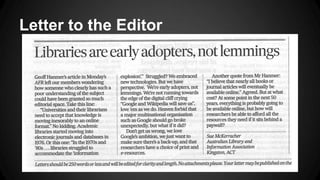
● Letters to the editor/call ins (Sound Off)
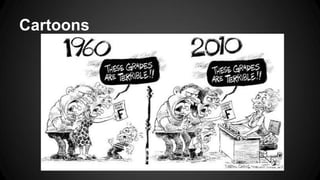
● Political cartoons
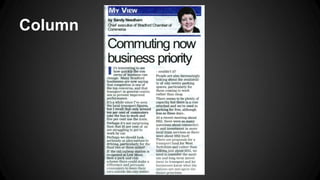
● Opinion piece(s) written by a columnist
● The paper’s editorial stance on a topic
Letter to the Editor
Cartoons
Column
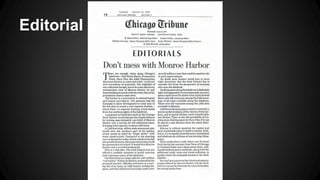
Editorial
Editorial v. Column
● An editorial and an opinion piece are similar forms of
writing.
● An editorial serves as the official view of the paper and
reflects the majority vote of the editorial board, the
governing body of the paper made up of editors and
business managers. They are usually unsigned and use
what is called the “editorial we.”
Editorial v. Column
● Opinion pieces are very much like an editorial but are
often written by a columnist, either someone locally, or
through syndication, such as Ariana Huffington. They
generally run about 800-1,000 words and writers are
paid for their work.
● Sometimes, an opinion piece is submitted by a member
of the community who is an “expert” on the topic he or
she is writing about.
Editorial v. Column
● Opinion pieces should not be confused with
a letter to the editor, even though both
express an opinion. Letters to the editor are
short and the writer does not get paid for
them.
Five Types of Editorials
An editorial is a writing style that expresses an
opinion or reaction to news, an event or issue
of concern. Most editorials are used to
influence readers to think or act in the same
way the writer does.
Five Types of Editorials
1. Explain, inform or interpret: Editors often use editorials to
explain the way the newspaper covered a sensitive or
controversial subject. They can provide background
information or identify issues. School newspapers may
explain new school rules or a particular student-body effort
like a food drive.
2. Criticize: These editorials constructively criticize actions,
decisions or situations while providing solutions to the
problem identified. Immediate purpose is to get readers to
see the problem, not the solution.
Five Types of Editorials
3. Persuade: Editorials of persuasion aim to immediately see the
solution, not the problem. From the first paragraph, readers will
be encouraged to take a specific, positive action. Political
endorsements are good examples of editorials of persuasion.
4. Praise or tribute: These editorials commend people and
organizations for something done well.
5. Entertainment: These have two categories. One is the short
humorous treatment of a light subject. The second is a slightly
satirical treatment of a serious subject.
Structure of an Editorial
○ Introduction – state the problem
■ Lead with an objective explanation of the issue or
controversy – the five Ws and the H.
■ Pull in facts and quotations from sources that are
relevant.
Structure of an Editorial
○ Body – expresses an opinion
■ Present your opposition first. As the writer, you
disagree with these viewpoints. Identify the
people who oppose you.
■ Use facts and quotations to state objectively their
opinions. Give a strong position of the opposition.
You gain nothing by refuting a weak position.
■ Directly refute the opposition’s belief. You can
begin your piece with a transition.
Structure of an Editorial
○ Conclusion – emphasizes the main issue
■ A quotation can be effective, especially from a
respected source. A rhetorical question can also
be effective. (i.e. If Congress doesn’t defend the
interests of children, who will?)
Class Discussion
● Topic: School Uniforms in Public Schools
o Take a class vote to determine stance
o Take some time to research the topic online
 What does the opposition say?
 Background
o What’s our focus?
o Some main points we would argue?

Editorial Writing

  • 1.
  • 2.
    Editorial Page Opinions havetheir place in news on the editorial/opinions page, which generally contains: ● Letters to the editor/call ins (Sound Off) ● Political cartoons ● Opinion piece(s) written by a columnist ● The paper’s editorial stance on a topic
  • 3.
  • 4.
  • 5.
  • 6.
  • 7.
    Editorial v. Column ●An editorial and an opinion piece are similar forms of writing. ● An editorial serves as the official view of the paper and reflects the majority vote of the editorial board, the governing body of the paper made up of editors and business managers. They are usually unsigned and use what is called the “editorial we.”
  • 8.
    Editorial v. Column ●Opinion pieces are very much like an editorial but are often written by a columnist, either someone locally, or through syndication, such as Ariana Huffington. They generally run about 800-1,000 words and writers are paid for their work. ● Sometimes, an opinion piece is submitted by a member of the community who is an “expert” on the topic he or she is writing about.
  • 9.
    Editorial v. Column ●Opinion pieces should not be confused with a letter to the editor, even though both express an opinion. Letters to the editor are short and the writer does not get paid for them.
  • 10.
    Five Types ofEditorials An editorial is a writing style that expresses an opinion or reaction to news, an event or issue of concern. Most editorials are used to influence readers to think or act in the same way the writer does.
  • 11.
    Five Types ofEditorials 1. Explain, inform or interpret: Editors often use editorials to explain the way the newspaper covered a sensitive or controversial subject. They can provide background information or identify issues. School newspapers may explain new school rules or a particular student-body effort like a food drive. 2. Criticize: These editorials constructively criticize actions, decisions or situations while providing solutions to the problem identified. Immediate purpose is to get readers to see the problem, not the solution.
  • 12.
    Five Types ofEditorials 3. Persuade: Editorials of persuasion aim to immediately see the solution, not the problem. From the first paragraph, readers will be encouraged to take a specific, positive action. Political endorsements are good examples of editorials of persuasion. 4. Praise or tribute: These editorials commend people and organizations for something done well. 5. Entertainment: These have two categories. One is the short humorous treatment of a light subject. The second is a slightly satirical treatment of a serious subject.
  • 13.
    Structure of anEditorial ○ Introduction – state the problem ■ Lead with an objective explanation of the issue or controversy – the five Ws and the H. ■ Pull in facts and quotations from sources that are relevant.
  • 14.
    Structure of anEditorial ○ Body – expresses an opinion ■ Present your opposition first. As the writer, you disagree with these viewpoints. Identify the people who oppose you. ■ Use facts and quotations to state objectively their opinions. Give a strong position of the opposition. You gain nothing by refuting a weak position. ■ Directly refute the opposition’s belief. You can begin your piece with a transition.
  • 15.
    Structure of anEditorial ○ Conclusion – emphasizes the main issue ■ A quotation can be effective, especially from a respected source. A rhetorical question can also be effective. (i.e. If Congress doesn’t defend the interests of children, who will?)
  • 16.
    Class Discussion ● Topic:School Uniforms in Public Schools o Take a class vote to determine stance o Take some time to research the topic online  What does the opposition say?  Background o What’s our focus? o Some main points we would argue?