BESTPRACTICES
ETHICSINACTION
LOUISE JETT
L E T T E R T O T H E
E D I T O R
W O R K S H O P
STAND UP.
SPEAK OUT.
A Letter to the Editor (LTE) is a written way
to communication with a newspaper,
magazine or other publication. It is a great
way to share your opinions and hopefully
shape local or national view and policies.
Newspapers are content hungry beasts,
and they actually appreciate LTEs, which
are among the most widely read features
they publish. But, you're never guaranteed
publication.
You can greatly improve your chances of
catching an editor's eye by implementing
some best practices.
WHYWRITEALETTER
TOTHEEDITOR?
Writers are more likely to be White, male, older, more
politically active, and less likely to be politically
moderate than the local population. Inequality in
political participation persists in this forum. Gender
and sense of local political efficacy influence how letter
writers make their points. Letters to the editor mostly
display inequalities similar to other forms of political
participation.
“SINCE THIS IS THE EDITORIAL SECTION I
INTEND TO EXPRESS MY OPINION: ” INEQUALITY
AND EXPRESSIVITY IN LETTERS TO THE EDITOR
– ANDREW J. PERRIN
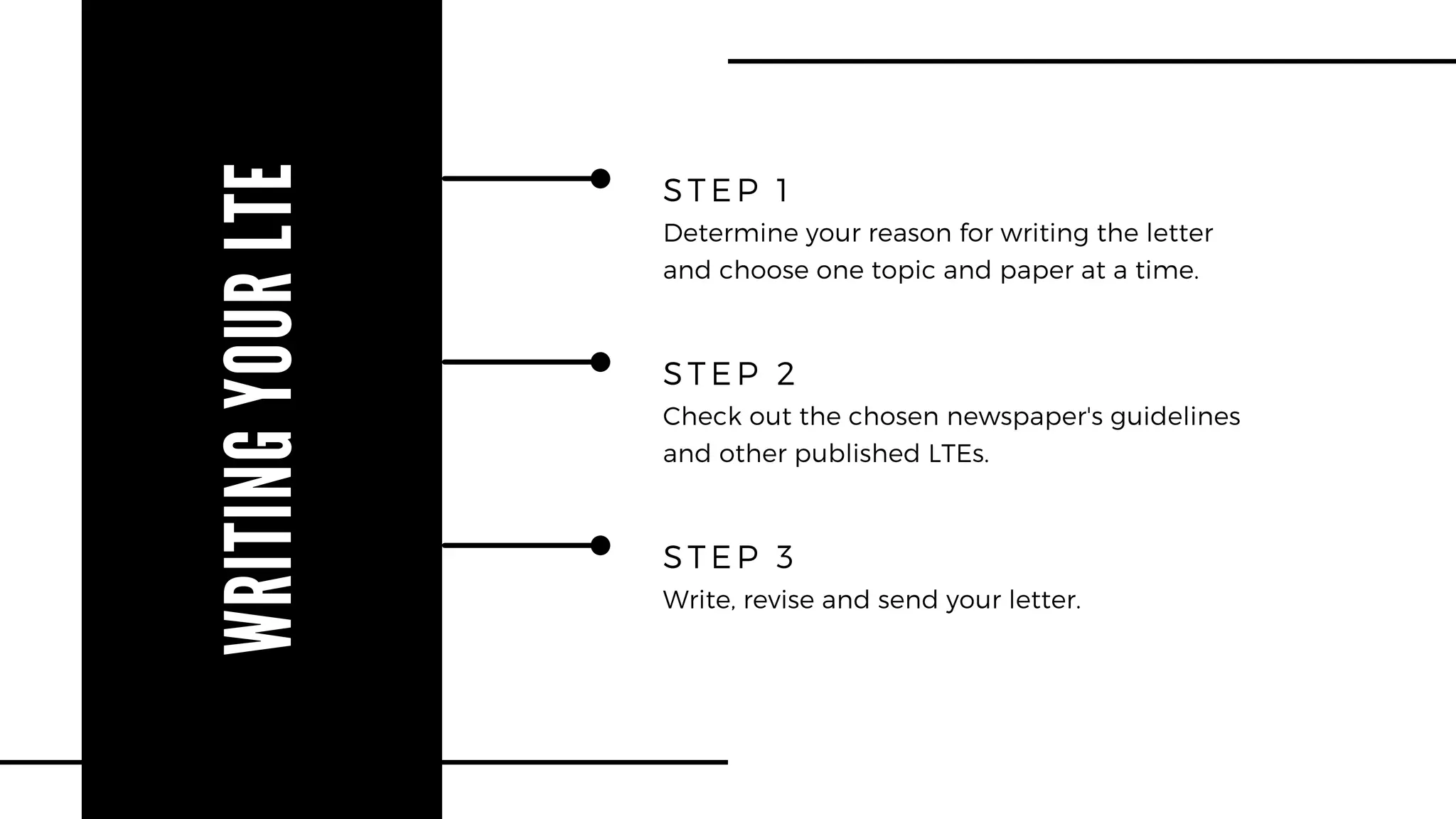
WRITINGYOURLTE
STEP 1
Determine your reason for writing the letter
and choose one topic and paper at a time.
STEP 2
Check out the chosen newspaper's guidelines
and other published LTEs.
STEP 3
Write, revise and send your letter.
What you do makes a
difference and you have to
decide what kind of
difference you want to make.
– JANE GOODALL
Choosing a Topic
and Purpose
YOU CAN MAKE A DIFFERENCE.
RESPOND TO AN
ARTICLE OR OTHER
LTE IN THE PAPER
The best letters are
those that are in
response to an article
or other LTE that ran in
the paper and many
papers require that
you reference the
specific article/LTE.
SHARE YOUR
EXPERTISE
If you have relevant
qualifications to the
topic you're
addressing be sure to
include that in your
letter.
LISTEN TO YOUR
HEART
Stand up for your
values and beliefs.
What change do you
want to see in your
community and the
world?
REFUTE, ADVOCATE,
AND MAKE A CALL
TO ACTION
Respond to a
community event or
local issue or localize
national news by
sharing your opinions
and experiences, as
well as suggestions.
CHOOSINGTHEPAPER(S)
RESEARCH & READ.
Find your chosen publication's Letters to the Editor
submission email on their website.
Be sure to check that you are obeying your
newspaper's word limit, sometimes as low as 150-
200 words!
Don't forget to check out other published LTEs in
the specific publication you choose. What do they all
have in common? Use what you learn when crafting
your letter.
Check out bit.ly/FindNewspapersforLTEs.
The site lists newspaper websites by state. You can
find a list of Missouri newspapers at bit.ly/MOLTE.
You can submit a LTE to the St. Louis American at
bit.ly/STLA-LTE.
Writing Your Letter
INCLUDE YOUR SOLUTION.
OPEN WITH AN EASY
SALUTATION
A simple "To the Editor
of the Daily Sun," or just
“To the Editor:” is
sufficient. If you have
the editor's name,
however, you should
use it to increase the
possibilities of your
letter being read.
Include your name,
phone number and/or
e-mail address at the
very top of the letter.
GRAB & KEEP THE
READER'S ATTENTION
Your opening sentence is
very important. It should
tell readers what you’re
writing about and make
them want to read more.
Share your key point at
the beginning and
include your opinion.
Criticize facts, not people.
Explain why the issue is
important, give evidence,
and state what you think
should be done.
READ/REVISE/SEND
YOUR LETTER
Read your letter out
loud. This is a great way
to catch errors and typos.
Be sure that your letter is
factually correct.
Stay focused on one
topic. Have you
mentioned your
applicable credentials?
Newspapers prefer
emailed LTEs.
KEEP IT BRIEF &
SIGN THE LETTER
Shorter letters have a
better chance of being
published. LTEs should
be 300 words or less.
Throughout your letter,
remember the rules:
• Be quick,
• Be concise, and then
• Wrap it up.
Conclude your LTE
with a call to action,
and sign the letter.
BESTPRACTICES
Proofread your letter.
Edit your writing to make it more lively and vivid.
Include necessary context, use of claims and evidence, while
establishing your voice, opinions and values.
Be mindful of the tone of your letter. Be kind.
Challenge facts and behaviors (votes). Don’t insult your opponents.
Define your audience and purpose. Stay focused.
Make references to the specific newspaper.
Keep it short and heartfelt. Pack some punch.
Write about timely topics. Write in active voice and 1st person.
Use a personal story or illustration.
Name names in your letter. Refer to the legislator or corporation
you are trying to influence by name.
Ask readers to follow-up, such as joining in calling on
policymakers to address the issue.
Know that your letter may be edited for length.
Be persistent. It may take many attempts before you have a
letter published.
Re-purpose your letter for other publications.
LTE Template
Your Name
Your Email
Newspaper Name
Date
Dear Editor,
The opening line should reference the article you are referencing (i.e., With respect to the article “titled like this,”), and then state your position.
The rest of the paragraph should summarize your issue of concern in a way that captures the attention of the reader. This is your opportunity to
tie your issue to a recently discussed topic, take a stance on a debated topic, or correct an error or misrepresentation you felt was portrayed in
an article.
Explain your ties to the issue. In other words, why are you speaking out about the subject? The subsequent paragraphs should further explain
your issue and why people should care about it. If you have data or statistics to bolster your argument, this is a good place to use them.
Follow your explanation with a call to action. What is at stake if no action is taken? What will happen if people respond with action? Make the
consequences of each very clear, and try, when possible, to inform the reader about the direct impact of taking or not taking action.
In your concluding paragraph, recap your point, reiterate your call to action, and include specific information on how readers can get involved.
Sincerely,
Your Name
Organization or Applicable Credentials
Template from Media Matters: The Complete Guide to Getting Positive Media Attention, on the
Advocacy & Communication Solutions, LLC, website. Review the full guide at http://bit.ly/2aHvZDm.
EXAMPLES
Recent LTEs worth sharing.
In freedom and justice, we should trust – www.wvnews.com/theet/opinion/letterstoeditor/in-
freedom-and-justice-we-should-trust/article_ae78fb55-db99-5505-ac12-ab8ecd5b147c.html
Aileen Clark: Not everyone follows the Bible – www.wctrib.com/opinion/letters/3977555-Aileen-
Clark-Not-everyone-follows-the-Bible
The U.S. Constitution is specifically and intentionally a secular document –
www.cleveland.com/letters/2019/07/the-us-constitution-is-specifically-and-intentionally-a-
secular-document-letter-to-the-editor.html
Views on gun ownership and abortion bans affecting religious freedom –
www.jacksonville.com/opinion/20190606/thursday-letters-views-on-gun-ownership-and-abortion-
bans-affecting-religious-freedom
Keep church and state separate – www.citizensvoice.com/opinion/keep-church-and-state-
separate-1.2490395
GOP ignores separation of church and state – www.tuscaloosanews.com/news/20190527/letter-gop-
ignores-separation-of-church-and-state
Within guidelines, students are allowed to pray in school –
www.stltoday.com/opinion/mailbag/within-guidelines-students-are-allowed-to-pray-in-
school/article_3f91168c-60b0-5cd5-ae24-3da01a6ff433.html
Legislation violates church and state separation – www.stltoday.com/opinion/mailbag/legislation-
violates-church-and-state-separation/article_101e7932-a23d-5ce4-8124-9e248cad1887.html
‘In God We Trust’ should have no place in our schools – www.stltoday.com/opinion/mailbag/in-god-
we-trust-should-have-no-place-in-our/article_e7aa7896-97ba-58f4-8eaa-cbc5a96a2987.html
RESOURCES
Louise Jett - ljett@ethicalstl.org
Thank you!
LTE Templates - www.doctemplates.net/letter-to-the-editor-templates
10 Tips - ncse.com/library-resource/ten-tips-writing-letter-to-editor
Writing an Effective Letter - www.ucsusa.org/action/writing-an-lte.html
Tool Box - ctb.ku.edu/en/table-of-contents/advocacy/direct-action/letters-to-editor/main
ACLU Tips - www.aclu.org/other/tips-writing-letter-editor
Sample Letters - www.nea.org/grants/sample-letters-to-the-editor.html
St. Louis Post Dispatch Letters - www.stltoday.com/opinion/mailbag
St. Louis Post Dispatch How-To - www.stltoday.com/opinion/columnists/how-to-write-a-letter-to-
the-editor/article_22c547ec-4cca-11df-b22d-0017a4a78c22.html
St. Louis American Letters - www.stlamerican.com/reader_interaction/letters_to_the_editor/

Letter to Editor Workshop

  • 1.
    BESTPRACTICES ETHICSINACTION LOUISE JETT L ET T E R T O T H E E D I T O R W O R K S H O P
  • 2.
    STAND UP. SPEAK OUT. ALetter to the Editor (LTE) is a written way to communication with a newspaper, magazine or other publication. It is a great way to share your opinions and hopefully shape local or national view and policies. Newspapers are content hungry beasts, and they actually appreciate LTEs, which are among the most widely read features they publish. But, you're never guaranteed publication. You can greatly improve your chances of catching an editor's eye by implementing some best practices. WHYWRITEALETTER TOTHEEDITOR?
  • 3.
    Writers are morelikely to be White, male, older, more politically active, and less likely to be politically moderate than the local population. Inequality in political participation persists in this forum. Gender and sense of local political efficacy influence how letter writers make their points. Letters to the editor mostly display inequalities similar to other forms of political participation. “SINCE THIS IS THE EDITORIAL SECTION I INTEND TO EXPRESS MY OPINION: ” INEQUALITY AND EXPRESSIVITY IN LETTERS TO THE EDITOR – ANDREW J. PERRIN
  • 4.
    WRITINGYOURLTE STEP 1 Determine yourreason for writing the letter and choose one topic and paper at a time. STEP 2 Check out the chosen newspaper's guidelines and other published LTEs. STEP 3 Write, revise and send your letter.
  • 5.
    What you domakes a difference and you have to decide what kind of difference you want to make. – JANE GOODALL
  • 6.
    Choosing a Topic andPurpose YOU CAN MAKE A DIFFERENCE. RESPOND TO AN ARTICLE OR OTHER LTE IN THE PAPER The best letters are those that are in response to an article or other LTE that ran in the paper and many papers require that you reference the specific article/LTE. SHARE YOUR EXPERTISE If you have relevant qualifications to the topic you're addressing be sure to include that in your letter. LISTEN TO YOUR HEART Stand up for your values and beliefs. What change do you want to see in your community and the world? REFUTE, ADVOCATE, AND MAKE A CALL TO ACTION Respond to a community event or local issue or localize national news by sharing your opinions and experiences, as well as suggestions.
  • 7.
    CHOOSINGTHEPAPER(S) RESEARCH & READ. Findyour chosen publication's Letters to the Editor submission email on their website. Be sure to check that you are obeying your newspaper's word limit, sometimes as low as 150- 200 words! Don't forget to check out other published LTEs in the specific publication you choose. What do they all have in common? Use what you learn when crafting your letter. Check out bit.ly/FindNewspapersforLTEs. The site lists newspaper websites by state. You can find a list of Missouri newspapers at bit.ly/MOLTE. You can submit a LTE to the St. Louis American at bit.ly/STLA-LTE.
  • 8.
    Writing Your Letter INCLUDEYOUR SOLUTION. OPEN WITH AN EASY SALUTATION A simple "To the Editor of the Daily Sun," or just “To the Editor:” is sufficient. If you have the editor's name, however, you should use it to increase the possibilities of your letter being read. Include your name, phone number and/or e-mail address at the very top of the letter. GRAB & KEEP THE READER'S ATTENTION Your opening sentence is very important. It should tell readers what you’re writing about and make them want to read more. Share your key point at the beginning and include your opinion. Criticize facts, not people. Explain why the issue is important, give evidence, and state what you think should be done. READ/REVISE/SEND YOUR LETTER Read your letter out loud. This is a great way to catch errors and typos. Be sure that your letter is factually correct. Stay focused on one topic. Have you mentioned your applicable credentials? Newspapers prefer emailed LTEs. KEEP IT BRIEF & SIGN THE LETTER Shorter letters have a better chance of being published. LTEs should be 300 words or less. Throughout your letter, remember the rules: • Be quick, • Be concise, and then • Wrap it up. Conclude your LTE with a call to action, and sign the letter.
  • 9.
    BESTPRACTICES Proofread your letter. Edityour writing to make it more lively and vivid. Include necessary context, use of claims and evidence, while establishing your voice, opinions and values. Be mindful of the tone of your letter. Be kind. Challenge facts and behaviors (votes). Don’t insult your opponents. Define your audience and purpose. Stay focused. Make references to the specific newspaper. Keep it short and heartfelt. Pack some punch. Write about timely topics. Write in active voice and 1st person. Use a personal story or illustration. Name names in your letter. Refer to the legislator or corporation you are trying to influence by name. Ask readers to follow-up, such as joining in calling on policymakers to address the issue. Know that your letter may be edited for length. Be persistent. It may take many attempts before you have a letter published. Re-purpose your letter for other publications.
  • 10.
    LTE Template Your Name YourEmail Newspaper Name Date Dear Editor, The opening line should reference the article you are referencing (i.e., With respect to the article “titled like this,”), and then state your position. The rest of the paragraph should summarize your issue of concern in a way that captures the attention of the reader. This is your opportunity to tie your issue to a recently discussed topic, take a stance on a debated topic, or correct an error or misrepresentation you felt was portrayed in an article. Explain your ties to the issue. In other words, why are you speaking out about the subject? The subsequent paragraphs should further explain your issue and why people should care about it. If you have data or statistics to bolster your argument, this is a good place to use them. Follow your explanation with a call to action. What is at stake if no action is taken? What will happen if people respond with action? Make the consequences of each very clear, and try, when possible, to inform the reader about the direct impact of taking or not taking action. In your concluding paragraph, recap your point, reiterate your call to action, and include specific information on how readers can get involved. Sincerely, Your Name Organization or Applicable Credentials Template from Media Matters: The Complete Guide to Getting Positive Media Attention, on the Advocacy & Communication Solutions, LLC, website. Review the full guide at http://bit.ly/2aHvZDm.
  • 11.
    EXAMPLES Recent LTEs worthsharing. In freedom and justice, we should trust – www.wvnews.com/theet/opinion/letterstoeditor/in- freedom-and-justice-we-should-trust/article_ae78fb55-db99-5505-ac12-ab8ecd5b147c.html Aileen Clark: Not everyone follows the Bible – www.wctrib.com/opinion/letters/3977555-Aileen- Clark-Not-everyone-follows-the-Bible The U.S. Constitution is specifically and intentionally a secular document – www.cleveland.com/letters/2019/07/the-us-constitution-is-specifically-and-intentionally-a- secular-document-letter-to-the-editor.html Views on gun ownership and abortion bans affecting religious freedom – www.jacksonville.com/opinion/20190606/thursday-letters-views-on-gun-ownership-and-abortion- bans-affecting-religious-freedom Keep church and state separate – www.citizensvoice.com/opinion/keep-church-and-state- separate-1.2490395 GOP ignores separation of church and state – www.tuscaloosanews.com/news/20190527/letter-gop- ignores-separation-of-church-and-state Within guidelines, students are allowed to pray in school – www.stltoday.com/opinion/mailbag/within-guidelines-students-are-allowed-to-pray-in- school/article_3f91168c-60b0-5cd5-ae24-3da01a6ff433.html Legislation violates church and state separation – www.stltoday.com/opinion/mailbag/legislation- violates-church-and-state-separation/article_101e7932-a23d-5ce4-8124-9e248cad1887.html ‘In God We Trust’ should have no place in our schools – www.stltoday.com/opinion/mailbag/in-god- we-trust-should-have-no-place-in-our/article_e7aa7896-97ba-58f4-8eaa-cbc5a96a2987.html
  • 12.
    RESOURCES Louise Jett -ljett@ethicalstl.org Thank you! LTE Templates - www.doctemplates.net/letter-to-the-editor-templates 10 Tips - ncse.com/library-resource/ten-tips-writing-letter-to-editor Writing an Effective Letter - www.ucsusa.org/action/writing-an-lte.html Tool Box - ctb.ku.edu/en/table-of-contents/advocacy/direct-action/letters-to-editor/main ACLU Tips - www.aclu.org/other/tips-writing-letter-editor Sample Letters - www.nea.org/grants/sample-letters-to-the-editor.html St. Louis Post Dispatch Letters - www.stltoday.com/opinion/mailbag St. Louis Post Dispatch How-To - www.stltoday.com/opinion/columnists/how-to-write-a-letter-to- the-editor/article_22c547ec-4cca-11df-b22d-0017a4a78c22.html St. Louis American Letters - www.stlamerican.com/reader_interaction/letters_to_the_editor/