Editorial Writing
• Writing an Editorial.
An editorial is an article
that presents the
newspaper's opinion on an
issue. It reflects the
majority vote of
the editorial board, the
governing body of the
newspaper made up of
editors and business
managers.
Types of Editorial
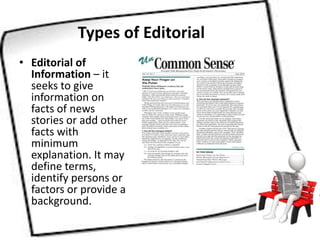
• Editorial of
Information – it
seeks to give
information on
facts of news
stories or add other
facts with
minimum
explanation. It may
define terms,
identify persons or
factors or provide a
background.
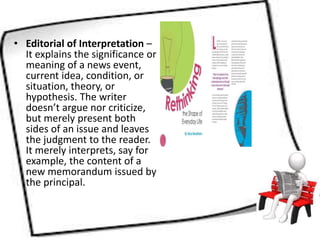
• Editorial of Interpretation –
It explains the significance or
meaning of a news event,
current idea, condition, or
situation, theory, or
hypothesis. The writer
doesn’t argue nor criticize,
but merely present both
sides of an issue and leaves
the judgment to the reader.
It merely interprets, say for
example, the content of a
new memorandum issued by
the principal.
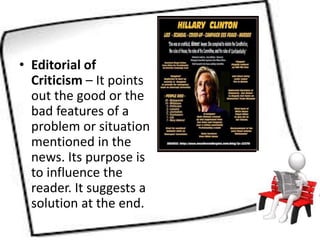
• Editorial of
Criticism – It points
out the good or the
bad features of a
problem or situation
mentioned in the
news. Its purpose is
to influence the
reader. It suggests a
solution at the end.
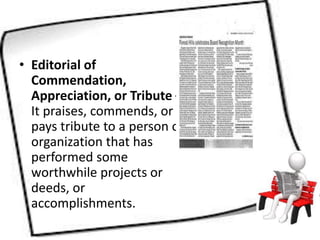
• Editorial of
Commendation,
Appreciation, or Tribute –
It praises, commends, or
pays tribute to a person or
organization that has
performed some
worthwhile projects or
deeds, or
accomplishments.
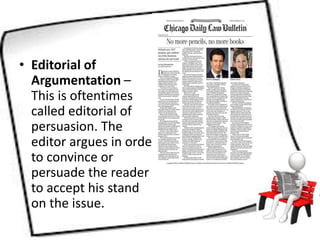
• Editorial of
Argumentation –
This is oftentimes
called editorial of
persuasion. The
editor argues in order
to convince or
persuade the reader
to accept his stand
on the issue.
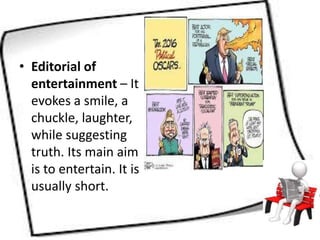
• Editorial of
entertainment – It
evokes a smile, a
chuckle, laughter,
while suggesting
truth. Its main aim
is to entertain. It is
usually short.
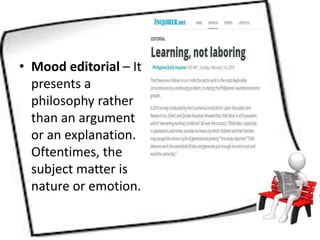
• Mood editorial – It
presents a
philosophy rather
than an argument
or an explanation.
Oftentimes, the
subject matter is
nature or emotion.
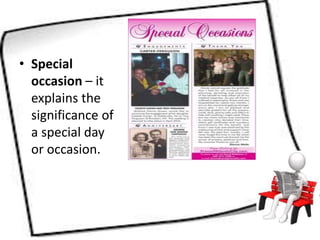
• Special
occasion – it
explains the
significance of
a special day
or occasion.
Editorial writing

Editorial writing

  • 1.
  • 2.
    • Writing anEditorial. An editorial is an article that presents the newspaper's opinion on an issue. It reflects the majority vote of the editorial board, the governing body of the newspaper made up of editors and business managers.
  • 3.
    Types of Editorial •Editorial of Information – it seeks to give information on facts of news stories or add other facts with minimum explanation. It may define terms, identify persons or factors or provide a background.
  • 4.
    • Editorial ofInterpretation – It explains the significance or meaning of a news event, current idea, condition, or situation, theory, or hypothesis. The writer doesn’t argue nor criticize, but merely present both sides of an issue and leaves the judgment to the reader. It merely interprets, say for example, the content of a new memorandum issued by the principal.
  • 5.
    • Editorial of Criticism– It points out the good or the bad features of a problem or situation mentioned in the news. Its purpose is to influence the reader. It suggests a solution at the end.
  • 6.
    • Editorial of Commendation, Appreciation,or Tribute – It praises, commends, or pays tribute to a person or organization that has performed some worthwhile projects or deeds, or accomplishments.
  • 7.
    • Editorial of Argumentation– This is oftentimes called editorial of persuasion. The editor argues in order to convince or persuade the reader to accept his stand on the issue.
  • 8.
    • Editorial of entertainment– It evokes a smile, a chuckle, laughter, while suggesting truth. Its main aim is to entertain. It is usually short.
  • 9.
    • Mood editorial– It presents a philosophy rather than an argument or an explanation. Oftentimes, the subject matter is nature or emotion.
  • 10.
    • Special occasion –it explains the significance of a special day or occasion.