Government &
Statistical Stories
Computer-assisted reporting
● We complain that the government collects too much information on
us but we find also it all useful.
● Data online can be a bit outdated because there is a lag between
when the government collects the information and when it is made
available. But, the data that is available can be used for
comparative studies and background information.
● Every year, more government data are being posted online, but
state or local government may not be available online. You may
have to ask for it.
o Even if you have a legal right to the data, use the Freedom of
Information Act as a last resort because it can be time-consuming.
Visuals
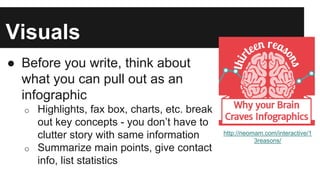
● Before you write, think about
what you can pull out as an
infographic
o Highlights, fax box, charts, etc. break
out key concepts - you don’t have to
clutter story with same information
o Summarize main points, give contact
info, list statistics
http://neomam.com/interactive/1
3reasons/
Example
Chicago 2012 Budget
Government stories
● Usually hard to write BUT they need
to be easy to read
● Huge numbers and complicated
processes cause a disconnect
● Lots of news comes from press
releases but don’t rely on it - dig
up info yourself
Reporting tips
● Human interest - who is affected?
o Right now, the state government of Illinois does not
have a budget. Think of all the people impacted.
• Students: K-College
• State Workers
• Health Services Beneficiaries
• Illinois State Museum Employees
• Police Officers
• Illinois Lottery Players
• People with Disabilities
• Everyone in Illinois
Reporting tips
● Follow the money –
o Who is – and isn’t – getting the contracts?
o How much are salaries? Are they going up?
o What are the costs of some projects? Could
they be done cheaper?
o Are there consultants who keep studying the
same issues repeatedly?
o What do the audits state? They can reveal
misuse of public funds.
Reporting tips
● Unions are still strong in some parts of
the country; school and city unions can
be good sources of what’s going on –
also how some state officials are trying
to undermine them.
● Non-officials – talk to those who do
the work. Spend time learning what
people do, how and why they do it
Reporting tips
● The system – learn how it works.
o If you don’t know how government
operates, you don’t know if it’s
working properly. But there often
is a behind-the-scenes system – who is
the real power behind the throne?
Writing Tips
● Start with same principles as
other stories:
o Subject - verb - object
o Active voice
o Interesting pace, etc.
● Try to break down complex info
into simple sentences.
● Avoid sentences starting with “there.”
Writing Tips
● Interpret info and numbers for readers -
focus on impact
o Explain in layman’s terms
● Have a human interest angle
● Use an impact lead
● Utilize lists if relevant
● Read aloud when editing
Budget stories
● Long process - budget planning
starts several months before
anything is approved;
requires a public hearing
● Ask financial officer to go over
the budget with you.
o Keep asking questions until you
understand, it or have the person
help you word it so it’s accurate.
o Accuracy and truth is you’re main priority.
Understanding budgets
● Basically two sections
o Revenue (income or “received”)
 Property taxes, income
taxes, sales taxes and fees
o Expenditures (“expenses”)
 Salaries and operating
costs, spending, etc.
Understanding budgets
Terms
o Assessment (estimated value) & property taxes –
Determined by city appraiser and based on factors such as size
of property, number of bedrooms, construction and so on.
o Capital budget – money used to pay for major
improvements such as highway construction.
Often raised by selling bonds and those
who buy them get interest back when the
city repays them.
Understanding budgets
● Terms continued...
o Deficit – when government spends more than it receives
o Fiscal year – year in which budgeted funds must be
spent. Often begins July 1 – June 30 but the Federal govt.
fiscal year is Oct. 1 – Sept. 30.
o Operating budget – money used to pay for operation of
government – mostly comes from taxes
o Per capita – the rate per person
Writing budget stories
● Impact is crucial in budget stories
● Graphics make a story more
presentable and easier to read.
● Get a reaction from city officials or, for
campus stories, from administrators,
students, professors and officials
whose departments will be affected
most.
Writing budget stories
● Key points to include
o Total amount of budget – rounded off if possible
o Historical comparisons – amount of increase or
decrease from the last fiscal year
o Tax or tuition levy: how funds will be raised –
impact on reader, comparison to current tax
o Major expenditures – major increases and
decreases in department funds
o Consequences – impact on govt. or agency -
cuts in personnel, services
o Reactions from officials and people affected by
increases or decreases
o Definitions and explanations of technical terms
Examples
● Budget story
http://www.latimes.com/local/lanow/la-me-ln-
county-budget-20150413-story.html
● Budget infographic
http://juneauempire.com/state/2015-02-
13/infographic-billion-blocks
Statistical stories
● Don’t flood story with stats and
overwhelm or bore the reader
● Don’t just throw them out there,
analyze what they mean
● Put numbers into perspective
o Explain change (up or down)
o State significance
Writing about numbers
● Use analogies
● Round off numbers –
$3.5 million, not $3,499,590
● Spread over several
paragraphs
● Interpret
● Use storytelling techniques
● Use graphics
Examples
● Story http://www.wfmj.com/story/28707910/more-
people-dying-of-heart-disease-stroke-worldwide
● Infographic
http://www.nhlbi.nih.gov/health/educational/hearttruth/im
ages/infographic-large-4.jpg

Government & Statistical Stories

  • 1.
  • 2.
    Computer-assisted reporting ● Wecomplain that the government collects too much information on us but we find also it all useful. ● Data online can be a bit outdated because there is a lag between when the government collects the information and when it is made available. But, the data that is available can be used for comparative studies and background information. ● Every year, more government data are being posted online, but state or local government may not be available online. You may have to ask for it. o Even if you have a legal right to the data, use the Freedom of Information Act as a last resort because it can be time-consuming.
  • 3.
    Visuals ● Before youwrite, think about what you can pull out as an infographic o Highlights, fax box, charts, etc. break out key concepts - you don’t have to clutter story with same information o Summarize main points, give contact info, list statistics http://neomam.com/interactive/1 3reasons/
  • 4.
  • 5.
    Government stories ● Usuallyhard to write BUT they need to be easy to read ● Huge numbers and complicated processes cause a disconnect ● Lots of news comes from press releases but don’t rely on it - dig up info yourself
  • 6.
    Reporting tips ● Humaninterest - who is affected? o Right now, the state government of Illinois does not have a budget. Think of all the people impacted. • Students: K-College • State Workers • Health Services Beneficiaries • Illinois State Museum Employees • Police Officers • Illinois Lottery Players • People with Disabilities • Everyone in Illinois
  • 7.
    Reporting tips ● Followthe money – o Who is – and isn’t – getting the contracts? o How much are salaries? Are they going up? o What are the costs of some projects? Could they be done cheaper? o Are there consultants who keep studying the same issues repeatedly? o What do the audits state? They can reveal misuse of public funds.
  • 8.
    Reporting tips ● Unionsare still strong in some parts of the country; school and city unions can be good sources of what’s going on – also how some state officials are trying to undermine them. ● Non-officials – talk to those who do the work. Spend time learning what people do, how and why they do it
  • 9.
    Reporting tips ● Thesystem – learn how it works. o If you don’t know how government operates, you don’t know if it’s working properly. But there often is a behind-the-scenes system – who is the real power behind the throne?
  • 10.
    Writing Tips ● Startwith same principles as other stories: o Subject - verb - object o Active voice o Interesting pace, etc. ● Try to break down complex info into simple sentences. ● Avoid sentences starting with “there.”
  • 11.
    Writing Tips ● Interpretinfo and numbers for readers - focus on impact o Explain in layman’s terms ● Have a human interest angle ● Use an impact lead ● Utilize lists if relevant ● Read aloud when editing
  • 12.
    Budget stories ● Longprocess - budget planning starts several months before anything is approved; requires a public hearing ● Ask financial officer to go over the budget with you. o Keep asking questions until you understand, it or have the person help you word it so it’s accurate. o Accuracy and truth is you’re main priority.
  • 13.
    Understanding budgets ● Basicallytwo sections o Revenue (income or “received”)  Property taxes, income taxes, sales taxes and fees o Expenditures (“expenses”)  Salaries and operating costs, spending, etc.
  • 14.
    Understanding budgets Terms o Assessment(estimated value) & property taxes – Determined by city appraiser and based on factors such as size of property, number of bedrooms, construction and so on. o Capital budget – money used to pay for major improvements such as highway construction. Often raised by selling bonds and those who buy them get interest back when the city repays them.
  • 15.
    Understanding budgets ● Termscontinued... o Deficit – when government spends more than it receives o Fiscal year – year in which budgeted funds must be spent. Often begins July 1 – June 30 but the Federal govt. fiscal year is Oct. 1 – Sept. 30. o Operating budget – money used to pay for operation of government – mostly comes from taxes o Per capita – the rate per person
  • 16.
    Writing budget stories ●Impact is crucial in budget stories ● Graphics make a story more presentable and easier to read. ● Get a reaction from city officials or, for campus stories, from administrators, students, professors and officials whose departments will be affected most.
  • 17.
    Writing budget stories ●Key points to include o Total amount of budget – rounded off if possible o Historical comparisons – amount of increase or decrease from the last fiscal year o Tax or tuition levy: how funds will be raised – impact on reader, comparison to current tax o Major expenditures – major increases and decreases in department funds o Consequences – impact on govt. or agency - cuts in personnel, services o Reactions from officials and people affected by increases or decreases o Definitions and explanations of technical terms
  • 18.
    Examples ● Budget story http://www.latimes.com/local/lanow/la-me-ln- county-budget-20150413-story.html ●Budget infographic http://juneauempire.com/state/2015-02- 13/infographic-billion-blocks
  • 19.
    Statistical stories ● Don’tflood story with stats and overwhelm or bore the reader ● Don’t just throw them out there, analyze what they mean ● Put numbers into perspective o Explain change (up or down) o State significance
  • 20.
    Writing about numbers ●Use analogies ● Round off numbers – $3.5 million, not $3,499,590 ● Spread over several paragraphs ● Interpret ● Use storytelling techniques ● Use graphics
  • 21.
    Examples ● Story http://www.wfmj.com/story/28707910/more- people-dying-of-heart-disease-stroke-worldwide ●Infographic http://www.nhlbi.nih.gov/health/educational/hearttruth/im ages/infographic-large-4.jpg