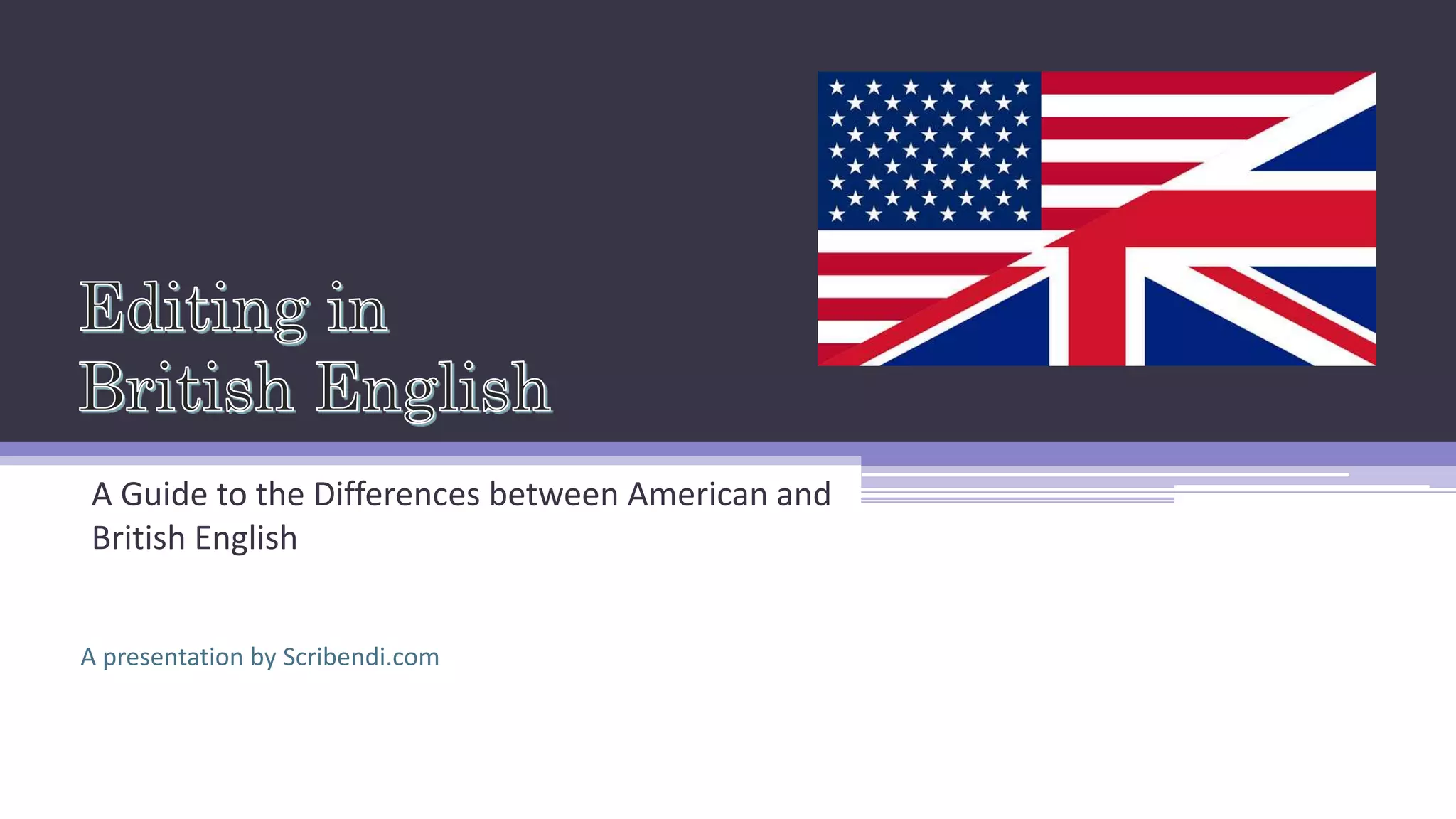
A Guide to the Differences between American and
British English
A presentation by Scribendi.com
Today, we're going to be looking at the main
differences between the two most common
varieties of English—British and American—and
what to watch out for when editing in British
English. Although the two aren't that different,
their variations in grammar—including spelling,
usage, and punctuation—are still quite significant.
By comparing British English to American English, this presentation will
list the most common things to watch out for when editing in British
English. We will cover the topic of British English grammar as a whole,
including spelling, usage, and punctuation, as well as the differences
between American and British English. By the time you're done reading
this article, you'll know exactly what to pay special attention to when
editing in British English. Chocks away!
British English is the variety of English spoken and written throughout the
United Kingdom. Although British English has regional varieties, we're
going to keep it simple here by taking a broad approach and examining
the main features of British spelling, grammar, vocabulary, usage, and
punctuation. Learning these basics will provide you with a great
knowledge base that you'll find especially helpful when writing or editing
in British English.
Let's start with the main differences between American and British
English, which include spelling, usage, and punctuation.
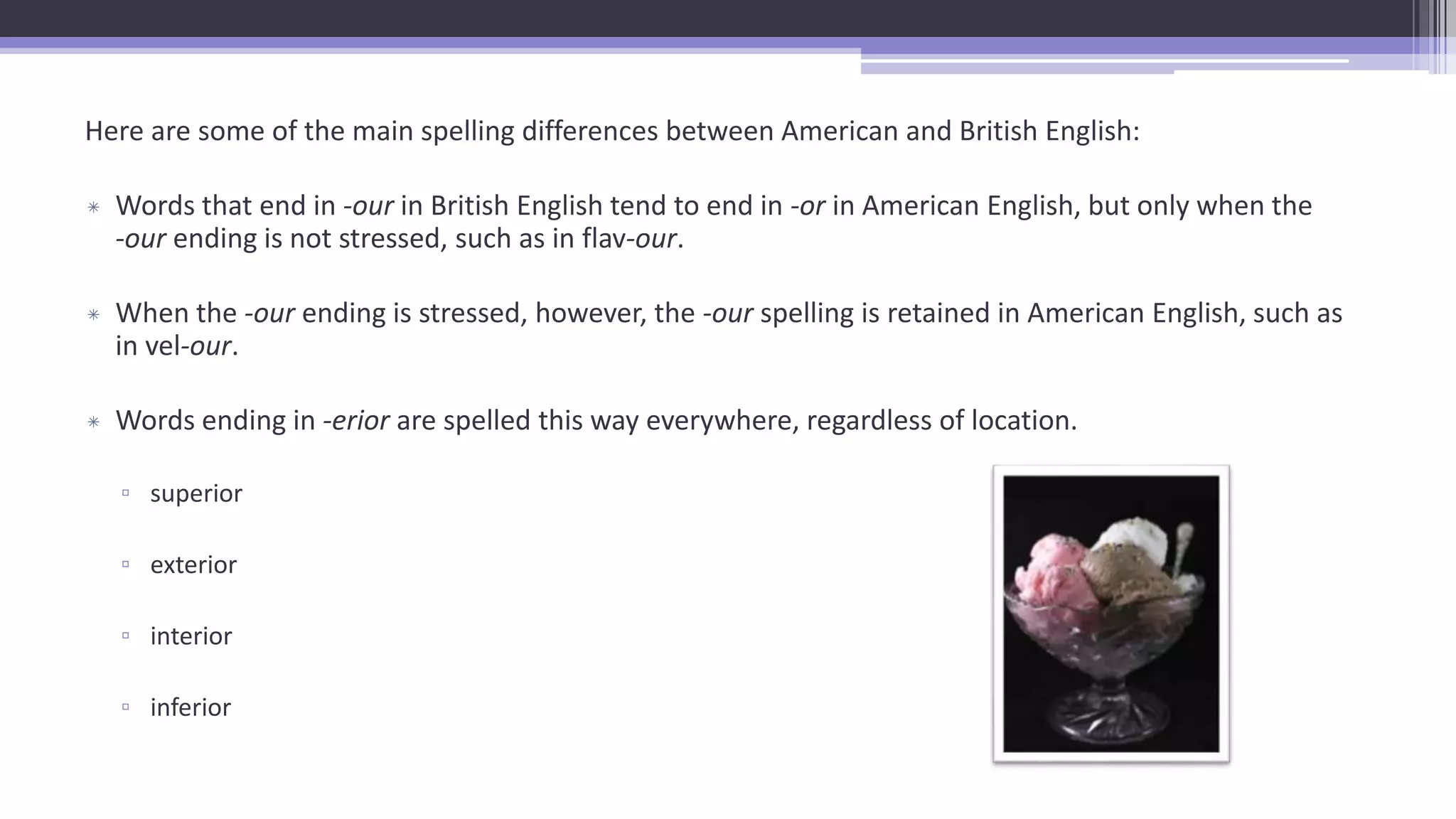
The spelling of English words has not always been standardized. With the publication of influential dictionaries
in the eighteenth and nineteenth centuries, spelling standards became increasingly common, although with
differences between countries. These variances occurred for cultural, political, and linguistic reasons, and over
the years, the differences have become more cemented (though never completely so). The primary differences
are between British and American spellings. American spelling conventions changed early on, and the variances
have persisted throughout the years.
VS.
Here are some of the main spelling differences between American and British English:
* Words that end in -our in British English tend to end in -or in American English, but only when the
-our ending is not stressed, such as in flav-our.
* When the -our ending is stressed, however, the -our spelling is retained in American English, such as
in vel-our.
* Words ending in -erior are spelled this way everywhere, regardless of location.
▫ superior
▫ exterior
▫ interior
▫ inferior
Many words in British English end in -er, especially Germanic and Romance words. However, certain
words with French, Latin, and Greek origins end in -re in British English. These -re endings are often not
used in American English (e.g., theatre in British English is spelled theater in American English). Here
are some other examples of -re endings in British English:
▫ centre
▫ metre
▫ fibre
▫ sabre
Many English words derived from Greek words end in -ize or -ise. The ending choice varies
between, and often within, countries. Great Britain uses both -ize and -ise, although the -ise
ending is more common.
For such Greek-derived words, the British usage is inconsistent. The -ise is more common, but
the Oxford University Press and the Oxford English Dictionary, for example, use the -ize. The
Cambridge University Press, on the other hand, adopts the -ise ending, and this is what is
typically used in the British mass media for words such as criticise or organise.
Some words ending in -ize/-ise are not derived from Greek, and their endings are thus not
interchangeable in British English. Examples include:
▫ size
▫ prize
▫ seize
The use of the -yze or the -yse ending varies between countries. The -yse ending is used in British
English, while the -yze ending is used in both American and Canadian English for words such as analyze.
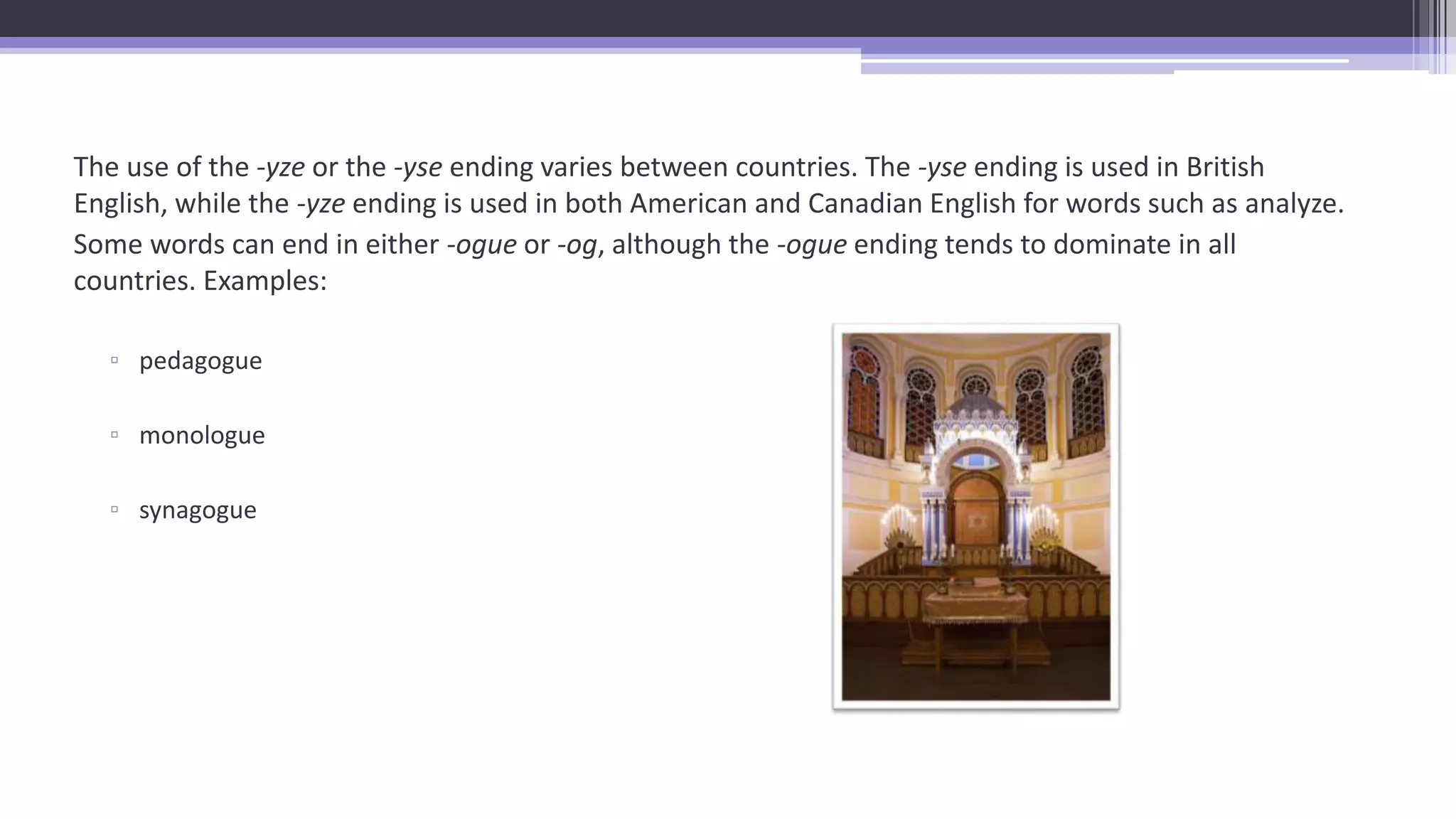
Some words can end in either -ogue or -og, although the -ogue ending tends to dominate in all
countries. Examples:
▫ pedagogue
▫ monologue
▫ synagogue
In British English (and that of most Commonwealth
countries), some words use either the ae or the oe
combination, while in American and Canadian English,
these are almost always reduced to a simple e. However,
there are certain exceptions. The word fetus, based on
etymology, should always be spelled fetus, but Britons
often adopt the oe spelling, and the word becomes
foetus. Academic journals everywhere tend to prefer the
etymologically correct spelling, fetus.
A few words always (or usually) retain the ae or oe construction, even in American English:
▫ phoenix
▫ subpoena
▫ toe
Latin -ae plural endings are not changed in any variety of English, as with the following:
▫ larvae
▫ formulae
▫ antennae
When adding a suffix that begins with a vowel, the final consonant is often doubled. This helps avoid
confusion. For example, if you have tap and do not double the consonant p when adding the suffix -ed,
you will end up with taped, which is the past tense of the verb to tape. Doubling the consonant creates
the word tapped instead.
Generally, this only occurs when the word ends with a single consonant following a single vowel and
when the final syllable is stressed. However, in British English, a final -l is often doubled to -ll, even when
the ending is unstressed. In American English, only one -l is used. Canadian English follows British usage
here, typically using the -ll.
This doubling in British English is generally true for any such words ending in -ed, -ing, -er, -est, and -or,
for example:
▫ counsellor
▫ counselling
▫ counselled
However, for words ending with -ise/-ize, -ism, -ist, and -ish, the final -l
is generally not doubled, as with the following:
▫ novelist
▫ sensualist
▫ normalise
In words with other endings, such as -ous, -ee, and -age, the usage varies, with some doubled (marvellous)
and others not (scandalous). Jewellery has -ll in British English but is spelled jewelry in American English.
Single -l endings are used if there is a double vowel.
▫ foal (oa) becomes foaling
▫ fool (oo) becomes fooling
▫ pool (oo) becomes pooling
Single -l endings are used if there is a consonant preceding the final
consonant.
▫ bowl (w before the l) becomes bowling
▫ whirl (r before the l) becomes whirling
The biggest differences between American English and British English are words with the following
combinations: -our versus -or, -re versus -er, -ize versus -ise, -yze versus -yse, -ogue versus -og, and
words with ae in American English that are spelled with oe in the British equivalent. If you're interested
in learning more about the differences between American and British English, Diffen.com is a great
resource.
Usage refers to language etiquette and how
words are commonly used (written and
spoken). It also refers to using the right
word in the right context. In terms of British
versus American English, usage is where
you'll see the most obvious distinctions.
Different words may be used for different
reasons: convention, simplicity, socio-
cultural reasons, and even aesthetics.
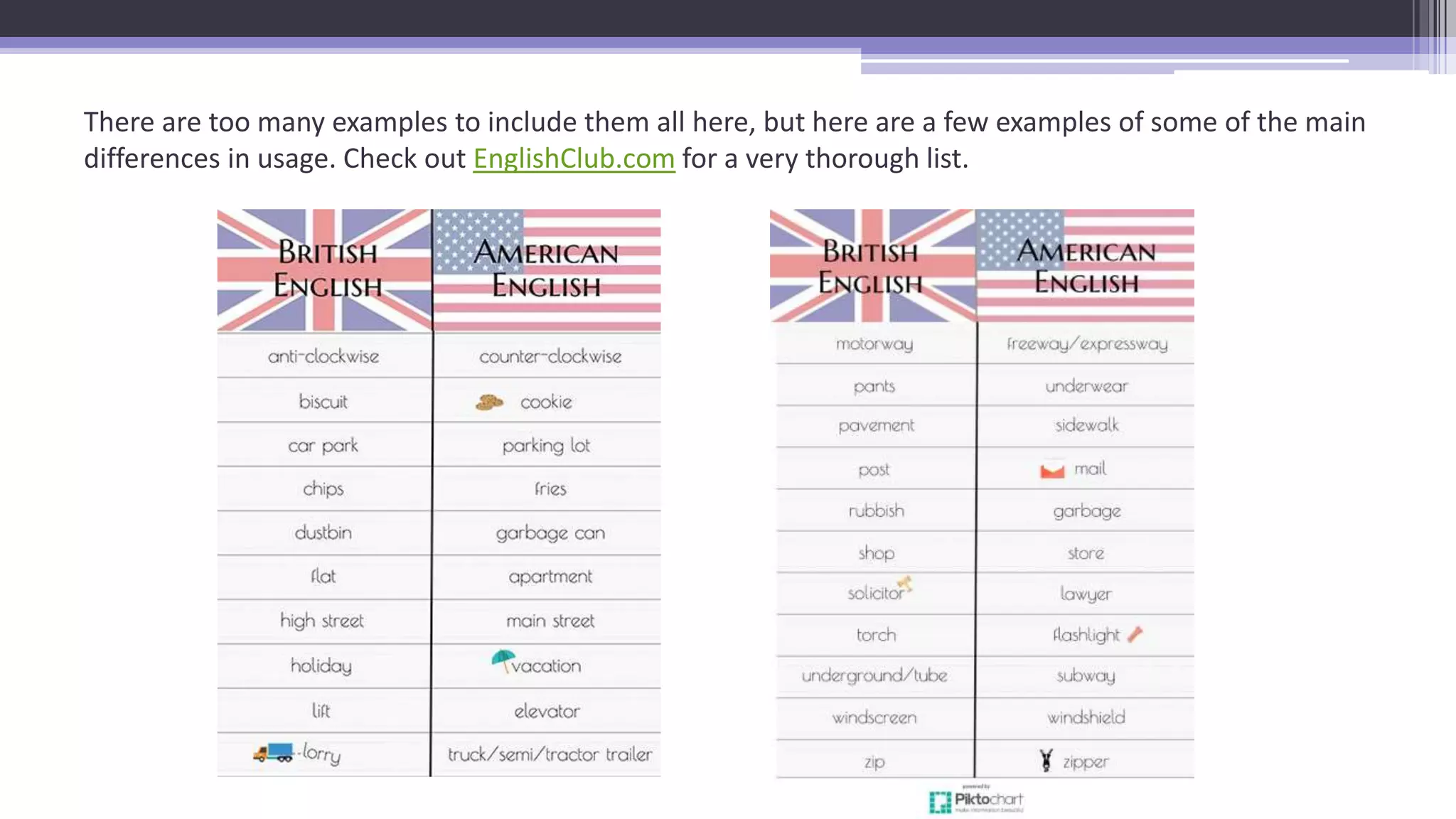
There are too many examples to include them all here, but here are a few examples of some of the main
differences in usage. Check out EnglishClub.com for a very thorough list.
Differences between American English and British English are probably the most noticeable in spoken
language, but along with spelling and usage, there are also slight differences when it comes to British
punctuation. The most important British punctuation rules to remember are:
▫ The serial comma is not used. Example: I bought flowers, a vase and a card.
▫ Single quotation marks (instead of double quotation marks) are used for initial quotations. For
quotations within initial quotations, double quotation marks are used.
▫ Punctuation (commas, periods) goes outside the quotation marks.
▫ When writing titles such as "Dr." or "Mr.," the periods are omitted ("Dr" or "Mr").
▫ When writing times, British English uses a period between the hours and minutes (e.g., 4.30 p.m.),
whereas American English uses a colon (e.g., 4:30 p.m.).
Now that you've learned about the differences between British and American spelling, grammar,
punctuation, and usage, it should be easier for you to spot these discrepancies and write or edit in
British English. It's really just a matter of keeping certain rules in mind.
If you're unsure about a certain rule or how to use a specific word, countless resources are available
online, including Scribendi.com's GrammarCamp, EditingCamp, and ProofreadingCamp online courses.
Of course, you can always refer back to this presentation as a quick resource, too!
Cheerio!
Want to learn more about the differences between
British and American English? Visit the editing experts at
www.scribendi.com, the leading online editing and
proofreading company, today!
If you want to become an English language expert
yourself, check out GrammarCamp.com,
EditingCamp.com, and ProofreadingCamp.com. These
online courses will help you master the English language
and become a better writer.
https://pixabay.com/en/flag-union-jack-british-union-flag-636036/
https://pixabay.com/en/american-flag-usa-painting-679823/
https://pixabay.com/en/write-plan-business-startup-593333/
https://pixabay.com/en/ice-cream-dessert-ice-chocolate-415385/
https://pixabay.com/en/bathrooms-theatre-on-the-water-243009/
https://pixabay.com/en/books-book-bookshelf-library-373053/
https://pixabay.com/en/st-petersburg-russia-choral-synagogue-95128/
https://pixabay.com/en/butterfly-great-spangled-fritillary-757574/
https://pixabay.com/en/thomas-hardy-novelist-poet-man-393744/
https://pixabay.com/en/tea-with-lemon-still-life-tea-pot-783352/
https://pixabay.com/en/man-coat-people-laboratory-lab-219928/
https://pixabay.com/en/reminder-bow-red-ribbon-hand-23771/
https://pixabay.com/en/hand-like-thumb-up-confirm-okay-157251/
https://pixabay.com/en/flags-unites-states-great-britain-38754/
https://pixabay.com/en/typewriter-travel-typewriter-795091/
https://pixabay.com/en/ball-about-british-united-kingdom-107867/

Editing in British English

  • 1.
    A Guide tothe Differences between American and British English A presentation by Scribendi.com
  • 2.
    Today, we're goingto be looking at the main differences between the two most common varieties of English—British and American—and what to watch out for when editing in British English. Although the two aren't that different, their variations in grammar—including spelling, usage, and punctuation—are still quite significant.
  • 3.
    By comparing BritishEnglish to American English, this presentation will list the most common things to watch out for when editing in British English. We will cover the topic of British English grammar as a whole, including spelling, usage, and punctuation, as well as the differences between American and British English. By the time you're done reading this article, you'll know exactly what to pay special attention to when editing in British English. Chocks away!
  • 4.
    British English isthe variety of English spoken and written throughout the United Kingdom. Although British English has regional varieties, we're going to keep it simple here by taking a broad approach and examining the main features of British spelling, grammar, vocabulary, usage, and punctuation. Learning these basics will provide you with a great knowledge base that you'll find especially helpful when writing or editing in British English. Let's start with the main differences between American and British English, which include spelling, usage, and punctuation.
  • 5.
    The spelling ofEnglish words has not always been standardized. With the publication of influential dictionaries in the eighteenth and nineteenth centuries, spelling standards became increasingly common, although with differences between countries. These variances occurred for cultural, political, and linguistic reasons, and over the years, the differences have become more cemented (though never completely so). The primary differences are between British and American spellings. American spelling conventions changed early on, and the variances have persisted throughout the years. VS.
  • 6.
    Here are someof the main spelling differences between American and British English: * Words that end in -our in British English tend to end in -or in American English, but only when the -our ending is not stressed, such as in flav-our. * When the -our ending is stressed, however, the -our spelling is retained in American English, such as in vel-our. * Words ending in -erior are spelled this way everywhere, regardless of location. ▫ superior ▫ exterior ▫ interior ▫ inferior
  • 7.
    Many words inBritish English end in -er, especially Germanic and Romance words. However, certain words with French, Latin, and Greek origins end in -re in British English. These -re endings are often not used in American English (e.g., theatre in British English is spelled theater in American English). Here are some other examples of -re endings in British English: ▫ centre ▫ metre ▫ fibre ▫ sabre
  • 8.
    Many English wordsderived from Greek words end in -ize or -ise. The ending choice varies between, and often within, countries. Great Britain uses both -ize and -ise, although the -ise ending is more common. For such Greek-derived words, the British usage is inconsistent. The -ise is more common, but the Oxford University Press and the Oxford English Dictionary, for example, use the -ize. The Cambridge University Press, on the other hand, adopts the -ise ending, and this is what is typically used in the British mass media for words such as criticise or organise. Some words ending in -ize/-ise are not derived from Greek, and their endings are thus not interchangeable in British English. Examples include: ▫ size ▫ prize ▫ seize
  • 9.
    The use ofthe -yze or the -yse ending varies between countries. The -yse ending is used in British English, while the -yze ending is used in both American and Canadian English for words such as analyze. Some words can end in either -ogue or -og, although the -ogue ending tends to dominate in all countries. Examples: ▫ pedagogue ▫ monologue ▫ synagogue
  • 10.
    In British English(and that of most Commonwealth countries), some words use either the ae or the oe combination, while in American and Canadian English, these are almost always reduced to a simple e. However, there are certain exceptions. The word fetus, based on etymology, should always be spelled fetus, but Britons often adopt the oe spelling, and the word becomes foetus. Academic journals everywhere tend to prefer the etymologically correct spelling, fetus.
  • 11.
    A few wordsalways (or usually) retain the ae or oe construction, even in American English: ▫ phoenix ▫ subpoena ▫ toe Latin -ae plural endings are not changed in any variety of English, as with the following: ▫ larvae ▫ formulae ▫ antennae
  • 12.
    When adding asuffix that begins with a vowel, the final consonant is often doubled. This helps avoid confusion. For example, if you have tap and do not double the consonant p when adding the suffix -ed, you will end up with taped, which is the past tense of the verb to tape. Doubling the consonant creates the word tapped instead. Generally, this only occurs when the word ends with a single consonant following a single vowel and when the final syllable is stressed. However, in British English, a final -l is often doubled to -ll, even when the ending is unstressed. In American English, only one -l is used. Canadian English follows British usage here, typically using the -ll.
  • 13.
    This doubling inBritish English is generally true for any such words ending in -ed, -ing, -er, -est, and -or, for example: ▫ counsellor ▫ counselling ▫ counselled However, for words ending with -ise/-ize, -ism, -ist, and -ish, the final -l is generally not doubled, as with the following: ▫ novelist ▫ sensualist ▫ normalise
  • 14.
    In words withother endings, such as -ous, -ee, and -age, the usage varies, with some doubled (marvellous) and others not (scandalous). Jewellery has -ll in British English but is spelled jewelry in American English. Single -l endings are used if there is a double vowel. ▫ foal (oa) becomes foaling ▫ fool (oo) becomes fooling ▫ pool (oo) becomes pooling Single -l endings are used if there is a consonant preceding the final consonant. ▫ bowl (w before the l) becomes bowling ▫ whirl (r before the l) becomes whirling
  • 15.
    The biggest differencesbetween American English and British English are words with the following combinations: -our versus -or, -re versus -er, -ize versus -ise, -yze versus -yse, -ogue versus -og, and words with ae in American English that are spelled with oe in the British equivalent. If you're interested in learning more about the differences between American and British English, Diffen.com is a great resource.
  • 16.
    Usage refers tolanguage etiquette and how words are commonly used (written and spoken). It also refers to using the right word in the right context. In terms of British versus American English, usage is where you'll see the most obvious distinctions. Different words may be used for different reasons: convention, simplicity, socio- cultural reasons, and even aesthetics.
  • 17.
    There are toomany examples to include them all here, but here are a few examples of some of the main differences in usage. Check out EnglishClub.com for a very thorough list.
  • 18.
    Differences between AmericanEnglish and British English are probably the most noticeable in spoken language, but along with spelling and usage, there are also slight differences when it comes to British punctuation. The most important British punctuation rules to remember are: ▫ The serial comma is not used. Example: I bought flowers, a vase and a card. ▫ Single quotation marks (instead of double quotation marks) are used for initial quotations. For quotations within initial quotations, double quotation marks are used. ▫ Punctuation (commas, periods) goes outside the quotation marks. ▫ When writing titles such as "Dr." or "Mr.," the periods are omitted ("Dr" or "Mr"). ▫ When writing times, British English uses a period between the hours and minutes (e.g., 4.30 p.m.), whereas American English uses a colon (e.g., 4:30 p.m.).
  • 19.
    Now that you'velearned about the differences between British and American spelling, grammar, punctuation, and usage, it should be easier for you to spot these discrepancies and write or edit in British English. It's really just a matter of keeping certain rules in mind. If you're unsure about a certain rule or how to use a specific word, countless resources are available online, including Scribendi.com's GrammarCamp, EditingCamp, and ProofreadingCamp online courses. Of course, you can always refer back to this presentation as a quick resource, too! Cheerio!
  • 20.
    Want to learnmore about the differences between British and American English? Visit the editing experts at www.scribendi.com, the leading online editing and proofreading company, today! If you want to become an English language expert yourself, check out GrammarCamp.com, EditingCamp.com, and ProofreadingCamp.com. These online courses will help you master the English language and become a better writer.
  • 21.
    https://pixabay.com/en/flag-union-jack-british-union-flag-636036/ https://pixabay.com/en/american-flag-usa-painting-679823/ https://pixabay.com/en/write-plan-business-startup-593333/ https://pixabay.com/en/ice-cream-dessert-ice-chocolate-415385/ https://pixabay.com/en/bathrooms-theatre-on-the-water-243009/ https://pixabay.com/en/books-book-bookshelf-library-373053/ https://pixabay.com/en/st-petersburg-russia-choral-synagogue-95128/ https://pixabay.com/en/butterfly-great-spangled-fritillary-757574/ https://pixabay.com/en/thomas-hardy-novelist-poet-man-393744/ https://pixabay.com/en/tea-with-lemon-still-life-tea-pot-783352/ https://pixabay.com/en/man-coat-people-laboratory-lab-219928/ https://pixabay.com/en/reminder-bow-red-ribbon-hand-23771/ https://pixabay.com/en/hand-like-thumb-up-confirm-okay-157251/ https://pixabay.com/en/flags-unites-states-great-britain-38754/ https://pixabay.com/en/typewriter-travel-typewriter-795091/ https://pixabay.com/en/ball-about-british-united-kingdom-107867/

Editor's Notes

  • #3 How presentation will benefit audience: Adult learners are more interested in a subject if they know how or why it is important to them. Presenter’s level of expertise in the subject: Briefly state your credentials in this area, or explain why participants should listen to you.
  • #4 Lesson descriptions should be brief.
  • #5 Example objectives At the end of this lesson, you will be able to: Save files to the team Web server. Move files to different locations on the team Web server. Share files on the team Web server.