


Presented by  Riaz Hussain and Sajid us salam THE DIFFERENCES IN AMERICAN ENGLISH AND BRITISH ENGLISH
Overview Varieties of English What do we mean by American English and British English? Importance of knowing these differences Historical background Grammatical differences Differences of vocabulary Differences of spelling Differences of pronunciation Recap Listen to an audio clip on these differences Questions
    Importance of knowing the differences The two varieties of English most widely found in print and taught around the world are British and American - it is therefore important for teachers to be aware of the major differences between the two. And while lexical differences are the easiest ones to notice, a knowledge of grammatical and phonological differences can be useful not only for teachers to be aware of, but also to be able to deal with should they come up in class. Lack of awareness can lead to embarrassment and confusion.
Formalizing the differences One particular contribution towards formalizing these differences came from Noah Webster , who wrote the first American dictionary (published 1828) with the intention of showing that people in the United States spoke a different dialect from Britain.
Henry Sweet predicted in 1877 that within a century, American English, Australian English and British English would be mutually unintelligible .   It may be the case that increased worldwide communication through radio, television, the Internet, and globalization has reduced the tendency to regional variation .
What do we mean by American English and British English?
American English American English  (AmE)  is the form of English used in the United State. It includes all English dialects used within the United States of America Regional dialects in the United States typically reflect the elements of the language of the main immigrant groups in any particular region of the country, especially in terms of pronunciation and vernacular vocabulary. Scholars have mapped at least four major regional variations of spoken American English: Northern (really north-eastern), Southern, Midland, and Western.
British English British English also has a reasonable degree of uniformity in its formal written form. The spoken forms though vary considerably, reflecting a long history of dialect development amid isolated populations. Dialects and accents vary not only between the countries in the United Kingdom, England, Northern Ireland, Scotland and Wales, but also within these individual countries. There are also differences in the English spoken by different socio-economic groups
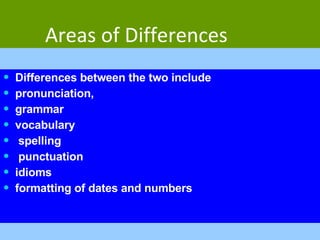
Areas of Differences Differences between the two include  pronunciation,  grammar  vocabulary  spelling punctuation  idioms formatting of dates and numbers
  Grammatical Differences In British English and  American English
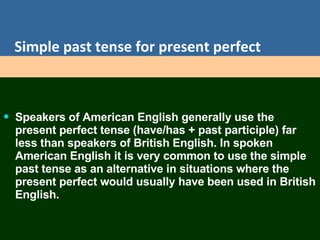
Simple past tense for present perfect Speakers of American English generally use the present perfect tense (have/has + past participle) far less than speakers of British English. In spoken American English it is very common to use the simple past tense as an alternative in situations where the present perfect would usually have been used in British English.
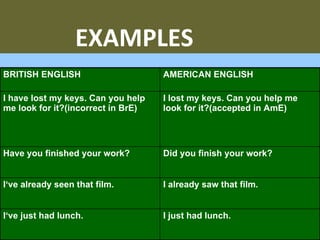
EXAMPLES I just had lunch. I‘ve just had lunch. I already saw that film. I‘ve already seen that film. Did you finish your work? Have you finished your work? I lost my keys. Can you help me look for it?(accepted in AmE) I have lost my keys. Can you help me look for it?(incorrect in BrE) AMERICAN ENGLISH BRITISH ENGLISH
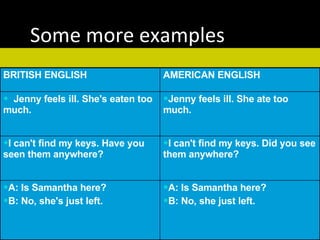
Some more examples A: Is Samantha here?  B: No, she just left.  A: Is Samantha here?  B: No, she's just left. I can't find my keys. Did you see them anywhere?  I can't find my keys. Have you seen them anywhere? Jenny feels ill. She ate too much.      Jenny feels ill. She's eaten too much.   AMERICAN ENGLISH BRITISH ENGLISH
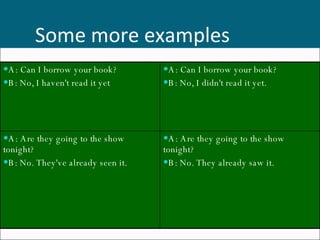
Some more examples A: Are they going to the show tonight?  B: No. They already saw it. A: Are they going to the show tonight?  B: No. They've already seen it. A: Can I borrow your book?  B: No, I didn't read it yet.  A: Can I borrow your book?  B: No, I haven't read it yet
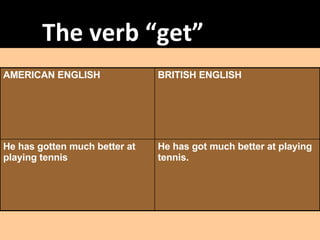
The verb “get” He has got much better at playing tennis. He has gotten much better at playing tennis BRITISH ENGLISH AMERICAN ENGLISH
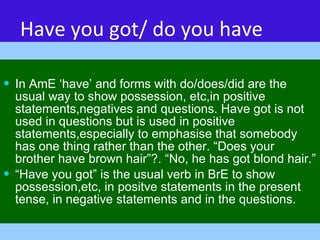
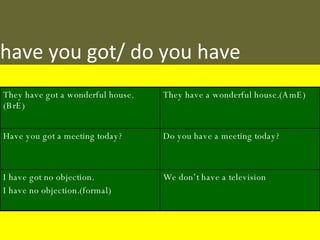
Have you got/ do you have In AmE ‘have’ and forms with do/does/did are the usual way to show possession, etc,in positive statements,negatives and questions. Have got is not used in questions but is used in positive statements,especially to emphasise that somebody has one thing rather than the other. “Does your brother have brown hair”?. “No, he has got blond hair.” “ Have you got” is the usual verb in BrE to show possession,etc, in positve statements in the present tense, in negative statements and in the questions.
have you got/ do you have We don’t have a television I have got no objection. I have no objection.(formal) Do you have a meeting today? Have you got a meeting today? They have a wonderful house.(AmE) They have got a wonderful house. (BrE)
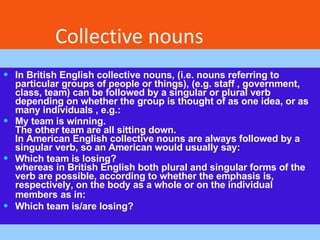
In British English collective nouns, (i.e. nouns referring to particular groups of people or things), (e.g. staff , government, class, team) can be followed by a singular or plural verb depending on whether the group is thought of as one idea, or as many individuals , e.g.: My team is winning. The other team are all sitting down. In American English collective nouns are always followed by a singular verb, so an American would usually say: Which team is losing? whereas in British English both plural and singular forms of the verb are possible, according to whether the emphasis is, respectively, on the body as a whole or on the individual members   as in: Which team is/are losing? Collective nouns
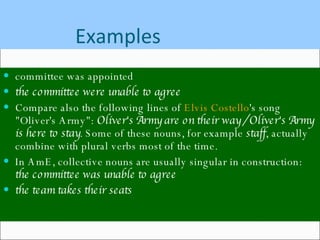
Examples committee was appointed  the committee were unable to agree   Compare also the following lines of  Elvis Costello 's song "Oliver's Army":  Oliver's Army are on their way / Oliver's Army is here to stay . Some of these nouns, for example  staff , actually combine with plural verbs most of the time. In AmE, collective nouns are usually singular in construction:  the committee was unable to agree   the team takes their seats
The Differences of Vocabulary   In British English and American English
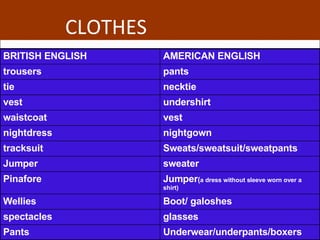
CLOTHES undershirt vest glasses spectacles Underwear/underpants/boxers Pants Boot/ galoshes Wellies Jumper ( a dress without sleeve worn over a shirt) Pinafore sweater Jumper Sweats/sweatsuit/sweatpants tracksuit nightgown nightdress vest waistcoat necktie tie pants trousers AMERICAN ENGLISH BRITISH ENGLISH
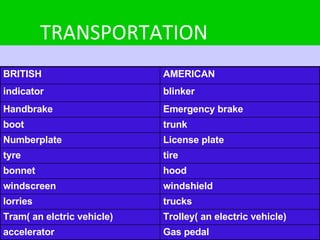
TRANSPORTATION AMERICAN BRITISH Trolley( an electric vehicle) Tram( an elctric vehicle) trucks lorries Gas pedal accelerator windshield windscreen hood bonnet tire tyre License plate Numberplate trunk boot Emergency brake Handbrake blinker indicator
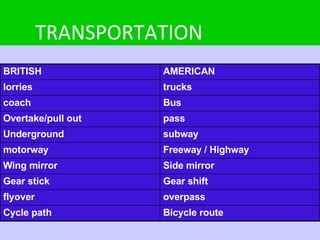
TRANSPORTATION trucks lorries Bicycle route Cycle path overpass flyover Gear shift Gear stick Side mirror Wing mirror Freeway / Highway motorway subway Underground pass Overtake/pull out Bus coach AMERICAN BRITISH
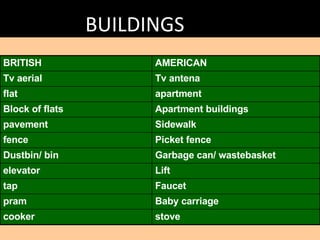
BUILDINGS AMERICAN BRITISH Baby carriage pram stove cooker Faucet tap Lift elevator Garbage can/ wastebasket Dustbin/ bin Picket fence fence Sidewalk pavement Apartment buildings Block of flats apartment flat Tv antena Tv aerial
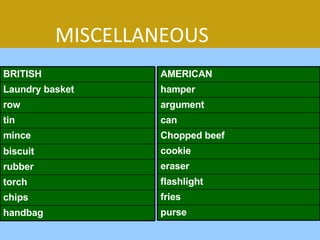
MISCELLANEOUS handbag chips torch rubber biscuit mince tin row Laundry basket BRITISH purse fries flashlight eraser cookie Chopped beef can argument hamper AMERICAN
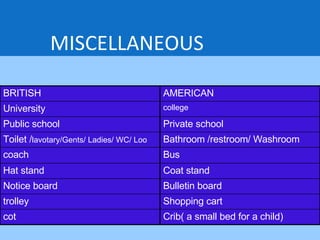
MISCELLANEOUS cot trolley Notice board Hat stand coach Toilet / lavotary/Gents/ Ladies/ WC/ Loo Public school University BRITISH Crib( a small bed for a child) Shopping cart Bulletin board Coat stand Bus Bathroom /restroom/ Washroom Private school college AMERICAN
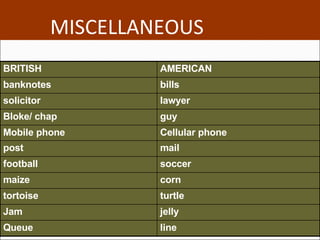
MISCELLANEOUS jelly Jam  line Queue turtle tortoise corn maize soccer football mail post Cellular phone Mobile phone  guy Bloke/ chap lawyer solicitor bills banknotes AMERICAN BRITISH
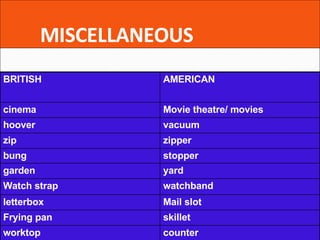
MISCELLANEOUS counter worktop skillet Frying pan Mail slot letterbox watchband Watch strap yard garden stopper bung zipper zip vacuum hoover Movie theatre/ movies cinema AMERICAN BRITISH
An interview with    Dileri Borunda Johnston   Author of "Speak American: A Survival Guide  to the Language and Culture of the U-S-A."
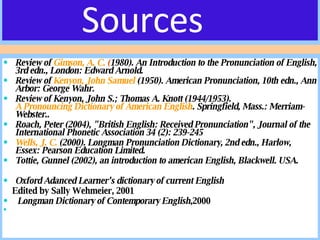
Sources Review of  Gimson, A. C.  ( 1980). An Introduction to the Pronunciation of English, 3rd edn., London: Edward Arnold.  Review of  Kenyon, John Samuel  (1950). American Pronunciation, 10th edn., Ann Arbor: George Wahr.  Review of Kenyon, John S.; Thomas A. Knott (1944/1953).  A Pronouncing Dictionary of American English . Springfield, Mass.: Merriam-Webster..  Roach, Peter (2004), "British English: Received Pronunciation", Journal of the International Phonetic Association 34 (2): 239-245  Wells, J. C.  (2000). Longman Pronunciation Dictionary, 2nd edn., Harlow, Essex: Pearson Education Limited.  Tottie, Gunnel (2002), an introduction to american English, Blackwell. USA. Oxford Adanced Learner’s dictionary of current English Edited by Sally Wehmeier, 2001 Longman Dictionary of Contemporary English ,2000
Internet Links   IPA website. www.voanews.com   www.wikipedia.com www.sciencedirect.com www.bbc.co.uk
Thank you very much Take care

Am N British

  • 1.
  • 2.
    Presented by Riaz Hussain and Sajid us salam THE DIFFERENCES IN AMERICAN ENGLISH AND BRITISH ENGLISH
  • 3.
    Overview Varieties ofEnglish What do we mean by American English and British English? Importance of knowing these differences Historical background Grammatical differences Differences of vocabulary Differences of spelling Differences of pronunciation Recap Listen to an audio clip on these differences Questions
  • 4.
    Importance of knowing the differences The two varieties of English most widely found in print and taught around the world are British and American - it is therefore important for teachers to be aware of the major differences between the two. And while lexical differences are the easiest ones to notice, a knowledge of grammatical and phonological differences can be useful not only for teachers to be aware of, but also to be able to deal with should they come up in class. Lack of awareness can lead to embarrassment and confusion.
  • 5.
    Formalizing the differencesOne particular contribution towards formalizing these differences came from Noah Webster , who wrote the first American dictionary (published 1828) with the intention of showing that people in the United States spoke a different dialect from Britain.
  • 6.
    Henry Sweet predictedin 1877 that within a century, American English, Australian English and British English would be mutually unintelligible . It may be the case that increased worldwide communication through radio, television, the Internet, and globalization has reduced the tendency to regional variation .
  • 7.
    What do wemean by American English and British English?
  • 8.
    American English AmericanEnglish (AmE) is the form of English used in the United State. It includes all English dialects used within the United States of America Regional dialects in the United States typically reflect the elements of the language of the main immigrant groups in any particular region of the country, especially in terms of pronunciation and vernacular vocabulary. Scholars have mapped at least four major regional variations of spoken American English: Northern (really north-eastern), Southern, Midland, and Western.
  • 9.
    British English BritishEnglish also has a reasonable degree of uniformity in its formal written form. The spoken forms though vary considerably, reflecting a long history of dialect development amid isolated populations. Dialects and accents vary not only between the countries in the United Kingdom, England, Northern Ireland, Scotland and Wales, but also within these individual countries. There are also differences in the English spoken by different socio-economic groups
  • 10.
    Areas of DifferencesDifferences between the two include pronunciation, grammar vocabulary spelling punctuation idioms formatting of dates and numbers
  • 11.
    GrammaticalDifferences In British English and American English
  • 12.
    Simple past tensefor present perfect Speakers of American English generally use the present perfect tense (have/has + past participle) far less than speakers of British English. In spoken American English it is very common to use the simple past tense as an alternative in situations where the present perfect would usually have been used in British English.
  • 13.
    EXAMPLES I justhad lunch. I‘ve just had lunch. I already saw that film. I‘ve already seen that film. Did you finish your work? Have you finished your work? I lost my keys. Can you help me look for it?(accepted in AmE) I have lost my keys. Can you help me look for it?(incorrect in BrE) AMERICAN ENGLISH BRITISH ENGLISH
  • 14.
    Some more examplesA: Is Samantha here? B: No, she just left. A: Is Samantha here? B: No, she's just left. I can't find my keys. Did you see them anywhere? I can't find my keys. Have you seen them anywhere? Jenny feels ill. She ate too much.    Jenny feels ill. She's eaten too much.  AMERICAN ENGLISH BRITISH ENGLISH
  • 15.
    Some more examplesA: Are they going to the show tonight? B: No. They already saw it. A: Are they going to the show tonight? B: No. They've already seen it. A: Can I borrow your book? B: No, I didn't read it yet. A: Can I borrow your book? B: No, I haven't read it yet
  • 16.
    The verb “get”He has got much better at playing tennis. He has gotten much better at playing tennis BRITISH ENGLISH AMERICAN ENGLISH
  • 17.
    Have you got/do you have In AmE ‘have’ and forms with do/does/did are the usual way to show possession, etc,in positive statements,negatives and questions. Have got is not used in questions but is used in positive statements,especially to emphasise that somebody has one thing rather than the other. “Does your brother have brown hair”?. “No, he has got blond hair.” “ Have you got” is the usual verb in BrE to show possession,etc, in positve statements in the present tense, in negative statements and in the questions.
  • 18.
    have you got/do you have We don’t have a television I have got no objection. I have no objection.(formal) Do you have a meeting today? Have you got a meeting today? They have a wonderful house.(AmE) They have got a wonderful house. (BrE)
  • 19.
    In British Englishcollective nouns, (i.e. nouns referring to particular groups of people or things), (e.g. staff , government, class, team) can be followed by a singular or plural verb depending on whether the group is thought of as one idea, or as many individuals , e.g.: My team is winning. The other team are all sitting down. In American English collective nouns are always followed by a singular verb, so an American would usually say: Which team is losing? whereas in British English both plural and singular forms of the verb are possible, according to whether the emphasis is, respectively, on the body as a whole or on the individual members as in: Which team is/are losing? Collective nouns
  • 20.
    Examples committee wasappointed the committee were unable to agree Compare also the following lines of Elvis Costello 's song "Oliver's Army": Oliver's Army are on their way / Oliver's Army is here to stay . Some of these nouns, for example staff , actually combine with plural verbs most of the time. In AmE, collective nouns are usually singular in construction: the committee was unable to agree the team takes their seats
  • 21.
    The Differences ofVocabulary In British English and American English
  • 22.
    CLOTHES undershirt vestglasses spectacles Underwear/underpants/boxers Pants Boot/ galoshes Wellies Jumper ( a dress without sleeve worn over a shirt) Pinafore sweater Jumper Sweats/sweatsuit/sweatpants tracksuit nightgown nightdress vest waistcoat necktie tie pants trousers AMERICAN ENGLISH BRITISH ENGLISH
  • 23.
    TRANSPORTATION AMERICAN BRITISHTrolley( an electric vehicle) Tram( an elctric vehicle) trucks lorries Gas pedal accelerator windshield windscreen hood bonnet tire tyre License plate Numberplate trunk boot Emergency brake Handbrake blinker indicator
  • 24.
    TRANSPORTATION trucks lorriesBicycle route Cycle path overpass flyover Gear shift Gear stick Side mirror Wing mirror Freeway / Highway motorway subway Underground pass Overtake/pull out Bus coach AMERICAN BRITISH
  • 25.
    BUILDINGS AMERICAN BRITISHBaby carriage pram stove cooker Faucet tap Lift elevator Garbage can/ wastebasket Dustbin/ bin Picket fence fence Sidewalk pavement Apartment buildings Block of flats apartment flat Tv antena Tv aerial
  • 26.
    MISCELLANEOUS handbag chipstorch rubber biscuit mince tin row Laundry basket BRITISH purse fries flashlight eraser cookie Chopped beef can argument hamper AMERICAN
  • 27.
    MISCELLANEOUS cot trolleyNotice board Hat stand coach Toilet / lavotary/Gents/ Ladies/ WC/ Loo Public school University BRITISH Crib( a small bed for a child) Shopping cart Bulletin board Coat stand Bus Bathroom /restroom/ Washroom Private school college AMERICAN
  • 28.
    MISCELLANEOUS jelly Jam line Queue turtle tortoise corn maize soccer football mail post Cellular phone Mobile phone guy Bloke/ chap lawyer solicitor bills banknotes AMERICAN BRITISH
  • 29.
    MISCELLANEOUS counter worktopskillet Frying pan Mail slot letterbox watchband Watch strap yard garden stopper bung zipper zip vacuum hoover Movie theatre/ movies cinema AMERICAN BRITISH
  • 30.
    An interview with Dileri Borunda Johnston Author of "Speak American: A Survival Guide to the Language and Culture of the U-S-A."
  • 31.
    Sources Review of Gimson, A. C. ( 1980). An Introduction to the Pronunciation of English, 3rd edn., London: Edward Arnold. Review of Kenyon, John Samuel (1950). American Pronunciation, 10th edn., Ann Arbor: George Wahr. Review of Kenyon, John S.; Thomas A. Knott (1944/1953). A Pronouncing Dictionary of American English . Springfield, Mass.: Merriam-Webster.. Roach, Peter (2004), "British English: Received Pronunciation", Journal of the International Phonetic Association 34 (2): 239-245 Wells, J. C. (2000). Longman Pronunciation Dictionary, 2nd edn., Harlow, Essex: Pearson Education Limited. Tottie, Gunnel (2002), an introduction to american English, Blackwell. USA. Oxford Adanced Learner’s dictionary of current English Edited by Sally Wehmeier, 2001 Longman Dictionary of Contemporary English ,2000
  • 32.
    Internet Links IPA website. www.voanews.com www.wikipedia.com www.sciencedirect.com www.bbc.co.uk
  • 33.
    Thank you verymuch Take care