How Do I Know if I'm
PLAGIARIZING?
The citation pros at Scribendi.com
teach you how to avoid plagiarism in
your academic work.F
Come see me
after class.
- Professor D.
The repercussions of PLAGIARISM are serious.
They can include a failing grade, recorded removal
from class, academic probation, or even expulsion.
PLAGIARISM really is that serious, which is why
you need to learn the following rules for how to
avoid it in your academic work.
TYPE 1: The Direct Copy
Directly lifting a segment of text (be
it a phrase, a paragraph, or an
entire paper) word for word, without
citation, as if it were your own.
Introduce the source, enclose the
quoted text in quotation marks, and
include an in-text citation.
The Mistake
The Solution
Type 2:
The Minimalist
The Mistake
The Solution
You change a few words or phrases
from a piece of source material, but
the original tone, structure, and
content remain the same.
Introduce the source and summarize
the content in question in your own
words, followed by an in-text
citation.
Type 3: The Combo
The Mistake
The Solution
Usually the product of laziness (or
of the assumption that your
instructor won't notice), this occurs
when you properly cite some pieces
of information, but not others.
As a general rule, all
information that is not common
knowledge should be cited.
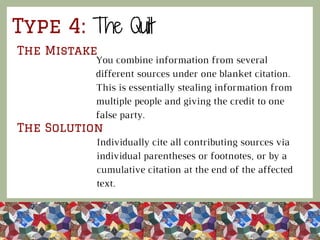
Type 4: The Quilt
The Mistake
The Solution
You combine information from several
different sources under one blanket citation.
This is essentially stealing information from
multiple people and giving the credit to one
false party.
Individually cite all contributing sources via
individual parentheses or footnotes, or by a
cumulative citation at the end of the affected
text.
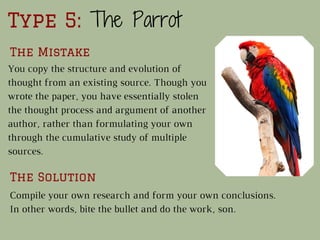
Type 5: The Parrot
The Mistake
The Solution
You copy the structure and evolution of
thought from an existing source. Though you
wrote the paper, you have essentially stolen
the thought process and argument of another
author, rather than formulating your own
through the cumulative study of multiple
sources.
Compile your own research and form your own conclusions.
In other words, bite the bullet and do the work, son.
Type 6: The Insecure
The Mistake
The Solution
I like to call this the Little Mermaid Complex;
you give up your own voice in an attempt to
please. In direct terms, this occurs when you
fully stock a paper with sourced material but
include little to no original content.
Remember that your professors want to know
your thoughts and ideas (backed up, of
course, by authoritative evidence from others).
Type 7: The Lost at Sea
The Mistake
The Solution
You fill your Works Cited with books and
articles you haven't actually read or ones that
you did but found inapplicable to meet the
minimum number of sources required.
Plain and simple, only include accurate
citations. This applies to URLs as well; if it's
out of date or no longer available online, your
grade could suffer for it.
Type 8: The Self­Obsessed
The Mistake
The Solution
Your own work is yours to use however you please, right?
Not in the world of academia. Handing in the same paper
twice, or even excerpts from work you did for another class,
counts as self-plagiarism.
Cite your previous work the way
you would all other sources.
The golden rule of avoiding plagiarism?
When in doubt, cite your source.
For more great information
about writing academic
papers, check out our blog
at Scribendi.com.

How Do I Know if I'm Plagiarizing?

  • 1.
    How Do IKnow if I'm PLAGIARIZING? The citation pros at Scribendi.com teach you how to avoid plagiarism in your academic work.F Come see me after class. - Professor D.
  • 2.
    The repercussions ofPLAGIARISM are serious. They can include a failing grade, recorded removal from class, academic probation, or even expulsion. PLAGIARISM really is that serious, which is why you need to learn the following rules for how to avoid it in your academic work.
  • 3.
    TYPE 1: The Direct Copy Directlylifting a segment of text (be it a phrase, a paragraph, or an entire paper) word for word, without citation, as if it were your own. Introduce the source, enclose the quoted text in quotation marks, and include an in-text citation. The Mistake The Solution
  • 4.
    Type 2: The Minimalist The Mistake TheSolution You change a few words or phrases from a piece of source material, but the original tone, structure, and content remain the same. Introduce the source and summarize the content in question in your own words, followed by an in-text citation.
  • 5.
    Type 3: The Combo TheMistake The Solution Usually the product of laziness (or of the assumption that your instructor won't notice), this occurs when you properly cite some pieces of information, but not others. As a general rule, all information that is not common knowledge should be cited.
  • 6.
    Type 4: The Quilt TheMistake The Solution You combine information from several different sources under one blanket citation. This is essentially stealing information from multiple people and giving the credit to one false party. Individually cite all contributing sources via individual parentheses or footnotes, or by a cumulative citation at the end of the affected text.
  • 7.
    Type 5: The Parrot TheMistake The Solution You copy the structure and evolution of thought from an existing source. Though you wrote the paper, you have essentially stolen the thought process and argument of another author, rather than formulating your own through the cumulative study of multiple sources. Compile your own research and form your own conclusions. In other words, bite the bullet and do the work, son.
  • 8.
    Type 6: The Insecure TheMistake The Solution I like to call this the Little Mermaid Complex; you give up your own voice in an attempt to please. In direct terms, this occurs when you fully stock a paper with sourced material but include little to no original content. Remember that your professors want to know your thoughts and ideas (backed up, of course, by authoritative evidence from others).
  • 9.
    Type 7: The Lost at Sea TheMistake The Solution You fill your Works Cited with books and articles you haven't actually read or ones that you did but found inapplicable to meet the minimum number of sources required. Plain and simple, only include accurate citations. This applies to URLs as well; if it's out of date or no longer available online, your grade could suffer for it.
  • 10.
    Type 8: The Self­Obsessed TheMistake The Solution Your own work is yours to use however you please, right? Not in the world of academia. Handing in the same paper twice, or even excerpts from work you did for another class, counts as self-plagiarism. Cite your previous work the way you would all other sources.
  • 11.
    The golden rule of avoiding plagiarism? When in doubt, cite your source. For more greatinformation about writing academic papers, check out our blog at Scribendi.com.