Dr. Priti Sonar,
Educationalist, Author, Trainer, Writer, Motivational Speaker
Educational Qualifications- M.A., M.Com, M.Ed., NET ( Education), NET
(Commerce), DSM, CCG, CCVE, Ph.D., MBA (Pursuing)
Experience- 14+ years of teaching experience, 7+ years of administrative experience.
 Special Achievement- Ex- BOS (Board of studies) member of S.N.D.T Women’s
University
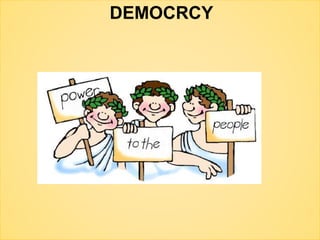
DEMOCRCY
INTRODUCTION
The term is typically used in the context of a form
of government in which all the citizen have the
right to vote.
Meaning:
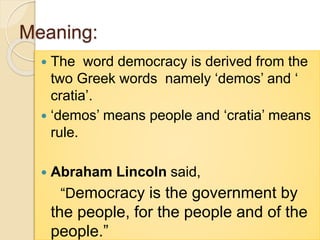
 The word democracy is derived from the
two Greek words namely ‘demos’ and ‘
cratia’.
 ‘demos’ means people and ‘cratia’ means
rule.
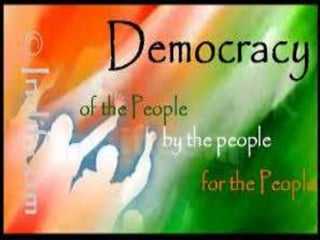
 Abraham Lincoln said,
“Democracy is the government by
the people, for the people and of the
people.”
Definition:
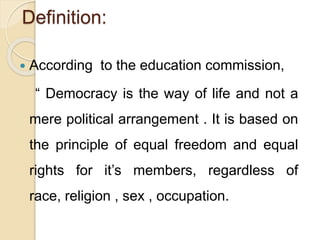
 According to the education commission,
“ Democracy is the way of life and not a
mere political arrangement . It is based on
the principle of equal freedom and equal
rights for it’s members, regardless of
race, religion , sex , occupation.
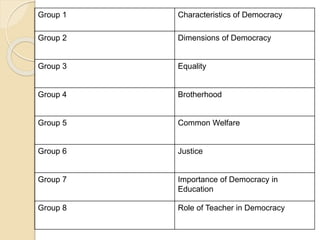
Group 1 Characteristics of Democracy
Group 2 Dimensions of Democracy
Group 3 Equality
Group 4 Brotherhood
Group 5 Common Welfare
Group 6 Justice
Group 7 Importance of Democracy in
Education
Group 8 Role of Teacher in Democracy
Characteristics of Democracy-
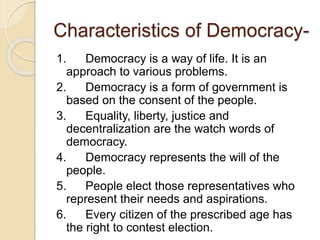
1. Democracy is a way of life. It is an
approach to various problems.
2. Democracy is a form of government is
based on the consent of the people.
3. Equality, liberty, justice and
decentralization are the watch words of
democracy.
4. Democracy represents the will of the
people.
5. People elect those representatives who
represent their needs and aspirations.
6. Every citizen of the prescribed age has
the right to contest election.
Dimensions of Democracy
 1. Economic Dimension- This implies economic
equality as far as possible, satisfaction of the
basic needs of the people and equality of
opportunity in undertaking economic activities.
 2. Educational Dimension- This implies equal
opportunity in obtaining education.
 3. Ethnical Dimension- This means faith that an
individual is entitled to enjoy full respect for his
individual.
 4. Political Dimension- This includes
participation of the people in government.
 5. Social Dimension- This incorporates equality
of all, irrespective of caste, class, colour, creed,
sex and wealth etc.
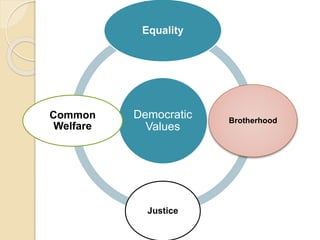
Democratic
Values
Equality
Brotherhood
Justice
Common
Welfare
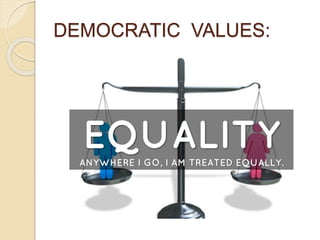
DEMOCRATIC VALUES:
DEMOCRATIC VALUES:
1. Equality:
Equality is when things are the same
(equal) in some particular way.
Equality means “ the state of being equal” .
 Equality of outcome can be achieved by
making sure that everyone is supported to
have accesses to resources and decision
making & to be recognized values and
respected.
 Equality implies the equal status of
every individual and ensuring equal
opportunities of development to every
person.
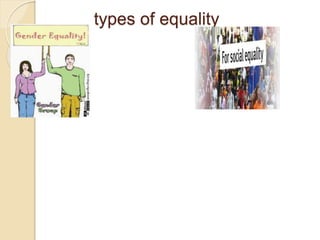
types of equality
Brotherhood
The condition or quality of being a brother or
brothers.
The quality of being brotherly; fellowship.
The belief that all people should act with
warmth and equality toward one another .
The definition of brotherhood is a relationship
between brothers or close friends, or is a
feeling of bonding with other people.
 When a group of people all shares the same goals and
tribulations and support each other.
Universal brotherhood
The concept of universal brotherhood is based on
the saying that “ all men are the family of Allah or
bhagwan”
In this sense the whole mankind into one
brotherhood and brings all of the members of the
human race to an equal footing in the matter of
fulfilling economic needs.
 .
What can be teacher role
to promote Brotherhood
Common Welfare
 Common welfare is where the
government is trying to help everyone.
 The duty of promoting the general
welfare of the political community as a
whole has been one of the primary
objectives.
 it refers to promoting the common good
or putting the interests of everyone over
the interests of a select group or a few
people.
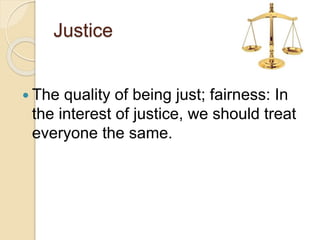
Justice
 The quality of being just; fairness: In
the interest of justice, we should treat
everyone the same.
Social justice
 Social justice denotes the equal
treatment of all citizens without any
social distinction based on caste,
colour, race, religion, sex and so on. It
means absence of privileges being
extended to any particular section of
the society, and improvement in the
conditions of backward classes (SCs,
STs, and OBCs) and women.
 How as a teacher you can promote
common welfare and justice?
1. Instead of focusing on individual objective a
teacher needs to focus on collective
objective.
2. Her behavior needs to be unbiased.
3. She needs to give equal and fair attention to
every individual.
4. Overall growth of the child should be the
focus.
5. Overall growth of the class should be the
focus.
6. No donation for admission
7. Admission should be on the basis of
entrance test only.
8. Hallo effect should be avoided as far as
Importance of Education in
Democracy
 Education enable the individual to
understand his rights and duties.
 Education develop dignity of labor and
sense of personal worth.
 Education develop values of Equality .
 Education help to evaluate the policies and
programmes of political parties.
 Education help to evaluate the merits and
demerits of candidates contesting election.
Significant implication of democracy
in education
 Education is essential to develop such
attitudes, skills and knowledge which
enabled the citizens to participate
intelligently in the social and other
processes.
Continue…
 Education helps to prevent exploitation.
 Education helps to develop quality of
leadership.
 Education develop the qualities of
brotherhood , appreciation of other point
of view.
 Education for all is a natural corollary of
democratic set-up.
 Education is essential to a citizen to
understand and discern intelligently the
programmes of political parties.

Democracy

  • 1.
    Dr. Priti Sonar, Educationalist,Author, Trainer, Writer, Motivational Speaker Educational Qualifications- M.A., M.Com, M.Ed., NET ( Education), NET (Commerce), DSM, CCG, CCVE, Ph.D., MBA (Pursuing) Experience- 14+ years of teaching experience, 7+ years of administrative experience.  Special Achievement- Ex- BOS (Board of studies) member of S.N.D.T Women’s University
  • 2.
  • 4.
    INTRODUCTION The term istypically used in the context of a form of government in which all the citizen have the right to vote.
  • 5.
    Meaning:  The worddemocracy is derived from the two Greek words namely ‘demos’ and ‘ cratia’.  ‘demos’ means people and ‘cratia’ means rule.  Abraham Lincoln said, “Democracy is the government by the people, for the people and of the people.”
  • 6.
    Definition:  According tothe education commission, “ Democracy is the way of life and not a mere political arrangement . It is based on the principle of equal freedom and equal rights for it’s members, regardless of race, religion , sex , occupation.
  • 7.
    Group 1 Characteristicsof Democracy Group 2 Dimensions of Democracy Group 3 Equality Group 4 Brotherhood Group 5 Common Welfare Group 6 Justice Group 7 Importance of Democracy in Education Group 8 Role of Teacher in Democracy
  • 8.
    Characteristics of Democracy- 1.Democracy is a way of life. It is an approach to various problems. 2. Democracy is a form of government is based on the consent of the people. 3. Equality, liberty, justice and decentralization are the watch words of democracy. 4. Democracy represents the will of the people. 5. People elect those representatives who represent their needs and aspirations. 6. Every citizen of the prescribed age has the right to contest election.
  • 9.
    Dimensions of Democracy 1. Economic Dimension- This implies economic equality as far as possible, satisfaction of the basic needs of the people and equality of opportunity in undertaking economic activities.  2. Educational Dimension- This implies equal opportunity in obtaining education.  3. Ethnical Dimension- This means faith that an individual is entitled to enjoy full respect for his individual.  4. Political Dimension- This includes participation of the people in government.  5. Social Dimension- This incorporates equality of all, irrespective of caste, class, colour, creed, sex and wealth etc.
  • 10.
  • 11.
  • 12.
    DEMOCRATIC VALUES: 1. Equality: Equalityis when things are the same (equal) in some particular way. Equality means “ the state of being equal” .
  • 13.
     Equality ofoutcome can be achieved by making sure that everyone is supported to have accesses to resources and decision making & to be recognized values and respected.  Equality implies the equal status of every individual and ensuring equal opportunities of development to every person.
  • 14.
  • 16.
    Brotherhood The condition orquality of being a brother or brothers. The quality of being brotherly; fellowship. The belief that all people should act with warmth and equality toward one another . The definition of brotherhood is a relationship between brothers or close friends, or is a feeling of bonding with other people.  When a group of people all shares the same goals and tribulations and support each other.
  • 17.
    Universal brotherhood The conceptof universal brotherhood is based on the saying that “ all men are the family of Allah or bhagwan” In this sense the whole mankind into one brotherhood and brings all of the members of the human race to an equal footing in the matter of fulfilling economic needs.
  • 18.
  • 19.
    What can beteacher role to promote Brotherhood
  • 20.
    Common Welfare  Commonwelfare is where the government is trying to help everyone.  The duty of promoting the general welfare of the political community as a whole has been one of the primary objectives.  it refers to promoting the common good or putting the interests of everyone over the interests of a select group or a few people.
  • 21.
    Justice  The qualityof being just; fairness: In the interest of justice, we should treat everyone the same.
  • 22.
    Social justice  Socialjustice denotes the equal treatment of all citizens without any social distinction based on caste, colour, race, religion, sex and so on. It means absence of privileges being extended to any particular section of the society, and improvement in the conditions of backward classes (SCs, STs, and OBCs) and women.
  • 23.
     How asa teacher you can promote common welfare and justice?
  • 24.
    1. Instead offocusing on individual objective a teacher needs to focus on collective objective. 2. Her behavior needs to be unbiased. 3. She needs to give equal and fair attention to every individual. 4. Overall growth of the child should be the focus. 5. Overall growth of the class should be the focus. 6. No donation for admission 7. Admission should be on the basis of entrance test only. 8. Hallo effect should be avoided as far as
  • 25.
    Importance of Educationin Democracy  Education enable the individual to understand his rights and duties.  Education develop dignity of labor and sense of personal worth.  Education develop values of Equality .  Education help to evaluate the policies and programmes of political parties.  Education help to evaluate the merits and demerits of candidates contesting election.
  • 26.
    Significant implication ofdemocracy in education  Education is essential to develop such attitudes, skills and knowledge which enabled the citizens to participate intelligently in the social and other processes.
  • 27.
    Continue…  Education helpsto prevent exploitation.  Education helps to develop quality of leadership.  Education develop the qualities of brotherhood , appreciation of other point of view.
  • 28.
     Education forall is a natural corollary of democratic set-up.  Education is essential to a citizen to understand and discern intelligently the programmes of political parties.