Grading Practices
Douglas Reeves, Ph.D.
Mt. Pleasant High School
2010-2011
Grading
Grades = Feedback to Improve
Performance!
 If you have high levels of success and low failure rates,
your policy is sound and should be left alone.
 If you have low levels of success and high failure rates,
what you are doing is not working.
 The “Real World” is not “You have one chance at it and
you’re done”.
 We seldom use “average” for anything else except
grades.
 Grades must never be used as punishment. It doesn’t
work!
 Rewards for work done daily are far greater than
punishment for work done late.
 The Driver’s License Test example – chance to “re-do/re-take”
Toxic (Ineffective) Grading Policies
 The use of “zeroes” for missing work.
Consequence should be to complete the work!
 The practice of using the “average” of all scores
during the grading period, a formula that
presumes that the learning early in the semester
is as important as learning at the end of the
semester. (Marzano 2000; O’Connor, 2007)
 The use of the “grading period killer” – the single
project, test, lab, paper, or other assignment that
will make or break students.
Toxic Grading Practices and Alternatives
Toxic
 “Zeroes” for missing
work
 Average/Mean
 Grading Period Killer:
One Test or Project
Alternative
 “Get ‘Er Done, Just Do It”,
complete/submit missing
work
 Best representation of
work (Re-do, Re-submit)
 Resilience, Personal
Responsibility (Don’t let
them off the hook!)
The Power of Zeroes Rick Wormeli, Middle Ground
 Convert “zeroes” to “50s”
 Conversion necessary so that any “calculating”
is mathematically justified.
 Not using “zeroes” is a more accurate picture of
the students’ ability.
 “Zero” has an undeserved and devastating effect
on students and their grades – so much that no
matter what student does, the “zero” distorts the
final grade as a true indicator of mastery.
 Mathematically and ethically – unacceptable!
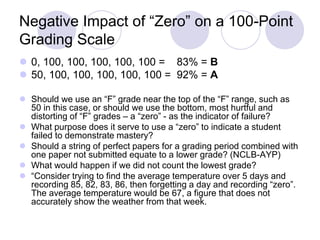
Negative Impact of “Zero” on a 100-Point
Grading Scale
 0, 100, 100, 100, 100, 100 = 83% = B
 50, 100, 100, 100, 100, 100 = 92% = A
 Should we use an “F” grade near the top of the “F” range, such as
50 in this case, or should we use the bottom, most hurtful and
distorting of “F” grades – a “zero” - as the indicator of failure?
 What purpose does it serve to use a “zero” to indicate a student
failed to demonstrate mastery?
 Should a string of perfect papers for a grading period combined with
one paper not submitted equate to a lower grade? (NCLB-AYP)
 What would happen if we did not count the lowest grade?
 “Consider trying to find the average temperature over 5 days and
recording 85, 82, 83, 86, then forgetting a day and recording “zero”.
The average temperature would be 67, a figure that does not
accurately show the weather from that week.
Accurate Grading Policies Rick Stiggins
Determine grades using the median
(middle grade) – not the mean/average.
Look for the most consistent level of
performance, not all performances.
We should not hold a student’s earlier
digressions in the grading period or year
against them.
Effective Grading Practices
-Douglas B. Reeves, Ph.D.
 To reduce failure rate, schools don’t need a new
curriculum, a new administration, new teachers,
or new technology. They just need a better
grading system.
 Grading seems to be regarded as the last
frontier of individual teacher/school discretion.
 The same school leaders and community
members who would be indignant if referees,
judges, etc. were inconsistent in their rulings
continue to tolerate inconsistencies that have
devastating effects on student achievement.
Did You Know………..
 Two common causes of course failures – 1)missing
homework; 2)poor performance on a single major
assignment. Adjusting your policy would have a huge
impact on student failures. (Reeves)
 Assessments are used to provide the ladder for the
student to crawl from his/her hole. Whether it is due to
immaturity, behavior or cognitive readiness level, great
teachers still provide the ladder. (Wormeli)
 Distorted and inaccurate grades are little more than
harsh punishment. Students want to throw down the ball
and go home. They see no reason to play. Grades that
reduce the negative effects of an imperfect grading
system keep students in the game. (Marzano)
The Grade Book
Concepts NOT assignments!
“Page 87” tells us nothing!
If concepts are listed in the grade book:
Teachers can easily tell parents, students, and
administrators what concepts are mastered.
IEP goals and objectives are easily written.
Incomplete grades can be given to individual
concepts- helping to identify areas that need
more instruction.
What should NOT be included in a
grade?
Effort
Participation
Attitude
Behavior
Homework
Group work
Re-Teaching and Re-Testing
In Class re-teaching/retesting
After School re-teaching & Extra Help
Lunch/Recess re-teaching & Extra Help
Student Accountability
Builds Positive Relationships with
Parents/Students
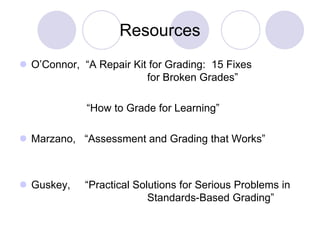
Resources
 O’Connor, “A Repair Kit for Grading: 15 Fixes
for Broken Grades”
“How to Grade for Learning”
 Marzano, “Assessment and Grading that Works”
 Guskey, “Practical Solutions for Serious Problems in
Standards-Based Grading”

Gradingpracticesmphspresentation sept2-110504194943-phpapp01

  • 1.
    Grading Practices Douglas Reeves,Ph.D. Mt. Pleasant High School 2010-2011
  • 2.
    Grading Grades = Feedbackto Improve Performance!  If you have high levels of success and low failure rates, your policy is sound and should be left alone.  If you have low levels of success and high failure rates, what you are doing is not working.  The “Real World” is not “You have one chance at it and you’re done”.  We seldom use “average” for anything else except grades.  Grades must never be used as punishment. It doesn’t work!  Rewards for work done daily are far greater than punishment for work done late.  The Driver’s License Test example – chance to “re-do/re-take”
  • 3.
    Toxic (Ineffective) GradingPolicies  The use of “zeroes” for missing work. Consequence should be to complete the work!  The practice of using the “average” of all scores during the grading period, a formula that presumes that the learning early in the semester is as important as learning at the end of the semester. (Marzano 2000; O’Connor, 2007)  The use of the “grading period killer” – the single project, test, lab, paper, or other assignment that will make or break students.
  • 4.
    Toxic Grading Practicesand Alternatives Toxic  “Zeroes” for missing work  Average/Mean  Grading Period Killer: One Test or Project Alternative  “Get ‘Er Done, Just Do It”, complete/submit missing work  Best representation of work (Re-do, Re-submit)  Resilience, Personal Responsibility (Don’t let them off the hook!)
  • 5.
    The Power ofZeroes Rick Wormeli, Middle Ground  Convert “zeroes” to “50s”  Conversion necessary so that any “calculating” is mathematically justified.  Not using “zeroes” is a more accurate picture of the students’ ability.  “Zero” has an undeserved and devastating effect on students and their grades – so much that no matter what student does, the “zero” distorts the final grade as a true indicator of mastery.  Mathematically and ethically – unacceptable!
  • 6.
    Negative Impact of“Zero” on a 100-Point Grading Scale  0, 100, 100, 100, 100, 100 = 83% = B  50, 100, 100, 100, 100, 100 = 92% = A  Should we use an “F” grade near the top of the “F” range, such as 50 in this case, or should we use the bottom, most hurtful and distorting of “F” grades – a “zero” - as the indicator of failure?  What purpose does it serve to use a “zero” to indicate a student failed to demonstrate mastery?  Should a string of perfect papers for a grading period combined with one paper not submitted equate to a lower grade? (NCLB-AYP)  What would happen if we did not count the lowest grade?  “Consider trying to find the average temperature over 5 days and recording 85, 82, 83, 86, then forgetting a day and recording “zero”. The average temperature would be 67, a figure that does not accurately show the weather from that week.
  • 7.
    Accurate Grading PoliciesRick Stiggins Determine grades using the median (middle grade) – not the mean/average. Look for the most consistent level of performance, not all performances. We should not hold a student’s earlier digressions in the grading period or year against them.
  • 8.
    Effective Grading Practices -DouglasB. Reeves, Ph.D.  To reduce failure rate, schools don’t need a new curriculum, a new administration, new teachers, or new technology. They just need a better grading system.  Grading seems to be regarded as the last frontier of individual teacher/school discretion.  The same school leaders and community members who would be indignant if referees, judges, etc. were inconsistent in their rulings continue to tolerate inconsistencies that have devastating effects on student achievement.
  • 9.
    Did You Know……….. Two common causes of course failures – 1)missing homework; 2)poor performance on a single major assignment. Adjusting your policy would have a huge impact on student failures. (Reeves)  Assessments are used to provide the ladder for the student to crawl from his/her hole. Whether it is due to immaturity, behavior or cognitive readiness level, great teachers still provide the ladder. (Wormeli)  Distorted and inaccurate grades are little more than harsh punishment. Students want to throw down the ball and go home. They see no reason to play. Grades that reduce the negative effects of an imperfect grading system keep students in the game. (Marzano)
  • 10.
    The Grade Book ConceptsNOT assignments! “Page 87” tells us nothing! If concepts are listed in the grade book: Teachers can easily tell parents, students, and administrators what concepts are mastered. IEP goals and objectives are easily written. Incomplete grades can be given to individual concepts- helping to identify areas that need more instruction.
  • 11.
    What should NOTbe included in a grade? Effort Participation Attitude Behavior Homework Group work
  • 12.
    Re-Teaching and Re-Testing InClass re-teaching/retesting After School re-teaching & Extra Help Lunch/Recess re-teaching & Extra Help Student Accountability Builds Positive Relationships with Parents/Students
  • 13.
    Resources  O’Connor, “ARepair Kit for Grading: 15 Fixes for Broken Grades” “How to Grade for Learning”  Marzano, “Assessment and Grading that Works”  Guskey, “Practical Solutions for Serious Problems in Standards-Based Grading”