
Copyright National Association of Secondary School Principals, the preeminent organization for middle level and high
                  school leadership. For information on NASSP products and service, visit www.principals.org.


                                 n Andy Fleenor, Sarah Lamb, Jennifer Anton, Todd Stinson, and Tony Donen


                                                    The
                 Grades
                  Game                             Most grading systems reward students for their


                 T
                                                   behavior, not whether they’ve mastered the material.

                                                   Changing to a grading system that bases grades on
                                                   mastery enables teachers to give students regular,
                                                   specific feedback about their learning.


                                 he high school conference room is full of adults and one teenager, Amy. Evenly
                                   distributed around the table are the math teacher, Amy’s parents, an assis-
                         tant principal, a special education teacher, Amy, and the principal. Such meetings are
                         almost never held to applaud the successes of the student, and this one is no excep-
                         tion. The topics today are Amy’s failing math grade and questionable graduation status.
                         The most uncomfortable person in the room is also the youngest, perhaps because she
                         knows exactly what is coming. Here’s the funny thing: everybody in the room knows
                         what discussion is about to take place. And although this is really not funny, everybody
                         also has a pretty good idea that an identical meeting will be needed in the future.
                             As you no doubt have already guessed, the focus of the meeting is the contents of
                         Amy’s grade report, particularly the category labeled “Homework.” Amy, it seems, had
                         not been doing any homework, and as a direct result, she failed several quizzes and
                         tests. Amy, the adults agree, is perfectly capable of doing well in math if she would
                         only apply herself. The person in question, driven to end this meeting as quickly as
                         possible and with the fewest consequences as possible, also agrees. So it is settled: Amy
                         will do her homework, apply herself, and everything will work out fine. Hands are
                         shaken, friendly goodbyes spoken, and everyone goes on about their business.
                             Fast forward one month: another meeting with the same players and the same script.
                         Such meetings are conducted daily across the United States, and only a tiny minority
                         makes any worthwhile change in the success level of the student. The fault for such
                         failure does not fall at the feet of the students, but rather at the feet of teachers and


48   z   Principal Leadership   z febr uary 2011
f e b r u a ry 2 0 1 1 z   Principal Leadership   z   49
Resources

As you begin to evaluate your                          as, “You need to pay more attention in class.” The goal, then, is to
grading system, the following resources will help      communicate specific, learning-based feedback in a student-friendly
you build your own knowledge of good grading           manner, and the best method of communication is in grade reports
and assessment practices.                              that use a learning-based or standards-based gradebook.
A Repair Kit for Grading: 15 Fixes for Broken
Grades by Ken O’Connor (2007, Educational
                                                       Learning, not Behavior
                                                       If you like a challenge, take a look at a typical grade report of a typical
Testing Service) is an excellent starting point
                                                       student in a typical class in your school and try to decipher what he
that helps readers focus on specific aspects of
                                                       or she is good at and what he or she is bad at. Some things are easy
grading.
                                                       to find out—he doesn’t do homework, she doesn’t study for tests, he
Classroom Assessment for Student Learning              misses a lot of school. Some things, with a bit of imagination, can be
by Rick Stiggins, Judy Arter, Jan Chappuis, and        presumed—it’s easy to tell that she cheats on homework because her
Steve Chappuis (2004, Assessment Training              homework grade is good but she fails all the tests. Or that he is bored
Institute) gives an overall perspective on what it     because he never does his homework, but he aces all the tests.
means to develop assessments that are focused               To take the challenge to the next level, look back at what you
on providing students with specific feedback for       said were strengths and weaknesses and see how many were behav-
improvement and offers a detailed step-by-step         ior-related as opposed to learning-related.
process on implementing good assessments.                   n Doesn’t do homework (behavior)
Grades Don’t Matter by Tony Donen, Jennifer                 n Doesn’t study (behavior)
Anton, Lisa Beard, Todd Stinson, and Glenda                 n Misses school a lot (behavior)
Sullivan (2010, Armour&Armour Publications) is              n Cheats on homework (behavior).
an easy read with real examples and testimonies
of what it looks like when theory is put into          Bored Behavior
practice.                                              It can be quite alarming (and eye-opening) to see exactly how many
                                                       of the grades students receive are based on their behaviors rather
                                                       than their learning. If you are teaching U.S. History, shouldn’t your
                                                       students’ grades be determined by how much they know about the
administrators who are giving such poor advice         subject and how they use the subject to solve problems? If your
to improve performance. Imagine observing an           answer is yes, then how can such assignments as word searches and
inexperienced teacher who has poor classroom           defining key terms from the book affect their overall grades?
management skills and delivers unengaging les-             Students should be assessed on what they know and can use
sons. What advice would you give him or her in         rather than on their behavior. The reality, unfortunately, is that the
a post-observation meeting? Would you tell him         opposite is often the case. Grades for students who work hard are
to work harder, to do more planning at home, to        frequently inflated, and when performance is essential, such as on
apply himself more to the job? Of course not.          high-stakes assessments, students fall short and use the excuse that
You would identify specific areas of strengths and     they are poor test takers. Also, although grades that are based on be-
weaknesses and offer practical, specific advice that   haviors reward the hardworkers and those students who are forever
will improve his or her teaching.                      compliant, they punish students who have yet to figure out how
    In regards to improving performance, students      to “do school.” To alleviate this inequity, schools must change their
are no different than adults. Amy did not need         grading practices. Fortunately, one simple change is all that is needed
to be told to work harder, primarily because she       to start the ball rolling.
didn’t know what to focus on. Instead of vague,
behavior-based remedies, she needed specific,          Changing the Game
learning-based remedies. Instead of a “work            Tommy Jenkins and Mary Smith are students in Honors Precalculus,
harder” treatment, she needed a “come in for extra     and both of them show a 78% as their current grade. One might
help on solving equations” treatment. When told        assume that they are similar students. As you dig deeper into their
to focus on specific areas, students will succeed      grade reports (and thus their teacher’s gradebook), you get a good
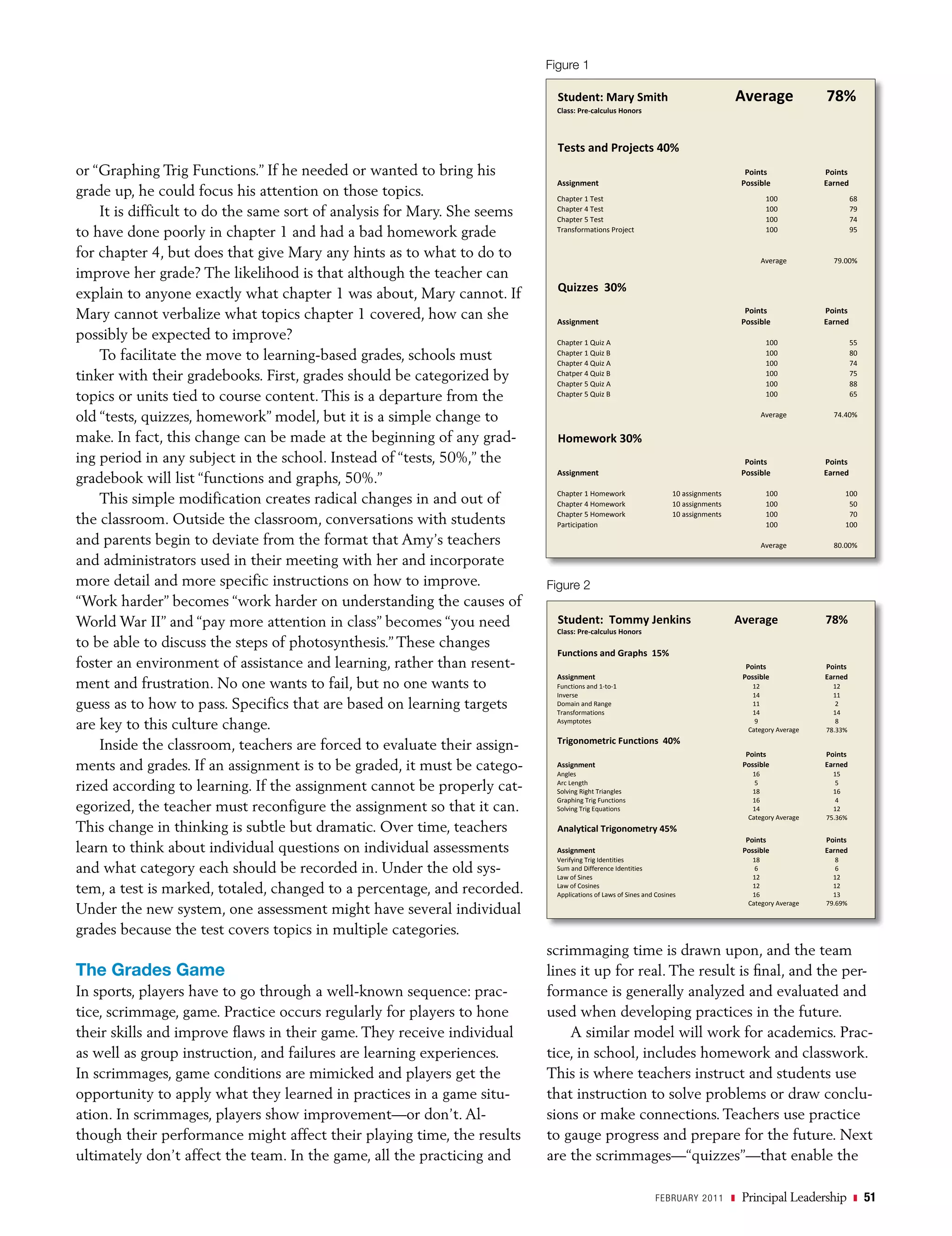
at a much higher rate than when they are offered       feel for Tommy but not so much for Mary. (See figures 1 and 2.) It is
overly general and nonspecific feedback, such          plain to see that Tommy does not understand “Domain and Range”

50   z   Principal Leadership   z febr uary 2011
Figure 1

                                                                            Student: Mary Smith                                          Average             78%
                                                                            Class: Pre-calculus Honors


                                                                            Tests and Projects 40%
or “Graphing Trig Functions.” If he needed or wanted to bring his                                                                         Points             Points
                                                                            Assignment                                                   Possible            Earned
grade up, he could focus his attention on those topics.                     Chapter 1 Test                                                     100                    68
    It is difficult to do the same sort of analysis for Mary. She seems     Chapter 4 Test
                                                                            Chapter 5 Test
                                                                                                                                               100
                                                                                                                                               100
                                                                                                                                                                      79
                                                                                                                                                                      74
to have done poorly in chapter 1 and had a bad homework grade               Transformations Project                                            100                    95


for chapter 4, but does that give Mary any hints as to what to do to                                                                          Average          79.00%
improve her grade? The likelihood is that although the teacher can
                                                                            Quizzes 30%
explain to anyone exactly what chapter 1 was about, Mary cannot. If
Mary cannot verbalize what topics chapter 1 covered, how can she            Assignment
                                                                                                                                          Points
                                                                                                                                         Possible
                                                                                                                                                             Points
                                                                                                                                                             Earned
possibly be expected to improve?                                            Chapter 1 Quiz A                                                   100                    55
    To facilitate the move to learning-based grades, schools must           Chapter 1 Quiz B
                                                                            Chapter 4 Quiz A
                                                                                                                                               100
                                                                                                                                               100
                                                                                                                                                                      80
                                                                                                                                                                      74
tinker with their gradebooks. First, grades should be categorized by        Chatper 4 Quiz B
                                                                            Chapter 5 Quiz A
                                                                                                                                               100
                                                                                                                                               100
                                                                                                                                                                      75
                                                                                                                                                                      88
topics or units tied to course content. This is a departure from the        Chapter 5 Quiz B                                                   100                    65


old “tests, quizzes, homework” model, but it is a simple change to                                                                            Average          74.40%


make. In fact, this change can be made at the beginning of any grad-        Homework 30%
ing period in any subject in the school. Instead of “tests, 50%,” the                                                                     Points             Points
                                                                            Assignment                                                   Possible            Earned
gradebook will list “functions and graphs, 50%.”
                                                                            Chapter 1 Homework                     10 assignments              100                100
    This simple modification creates radical changes in and out of          Chapter 4 Homework                     10 assignments              100                 50
                                                                            Chapter 5 Homework                     10 assignments              100                 70
the classroom. Outside the classroom, conversations with students           Participation                                                      100                100

and parents begin to deviate from the format that Amy’s teachers                                                                              Average          80.00%

and administrators used in their meeting with her and incorporate
more detail and more specific instructions on how to improve.             Figure 2
“Work harder” becomes “work harder on understanding the causes of
World War II” and “pay more attention in class” becomes “you need           Student: Tommy Jenkins                                   Average                 78%
                                                                            Class: Pre-calculus Honors
to be able to discuss the steps of photosynthesis.” These changes
                                                                            Functions and Graphs 15%
foster an environment of assistance and learning, rather than resent-                                                                     Points             Points
                                                                            Assignment                                                   Possible            Earned
ment and frustration. No one wants to fail, but no one wants to             Functions and 1-to-1                                           12                  12
                                                                            Inverse                                                        14                  11
guess as to how to pass. Specifics that are based on learning targets       Domain and Range
                                                                            Transformations
                                                                                                                                           11
                                                                                                                                           14
                                                                                                                                                                2
                                                                                                                                                               14

are key to this culture change.                                             Asymptotes                                                      9
                                                                                                                                          Category Average
                                                                                                                                                                8
                                                                                                                                                             78.33%
                                                                            Trigonometric Functions 40%
    Inside the classroom, teachers are forced to evaluate their assign-                                                                   Points             Points
ments and grades. If an assignment is to be graded, it must be catego-      Assignment
                                                                            Angles
                                                                                                                                         Possible
                                                                                                                                           16
                                                                                                                                                             Earned
                                                                                                                                                               15

rized according to learning. If the assignment cannot be properly cat-      Arc Length
                                                                            Solving Right Triangles
                                                                                                                                            5
                                                                                                                                           18
                                                                                                                                                                5
                                                                                                                                                               16
                                                                            Graphing Trig Functions                                        16                   4
egorized, the teacher must reconfigure the assignment so that it can.       Solving Trig Equations                                         14                  12
                                                                                                                                          Category Average   75.36%
This change in thinking is subtle but dramatic. Over time, teachers         Analytical Trigonometry 45%
                                                                                                                                          Points             Points
learn to think about individual questions on individual assessments         Assignment                                                   Possible            Earned
                                                                            Verifying Trig Identities                                      18                   8
and what category each should be recorded in. Under the old sys-            Sum and Difference Identities
                                                                            Law of Sines
                                                                                                                                            6
                                                                                                                                           12
                                                                                                                                                                6
                                                                                                                                                               12
tem, a test is marked, totaled, changed to a percentage, and recorded.      Law of Cosines
                                                                            Applications of Laws of Sines and Cosines
                                                                                                                                           12
                                                                                                                                           16
                                                                                                                                                               12
                                                                                                                                                               13
                                                                                                                                          Category Average   79.69%
Under the new system, one assessment might have several individual
grades because the test covers topics in multiple categories.
                                                                          scrimmaging time is drawn upon, and the team
The Grades Game                                                           lines it up for real. The result is final, and the per-
In sports, players have to go through a well-known sequence: prac-        formance is generally analyzed and evaluated and
tice, scrimmage, game. Practice occurs regularly for players to hone      used when developing practices in the future.
their skills and improve flaws in their game. They receive individual         A similar model will work for academics. Prac-
as well as group instruction, and failures are learning experiences.      tice, in school, includes homework and classwork.
In scrimmages, game conditions are mimicked and players get the           This is where teachers instruct and students use
opportunity to apply what they learned in practices in a game situ-       that instruction to solve problems or draw conclu-
ation. In scrimmages, players show improvement—or don’t. Al-              sions or make connections. Teachers use practice
though their performance might affect their playing time, the results     to gauge progress and prepare for the future. Next
ultimately don’t affect the team. In the game, all the practicing and     are the scrimmages—“quizzes”—that enable the

                                                                                                              f e b r u a ry 2 0 1 1 z   Principal Leadership         z    51
teacher to check the pulse of the class. Quizzes       Conclusion
shouldn’t define a student’s success or failure, but   Teachers and administrators realize that grades are a game and that
should instead be a barometer for both the teacher     often the winners are those students who do the most work. But
and the student about the progress being made.         quantity should not trump quality. Grades should be based on what
    After scrimmaging (and discussing the suc-         students know and can do, rather than on how much work they can
cesses and failures of the scrimmage), it’s time       (and will) complete. Students should receive regular and specific
for a game, or test. Tests matter because they are     feedback about what they know and don’t know. Offering regular,
opportunities for students to show exactly what        specific feedback and grading that are based on learning and not
they can and can’t do, what they do and don’t un-      behavior will have an immediate positive impact on your school. It
derstand, what they know and don’t know. Ideally,      will redefine students’ role in the learning process, completely alter
like in sports, practicing and scrimmaging have        communication patterns with students and parents, and ultimately
prepared students for the game (test), and the         will improve performance top to bottom. PL
results can almost be predicted. In sports, practice
and scrimmage are essential pieces to success, but     Andy Fleenor (andyfleenor@thegradesgame.com) is the head of the mathematics
in the end no one really cares about the athletes’     department at Fairview (TN) High School.

practice habits or scrimmage performance. The          Sarah Lamb (sarahlamb@thegradesgame.com) is the assistant principal for grades 11 and
only thing that matters is how well they play the      12 at Fairview.

game. In school, how much should we really care        Jennifer Anton (jenniferanton@thegradesgame.com) is an assistant principal at
about students’ homework habits or performance         Independence High School in Thompson’s Station, TN.

on quizzes? They are important, yes. They should       Todd Stinson (toddstinson@thegradesgame.com) is the assistant principal for grades 9 and
be used to help the students, absolutely. But they     10 at Fairview.

should not affect students’ grades.                    Tony Donen (tonydonen@thegradesgame.com) is the principal of Fairview.


52   z   Principal Leadership   z febr uary 2011

The Grades Game

  • 1.
    Copyright National Associationof Secondary School Principals, the preeminent organization for middle level and high school leadership. For information on NASSP products and service, visit www.principals.org. n Andy Fleenor, Sarah Lamb, Jennifer Anton, Todd Stinson, and Tony Donen The Grades Game Most grading systems reward students for their T behavior, not whether they’ve mastered the material. Changing to a grading system that bases grades on mastery enables teachers to give students regular, specific feedback about their learning. he high school conference room is full of adults and one teenager, Amy. Evenly distributed around the table are the math teacher, Amy’s parents, an assis- tant principal, a special education teacher, Amy, and the principal. Such meetings are almost never held to applaud the successes of the student, and this one is no excep- tion. The topics today are Amy’s failing math grade and questionable graduation status. The most uncomfortable person in the room is also the youngest, perhaps because she knows exactly what is coming. Here’s the funny thing: everybody in the room knows what discussion is about to take place. And although this is really not funny, everybody also has a pretty good idea that an identical meeting will be needed in the future. As you no doubt have already guessed, the focus of the meeting is the contents of Amy’s grade report, particularly the category labeled “Homework.” Amy, it seems, had not been doing any homework, and as a direct result, she failed several quizzes and tests. Amy, the adults agree, is perfectly capable of doing well in math if she would only apply herself. The person in question, driven to end this meeting as quickly as possible and with the fewest consequences as possible, also agrees. So it is settled: Amy will do her homework, apply herself, and everything will work out fine. Hands are shaken, friendly goodbyes spoken, and everyone goes on about their business. Fast forward one month: another meeting with the same players and the same script. Such meetings are conducted daily across the United States, and only a tiny minority makes any worthwhile change in the success level of the student. The fault for such failure does not fall at the feet of the students, but rather at the feet of teachers and 48 z Principal Leadership z febr uary 2011
  • 2.
    f e br u a ry 2 0 1 1 z Principal Leadership z 49
  • 3.
    Resources As you beginto evaluate your as, “You need to pay more attention in class.” The goal, then, is to grading system, the following resources will help communicate specific, learning-based feedback in a student-friendly you build your own knowledge of good grading manner, and the best method of communication is in grade reports and assessment practices. that use a learning-based or standards-based gradebook. A Repair Kit for Grading: 15 Fixes for Broken Grades by Ken O’Connor (2007, Educational Learning, not Behavior If you like a challenge, take a look at a typical grade report of a typical Testing Service) is an excellent starting point student in a typical class in your school and try to decipher what he that helps readers focus on specific aspects of or she is good at and what he or she is bad at. Some things are easy grading. to find out—he doesn’t do homework, she doesn’t study for tests, he Classroom Assessment for Student Learning misses a lot of school. Some things, with a bit of imagination, can be by Rick Stiggins, Judy Arter, Jan Chappuis, and presumed—it’s easy to tell that she cheats on homework because her Steve Chappuis (2004, Assessment Training homework grade is good but she fails all the tests. Or that he is bored Institute) gives an overall perspective on what it because he never does his homework, but he aces all the tests. means to develop assessments that are focused To take the challenge to the next level, look back at what you on providing students with specific feedback for said were strengths and weaknesses and see how many were behav- improvement and offers a detailed step-by-step ior-related as opposed to learning-related. process on implementing good assessments. n Doesn’t do homework (behavior) Grades Don’t Matter by Tony Donen, Jennifer n Doesn’t study (behavior) Anton, Lisa Beard, Todd Stinson, and Glenda n Misses school a lot (behavior) Sullivan (2010, Armour&Armour Publications) is n Cheats on homework (behavior). an easy read with real examples and testimonies of what it looks like when theory is put into Bored Behavior practice. It can be quite alarming (and eye-opening) to see exactly how many of the grades students receive are based on their behaviors rather than their learning. If you are teaching U.S. History, shouldn’t your students’ grades be determined by how much they know about the administrators who are giving such poor advice subject and how they use the subject to solve problems? If your to improve performance. Imagine observing an answer is yes, then how can such assignments as word searches and inexperienced teacher who has poor classroom defining key terms from the book affect their overall grades? management skills and delivers unengaging les- Students should be assessed on what they know and can use sons. What advice would you give him or her in rather than on their behavior. The reality, unfortunately, is that the a post-observation meeting? Would you tell him opposite is often the case. Grades for students who work hard are to work harder, to do more planning at home, to frequently inflated, and when performance is essential, such as on apply himself more to the job? Of course not. high-stakes assessments, students fall short and use the excuse that You would identify specific areas of strengths and they are poor test takers. Also, although grades that are based on be- weaknesses and offer practical, specific advice that haviors reward the hardworkers and those students who are forever will improve his or her teaching. compliant, they punish students who have yet to figure out how In regards to improving performance, students to “do school.” To alleviate this inequity, schools must change their are no different than adults. Amy did not need grading practices. Fortunately, one simple change is all that is needed to be told to work harder, primarily because she to start the ball rolling. didn’t know what to focus on. Instead of vague, behavior-based remedies, she needed specific, Changing the Game learning-based remedies. Instead of a “work Tommy Jenkins and Mary Smith are students in Honors Precalculus, harder” treatment, she needed a “come in for extra and both of them show a 78% as their current grade. One might help on solving equations” treatment. When told assume that they are similar students. As you dig deeper into their to focus on specific areas, students will succeed grade reports (and thus their teacher’s gradebook), you get a good at a much higher rate than when they are offered feel for Tommy but not so much for Mary. (See figures 1 and 2.) It is overly general and nonspecific feedback, such plain to see that Tommy does not understand “Domain and Range” 50 z Principal Leadership z febr uary 2011
  • 4.
    Figure 1 Student: Mary Smith Average 78% Class: Pre-calculus Honors Tests and Projects 40% or “Graphing Trig Functions.” If he needed or wanted to bring his Points Points Assignment Possible Earned grade up, he could focus his attention on those topics. Chapter 1 Test 100 68 It is difficult to do the same sort of analysis for Mary. She seems Chapter 4 Test Chapter 5 Test 100 100 79 74 to have done poorly in chapter 1 and had a bad homework grade Transformations Project 100 95 for chapter 4, but does that give Mary any hints as to what to do to Average 79.00% improve her grade? The likelihood is that although the teacher can Quizzes 30% explain to anyone exactly what chapter 1 was about, Mary cannot. If Mary cannot verbalize what topics chapter 1 covered, how can she Assignment Points Possible Points Earned possibly be expected to improve? Chapter 1 Quiz A 100 55 To facilitate the move to learning-based grades, schools must Chapter 1 Quiz B Chapter 4 Quiz A 100 100 80 74 tinker with their gradebooks. First, grades should be categorized by Chatper 4 Quiz B Chapter 5 Quiz A 100 100 75 88 topics or units tied to course content. This is a departure from the Chapter 5 Quiz B 100 65 old “tests, quizzes, homework” model, but it is a simple change to Average 74.40% make. In fact, this change can be made at the beginning of any grad- Homework 30% ing period in any subject in the school. Instead of “tests, 50%,” the Points Points Assignment Possible Earned gradebook will list “functions and graphs, 50%.” Chapter 1 Homework 10 assignments 100 100 This simple modification creates radical changes in and out of Chapter 4 Homework 10 assignments 100 50 Chapter 5 Homework 10 assignments 100 70 the classroom. Outside the classroom, conversations with students Participation 100 100 and parents begin to deviate from the format that Amy’s teachers Average 80.00% and administrators used in their meeting with her and incorporate more detail and more specific instructions on how to improve. Figure 2 “Work harder” becomes “work harder on understanding the causes of World War II” and “pay more attention in class” becomes “you need Student: Tommy Jenkins Average 78% Class: Pre-calculus Honors to be able to discuss the steps of photosynthesis.” These changes Functions and Graphs 15% foster an environment of assistance and learning, rather than resent- Points Points Assignment Possible Earned ment and frustration. No one wants to fail, but no one wants to Functions and 1-to-1 12 12 Inverse 14 11 guess as to how to pass. Specifics that are based on learning targets Domain and Range Transformations 11 14 2 14 are key to this culture change. Asymptotes 9 Category Average 8 78.33% Trigonometric Functions 40% Inside the classroom, teachers are forced to evaluate their assign- Points Points ments and grades. If an assignment is to be graded, it must be catego- Assignment Angles Possible 16 Earned 15 rized according to learning. If the assignment cannot be properly cat- Arc Length Solving Right Triangles 5 18 5 16 Graphing Trig Functions 16 4 egorized, the teacher must reconfigure the assignment so that it can. Solving Trig Equations 14 12 Category Average 75.36% This change in thinking is subtle but dramatic. Over time, teachers Analytical Trigonometry 45% Points Points learn to think about individual questions on individual assessments Assignment Possible Earned Verifying Trig Identities 18 8 and what category each should be recorded in. Under the old sys- Sum and Difference Identities Law of Sines 6 12 6 12 tem, a test is marked, totaled, changed to a percentage, and recorded. Law of Cosines Applications of Laws of Sines and Cosines 12 16 12 13 Category Average 79.69% Under the new system, one assessment might have several individual grades because the test covers topics in multiple categories. scrimmaging time is drawn upon, and the team The Grades Game lines it up for real. The result is final, and the per- In sports, players have to go through a well-known sequence: prac- formance is generally analyzed and evaluated and tice, scrimmage, game. Practice occurs regularly for players to hone used when developing practices in the future. their skills and improve flaws in their game. They receive individual A similar model will work for academics. Prac- as well as group instruction, and failures are learning experiences. tice, in school, includes homework and classwork. In scrimmages, game conditions are mimicked and players get the This is where teachers instruct and students use opportunity to apply what they learned in practices in a game situ- that instruction to solve problems or draw conclu- ation. In scrimmages, players show improvement—or don’t. Al- sions or make connections. Teachers use practice though their performance might affect their playing time, the results to gauge progress and prepare for the future. Next ultimately don’t affect the team. In the game, all the practicing and are the scrimmages—“quizzes”—that enable the f e b r u a ry 2 0 1 1 z Principal Leadership z 51
  • 5.
    teacher to checkthe pulse of the class. Quizzes Conclusion shouldn’t define a student’s success or failure, but Teachers and administrators realize that grades are a game and that should instead be a barometer for both the teacher often the winners are those students who do the most work. But and the student about the progress being made. quantity should not trump quality. Grades should be based on what After scrimmaging (and discussing the suc- students know and can do, rather than on how much work they can cesses and failures of the scrimmage), it’s time (and will) complete. Students should receive regular and specific for a game, or test. Tests matter because they are feedback about what they know and don’t know. Offering regular, opportunities for students to show exactly what specific feedback and grading that are based on learning and not they can and can’t do, what they do and don’t un- behavior will have an immediate positive impact on your school. It derstand, what they know and don’t know. Ideally, will redefine students’ role in the learning process, completely alter like in sports, practicing and scrimmaging have communication patterns with students and parents, and ultimately prepared students for the game (test), and the will improve performance top to bottom. PL results can almost be predicted. In sports, practice and scrimmage are essential pieces to success, but Andy Fleenor (andyfleenor@thegradesgame.com) is the head of the mathematics in the end no one really cares about the athletes’ department at Fairview (TN) High School. practice habits or scrimmage performance. The Sarah Lamb (sarahlamb@thegradesgame.com) is the assistant principal for grades 11 and only thing that matters is how well they play the 12 at Fairview. game. In school, how much should we really care Jennifer Anton (jenniferanton@thegradesgame.com) is an assistant principal at about students’ homework habits or performance Independence High School in Thompson’s Station, TN. on quizzes? They are important, yes. They should Todd Stinson (toddstinson@thegradesgame.com) is the assistant principal for grades 9 and be used to help the students, absolutely. But they 10 at Fairview. should not affect students’ grades. Tony Donen (tonydonen@thegradesgame.com) is the principal of Fairview. 52 z Principal Leadership z febr uary 2011