Presented by zunara sabir
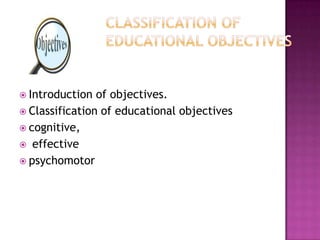
 Introduction  of objectives.
 Classification of educational objectives
 cognitive,
 effective
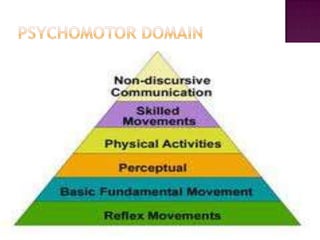
 psychomotor
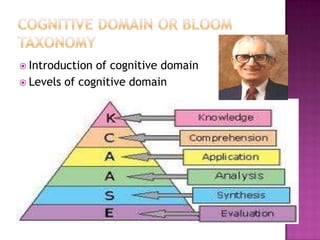
 Introduction of cognitive domain
 Levels of cognitive domain
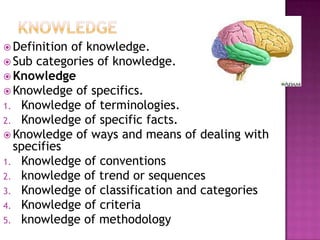
 Definitionof knowledge.
 Sub categories of knowledge.
 Knowledge
 Knowledge of specifics.
1. Knowledge of terminologies.
2. Knowledge of specific facts.
 Knowledge of ways and means of dealing with
  specifies
1. Knowledge of conventions
2. knowledge of trend or sequences
3. Knowledge of classification and categories
4. Knowledge of criteria
5. knowledge of methodology
 knowledge   of universal and abstraction in a
  field
 knowledge of principals and verbalization
 Knowledge of theories and structures.
 Action verb
 defines, describes, identifies, knows, labels,
  lists, matches, names, outlines, recalls, reco
  gnizes, reproduces, selects, states.
Introduction
Sub categories of
 knowledge.
translation
interpretation
Extrapolation
 comprehends, converts, defends, distinguishes, esti
 mates, explains, extends, generalizes, gives
 examples, infers, interprets, paraphrases, predicts,
 rewrites, summarizes, translates.
 Definition of application
 Action verbs
 applies, changes, computes, constructs, dem
  onstrates, discovers, manipulates, modifies,
  operates, predicts, prepares, produces, relat
  es, shows, solves, uses.
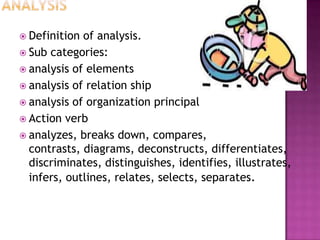
 Definition of analysis.
 Sub categories:
 analysis of elements
 analysis of relation ship
 analysis of organization principal
 Action verb
 analyzes, breaks down, compares,
  contrasts, diagrams, deconstructs, differentiates,
  discriminates, distinguishes, identifies, illustrates,
  infers, outlines, relates, selects, separates.
 Introduction
 Sub categories:
 production of unique communication
 production of a plan or proposed set of
  operation
 Derivation of set of abstract relations.
 Action  verbs
 categorizes, combines, compiles, composes,
  creates, devises, designs, explains,
  generates, modifies, organizes, plans,
  rearranges, reconstructs, relates,
  reorganizes, revises, rewrites, summarizes,
  tells, writes.
 Introduction
 Subcategories
 Judgment    in term of internal evidence.
 Judgment in term of external criteria.
 Action verbs
 appraises, compares, concludes, contrasts,
  criticizes, critiques, defends, describes,
  discriminates, evaluates, explains, interprets,
  justifies, relates, summarizes, supports.
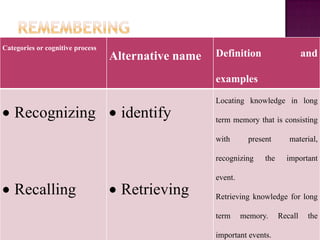
Categories or cognitive process
                                  Alternative name   Definition                     and

                                                     examples
                                                     Locating knowledge in long
   Recognizing                      identify         term memory that is consisting

                                                     with       present       material,

                                                     recognizing     the     important

                                                     event.
   Recalling                        Retrieving       Retrieving knowledge for long

                                                     term     memory.      Recall    the

                                                     important events.
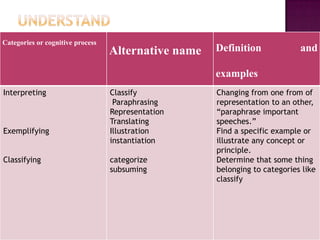
Categories or cognitive process
                                  Alternative name   Definition             and

                                                     examples
Interpreting                      Classify           Changing from one from of
                                   Paraphrasing      representation to an other,
                                  Representation     “paraphrase important
                                  Translating        speeches.”
Exemplifying                      Illustration       Find a specific example or
                                  instantiation      illustrate any concept or
                                                     principle.
Classifying                       categorize         Determine that some thing
                                  subsuming          belonging to categories like
                                                     classify
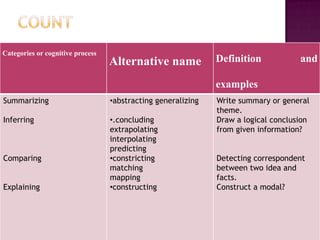
Categories or cognitive process
                                  Alternative name            Definition            and

                                                              examples
Summarizing                       •abstracting generalizing   Write summary or general
                                                              theme.
Inferring                         •.concluding                Draw a logical conclusion
                                  extrapolating               from given information?
                                  interpolating
                                  predicting
Comparing                         •constricting               Detecting correspondent
                                  matching                    between two idea and
                                  mapping                     facts.
Explaining                        •constructing               Construct a modal?
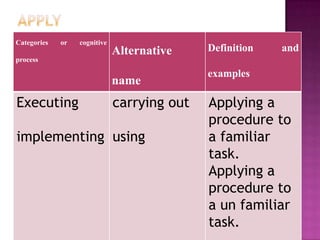
Categories   or   cognitive
                              Alternative    Definition   and
process

                                             examples
                              name
Executing                     carrying out   Applying a
                                             procedure to
implementing using                           a familiar
                                             task.
                                             Applying a
                                             procedure to
                                             a un familiar
                                             task.
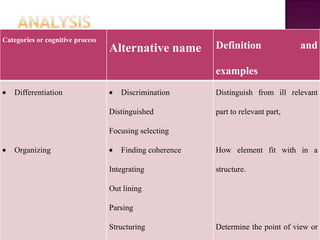
Categories or cognitive process
                                  Alternative name       Definition               and

                                                         examples
   Differentiation                   Discrimination      Distinguish from ill relevant

                                  Distinguished          part to relevant part,

                                  Focusing selecting

   Organizing                        Finding coherence   How element fit with in a

                                  Integrating            structure.

                                  Out lining

                                  Parsing

                                  Structuring            Determine the point of view or
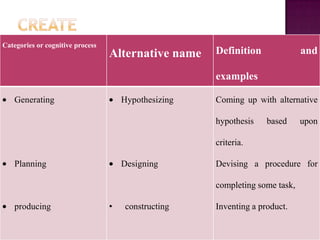
Categories or cognitive process
                                  Alternative name    Definition              and

                                                      examples

   Generating                         Hypothesizing   Coming up with alternative

                                                      hypothesis    based     upon

                                                      criteria.

   Planning                           Designing       Devising a procedure for

                                                      completing some task,

   producing                      •   constructing    Inventing a product.
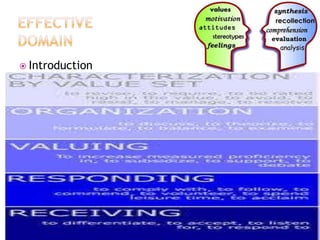
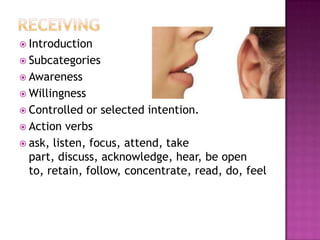
 Introduction
 Introduction
 Subcategories
 Awareness
 Willingness
 Controlled  or selected intention.
 Action verbs
 ask, listen, focus, attend, take
  part, discuss, acknowledge, hear, be open
  to, retain, follow, concentrate, read, do, feel
 Introduction
  Subcategories
 Acquiescence in responding
 Willingness to response
 Satisfaction to response
 Action verb
 react, respond, seek
  clarification, interpret, clarify, provide other
  references and
  examples, contribute, question, present, cite, beco
  me animated or excited, help team, write, perform
 Introduction
 Subcategories
 Acceptance  of value
 preference for a value
 Commitment
 Action verb
 argue, challenge, debate, refute, confront, justify,
  persuade, criticize
 Introduction
 Subcategories
 Conceptualization   of a value
 organization of a value
 Action verbs
 build, develop, formulate, defend, modify, relate, p
  riorities, reconcile, contrast, arrange, compare
 Introduction
 Subcategories
 Generalization   set
 Characterization
 Action verbs
 act, display, influence, solve, practice,
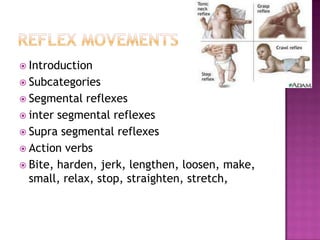
 Introduction
 Subcategories
 Segmental  reflexes
 inter segmental reflexes
 Supra segmental reflexes
 Action verbs
 Bite, harden, jerk, lengthen, loosen, make,
  small, relax, stop, straighten, stretch,
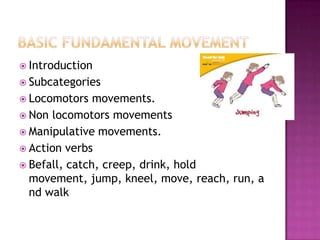
 Introduction
 Subcategories
 Locomotors   movements.
 Non locomotors movements
 Manipulative movements.
 Action verbs
 Befall, catch, creep, drink, hold
  movement, jump, kneel, move, reach, run, a
  nd walk
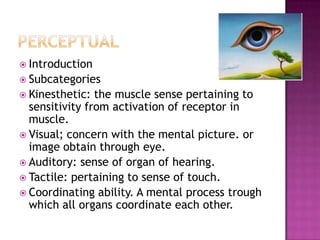
 Introduction
 Subcategories
 Kinesthetic:  the muscle sense pertaining to
  sensitivity from activation of receptor in
  muscle.
 Visual; concern with the mental picture. or
  image obtain through eye.
 Auditory: sense of organ of hearing.
 Tactile: pertaining to sense of touch.
 Coordinating ability. A mental process trough
  which all organs coordinate each other.
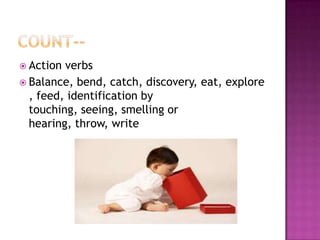
 Action verbs
 Balance, bend, catch, discovery, eat, explore
  , feed, identification by
  touching, seeing, smelling or
  hearing, throw, write
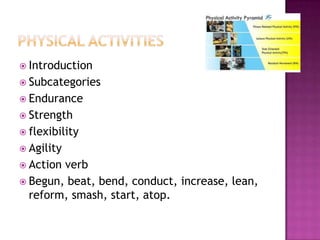
 Introduction
 Subcategories
 Endurance
 Strength
 flexibility
 Agility
 Actionverb
 Begun, beat, bend, conduct, increase, lean,
  reform, smash, start, atop.
 Introduction
 Subcategories
 Simple  skill
 Compound skill
 Complex skill
 Action verb
 Dance, dig, dive, knit, play, row, skate,
  shoot, swim, type.
 Introduction
 Subcategories
 Expressive movement
 Interpretive movement.
 Action verbs
 Mimic, pose, sit, sketch, smile, communicati
  on, stand, tease
 introduction
 Essentialpart
 Optional part
1. Level of achievement
2. Condition of performance
 Characteristic
 Advantages
 Methods
 RobertMager’s approach
 Robert Miller’s approach
 RCEM approach
 This approach consider that objectives
  should be written in followings ways
 Identify the terminal behavior and define it.
 Important behavior under which the
  expected behaviors would be accrued.
 Criteria which help to compare the learner
  behavior.
 Draw back of Robert Approach
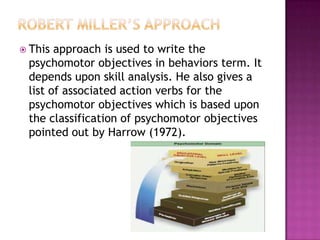
 This approach is used to write the
 psychomotor objectives in behaviors term. It
 depends upon skill analysis. He also gives a
 list of associated action verbs for the
 psychomotor objectives which is based upon
 the classification of psychomotor objectives
 pointed out by Harrow (1972).
 Introduction
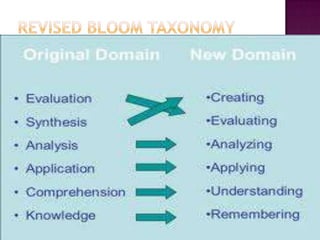
     Taxonomy         of educational objectives in
       RCEM
Bloom taxonomy of objectives         RCEM taxonomy of objectives


1. Knowledge                         1. Knowledge

2. Comprehension                     2. Understanding

3. Application                       3. application

4. Analysis                          4. creativity

5. Synthesis
   Mental process
       Recall
       Recognized
       seeing relation ship
       cite example
       discrimination
       classify
       interpret
       verify
       generalize
       reason out
       formulate hypothesis
       establish hypothesis
       infer
       predict
       analyze
       synthesize
Classification of educational objectives

Classification of educational objectives

  • 2.
  • 3.
     Introduction of objectives.  Classification of educational objectives  cognitive,  effective  psychomotor
  • 4.
     Introduction ofcognitive domain  Levels of cognitive domain
  • 5.
     Definitionof knowledge. Sub categories of knowledge.  Knowledge  Knowledge of specifics. 1. Knowledge of terminologies. 2. Knowledge of specific facts.  Knowledge of ways and means of dealing with specifies 1. Knowledge of conventions 2. knowledge of trend or sequences 3. Knowledge of classification and categories 4. Knowledge of criteria 5. knowledge of methodology
  • 6.
     knowledge of universal and abstraction in a field  knowledge of principals and verbalization  Knowledge of theories and structures.  Action verb  defines, describes, identifies, knows, labels, lists, matches, names, outlines, recalls, reco gnizes, reproduces, selects, states.
  • 7.
    Introduction Sub categories of knowledge. translation interpretation Extrapolation
  • 8.
     comprehends, converts,defends, distinguishes, esti mates, explains, extends, generalizes, gives examples, infers, interprets, paraphrases, predicts, rewrites, summarizes, translates.
  • 9.
     Definition ofapplication  Action verbs  applies, changes, computes, constructs, dem onstrates, discovers, manipulates, modifies, operates, predicts, prepares, produces, relat es, shows, solves, uses.
  • 10.
     Definition ofanalysis.  Sub categories:  analysis of elements  analysis of relation ship  analysis of organization principal  Action verb  analyzes, breaks down, compares, contrasts, diagrams, deconstructs, differentiates, discriminates, distinguishes, identifies, illustrates, infers, outlines, relates, selects, separates.
  • 11.
     Introduction  Subcategories:  production of unique communication  production of a plan or proposed set of operation  Derivation of set of abstract relations.
  • 12.
     Action verbs  categorizes, combines, compiles, composes, creates, devises, designs, explains, generates, modifies, organizes, plans, rearranges, reconstructs, relates, reorganizes, revises, rewrites, summarizes, tells, writes.
  • 13.
     Introduction  Subcategories Judgment in term of internal evidence.  Judgment in term of external criteria.  Action verbs  appraises, compares, concludes, contrasts, criticizes, critiques, defends, describes, discriminates, evaluates, explains, interprets, justifies, relates, summarizes, supports.
  • 15.
    Categories or cognitiveprocess Alternative name Definition and examples Locating knowledge in long Recognizing identify term memory that is consisting with present material, recognizing the important event. Recalling Retrieving Retrieving knowledge for long term memory. Recall the important events.
  • 16.
    Categories or cognitiveprocess Alternative name Definition and examples Interpreting Classify Changing from one from of Paraphrasing representation to an other, Representation “paraphrase important Translating speeches.” Exemplifying Illustration Find a specific example or instantiation illustrate any concept or principle. Classifying categorize Determine that some thing subsuming belonging to categories like classify
  • 17.
    Categories or cognitiveprocess Alternative name Definition and examples Summarizing •abstracting generalizing Write summary or general theme. Inferring •.concluding Draw a logical conclusion extrapolating from given information? interpolating predicting Comparing •constricting Detecting correspondent matching between two idea and mapping facts. Explaining •constructing Construct a modal?
  • 18.
    Categories or cognitive Alternative Definition and process examples name Executing carrying out Applying a procedure to implementing using a familiar task. Applying a procedure to a un familiar task.
  • 19.
    Categories or cognitiveprocess Alternative name Definition and examples Differentiation Discrimination Distinguish from ill relevant Distinguished part to relevant part, Focusing selecting Organizing Finding coherence How element fit with in a Integrating structure. Out lining Parsing Structuring Determine the point of view or
  • 20.
    Categories or cognitiveprocess Alternative name Definition and examples Generating Hypothesizing Coming up with alternative hypothesis based upon criteria. Planning Designing Devising a procedure for completing some task, producing • constructing Inventing a product.
  • 21.
  • 22.
     Introduction  Subcategories Awareness  Willingness  Controlled or selected intention.  Action verbs  ask, listen, focus, attend, take part, discuss, acknowledge, hear, be open to, retain, follow, concentrate, read, do, feel
  • 23.
     Introduction  Subcategories  Acquiescence in responding  Willingness to response  Satisfaction to response  Action verb  react, respond, seek clarification, interpret, clarify, provide other references and examples, contribute, question, present, cite, beco me animated or excited, help team, write, perform
  • 24.
     Introduction  Subcategories Acceptance of value  preference for a value  Commitment  Action verb  argue, challenge, debate, refute, confront, justify, persuade, criticize
  • 25.
     Introduction  Subcategories Conceptualization of a value  organization of a value  Action verbs  build, develop, formulate, defend, modify, relate, p riorities, reconcile, contrast, arrange, compare
  • 26.
     Introduction  Subcategories Generalization set  Characterization  Action verbs  act, display, influence, solve, practice,
  • 28.
     Introduction  Subcategories Segmental reflexes  inter segmental reflexes  Supra segmental reflexes  Action verbs  Bite, harden, jerk, lengthen, loosen, make, small, relax, stop, straighten, stretch,
  • 29.
     Introduction  Subcategories Locomotors movements.  Non locomotors movements  Manipulative movements.  Action verbs  Befall, catch, creep, drink, hold movement, jump, kneel, move, reach, run, a nd walk
  • 30.
     Introduction  Subcategories Kinesthetic: the muscle sense pertaining to sensitivity from activation of receptor in muscle.  Visual; concern with the mental picture. or image obtain through eye.  Auditory: sense of organ of hearing.  Tactile: pertaining to sense of touch.  Coordinating ability. A mental process trough which all organs coordinate each other.
  • 31.
     Action verbs Balance, bend, catch, discovery, eat, explore , feed, identification by touching, seeing, smelling or hearing, throw, write
  • 32.
     Introduction  Subcategories Endurance  Strength  flexibility  Agility  Actionverb  Begun, beat, bend, conduct, increase, lean, reform, smash, start, atop.
  • 33.
     Introduction  Subcategories Simple skill  Compound skill  Complex skill  Action verb  Dance, dig, dive, knit, play, row, skate, shoot, swim, type.
  • 34.
     Introduction  Subcategories Expressive movement  Interpretive movement.  Action verbs  Mimic, pose, sit, sketch, smile, communicati on, stand, tease
  • 35.
     introduction  Essentialpart Optional part 1. Level of achievement 2. Condition of performance  Characteristic  Advantages  Methods
  • 36.
     RobertMager’s approach Robert Miller’s approach  RCEM approach
  • 37.
     This approachconsider that objectives should be written in followings ways  Identify the terminal behavior and define it.  Important behavior under which the expected behaviors would be accrued.  Criteria which help to compare the learner behavior.  Draw back of Robert Approach
  • 38.
     This approachis used to write the psychomotor objectives in behaviors term. It depends upon skill analysis. He also gives a list of associated action verbs for the psychomotor objectives which is based upon the classification of psychomotor objectives pointed out by Harrow (1972).
  • 39.
     Introduction  Taxonomy of educational objectives in RCEM Bloom taxonomy of objectives RCEM taxonomy of objectives 1. Knowledge 1. Knowledge 2. Comprehension 2. Understanding 3. Application 3. application 4. Analysis 4. creativity 5. Synthesis
  • 40.
    Mental process  Recall  Recognized  seeing relation ship  cite example  discrimination  classify  interpret  verify  generalize  reason out  formulate hypothesis  establish hypothesis  infer  predict  analyze  synthesize