What are the best uses
  for project-based
 learning in higher
     education?
         By:
        Abby
        Anna
         Liz
       Tanisha
Problem-Based Learning
O Problem-based learning (PBL) is an
  educational approach that challenges
  students to "learn to learn.”
O Students work cooperatively in groups to
  seek solutions to real-world problems and
  more importantly, to develop skills to
  become self-directed learners.
Project-Based Learning
O Based on constructivist theory
O Purposing
O Planning
O Executing
O Judging
O MAIN GOAL: Engage your learners
Quote
O Kilpatrick stated, “engaging learners in
  purposeful activities that they help to
  select, plan, implement, and evaluate
  facilitates learners’ learning and helps
  them solve problems and acquire the
  skills and judgment necessary to function
  as adults in a democratic society”
  (Foshay, 1999).
Project-Based Learning
O Has to be used to rebuild real-world
  complexity
O Collaborative learning promotes the
  exchange and reflection on different
  views.
O Uses:
  O Team work skills,
  O alternative perspectives on a problem
  O central skill for performing tasks
Adult Learners
O Adult education is defined as “participation
  in systematic learning activities for the
  purpose of acquiring new knowledge or
  skills or changing attitudes or values, by
  persons who have assumed adult social
  roles” (Lyman, 1999, p. 102).
Common Characteristics
• They are in a continuing process of
growth, not at the start of a process.
• They bring with them a package of
experience and values.
• They come to education with intentions.
• They bring expectations about the learning
process.
• They have competing interests.
• They already have their own set of
patterns of learning (p. 24).
Self-Directed
O Student takes charge of own
  learning, with minimal help from the
  instructor.
O Using: Computer based learning.
Goal-Oriented
O Student come into the learning experience
  knowing the goal they want to achieve.
O Teacher has set up class so students can
  reach their goal.
Relevancy-Oriented
O Learning has to be applicable to the
  student’s work or other responsibilities to
  be of value to them.
O Instructor then identifies objectives for
  adult participants before the course
  begins.
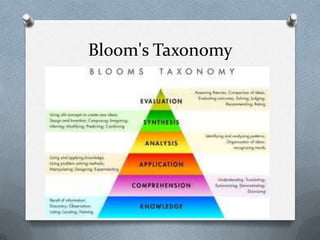
Bloom's Taxonomy
Cont.
O “Benjamin Bloom created this taxonomy for
  categorizing level of abstraction of questions
  that commonly occur in educational settings.
  The taxonomy provides a useful structure in
  which to categorize test questions, since
  professors will characteristically ask questions
  within particular levels, and if you can
  determine the levels of questions that will
  appear on your exams, you will be able to
  study using appropriate strategies.”
LEARNING TO LEARN
O   COOPERATIVE LEARNING SKILLS
O   INQUIRY SKILLS
O   REFLECTION SKILLS
O   ASSESSMENT
O   CONCLUSION
Some challenges for PBL
        classrooms
O Limited experience in group work
  management
O Lack of familiarity with inquiry learning
O Inadequate feedback on learning and
  assessment
Limited experience in group work
          management

O Group work is integral to PBL and students
  need to learn how to make optimal use of their
  time and resources while working in groups.
  Functioning effectively in groups involves
  knowing how to organize the work, distribute
  responsibility, break up complex tasks, and
  provide useful feedback on work that is done.
  Teachers can contribute by helping students
  better understand the merits of group work.
Lack of familiarity with inquiry
             learning

O When faced with problem tasks, students often find it
  difficult to identify the critical issues and to generate
  coherent research designs. They are often unclear
  about how they can relate what they are currently
  reading to what they already know. They are also
  unfamiliar with different stages of the inquiry
  process, such as generating hypotheses, providing
  logical arguments, and transforming data into a
  product. When students have an appropriate learning
  context and the need to seek the necessary
  information, they also see how things finally "come
  together". This is an aspect of critical reading that
  can be promoted within the framework of problem-
  based learning.
Inadequate feedback on learning
       and assessment
O Giving feedback to students is integral to
  improving student learning. Barron et al.
  (1998) suggest that teachers can better guide
  and monitor projects by incorporating
  formative self-reflections by students, by
  creating a classroom culture that supports
  frequent feedback and assessment, and by
  finding ways for students to compare their
  work with others. Teachers can make students
  take their work seriously by incorporating
  opportunities that involve external audiences
  in assessing students' performance.

Ed 335 pbl

  • 1.
    What are thebest uses for project-based learning in higher education? By: Abby Anna Liz Tanisha
  • 2.
    Problem-Based Learning O Problem-basedlearning (PBL) is an educational approach that challenges students to "learn to learn.” O Students work cooperatively in groups to seek solutions to real-world problems and more importantly, to develop skills to become self-directed learners.
  • 3.
    Project-Based Learning O Basedon constructivist theory O Purposing O Planning O Executing O Judging O MAIN GOAL: Engage your learners
  • 4.
    Quote O Kilpatrick stated,“engaging learners in purposeful activities that they help to select, plan, implement, and evaluate facilitates learners’ learning and helps them solve problems and acquire the skills and judgment necessary to function as adults in a democratic society” (Foshay, 1999).
  • 5.
    Project-Based Learning O Hasto be used to rebuild real-world complexity O Collaborative learning promotes the exchange and reflection on different views. O Uses: O Team work skills, O alternative perspectives on a problem O central skill for performing tasks
  • 6.
    Adult Learners O Adulteducation is defined as “participation in systematic learning activities for the purpose of acquiring new knowledge or skills or changing attitudes or values, by persons who have assumed adult social roles” (Lyman, 1999, p. 102).
  • 7.
    Common Characteristics • Theyare in a continuing process of growth, not at the start of a process. • They bring with them a package of experience and values. • They come to education with intentions. • They bring expectations about the learning process. • They have competing interests. • They already have their own set of patterns of learning (p. 24).
  • 8.
    Self-Directed O Student takescharge of own learning, with minimal help from the instructor. O Using: Computer based learning.
  • 9.
    Goal-Oriented O Student comeinto the learning experience knowing the goal they want to achieve. O Teacher has set up class so students can reach their goal.
  • 10.
    Relevancy-Oriented O Learning hasto be applicable to the student’s work or other responsibilities to be of value to them. O Instructor then identifies objectives for adult participants before the course begins.
  • 11.
  • 12.
    Cont. O “Benjamin Bloomcreated this taxonomy for categorizing level of abstraction of questions that commonly occur in educational settings. The taxonomy provides a useful structure in which to categorize test questions, since professors will characteristically ask questions within particular levels, and if you can determine the levels of questions that will appear on your exams, you will be able to study using appropriate strategies.”
  • 13.
    LEARNING TO LEARN O COOPERATIVE LEARNING SKILLS O INQUIRY SKILLS O REFLECTION SKILLS O ASSESSMENT O CONCLUSION
  • 14.
    Some challenges forPBL classrooms O Limited experience in group work management O Lack of familiarity with inquiry learning O Inadequate feedback on learning and assessment
  • 15.
    Limited experience ingroup work management O Group work is integral to PBL and students need to learn how to make optimal use of their time and resources while working in groups. Functioning effectively in groups involves knowing how to organize the work, distribute responsibility, break up complex tasks, and provide useful feedback on work that is done. Teachers can contribute by helping students better understand the merits of group work.
  • 16.
    Lack of familiaritywith inquiry learning O When faced with problem tasks, students often find it difficult to identify the critical issues and to generate coherent research designs. They are often unclear about how they can relate what they are currently reading to what they already know. They are also unfamiliar with different stages of the inquiry process, such as generating hypotheses, providing logical arguments, and transforming data into a product. When students have an appropriate learning context and the need to seek the necessary information, they also see how things finally "come together". This is an aspect of critical reading that can be promoted within the framework of problem- based learning.
  • 17.
    Inadequate feedback onlearning and assessment O Giving feedback to students is integral to improving student learning. Barron et al. (1998) suggest that teachers can better guide and monitor projects by incorporating formative self-reflections by students, by creating a classroom culture that supports frequent feedback and assessment, and by finding ways for students to compare their work with others. Teachers can make students take their work seriously by incorporating opportunities that involve external audiences in assessing students' performance.