By
Elayne Wyatt
2015
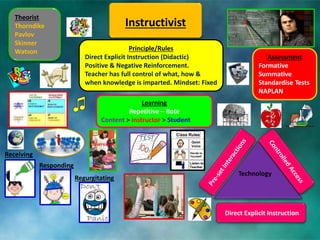
Instructivist
Direct Explicit Instruction
Theorist
Thorndike
Pavlov
Skinner
Watson
Technology
Principle/Rules
Direct Explicit Instruction (Didactic)
Positive & Negative Reinforcement.
Teacher has full control of what, how &
when knowledge is imparted. Mindset: Fixed
Assessment
Formative
Summative
Standardise Tests
NAPLAN
Receiving
Responding
Learning
Repetitive – Rote
Content > Instructor > Student
Regurgitating
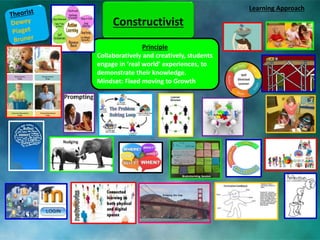
Constructivist
Learning Approach
Principle
Collaboratively and creatively, students
engage in ‘real world’ experiences, to
demonstrate their knowledge.
Mindset: Fixed moving to Growth
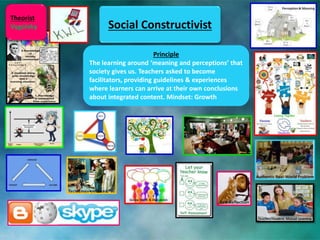
Social Constructivist
Theorist
Vygotsky
Principle
The learning around ‘meaning and perceptions’ that
society gives us. Teachers asked to become
facilitators, providing guidelines & experiences
where learners can arrive at their own conclusions
about integrated content. Mindset: Growth
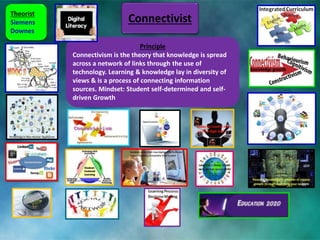
Connectivist
Principle
Connectivism is the theory that knowledge is spread
across a network of links through the use of
technology. Learning & knowledge lay in diversity of
views & is a process of connecting information
sources. Mindset: Student self-determined and self-
driven Growth
Theorist
Siemens
Downes
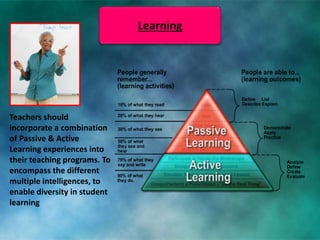
Learning
Teachers should
incorporate a combination
of Passive & Active
Learning experiences into
their teaching programs. To
encompass the different
multiple intelligences, to
enable diversity in student
learning
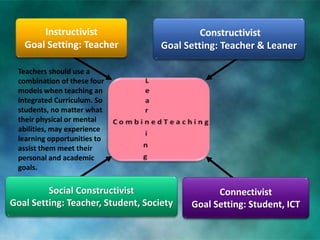
Instructivist
Goal Setting: Teacher
Social Constructivist
Goal Setting: Teacher, Student, Society
Constructivist
Goal Setting: Teacher & Leaner
Connectivist
Goal Setting: Student, ICT
Teachers should use a
combination of these four
models when teaching an
integrated Curriculum. So
students, no matter what
their physical or mental
abilities, may experience
learning opportunities to
assist them meet their
personal and academic
goals.
References
Atkins, Dr. J. (2013, August 6). Instructivism versus Constructivism [Video file]. Retrieved from
https://www.youtube.com/watch?v=DedGcFx2SqA
Burke, S. (2012, February, 12). Connectivism.[Video file]. Retrieved from https://www.youtube.com/watch?v=-
20Oqm1GvsU
Downes, S. (2011, September, 22). Elements of Connectivism. [Video file]. Retrieved from http://education-
2020.wikispaces.com/Connectivism
Farnum, R. (2013, June 12). Social Constructivism. [Video file]. Retrieved from
https://www.youtube.com/watch?v=2wXd5RsCsgo
Fetherston, T (2007). Becoming an Effective Teacher. (pp. 151-201) South Melbourne: Cengage Learning
Gerstein, J. Moving from Education 1.0 Through Education 2.0 Towards Education 3.0. Retrieved from
http://scholarworks.boisestate.edu/cgi/viewcontent.cgi?article=1104&context=edtech_facpubs
Google Images. (2015). Retrieved from
https://www.google.com.au/imghp?hl=en&tab=wi&ei=g1XdVbOsFcGxmwXu3JSoBQ&ved=0CBMQqi4oAQ
Kalantzis, M. & Cope, B. (2012). Literacies. Port Melbourne, VIC: Cambridge University Press
Marsh, C. (2008). Becoming a Teacher: Knowledge, Skills and Issues. French Forest, NSW: Pearson Education
Australia
Readman, K. & Allen, B. (2014). Practical Planning and Assessment. South Melbourne, VIC: Oxford University Press
Teaching Leaning Learning. (2014). Fixed Growth Mindset. Retrieved from
https://chrishildrew.files.wordpress.com/2014/03/fixedgrowth-copy.jpg
UCD Dublin. (2015). Education Theory: Constructivism and Social Constructivism. Retrieved from
http://www.ucdoer.ie/index.php/Education_Theory/Constructivism_and_Social_Constructivism

Models of teaching and learning

  • 1.
  • 2.
    Instructivist Direct Explicit Instruction Theorist Thorndike Pavlov Skinner Watson Technology Principle/Rules DirectExplicit Instruction (Didactic) Positive & Negative Reinforcement. Teacher has full control of what, how & when knowledge is imparted. Mindset: Fixed Assessment Formative Summative Standardise Tests NAPLAN Receiving Responding Learning Repetitive – Rote Content > Instructor > Student Regurgitating
  • 3.
    Constructivist Learning Approach Principle Collaboratively andcreatively, students engage in ‘real world’ experiences, to demonstrate their knowledge. Mindset: Fixed moving to Growth
  • 4.
    Social Constructivist Theorist Vygotsky Principle The learningaround ‘meaning and perceptions’ that society gives us. Teachers asked to become facilitators, providing guidelines & experiences where learners can arrive at their own conclusions about integrated content. Mindset: Growth
  • 5.
    Connectivist Principle Connectivism is thetheory that knowledge is spread across a network of links through the use of technology. Learning & knowledge lay in diversity of views & is a process of connecting information sources. Mindset: Student self-determined and self- driven Growth Theorist Siemens Downes
  • 6.
    Learning Teachers should incorporate acombination of Passive & Active Learning experiences into their teaching programs. To encompass the different multiple intelligences, to enable diversity in student learning
  • 7.
    Instructivist Goal Setting: Teacher SocialConstructivist Goal Setting: Teacher, Student, Society Constructivist Goal Setting: Teacher & Leaner Connectivist Goal Setting: Student, ICT Teachers should use a combination of these four models when teaching an integrated Curriculum. So students, no matter what their physical or mental abilities, may experience learning opportunities to assist them meet their personal and academic goals.
  • 9.
    References Atkins, Dr. J.(2013, August 6). Instructivism versus Constructivism [Video file]. Retrieved from https://www.youtube.com/watch?v=DedGcFx2SqA Burke, S. (2012, February, 12). Connectivism.[Video file]. Retrieved from https://www.youtube.com/watch?v=- 20Oqm1GvsU Downes, S. (2011, September, 22). Elements of Connectivism. [Video file]. Retrieved from http://education- 2020.wikispaces.com/Connectivism Farnum, R. (2013, June 12). Social Constructivism. [Video file]. Retrieved from https://www.youtube.com/watch?v=2wXd5RsCsgo Fetherston, T (2007). Becoming an Effective Teacher. (pp. 151-201) South Melbourne: Cengage Learning Gerstein, J. Moving from Education 1.0 Through Education 2.0 Towards Education 3.0. Retrieved from http://scholarworks.boisestate.edu/cgi/viewcontent.cgi?article=1104&context=edtech_facpubs Google Images. (2015). Retrieved from https://www.google.com.au/imghp?hl=en&tab=wi&ei=g1XdVbOsFcGxmwXu3JSoBQ&ved=0CBMQqi4oAQ Kalantzis, M. & Cope, B. (2012). Literacies. Port Melbourne, VIC: Cambridge University Press Marsh, C. (2008). Becoming a Teacher: Knowledge, Skills and Issues. French Forest, NSW: Pearson Education Australia Readman, K. & Allen, B. (2014). Practical Planning and Assessment. South Melbourne, VIC: Oxford University Press Teaching Leaning Learning. (2014). Fixed Growth Mindset. Retrieved from https://chrishildrew.files.wordpress.com/2014/03/fixedgrowth-copy.jpg UCD Dublin. (2015). Education Theory: Constructivism and Social Constructivism. Retrieved from http://www.ucdoer.ie/index.php/Education_Theory/Constructivism_and_Social_Constructivism