Wastewater
Management
Week 6
Course Outcome
Identify source pollution.
Design on prevention and
control approach.
Evaluate the effectiveness
of prevention and control
approach
Definition
Combination of the liquid or
water-carried wastes removed
from residences, institutions,
commercial and industrial
establishments via toilets, floor
drains as well as other
inadvertent water generally
carried which must be treated.
Source of Wastewater
Wastewater
Toilet Kitchen
Storm
water
Household Industries
Combine
Separated System
Combine System
Point Sources Point Sources
Point Sources Open Dumping
Effect
 The destruction of the receiving water for desirable uses such as
drinking or recreation.
 The production of large amounts of malodorous gases.
 Microscopic pathogens may proliferate and cause disease.
 The nutrients present in wastewater may stimulate aquatic growth
and cause oxygen depletion of the receiving water.
 The toxins such as heavy metals or pesticides present in wastewater
may be poisonous and, therefore, detrimental to the biome.
Malaysia Law
It is mandatory for wastewater in urban areas
and townships to be treated before
discharged into surface waters. The quality of
effluent from treatment plants is regulated by
the Environmental Quality Act 1974 and its
regulations such as the Environmental
Quality (Sewage) Regulations 2009 and
Environmental Quality (Industrial Effluent)
Regulations 2009.
Malaysia Policies
1. The National Water Services Commission
(SPAN) was set-up to regulate the water supply
services and sewerage services industry through
fair, effective, and transparent
implementation of Water Services Industry Act
2006 (Act 655) towards a sustainable, reliable
and affordable water services for all.
2. The Sewerage Services Department is
responsible for the implementation of STP
projects and act as advisory body to the
Ministry of Energy, Green Technology, and
Water pertaining to sewerage issues
Malaysia Policies
3. Indah Water Konsortium, a company owned by the
Minister of Finance Incorporated, is Malaysia's
national sewerage company which has been
entrusted with the task of developing and
maintaining a modern and efficient sewerage
system for all Malaysians.
4. The Department of Environment (DOE) is the
regulatory body for wastewater effluent quality
through the Environmental Quality Act 1974. The
quality of surface water is determined by the Water
Quality Index and the suitability of surface water for
irrigation is based on the designated classifications in
the National Water Quality Standards for Malaysia.
PARAMETER LIMITS OF EFFLUENT
OF STANDARDS A AND B
Standard Parameter Unit A B
(I) Temperature oC 40 40
(ii) pH Value - 6.0-9.0 5.5-9.0
(iii) BOD5 at 20oC mg/1 20 50
(iv) COD mg/1 50 100
(v) Suspended Solids mg/1 50 100
(xxiii) Oil and Grease mg/1 Not
detectable 10.0
Treatment Objective
Mainly concerned with the removal of
suspended and floatable materials,
the treatment of biodegradable
organic and in some cases the
elimination of pathogenic organisms
before discharge to the environment.
Wastewater Treatment
Process
Operating Concept
1. Physical Unit Operations
 Physical unit operations are treatment methods,
which use the application of physical forces to
treat sewage. These include screening, mixing,
flocculation, sedimentation, filtration and
flotation.
2. Chemical Unit Processes
 Treatment methods in which the removal or
conversion of pollutants by the addition of
chemicals or by chemical reactions are known as
Chemical Unit Processes. These include
precipitation, adsorption and disinfection.
3. Biological Unit Processes
 Biological unit processes describe methods, which
remove pollutants by biological activity.
Biodegradable organic substances are converted
into gases that escape to the atmosphere and cell
tissue is removed by settling
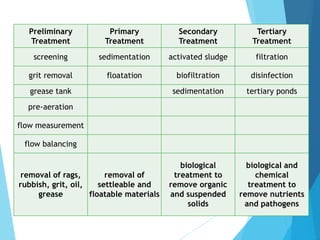
Sewage Treatment Methods
Historically unit operations have been grouped
together to provide various levels of treatment:
Preliminary and/or Primary Treatment refers
to physical unit operations and is the first stage
of treatment applied to any sewage.
Secondary Treatment refers to biological and
chemical unit processes
Tertiary refers to combinations of all three.
Preliminary
Treatment
Primary
Treatment
Secondary
Treatment
Tertiary
Treatment
screening sedimentation activated sludge filtration
grit removal floatation biofiltration disinfection
grease tank sedimentation tertiary ponds
pre-aeration
flow measurement
flow balancing
removal of rags,
rubbish, grit, oil,
grease
removal of
settleable and
floatable materials
biological
treatment to
remove organic
and suspended
solids
biological and
chemical
treatment to
remove nutrients
and pathogens
Sewage Treatment Systems
Aerobic
Processes
Suspended Growth Activated Sludge
- plug flow
- complete mix
- sequencing batch reactor
- extended aeration *
- oxidation ditch *
- deep shaft *
- Aerated Lagoons *
Attached Growth Trickling Filters
- low rate
- high rate *
- Rotating Biological Contactors *
- Submerged Biological Contactors *
Combines Biofilter Activated Sludge
Trickling Filter Activated Sludge *
Anaerobic
Process
Suspended Growth
Attached Growth
Anaerobic Contact
Anaerobic Filter
Expanded Bed
Pond Processes
Aerobic Stabilization (Oxidation)
Facultative
Anaerobic
Sewage Treatment Systems
Primary Treatment Individual Septic Tanks
Communal Septic Tanks
Imhoff Tanks
Secondary Treatment Package (pre fabricated) Plants - activated sludge
systems
- sequencing batch reactors
- contact stabilization
- rotating biological contactors
Individually Designed Plants
- activated sludge systems
- oxidation ponds
- sequencing batch reactors
- rotating biological contactors
- trickling filter
- facultation lagoons
- aerated lagoons
PUBLIC SEWAGE TREATMENT
PLANTS IN MALAYSIA
 In Malaysia, 38% of public sewage treatment plants in
the country are mechanical plants.
No. Types of Sewage Treatment Plant As At Dec 2008
Population
Equivalent
1 Imhoff Tank 760 557,752
2 Oxidation Ponds 436 1,824,403
3 Mechanical Plants 4,026 15,099,139
4 Network Pump Stations 668 3,558,108
TOTAL 5,890 21,039,402
Communal Septic Tank 3,635 433,573
Primary Treatment
(Physical Treatment)
A screen is a device with generally uniform openings that is
used to retain coarse solids. Screens may be divided into
coarse (6 -15 cm), fine (<6cm) and Micro screens (<0.5μm)
Screening
1. 𝒉 𝟏 −
𝑽 𝟐
𝟐𝒈
= 𝒉 𝟐 −
𝑽 𝒔𝒄
𝟐
𝟐𝒈
+ Losses
2. ∆𝒉 = 𝒉 𝟏 - 𝒉 𝟐 =
𝟏
𝟐𝒈𝑪 𝒅
(𝑽 𝒔𝒄-𝑽) 𝟐
𝒉 𝟏= Upstream depth (m)
𝒉 𝟐= Downstream depth (m)
𝑽= Upstream velocity (m/s)
𝑽 𝒔𝒄= Downstream velocity (m/s)
𝑪𝒅= Discharge coefficient (0.7 - 0.84)
Design Factor
Grit Removal
 The purpose of grit removal is to remove inorganic
solids (sand, gravel, clay, egg shells, coffee grounds,
metal filings, seeds, and other similar materials) that
could cause excessive mechanical wear.
 Wastewater systems typically average 0.3 to 4.5 m3 of
grit per 3.8 x 10⁶ L of flow
 In the grit channel, the velocity should decrease to
about 0.34 m/sec to permit heavy inorganic solids to
settle
 Require Settling Time (ST)
ST =
𝐿𝑖𝑞𝑢𝑖𝑑 𝐷𝑒𝑝𝑡𝑕 (𝑚)
𝑆𝑒𝑡𝑡𝑙𝑖𝑛𝑔 𝑣𝑒𝑙𝑜𝑐𝑖𝑡𝑦 (
𝑚
𝑠
)
 Require Channel Length (CL)
CL =
𝐶𝑕𝑎𝑛𝑛𝑒𝑙 𝐷𝑒𝑝𝑡𝑕 𝑚 ×𝑓𝑙𝑜𝑤 𝑣𝑒𝑙𝑜𝑐𝑖𝑡𝑦 (
𝑚
𝑠
)
0.025 𝑚/𝑠
Design Factor
Example
The plant’s grit channel is designed to remove sand, which
has a settling velocity of 0.025 m/sec. The channel is
currently operating at a depth of 1 m. The calculated
velocity of flow through the channel is 0.30 m/sec. The
channel is 12 m long;
1. Calculate settling time
2. Is it long enough to remove the desired sand particle
size?
Example 2
 Average wastewater flowrate = 0.5 m3/s
 Peak factor = 2.7
1. Estimating peak flowrate
2. Determining the grit chamber volume
3. Determining the dimensions of each grit chamber
4. Determining the detention time at average flow
Primary Clarifier
 Primary treatment (primary
sedimentation or clarification) should
remove organic settleable and
organic floatable solids.
 Each primary clarification unit can be
expected to remove
1. 90 to 95% of settleable solids;
2. 40 to 60% of the total suspended
solids;
3. 25 to 35% of BOD.
Design Consideration
1. Detention time
 Coalescence of a suspension of solids becomes more complete
as time elapse
 Provide 1.5-2.5 hr based on the average rate of wastewater
flow
2. Surface loading rates
 Set low enough to ensure satisfactory performance at peak
flow rate
3. Weir loading rates
4. Scour velocity
 To avoid resuspension (scouring) of settled particles,
horizontal velocities through the tank should be kept
sufficiently low
Design Data
Design Data
BOD & TSS Removal
𝑹 =
𝒕
𝒂 + 𝒃𝒕
R = removal efficiency
t = calculated detention time (day)
a & b = empirical constant
Example 1
The settling test was performed in the settling column of
height 2.5 m. Four numbers of ports were provided to the
column at the height of 0.5 m from bottom. Samples were
collected from these ports at every 30 min and the results
obtained are plotted in the Figure 16.1. Determine the
overall removal of solids after 1.0 h of settling.
Solution
Example 2
Design the primary sedimentation tank to treat wastewater
with average flow rate of 10 MLD and peak flow of 22.5
MLD?
Solution
Secondary Treatment
(Biological Treatment)
 Coagulate and remove the non-settleable colloidal solids
and to stabilize the organic matter. Specifically,
1) Transform, oxidize, the dissolved and
particulate biodegradable constituents
into acceptable end products
2) Capture and incorporate suspended and
non-settable colloidal solids into a
biological floc or biofilm
3) Transform or remove nutrients such as N
and P
4) Remove trace organics and compounds
Biological Treatment
Processes
Suspended growth
 The MOs responsible for
treatment are
maintained in liquid
suspension
 Air is provided, MOs are
grown in prodigious
numbers and mixed with
the incoming waste.
 The biomass is then
settled
Attached growth
 The MOs responsible for
treatment are attached
to an packing material
 Air is provided
 The biomass is then
remove from the media
Suspended Growth
Attach Growth
Microbial Metabolism
 primarily bacteria convert the
colloidal and dissolved
carbonaceous organic matter
into gases and cell tissue
 1 (organic matter) + 2O2 +
3NH3 + 4PO4
3-  5 (new
cells) + 6CO2 + 7H20
 Respiratory metabolism.
 Generate energy by enzyme-mediated electron transport from an electron
donor to an external electron acceptor.
 Fermentation metabolism.
 Does not involve the participation of an external electron acceptor.
 Aerobic respiration.
 When molecular oxygen is used as the electron acceptor in respiratory
metabolism.
 Anoxic respiration.
 When respiratory organisms use oxidized inorganic compounds such as nitrate
and nitrite function as electron acceptors.
 Anaerobic .
 Can exist only in environments devoid of oxygen and generate energy by
fermentation.
 Facultative anaerobes.
 Have the ability to grow in either the presence or absence of molecular
oxygen.
Nutrient Requirements
 Carbon:
 Heterotrophs. Use organic carbon as a carbon source for the
production of cell tissue.
 Autotrophs : Derive cell carbon from carbon dioxide.
 Energy
 Phototrophs : Use light as an energy source.
 Chemotrophs : Derive their energy from chemical reactions.
 Nutrients.
 The principal inorganic nutrients are N, S, P, K, Mg, Ca, Fe,
Na and Cl plus minor trace amounts of organic substances,
known as "growth factors" such as amino acids, purines and
vitamins.
Modeling Suspended Growth
Treatment Process
Accumulation = Inflow - Outflow + Net Growth
Complete Mix Reactor With
Activated Sludge
 𝑩𝒊𝒐𝒎𝒂𝒔 𝒊𝒏 + 𝑩𝒊𝒐𝒎𝒂𝒔𝒔 𝑮𝒓𝒐𝒘𝒕𝒉 =
𝑩𝒊𝒐𝒎𝒂𝒔𝒔 𝒐𝒖𝒕 (𝒆𝒇𝒇𝒍𝒖𝒆𝒏𝒕 & 𝒔𝒍𝒖𝒅𝒈𝒆)
𝑄0 𝑋0 + 𝑉
𝑘0 𝑋𝑆
𝐾𝑠 + 𝑆
− 𝑘 𝑑 𝑋
= 𝑄0 − 𝑄 𝑤 𝑋 𝑒 + 𝑄 𝑤 𝑋 𝑢
 𝑭𝒐𝒐𝒅 𝒊𝒏 + 𝑭𝒐𝒐𝒅 𝑪𝒐𝒏𝒔𝒖𝒎𝒆𝒅 = 𝑭𝒐𝒐𝒅 𝒐𝒖𝒕
𝑄0 𝑆0 + 𝑉
𝑘0 𝑋𝑆
𝑌(𝐾𝑠 + 𝑆)
= 𝑄0 − 𝑄 𝑤 𝑆 + 𝑄 𝑤 𝑆
Complete Mix Reactor With
Activated Sludge
Biomass
𝑉
𝑘0 𝑋𝑆
𝐾𝑠 + 𝑆
− 𝑘 𝑑 𝑋 = 𝑄 𝑤 𝑋 𝑢
𝐹𝑜𝑜𝑑
𝑄0 𝑆0 − 𝑉
𝑘0 𝑋𝑆
𝑌(𝐾𝑠 + 𝑆)
= 𝑄0 𝑆
Complete Mix Reactor With
Activated Sludge
Hydraulic retention time
𝑽
𝑸 𝟎
= 𝜽
Mean cell residence time
𝑽𝑿
𝑸 𝒘 𝑿 𝒖
= 𝜽 𝒄
𝟏
𝜽 𝒄
=
𝒀(𝑺 𝟎 − 𝑺)
𝜽𝑿
− 𝒌 𝒅
Mix Liquor Suspended Solid 𝑿 =
𝜽 𝒄 𝒀(𝑺 𝟎−𝑺)
𝜽(𝟏+𝒌 𝒅 𝜽 𝒄)
Example 3
Assume that the primary sedimentation process removes
60% of the suspended solids and 40% of the BOD5 of the raw
sewage
a) Determine the SS and BOD5 concentrations in the
primary sedimentation effluent flow
b) Also determine the mass of primary sludge produced per
day at average flow conditions, as both dry solids and as
wet sludge assuming a sludge concentration of 6% solids
and a specific gravity of 1.03.
Solution
Example 4
 The primary effluent is to be treated by two parallel trains of the
complete mix activated sludge process. Assume average flow
conditions, and the primary sedimentation performance as described.
Assume the following for the activated sludge process:
• Plant effluent BOD5 of 8 mg/L
• Biomass yield of 0.55 kg biomass / kg BOD
• Endogenous decay rate (kd) = 0.04 day-1
• Solids Retention Time (θC) = 8 days
• MLVSS concentration in the aeration tank of 3000 mg/L
• Waste and recycle solids concentration of 12,000 mg/L
a) Determine the aeration tank volume in cubic meters.
b) Determine the mass and volumetric flow rates (kg/day and cubic meters
per day) of wasted sludge.
c) Determine the return (recycle) flow rate in cubic meters per day (and in
MGD).
d) Determine the volumetric BOD loading to the aeration tank in lb BOD per
1000ft3.
e) Determine the food to microorganism ratio (F/M) for the aeration tank in
kg BOD per day per kg MLVSS.
f) Determine the design hydraulic detention time (θ) in hours.
Solution
a) Determine the aeration tank volume in cubic meters.
Solution (cont’)
Solution (cont’)
Solution (cont’)
Treatment Pond
 The primary goals of wastewater treatment ponds focus
on simplicity and flexibility of operation, protection of
the water environment, and protection of public health.
 Ponds are relatively easy to build and manage; they
accommodate large fluctuations in flow and can also
provide treatment that approaches conventional
systems at much lower cost
Aerated Lagoon
𝐵𝑂𝐷 𝑖𝑛 = 𝐵𝑂𝐷 𝑜𝑢𝑡 + 𝐵𝑂𝐷 𝑐𝑜𝑛𝑠𝑢𝑚𝑒𝑑
𝑄𝑆0 = 𝑄𝑆 + 𝑉𝑘𝑆
𝑺
𝑺 𝟎
=
𝟏
𝟏 + 𝒌𝑽/𝑸
=
𝟏
𝟏 + 𝒌𝜽
 S = effluent BOD concentration, milligrams per liter
 So = influent BOD concentration, milligrams per liter
 k = overall first-order BOD removal rate, per day =
0.25 to 1.0, Q = wastewater flow, cubic meters per
day or million gallons per day
 θ = total hydraulic retention time, days
Aerated Lagoon
𝑺 𝒏
𝑺 𝟎
=
𝟏
(𝟏 +
𝒌 𝜽
𝒏
) 𝒏
n = series of pond
𝑇𝑒𝑚𝑝𝑒𝑟𝑎𝑡𝑢𝑟𝑒
𝒌 𝑻
𝒌 𝟐𝟎
= ∅ 𝑻−𝟐𝟎
kT = Rate constant for temperature (d-1)
Modeling Attached Growth
Treatment Process
𝑺 𝒆
𝑺 𝒐
= 𝒆−𝒌𝑫/𝑸 𝒏
 Se = effluent BOD concentration, milligrams per liter
 So = influent BOD concentration, milligrams per liter
 K = treatability constant min-1 range from 0.01-0.1
 D = medium depth (m)
 Q = hydraulic loading m3/m2.min
 n = coefficient related to medium characteristic
𝑺 𝒆
𝑺 𝒂
= 〖
𝒆−𝒌𝑫/𝑸 𝒏
𝟏 + 𝑹 − 𝑹𝒆−𝒌𝑫/𝑸 𝒏 〗
Sa = mix raw and recycle BOD concentration, milligrams per
liter
R= ratio of recycle flow
𝑺 𝒂 =
𝑺 𝟎+𝑹𝑺 𝒆
𝟏+𝑹
Tertiary Treatment
 Advanced level of treatment to remove constituents of
concern including nutrients, toxic compounds, and
increased amounts of organic matter and suspended
solids.
 This level of treatment is utilized when the effluent is
discharged to a sensitive receiving environment or in
water reuse applications.
 The process can be accomplished using a variety of
physical, chemical, or biological treatment processes
to remove targeted pollutants.
Wastewater – Tertiary
Treatment
 Industrial wastes is part of the waste
streams and are not removed in
primary and secondary treatment;
 Some are not biodegradable
 Some are toxic or hazardous
 Tertiary/advanced treatment – use
techniques geared to specific problem
Tertiary Treatment
Wastewater – Tertiary
Treatment
1. Coagulation – settling – filtration
 Process is similar to that used in water
treatment
 Removes
• residual suspended solids
• microorganisms
 Commonly use dual- or multimedia
filters
• sand filters (single media) clog too easily
Wastewater – Tertiary
Treatment
2. Carbon Adsorption
 Carbon is heated to about 1500 oC to
―activate‖ surfaces
 High surface area of particles with vast pore
spaces
 capable of absorbing high quantity of organics
 Wastewater effluent is passed through filter
(under pressure)
 Removed material that cause odor and smell
as well as toxic organics
Wastewater – Tertiary
Treatment
3. Membrane process
 To remove dissolved irons. Expensive.
 Examples: reverse osmosis, electrodialysis
Wastewater – Tertiary
Treatment
 The Reverse Osmosis process uses a
semi-permeable membrane to
separate and remove dissolved solids,
organics, pyrogens, submicron
colloidal matter, viruses, and bacteria
from water.
 The process is called "reverse" osmosis
since it requires pressure to force pure
water across a membrane, leaving the
impurities behind.
Wastewater – Tertiary
Treatment
 Reverse Osmosis is capable of removing 95%-99% of the
total dissolved solids (TDS) and 99% of all bacteria, thus
providing safe, pure water
Wastewater – Tertiary
Treatment
4) Electrodialysis – Another
membrane process, uses electrical
potential to drive the positive and
negative ions of the dissolved salts
through separate semipermeable
membranous filters, leaving fresh
water between the filters.
Wastewater –Tertiary
Treatment
4. Nutrients removal
 The problem with nutrient in the
water – Eutrophication
Wastewater – Tertiary
Treatment
 Eutrophication is an increase in
chemical nutrients — compounds
containing nitrogen or
phosphorus — resultant in
excessive plant growth and
further effects including lack of
oxygen and severe reductions in
water quality, fish, and other
animal populations.
Sludge
Treatment
 Sludge disposal facilities
represent 40 – 60 % of the
construction cost for WWTP,
account for 50% of
operating cost.
 Primary sludge
 Contains inorganic solids
and coarser fraction of the
organic colloids
 Secondary sludge
 Consists of wasted
microorganisms and inert
materials; about 90%
organic material
Sludge
Thickening
Increasing the solids content can
result in drastic reductions in the
sludge volume.
The cost for sludge disposal
facilities is based on the volume of
sludge to be handled.
Thus considerable saving can be
attained by sludge volume
reduction – sludge thickening
process.
Sludge
Thickening
 1. Gravity thickening
 Best with primary sludge
 Concept is similar to secondary
clarifiers tank.
 Able to double the solids content
thereby eliminating half the
volume of the sludge.
 Need aerobic condition
Gravity Thickening
Sludge
Thickening
2. Flotation
 Especially effective on activated sludge
 Thickening by dissolved air floatation.
 Small quantity of water is aerated under
a pressure about 400kpa near the bottom
of the sludge tank.
 The bubble will entrapped in the sludge
solids, floating the solids to the surface.
 Then the thickened sludge is skimmed off
at the top of the tank.
Dissolved Air Floatation
System
Sludge
Stabilization
Chemical, biological and/or
heat processes to make the
sludge suitable for reuse or
disposal.
Stabilization results in:
reduced pathogens,
elimination of offensive
odors, lessens opportunity
for putrefaction.
Sludge Stabilization
1) Aerobic Digestion
 Extension of activated
sludge
 Accomplished by
aeration of sludge then
followed by
sedimentation
 Treated sludge is 3%
solids
Sludge
Stabilization
 Anaerobic Digestion
 2 stages: acid fermentation
followed by methane production
 Advantages:
 produce methane
 do not add oxygen
Sludge Conditioning
 Sludge is conditioned to improve dewatering
characteristics usually chemically or with heat.
 Chemical Conditioning.
 Chemicals include: ferric chloride, lime, alum and
organic polymers. Polymers do not increase the dry
solids but lime and iron salts can increase the dry
solids by 20-30%.
 Can reduce the water content from 90-99 to 65-85%.
 Most easily metered and applied in the liquid form.
 Dosage. Use pilot testing.
 Heat Treatment. Stabilizes sludges as well as
conditioning and usually sterilized and easy to dewater
Sludge
Dewatering
 Dewatering is physical unit operation
used to reduce the moisture content of
sludge for one of the following reasons:
 Trucking costs are reduced if the volume
is reduced.
 Easier to handle.
 Required prior to incineration
 May be required to render the biosolids
odorless and non-putrescible.
 Required prior to landfilling.
Sludge De-
watering
1. Sludge Drying Beds
 Most popular method
 Simple, low maintenance
 Effected by climate
2. Filtration
 Apply vacuum to pull out
water
 Force out water by
essentially squeezing water
between two moving filter
belts
Sludge De-watering
Drying beds
Vacuum
filtration
Sludge Volume Reduction
1. Incineration
 Complete evaporation of water from sludge
 Requires fuel
 Solid material is inert
 Exhaust air must be treated prior to discharge
2. Wet Oxidation
 Treated sludge is wet
 Requires energy
 Solid material is inert
 Exhaust air must be treated prior to discharge
Sludge Disposal
 Land Spreading
 lawns, gardens
 agricultural land
 forest land
 golf courses and other public
recreational areas
 Municipal Solid Waste Landfill
 Utilization in other materials
THANK YOU

Ecw 579 week 6. latest

  • 1.
  • 2.
    Course Outcome Identify sourcepollution. Design on prevention and control approach. Evaluate the effectiveness of prevention and control approach
  • 3.
    Definition Combination of theliquid or water-carried wastes removed from residences, institutions, commercial and industrial establishments via toilets, floor drains as well as other inadvertent water generally carried which must be treated.
  • 4.
    Source of Wastewater Wastewater ToiletKitchen Storm water Household Industries Combine
  • 5.
  • 7.
  • 9.
  • 10.
  • 11.
    Effect  The destructionof the receiving water for desirable uses such as drinking or recreation.  The production of large amounts of malodorous gases.  Microscopic pathogens may proliferate and cause disease.  The nutrients present in wastewater may stimulate aquatic growth and cause oxygen depletion of the receiving water.  The toxins such as heavy metals or pesticides present in wastewater may be poisonous and, therefore, detrimental to the biome.
  • 12.
    Malaysia Law It ismandatory for wastewater in urban areas and townships to be treated before discharged into surface waters. The quality of effluent from treatment plants is regulated by the Environmental Quality Act 1974 and its regulations such as the Environmental Quality (Sewage) Regulations 2009 and Environmental Quality (Industrial Effluent) Regulations 2009.
  • 13.
    Malaysia Policies 1. TheNational Water Services Commission (SPAN) was set-up to regulate the water supply services and sewerage services industry through fair, effective, and transparent implementation of Water Services Industry Act 2006 (Act 655) towards a sustainable, reliable and affordable water services for all. 2. The Sewerage Services Department is responsible for the implementation of STP projects and act as advisory body to the Ministry of Energy, Green Technology, and Water pertaining to sewerage issues
  • 14.
    Malaysia Policies 3. IndahWater Konsortium, a company owned by the Minister of Finance Incorporated, is Malaysia's national sewerage company which has been entrusted with the task of developing and maintaining a modern and efficient sewerage system for all Malaysians. 4. The Department of Environment (DOE) is the regulatory body for wastewater effluent quality through the Environmental Quality Act 1974. The quality of surface water is determined by the Water Quality Index and the suitability of surface water for irrigation is based on the designated classifications in the National Water Quality Standards for Malaysia.
  • 16.
    PARAMETER LIMITS OFEFFLUENT OF STANDARDS A AND B Standard Parameter Unit A B (I) Temperature oC 40 40 (ii) pH Value - 6.0-9.0 5.5-9.0 (iii) BOD5 at 20oC mg/1 20 50 (iv) COD mg/1 50 100 (v) Suspended Solids mg/1 50 100 (xxiii) Oil and Grease mg/1 Not detectable 10.0
  • 17.
    Treatment Objective Mainly concernedwith the removal of suspended and floatable materials, the treatment of biodegradable organic and in some cases the elimination of pathogenic organisms before discharge to the environment.
  • 18.
  • 19.
    Operating Concept 1. PhysicalUnit Operations  Physical unit operations are treatment methods, which use the application of physical forces to treat sewage. These include screening, mixing, flocculation, sedimentation, filtration and flotation. 2. Chemical Unit Processes  Treatment methods in which the removal or conversion of pollutants by the addition of chemicals or by chemical reactions are known as Chemical Unit Processes. These include precipitation, adsorption and disinfection. 3. Biological Unit Processes  Biological unit processes describe methods, which remove pollutants by biological activity. Biodegradable organic substances are converted into gases that escape to the atmosphere and cell tissue is removed by settling
  • 20.
    Sewage Treatment Methods Historicallyunit operations have been grouped together to provide various levels of treatment: Preliminary and/or Primary Treatment refers to physical unit operations and is the first stage of treatment applied to any sewage. Secondary Treatment refers to biological and chemical unit processes Tertiary refers to combinations of all three.
  • 21.
    Preliminary Treatment Primary Treatment Secondary Treatment Tertiary Treatment screening sedimentation activatedsludge filtration grit removal floatation biofiltration disinfection grease tank sedimentation tertiary ponds pre-aeration flow measurement flow balancing removal of rags, rubbish, grit, oil, grease removal of settleable and floatable materials biological treatment to remove organic and suspended solids biological and chemical treatment to remove nutrients and pathogens
  • 22.
    Sewage Treatment Systems Aerobic Processes SuspendedGrowth Activated Sludge - plug flow - complete mix - sequencing batch reactor - extended aeration * - oxidation ditch * - deep shaft * - Aerated Lagoons * Attached Growth Trickling Filters - low rate - high rate * - Rotating Biological Contactors * - Submerged Biological Contactors * Combines Biofilter Activated Sludge Trickling Filter Activated Sludge * Anaerobic Process Suspended Growth Attached Growth Anaerobic Contact Anaerobic Filter Expanded Bed Pond Processes Aerobic Stabilization (Oxidation) Facultative Anaerobic
  • 23.
    Sewage Treatment Systems PrimaryTreatment Individual Septic Tanks Communal Septic Tanks Imhoff Tanks Secondary Treatment Package (pre fabricated) Plants - activated sludge systems - sequencing batch reactors - contact stabilization - rotating biological contactors Individually Designed Plants - activated sludge systems - oxidation ponds - sequencing batch reactors - rotating biological contactors - trickling filter - facultation lagoons - aerated lagoons
  • 24.
    PUBLIC SEWAGE TREATMENT PLANTSIN MALAYSIA  In Malaysia, 38% of public sewage treatment plants in the country are mechanical plants. No. Types of Sewage Treatment Plant As At Dec 2008 Population Equivalent 1 Imhoff Tank 760 557,752 2 Oxidation Ponds 436 1,824,403 3 Mechanical Plants 4,026 15,099,139 4 Network Pump Stations 668 3,558,108 TOTAL 5,890 21,039,402 Communal Septic Tank 3,635 433,573
  • 26.
    Primary Treatment (Physical Treatment) Ascreen is a device with generally uniform openings that is used to retain coarse solids. Screens may be divided into coarse (6 -15 cm), fine (<6cm) and Micro screens (<0.5μm)
  • 27.
    Screening 1. 𝒉 𝟏− 𝑽 𝟐 𝟐𝒈 = 𝒉 𝟐 − 𝑽 𝒔𝒄 𝟐 𝟐𝒈 + Losses 2. ∆𝒉 = 𝒉 𝟏 - 𝒉 𝟐 = 𝟏 𝟐𝒈𝑪 𝒅 (𝑽 𝒔𝒄-𝑽) 𝟐 𝒉 𝟏= Upstream depth (m) 𝒉 𝟐= Downstream depth (m) 𝑽= Upstream velocity (m/s) 𝑽 𝒔𝒄= Downstream velocity (m/s) 𝑪𝒅= Discharge coefficient (0.7 - 0.84)
  • 28.
  • 30.
    Grit Removal  Thepurpose of grit removal is to remove inorganic solids (sand, gravel, clay, egg shells, coffee grounds, metal filings, seeds, and other similar materials) that could cause excessive mechanical wear.  Wastewater systems typically average 0.3 to 4.5 m3 of grit per 3.8 x 10⁶ L of flow  In the grit channel, the velocity should decrease to about 0.34 m/sec to permit heavy inorganic solids to settle
  • 31.
     Require SettlingTime (ST) ST = 𝐿𝑖𝑞𝑢𝑖𝑑 𝐷𝑒𝑝𝑡𝑕 (𝑚) 𝑆𝑒𝑡𝑡𝑙𝑖𝑛𝑔 𝑣𝑒𝑙𝑜𝑐𝑖𝑡𝑦 ( 𝑚 𝑠 )  Require Channel Length (CL) CL = 𝐶𝑕𝑎𝑛𝑛𝑒𝑙 𝐷𝑒𝑝𝑡𝑕 𝑚 ×𝑓𝑙𝑜𝑤 𝑣𝑒𝑙𝑜𝑐𝑖𝑡𝑦 ( 𝑚 𝑠 ) 0.025 𝑚/𝑠
  • 32.
  • 33.
    Example The plant’s gritchannel is designed to remove sand, which has a settling velocity of 0.025 m/sec. The channel is currently operating at a depth of 1 m. The calculated velocity of flow through the channel is 0.30 m/sec. The channel is 12 m long; 1. Calculate settling time 2. Is it long enough to remove the desired sand particle size?
  • 34.
    Example 2  Averagewastewater flowrate = 0.5 m3/s  Peak factor = 2.7 1. Estimating peak flowrate 2. Determining the grit chamber volume 3. Determining the dimensions of each grit chamber 4. Determining the detention time at average flow
  • 36.
    Primary Clarifier  Primarytreatment (primary sedimentation or clarification) should remove organic settleable and organic floatable solids.  Each primary clarification unit can be expected to remove 1. 90 to 95% of settleable solids; 2. 40 to 60% of the total suspended solids; 3. 25 to 35% of BOD.
  • 39.
    Design Consideration 1. Detentiontime  Coalescence of a suspension of solids becomes more complete as time elapse  Provide 1.5-2.5 hr based on the average rate of wastewater flow 2. Surface loading rates  Set low enough to ensure satisfactory performance at peak flow rate 3. Weir loading rates 4. Scour velocity  To avoid resuspension (scouring) of settled particles, horizontal velocities through the tank should be kept sufficiently low
  • 40.
  • 41.
  • 42.
    BOD & TSSRemoval 𝑹 = 𝒕 𝒂 + 𝒃𝒕 R = removal efficiency t = calculated detention time (day) a & b = empirical constant
  • 43.
    Example 1 The settlingtest was performed in the settling column of height 2.5 m. Four numbers of ports were provided to the column at the height of 0.5 m from bottom. Samples were collected from these ports at every 30 min and the results obtained are plotted in the Figure 16.1. Determine the overall removal of solids after 1.0 h of settling.
  • 44.
  • 45.
    Example 2 Design theprimary sedimentation tank to treat wastewater with average flow rate of 10 MLD and peak flow of 22.5 MLD?
  • 46.
  • 47.
    Secondary Treatment (Biological Treatment) Coagulate and remove the non-settleable colloidal solids and to stabilize the organic matter. Specifically, 1) Transform, oxidize, the dissolved and particulate biodegradable constituents into acceptable end products 2) Capture and incorporate suspended and non-settable colloidal solids into a biological floc or biofilm 3) Transform or remove nutrients such as N and P 4) Remove trace organics and compounds
  • 48.
    Biological Treatment Processes Suspended growth The MOs responsible for treatment are maintained in liquid suspension  Air is provided, MOs are grown in prodigious numbers and mixed with the incoming waste.  The biomass is then settled Attached growth  The MOs responsible for treatment are attached to an packing material  Air is provided  The biomass is then remove from the media
  • 49.
  • 50.
  • 51.
    Microbial Metabolism  primarilybacteria convert the colloidal and dissolved carbonaceous organic matter into gases and cell tissue  1 (organic matter) + 2O2 + 3NH3 + 4PO4 3-  5 (new cells) + 6CO2 + 7H20
  • 52.
     Respiratory metabolism. Generate energy by enzyme-mediated electron transport from an electron donor to an external electron acceptor.  Fermentation metabolism.  Does not involve the participation of an external electron acceptor.  Aerobic respiration.  When molecular oxygen is used as the electron acceptor in respiratory metabolism.  Anoxic respiration.  When respiratory organisms use oxidized inorganic compounds such as nitrate and nitrite function as electron acceptors.  Anaerobic .  Can exist only in environments devoid of oxygen and generate energy by fermentation.  Facultative anaerobes.  Have the ability to grow in either the presence or absence of molecular oxygen.
  • 53.
    Nutrient Requirements  Carbon: Heterotrophs. Use organic carbon as a carbon source for the production of cell tissue.  Autotrophs : Derive cell carbon from carbon dioxide.  Energy  Phototrophs : Use light as an energy source.  Chemotrophs : Derive their energy from chemical reactions.  Nutrients.  The principal inorganic nutrients are N, S, P, K, Mg, Ca, Fe, Na and Cl plus minor trace amounts of organic substances, known as "growth factors" such as amino acids, purines and vitamins.
  • 54.
    Modeling Suspended Growth TreatmentProcess Accumulation = Inflow - Outflow + Net Growth
  • 55.
    Complete Mix ReactorWith Activated Sludge  𝑩𝒊𝒐𝒎𝒂𝒔 𝒊𝒏 + 𝑩𝒊𝒐𝒎𝒂𝒔𝒔 𝑮𝒓𝒐𝒘𝒕𝒉 = 𝑩𝒊𝒐𝒎𝒂𝒔𝒔 𝒐𝒖𝒕 (𝒆𝒇𝒇𝒍𝒖𝒆𝒏𝒕 & 𝒔𝒍𝒖𝒅𝒈𝒆) 𝑄0 𝑋0 + 𝑉 𝑘0 𝑋𝑆 𝐾𝑠 + 𝑆 − 𝑘 𝑑 𝑋 = 𝑄0 − 𝑄 𝑤 𝑋 𝑒 + 𝑄 𝑤 𝑋 𝑢  𝑭𝒐𝒐𝒅 𝒊𝒏 + 𝑭𝒐𝒐𝒅 𝑪𝒐𝒏𝒔𝒖𝒎𝒆𝒅 = 𝑭𝒐𝒐𝒅 𝒐𝒖𝒕 𝑄0 𝑆0 + 𝑉 𝑘0 𝑋𝑆 𝑌(𝐾𝑠 + 𝑆) = 𝑄0 − 𝑄 𝑤 𝑆 + 𝑄 𝑤 𝑆
  • 56.
    Complete Mix ReactorWith Activated Sludge Biomass 𝑉 𝑘0 𝑋𝑆 𝐾𝑠 + 𝑆 − 𝑘 𝑑 𝑋 = 𝑄 𝑤 𝑋 𝑢 𝐹𝑜𝑜𝑑 𝑄0 𝑆0 − 𝑉 𝑘0 𝑋𝑆 𝑌(𝐾𝑠 + 𝑆) = 𝑄0 𝑆
  • 57.
    Complete Mix ReactorWith Activated Sludge Hydraulic retention time 𝑽 𝑸 𝟎 = 𝜽 Mean cell residence time 𝑽𝑿 𝑸 𝒘 𝑿 𝒖 = 𝜽 𝒄 𝟏 𝜽 𝒄 = 𝒀(𝑺 𝟎 − 𝑺) 𝜽𝑿 − 𝒌 𝒅 Mix Liquor Suspended Solid 𝑿 = 𝜽 𝒄 𝒀(𝑺 𝟎−𝑺) 𝜽(𝟏+𝒌 𝒅 𝜽 𝒄)
  • 58.
    Example 3 Assume thatthe primary sedimentation process removes 60% of the suspended solids and 40% of the BOD5 of the raw sewage a) Determine the SS and BOD5 concentrations in the primary sedimentation effluent flow b) Also determine the mass of primary sludge produced per day at average flow conditions, as both dry solids and as wet sludge assuming a sludge concentration of 6% solids and a specific gravity of 1.03.
  • 59.
  • 60.
    Example 4  Theprimary effluent is to be treated by two parallel trains of the complete mix activated sludge process. Assume average flow conditions, and the primary sedimentation performance as described. Assume the following for the activated sludge process: • Plant effluent BOD5 of 8 mg/L • Biomass yield of 0.55 kg biomass / kg BOD • Endogenous decay rate (kd) = 0.04 day-1 • Solids Retention Time (θC) = 8 days • MLVSS concentration in the aeration tank of 3000 mg/L • Waste and recycle solids concentration of 12,000 mg/L a) Determine the aeration tank volume in cubic meters. b) Determine the mass and volumetric flow rates (kg/day and cubic meters per day) of wasted sludge. c) Determine the return (recycle) flow rate in cubic meters per day (and in MGD). d) Determine the volumetric BOD loading to the aeration tank in lb BOD per 1000ft3. e) Determine the food to microorganism ratio (F/M) for the aeration tank in kg BOD per day per kg MLVSS. f) Determine the design hydraulic detention time (θ) in hours.
  • 61.
    Solution a) Determine theaeration tank volume in cubic meters.
  • 62.
  • 63.
  • 64.
  • 65.
    Treatment Pond  Theprimary goals of wastewater treatment ponds focus on simplicity and flexibility of operation, protection of the water environment, and protection of public health.  Ponds are relatively easy to build and manage; they accommodate large fluctuations in flow and can also provide treatment that approaches conventional systems at much lower cost
  • 68.
    Aerated Lagoon 𝐵𝑂𝐷 𝑖𝑛= 𝐵𝑂𝐷 𝑜𝑢𝑡 + 𝐵𝑂𝐷 𝑐𝑜𝑛𝑠𝑢𝑚𝑒𝑑 𝑄𝑆0 = 𝑄𝑆 + 𝑉𝑘𝑆 𝑺 𝑺 𝟎 = 𝟏 𝟏 + 𝒌𝑽/𝑸 = 𝟏 𝟏 + 𝒌𝜽  S = effluent BOD concentration, milligrams per liter  So = influent BOD concentration, milligrams per liter  k = overall first-order BOD removal rate, per day = 0.25 to 1.0, Q = wastewater flow, cubic meters per day or million gallons per day  θ = total hydraulic retention time, days
  • 69.
    Aerated Lagoon 𝑺 𝒏 𝑺𝟎 = 𝟏 (𝟏 + 𝒌 𝜽 𝒏 ) 𝒏 n = series of pond 𝑇𝑒𝑚𝑝𝑒𝑟𝑎𝑡𝑢𝑟𝑒 𝒌 𝑻 𝒌 𝟐𝟎 = ∅ 𝑻−𝟐𝟎 kT = Rate constant for temperature (d-1)
  • 70.
    Modeling Attached Growth TreatmentProcess 𝑺 𝒆 𝑺 𝒐 = 𝒆−𝒌𝑫/𝑸 𝒏  Se = effluent BOD concentration, milligrams per liter  So = influent BOD concentration, milligrams per liter  K = treatability constant min-1 range from 0.01-0.1  D = medium depth (m)  Q = hydraulic loading m3/m2.min  n = coefficient related to medium characteristic
  • 71.
    𝑺 𝒆 𝑺 𝒂 =〖 𝒆−𝒌𝑫/𝑸 𝒏 𝟏 + 𝑹 − 𝑹𝒆−𝒌𝑫/𝑸 𝒏 〗 Sa = mix raw and recycle BOD concentration, milligrams per liter R= ratio of recycle flow 𝑺 𝒂 = 𝑺 𝟎+𝑹𝑺 𝒆 𝟏+𝑹
  • 72.
    Tertiary Treatment  Advancedlevel of treatment to remove constituents of concern including nutrients, toxic compounds, and increased amounts of organic matter and suspended solids.  This level of treatment is utilized when the effluent is discharged to a sensitive receiving environment or in water reuse applications.  The process can be accomplished using a variety of physical, chemical, or biological treatment processes to remove targeted pollutants.
  • 73.
    Wastewater – Tertiary Treatment Industrial wastes is part of the waste streams and are not removed in primary and secondary treatment;  Some are not biodegradable  Some are toxic or hazardous  Tertiary/advanced treatment – use techniques geared to specific problem
  • 74.
  • 75.
    Wastewater – Tertiary Treatment 1.Coagulation – settling – filtration  Process is similar to that used in water treatment  Removes • residual suspended solids • microorganisms  Commonly use dual- or multimedia filters • sand filters (single media) clog too easily
  • 76.
    Wastewater – Tertiary Treatment 2.Carbon Adsorption  Carbon is heated to about 1500 oC to ―activate‖ surfaces  High surface area of particles with vast pore spaces  capable of absorbing high quantity of organics  Wastewater effluent is passed through filter (under pressure)  Removed material that cause odor and smell as well as toxic organics
  • 77.
    Wastewater – Tertiary Treatment 3.Membrane process  To remove dissolved irons. Expensive.  Examples: reverse osmosis, electrodialysis
  • 78.
    Wastewater – Tertiary Treatment The Reverse Osmosis process uses a semi-permeable membrane to separate and remove dissolved solids, organics, pyrogens, submicron colloidal matter, viruses, and bacteria from water.  The process is called "reverse" osmosis since it requires pressure to force pure water across a membrane, leaving the impurities behind.
  • 79.
    Wastewater – Tertiary Treatment Reverse Osmosis is capable of removing 95%-99% of the total dissolved solids (TDS) and 99% of all bacteria, thus providing safe, pure water
  • 80.
    Wastewater – Tertiary Treatment 4)Electrodialysis – Another membrane process, uses electrical potential to drive the positive and negative ions of the dissolved salts through separate semipermeable membranous filters, leaving fresh water between the filters.
  • 81.
    Wastewater –Tertiary Treatment 4. Nutrientsremoval  The problem with nutrient in the water – Eutrophication
  • 82.
    Wastewater – Tertiary Treatment Eutrophication is an increase in chemical nutrients — compounds containing nitrogen or phosphorus — resultant in excessive plant growth and further effects including lack of oxygen and severe reductions in water quality, fish, and other animal populations.
  • 85.
    Sludge Treatment  Sludge disposalfacilities represent 40 – 60 % of the construction cost for WWTP, account for 50% of operating cost.  Primary sludge  Contains inorganic solids and coarser fraction of the organic colloids  Secondary sludge  Consists of wasted microorganisms and inert materials; about 90% organic material
  • 88.
    Sludge Thickening Increasing the solidscontent can result in drastic reductions in the sludge volume. The cost for sludge disposal facilities is based on the volume of sludge to be handled. Thus considerable saving can be attained by sludge volume reduction – sludge thickening process.
  • 89.
    Sludge Thickening  1. Gravitythickening  Best with primary sludge  Concept is similar to secondary clarifiers tank.  Able to double the solids content thereby eliminating half the volume of the sludge.  Need aerobic condition
  • 90.
  • 91.
    Sludge Thickening 2. Flotation  Especiallyeffective on activated sludge  Thickening by dissolved air floatation.  Small quantity of water is aerated under a pressure about 400kpa near the bottom of the sludge tank.  The bubble will entrapped in the sludge solids, floating the solids to the surface.  Then the thickened sludge is skimmed off at the top of the tank.
  • 92.
  • 93.
    Sludge Stabilization Chemical, biological and/or heatprocesses to make the sludge suitable for reuse or disposal. Stabilization results in: reduced pathogens, elimination of offensive odors, lessens opportunity for putrefaction.
  • 94.
    Sludge Stabilization 1) AerobicDigestion  Extension of activated sludge  Accomplished by aeration of sludge then followed by sedimentation  Treated sludge is 3% solids
  • 95.
    Sludge Stabilization  Anaerobic Digestion 2 stages: acid fermentation followed by methane production  Advantages:  produce methane  do not add oxygen
  • 96.
    Sludge Conditioning  Sludgeis conditioned to improve dewatering characteristics usually chemically or with heat.  Chemical Conditioning.  Chemicals include: ferric chloride, lime, alum and organic polymers. Polymers do not increase the dry solids but lime and iron salts can increase the dry solids by 20-30%.  Can reduce the water content from 90-99 to 65-85%.  Most easily metered and applied in the liquid form.  Dosage. Use pilot testing.  Heat Treatment. Stabilizes sludges as well as conditioning and usually sterilized and easy to dewater
  • 97.
    Sludge Dewatering  Dewatering isphysical unit operation used to reduce the moisture content of sludge for one of the following reasons:  Trucking costs are reduced if the volume is reduced.  Easier to handle.  Required prior to incineration  May be required to render the biosolids odorless and non-putrescible.  Required prior to landfilling.
  • 98.
    Sludge De- watering 1. SludgeDrying Beds  Most popular method  Simple, low maintenance  Effected by climate 2. Filtration  Apply vacuum to pull out water  Force out water by essentially squeezing water between two moving filter belts
  • 99.
  • 100.
    Sludge Volume Reduction 1.Incineration  Complete evaporation of water from sludge  Requires fuel  Solid material is inert  Exhaust air must be treated prior to discharge 2. Wet Oxidation  Treated sludge is wet  Requires energy  Solid material is inert  Exhaust air must be treated prior to discharge
  • 101.
    Sludge Disposal  LandSpreading  lawns, gardens  agricultural land  forest land  golf courses and other public recreational areas  Municipal Solid Waste Landfill  Utilization in other materials
  • 102.