Presentation on Biochemical ETP 1
Presentation on Biochemical ETP 2
Prepared By : Mazadul Hasan sheshir
ID: 2010000400008
13th
Batch (session 2009-2013)
Department : Wet Processing Technology
Email: mazadulhasan@yahoo.com
Blog : www. Textilelab.blogspot.com (visit)
Southeast University
Department Of Textile Engineering
I/A 251,252 Tejgaon Dhaka Bangladesh
Prepared By :
Total Textile Process at a Glance
Presentation on Biochemical ETP 5
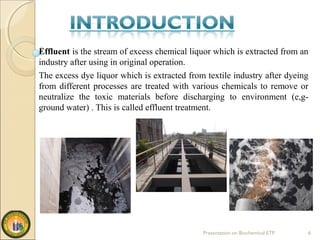
Effluent is the stream of excess chemical liquor which is extracted from an
industry after using in original operation.
The excess dye liquor which is extracted from textile industry after dyeing
from different processes are treated with various chemicals to remove or
neutralize the toxic materials before discharging to environment (e,g-
ground water) . This is called effluent treatment.
Presentation on Biochemical ETP 6
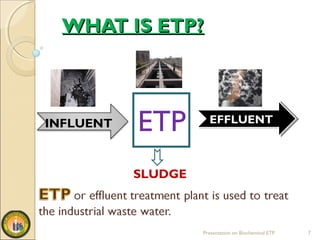
WHAT IS ETP?WHAT IS ETP?
Presentation on Biochemical ETP 7
INFLUENT ETP EFFLUENT
SLUDGE
Presentation on Biochemical ETP 8
 BIOCHEMICAL ETP:
TREATMENT OF WASTE WATER
BY CHEMICAL & BACTERIA.
TREATMENT CAPACITY: 120
m33
/hr
STORAGE CAPACITY: 6000 m3
Presentation on Biochemical ETP 9
FLOW CHART OF ETP OF ECHOTEX LTDFLOW CHART OF ETP OF ECHOTEX LTD..
Presentation on Biochemical ETP
10
INFLUENT
SCREENING
EQUALIZATION TANK
OZONE CONTACT
TANK-1
FLOCCULATION
TANK-1
SEQUENCING BATCH
REACTOR
INTERMEDIATE
TANK
OZONE CONTACT
TANK-2
PRIMARY INCLINED PLATE
SETTELER
FINAL
TREATD
WATER
FLOCCULATI
ON TANK-2
TERTIARY
INCLINED
PLATE
SETTELER
AEROBIC DIGESTER
TANK
SLUDGE CONDITIONONG
TANK
FILTER PRESS
Recyclewastewater
Recycle wastewater
SLUDGE
DISPOSAL
DISCHARGED
TO CANAL
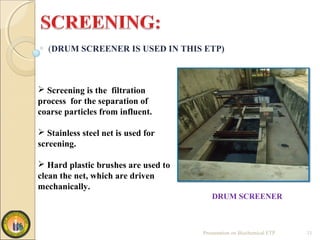
(DRUM SCREENER IS USED IN THIS ETP)
Presentation on Biochemical ETP 11
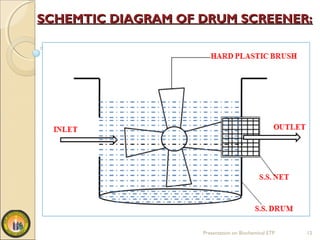
 Screening is the filtration
process for the separation of
coarse particles from influent.
 Stainless steel net is used for
screening.
 Hard plastic brushes are used to
clean the net, which are driven
mechanically.
DRUM SCREENER
Presentation on Biochemical ETP 12
SCHEMTIC DIAGRAM OF DRUM SCREENER:SCHEMTIC DIAGRAM OF DRUM SCREENER:
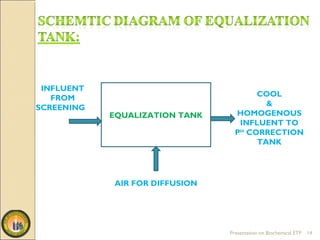
EQUALIZATION IS THE PROCESS TO
MAKE THE WASTE WATER-
-HOMOGENOUS &
-COOL
Dine By air passing.
EQUALIZATION TANK IS ALSO
CALLED HOMOGENOUS TANK.
RETENTION TIME 8 HOURS.
THIS TANK IS MADE OF RCC.
CAPACITY: 2750 m3
Presentation on Biochemical ETP 13
EQUALIZATION TANK:
Presentation on Biochemical ETP 14
EQUALIZATION TANK
INFLUENT
FROM
SCREENING
AIR FOR DIFFUSION
COOL
&
HOMOGENOUS
INFLUENT TO
PH
CORRECTION
TANK
Ozone contact tank is used
to_____
Remove color
Add more DO
Kill Anaerobic Bacteria
O3 is create by Ozonator
Presentation on Biochemical ETP 15
This tank is made of RCC
Capacity : 31.08 m3
FLOCCULATION TANK IS USE FOR____FLOCCULATION TANK IS USE FOR____
Coagulant-flocculants
(lime, ferrous & polymer)
Break down Color Bond
Decolorant
This Tank Is Made Of RCC
Capacity: 31.08 m3
Presentation on Biochemical ETP 16
According to IUPAC “flocculation is a process of contact and adhesion
whereby the particles of a dispersion from larger size clusters”
Flocculation process in ETP means increasing the particle size.
Presentation on Biochemical ETP 17
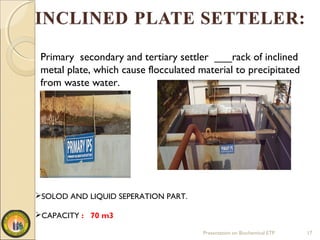
SOLOD AND LIQUID SEPERATION PART.
CAPACITY : 70 m3
Primary secondary and tertiary settler ___rack of inclined
metal plate, which cause flocculated material to precipitated
from waste water.
Presentation on Biochemical ETP 18
THIS TANK IS MADE OF RCC
CAPACITY: 842.4 m3
Sequencing batch reactors are industrial
processing tanks for the treatment of
wastewater . SBR reactors treat waste water
from industrial area, and sewage or output from
anaerobic digesters or mechanical biochemical and
biological treatment facilities in batches,
Oxygen is bubble through the waste water to
reduce Biochemical oxygen demand (BOD) ,
chemical oxygen demand (COD) to make
suitable for use in land and aquatic life.
Here used bacteria should be aerobic,
Presentation on Biochemical ETP 19
CAPACITY : 375.76 m3
Generally use to reduce temperature and increase DO.
To storage the wastewater for next treatment.
Presentation on Biochemical ETP 20
THIS TANK IS MADE OF RCC
CAPACITY : 245 m3
Aerobic digestion is an open system that utilizes oxygen
and biologically treats waste with naturally occurring
organism.
AEROBIC
DIGESTERDIGESTER
TANKTANK
WASTEWATER
FROM INCLINED
PLATE SETTELER
SLUDGE TO
CONDITIONING
TANK
RECYLCE
WASTEWATER TO
EQUALIZATION
TANK
Presentation on Biochemical ETP 21
SIZE : 5 m3
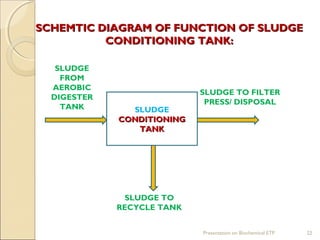
Sludge conditioning is a process whereby sludge solids are treated with chemicals
or various other means to prepare the sludge for dewatering processes.
Presentation on Biochemical ETP 22
SCHEMTIC DIAGRAM OF FUNCTION OF SLUDGESCHEMTIC DIAGRAM OF FUNCTION OF SLUDGE
CONDITIONING TANK:CONDITIONING TANK:
SLUDGE
CONDITIONINGCONDITIONING
TANKTANK
SLUDGE
FROM
AEROBIC
DIGESTER
TANK
SLUDGE TO FILTER
PRESS/ DISPOSAL
SLUDGE TO
RECYCLE TANK
Presentation on Biochemical ETP 23
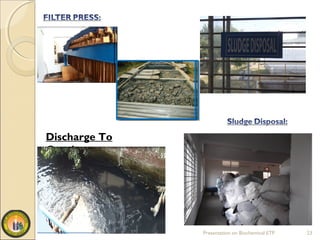
Discharge To
Canal
AcknowledgementAcknowledgement
Presentation on Biochemical ETP 24
At first we want to give thanks to our honorable course teacher
Assistant professor Dr. Arun Kanti Guha, for assigning us for
this important assignment and also for his immense help in during
making this assignment paper. We also want to pay thanks to our
senior brother Mazedul Hasan Shishir (13th
batch) for his help and
support.
At last we want to pay thanks to our group members for help and co-
operation with hard working mentality so that we could complete the
task with success.
References:References:
Presentation on Biochemical ETP 25
1. Visit of ECHOTEX by 13th
batch with Arun Kanti Guha
2. www.textilelearners.blogspot.com/effluenttreatmentplant
3. Class lectures of Environment pollution and its control.
4. http://www.akarwastewatertreatmentplants.com/hospital-effluent-treatment-p
5. Div. of Environmental Biotechnology, School of Bio
Sciences and Technology, VIT University, Vellore-
632014, INDIA
6. Sixth International Water Technology Conference, IWTC
2001, Alexandria, Egypt
7. http://www.jea.com/about/pub/downloads/ip/CleanConn-
JulAug03.pdf
1. Yarn Manufacturing Technology
Link : http://www.facebook.com/pages/Yarn-Manufacturing-
Technology/485014954866808
2. Fabric Manufacturing Technology
Link : http://www.facebook.com/pages/Fabric-Manufacturing-
Technology/459520217425605
3. Garments Manufacturing Technology
Link : http://www.facebook.com/pages/Garments-Manufacturing-
Technology/472364799463126
3. Wet processing Technology
Link : http://www.facebook.com/pages/Wet-Processing-Technology-
Dyeing-/468645219825404
4. Fashion-Design-and-Technology
Link : http://www.facebook.com/pages/Fashion-Design-and-
My Facebook Textile related Pages
http://www.textilelab.blogspot.com (Visit please )

Biochemical etp

  • 1.
  • 2.
  • 3.
    Prepared By :Mazadul Hasan sheshir ID: 2010000400008 13th Batch (session 2009-2013) Department : Wet Processing Technology Email: mazadulhasan@yahoo.com Blog : www. Textilelab.blogspot.com (visit) Southeast University Department Of Textile Engineering I/A 251,252 Tejgaon Dhaka Bangladesh Prepared By :
  • 4.
  • 5.
  • 6.
    Effluent is thestream of excess chemical liquor which is extracted from an industry after using in original operation. The excess dye liquor which is extracted from textile industry after dyeing from different processes are treated with various chemicals to remove or neutralize the toxic materials before discharging to environment (e,g- ground water) . This is called effluent treatment. Presentation on Biochemical ETP 6
  • 7.
    WHAT IS ETP?WHATIS ETP? Presentation on Biochemical ETP 7 INFLUENT ETP EFFLUENT SLUDGE
  • 8.
    Presentation on BiochemicalETP 8  BIOCHEMICAL ETP: TREATMENT OF WASTE WATER BY CHEMICAL & BACTERIA. TREATMENT CAPACITY: 120 m33 /hr STORAGE CAPACITY: 6000 m3
  • 9.
  • 10.
    FLOW CHART OFETP OF ECHOTEX LTDFLOW CHART OF ETP OF ECHOTEX LTD.. Presentation on Biochemical ETP 10 INFLUENT SCREENING EQUALIZATION TANK OZONE CONTACT TANK-1 FLOCCULATION TANK-1 SEQUENCING BATCH REACTOR INTERMEDIATE TANK OZONE CONTACT TANK-2 PRIMARY INCLINED PLATE SETTELER FINAL TREATD WATER FLOCCULATI ON TANK-2 TERTIARY INCLINED PLATE SETTELER AEROBIC DIGESTER TANK SLUDGE CONDITIONONG TANK FILTER PRESS Recyclewastewater Recycle wastewater SLUDGE DISPOSAL DISCHARGED TO CANAL
  • 11.
    (DRUM SCREENER ISUSED IN THIS ETP) Presentation on Biochemical ETP 11  Screening is the filtration process for the separation of coarse particles from influent.  Stainless steel net is used for screening.  Hard plastic brushes are used to clean the net, which are driven mechanically. DRUM SCREENER
  • 12.
    Presentation on BiochemicalETP 12 SCHEMTIC DIAGRAM OF DRUM SCREENER:SCHEMTIC DIAGRAM OF DRUM SCREENER:
  • 13.
    EQUALIZATION IS THEPROCESS TO MAKE THE WASTE WATER- -HOMOGENOUS & -COOL Dine By air passing. EQUALIZATION TANK IS ALSO CALLED HOMOGENOUS TANK. RETENTION TIME 8 HOURS. THIS TANK IS MADE OF RCC. CAPACITY: 2750 m3 Presentation on Biochemical ETP 13 EQUALIZATION TANK:
  • 14.
    Presentation on BiochemicalETP 14 EQUALIZATION TANK INFLUENT FROM SCREENING AIR FOR DIFFUSION COOL & HOMOGENOUS INFLUENT TO PH CORRECTION TANK
  • 15.
    Ozone contact tankis used to_____ Remove color Add more DO Kill Anaerobic Bacteria O3 is create by Ozonator Presentation on Biochemical ETP 15 This tank is made of RCC Capacity : 31.08 m3
  • 16.
    FLOCCULATION TANK ISUSE FOR____FLOCCULATION TANK IS USE FOR____ Coagulant-flocculants (lime, ferrous & polymer) Break down Color Bond Decolorant This Tank Is Made Of RCC Capacity: 31.08 m3 Presentation on Biochemical ETP 16 According to IUPAC “flocculation is a process of contact and adhesion whereby the particles of a dispersion from larger size clusters” Flocculation process in ETP means increasing the particle size.
  • 17.
    Presentation on BiochemicalETP 17 SOLOD AND LIQUID SEPERATION PART. CAPACITY : 70 m3 Primary secondary and tertiary settler ___rack of inclined metal plate, which cause flocculated material to precipitated from waste water.
  • 18.
    Presentation on BiochemicalETP 18 THIS TANK IS MADE OF RCC CAPACITY: 842.4 m3 Sequencing batch reactors are industrial processing tanks for the treatment of wastewater . SBR reactors treat waste water from industrial area, and sewage or output from anaerobic digesters or mechanical biochemical and biological treatment facilities in batches, Oxygen is bubble through the waste water to reduce Biochemical oxygen demand (BOD) , chemical oxygen demand (COD) to make suitable for use in land and aquatic life. Here used bacteria should be aerobic,
  • 19.
    Presentation on BiochemicalETP 19 CAPACITY : 375.76 m3 Generally use to reduce temperature and increase DO. To storage the wastewater for next treatment.
  • 20.
    Presentation on BiochemicalETP 20 THIS TANK IS MADE OF RCC CAPACITY : 245 m3 Aerobic digestion is an open system that utilizes oxygen and biologically treats waste with naturally occurring organism. AEROBIC DIGESTERDIGESTER TANKTANK WASTEWATER FROM INCLINED PLATE SETTELER SLUDGE TO CONDITIONING TANK RECYLCE WASTEWATER TO EQUALIZATION TANK
  • 21.
    Presentation on BiochemicalETP 21 SIZE : 5 m3 Sludge conditioning is a process whereby sludge solids are treated with chemicals or various other means to prepare the sludge for dewatering processes.
  • 22.
    Presentation on BiochemicalETP 22 SCHEMTIC DIAGRAM OF FUNCTION OF SLUDGESCHEMTIC DIAGRAM OF FUNCTION OF SLUDGE CONDITIONING TANK:CONDITIONING TANK: SLUDGE CONDITIONINGCONDITIONING TANKTANK SLUDGE FROM AEROBIC DIGESTER TANK SLUDGE TO FILTER PRESS/ DISPOSAL SLUDGE TO RECYCLE TANK
  • 23.
    Presentation on BiochemicalETP 23 Discharge To Canal
  • 24.
    AcknowledgementAcknowledgement Presentation on BiochemicalETP 24 At first we want to give thanks to our honorable course teacher Assistant professor Dr. Arun Kanti Guha, for assigning us for this important assignment and also for his immense help in during making this assignment paper. We also want to pay thanks to our senior brother Mazedul Hasan Shishir (13th batch) for his help and support. At last we want to pay thanks to our group members for help and co- operation with hard working mentality so that we could complete the task with success.
  • 25.
    References:References: Presentation on BiochemicalETP 25 1. Visit of ECHOTEX by 13th batch with Arun Kanti Guha 2. www.textilelearners.blogspot.com/effluenttreatmentplant 3. Class lectures of Environment pollution and its control. 4. http://www.akarwastewatertreatmentplants.com/hospital-effluent-treatment-p 5. Div. of Environmental Biotechnology, School of Bio Sciences and Technology, VIT University, Vellore- 632014, INDIA 6. Sixth International Water Technology Conference, IWTC 2001, Alexandria, Egypt 7. http://www.jea.com/about/pub/downloads/ip/CleanConn- JulAug03.pdf
  • 28.
    1. Yarn ManufacturingTechnology Link : http://www.facebook.com/pages/Yarn-Manufacturing- Technology/485014954866808 2. Fabric Manufacturing Technology Link : http://www.facebook.com/pages/Fabric-Manufacturing- Technology/459520217425605 3. Garments Manufacturing Technology Link : http://www.facebook.com/pages/Garments-Manufacturing- Technology/472364799463126 3. Wet processing Technology Link : http://www.facebook.com/pages/Wet-Processing-Technology- Dyeing-/468645219825404 4. Fashion-Design-and-Technology Link : http://www.facebook.com/pages/Fashion-Design-and- My Facebook Textile related Pages http://www.textilelab.blogspot.com (Visit please )