SUSE for Hadoop & Big Data 
Stephen Mogg 
SUSE UK 
October 2014
2 
About SUSE 
• Established 1992 
• Original Provider of Enterprise Linux 
About Me 
• SUSE Employee 4 years 
• Systems Engineer
3 
If you want to know more about SUSE 
• New Certifications 
• New Resources 
• New Lab
SUSE for Hadoop
5 
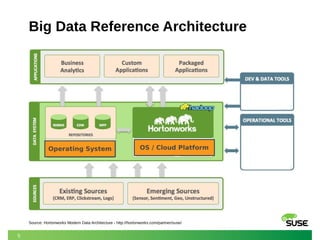
Big Data Reference Architecture 
Operating System OS / Cloud Platform 
Source: Hortonworks Modern Data Architecture - http://hortonworks.com/partner/suse/
6 
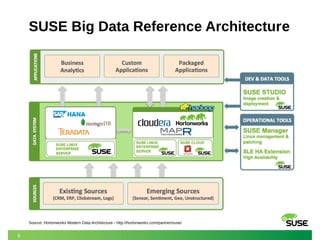
SUSE Big Data Reference Architecture 
Source: Hortonworks Modern Data Architecture - http://hortonworks.com/partner/suse/
7 
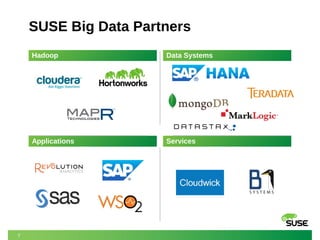
SUSE Big Data Partners 
Hadoop Data Systems 
Applications Services
8 
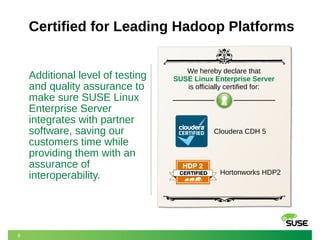
Certified for Leading Hadoop Platforms 
Additional level of testing 
and quality assurance to 
make sure SUSE Linux 
Enterprise Server 
integrates with partner 
software, saving our 
customers time while 
providing them with an 
assurance of 
interoperability. 
We hereby declare that 
SUSE Linux Enterprise Server 
is officially certified for: 
Cloudera CDH 5 
Hortonworks HDP2
Market Leadership
10 
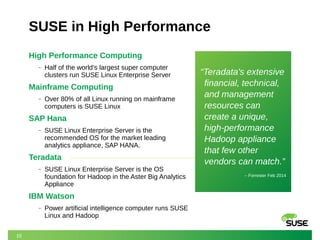
SUSE in High Performance 
“Teradata's extensive 
financial, technical, 
and management 
resources can 
create a unique, 
high-performance 
Hadoop appliance 
that few other 
vendors can match.” 
– Forrester Feb 2014 
High Performance Computing 
‒ Half of the world's largest super computer 
clusters run SUSE Linux Enterprise Server 
Mainframe Computing 
‒ Over 80% of all Linux running on mainframe 
computers is SUSE Linux 
SAP Hana 
‒ SUSE Linux Enterprise Server is the 
recommended OS for the market leading 
analytics appliance, SAP HANA. 
Teradata 
‒ SUSE Linux Enterprise Server is the OS 
foundation for Hadoop in the Aster Big Analytics 
Appliance 
IBM Watson 
‒ Power artificial intelligence computer runs SUSE 
Linux and Hadoop
11 
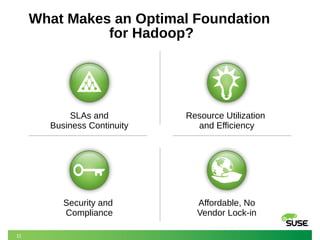
What Makes an Optimal Foundation 
for Hadoop? 
SLAs and 
Business Continuity 
Resource Utilization 
and Efficiency 
Security and 
Compliance 
Affordable, No 
Vendor Lock-in
12 
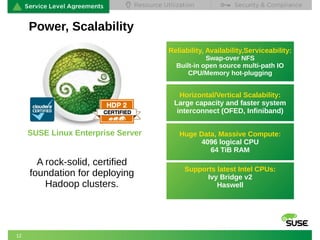
Power, Scalability 
Reliability, Availability,Serviceability: 
Swap-over NFS 
Built-in open source multi-path IO 
CPU/Memory hot-plugging 
Horizontal/Vertical Scalability: 
Large capacity and faster system 
interconnect (OFED, Infiniband) 
A rock-solid, certified 
foundation for deploying 
Hadoop clusters. 
Huge Data, Massive Compute: 
4096 logical CPU 
64 TiB RAM 
Supports latest Intel CPUs: 
Ivy Bridge v2 
Haswell 
SUSE Linux Enterprise Server
13 
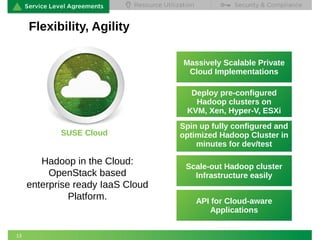
Flexibility, Agility 
Massively Scalable Private 
Cloud Implementations 
Deploy pre-configured 
Hadoop clusters on 
KVM, Xen, Hyper-V, ESXi 
Spin up fully configured and 
optimized Hadoop Cluster in 
minutes for dev/test 
Scale-out Hadoop cluster 
Infrastructure easily 
API for Cloud-aware 
Applications 
SUSE Cloud 
Hadoop in the Cloud: 
OpenStack based 
enterprise ready IaaS Cloud 
Platform.
14 
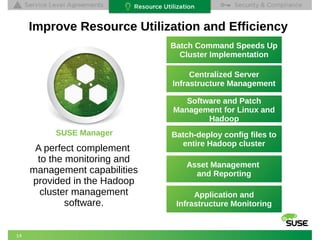
Improve Resource Utilization and Efficiency 
Batch Command Speeds Up 
Cluster Implementation 
Centralized Server 
Infrastructure Management 
Software and Patch 
Management for Linux and 
Hadoop 
Batch-deploy config files to 
entire Hadoop cluster 
Asset Management 
and Reporting 
Application and 
Infrastructure Monitoring 
SUSE Manager 
A perfect complement 
to the monitoring and 
management capabilities 
provided in the Hadoop 
cluster management 
software.
15 
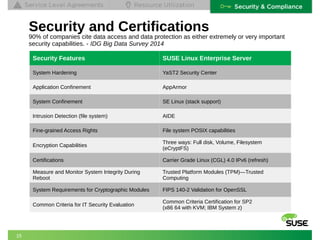
Security and Certifications 
90% of companies cite data access and data protection as either extremely or very important 
security capabilities. - IDG Big Data Survey 2014 
Security Features SUSE Linux Enterprise Server 
System Hardening YaST2 Security Center 
Application Confinement AppArmor 
System Confinement SE Linux (stack support) 
Intrusion Detection (file system) AIDE 
Fine-grained Access Rights File system POSIX capabilities 
Encryption Capabilities Three ways: Full disk, Volume, Filesystem 
(eCryptFS) 
Certifications Carrier Grade Linux (CGL) 4.0 IPv6 (refresh) 
Measure and Monitor System Integrity During 
Trusted Platform Modules (TPM)—Trusted 
Reboot 
Computing 
System Requirements for Cryptographic Modules FIPS 140-2 Validation for OpenSSL 
Common Criteria for IT Security Evaluation Common Criteria Certification for SP2 
(x86 64 with KVM; IBM System z)
16 
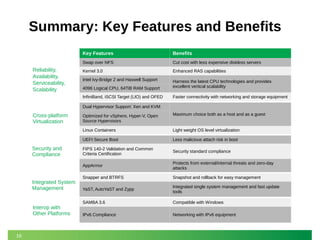
Summary: Key Features and Benefits 
Key Features Benefits 
Reliability, 
Availability, 
Serviceability, 
Scalability 
Swap over NFS Cut cost with less expensive diskless servers 
Kernel 3.0 Enhanced RAS capabilities 
Intel Ivy-Bridge 2 and Haswell Support Harness the latest CPU technologies and provides 
excellent 4096 Logical CPU, 64TiB RAM Support vertical scalability 
InfiniBand, iSCSI Target (LIO) and OFED Faster connectivity with networking and storage equipment 
Dual Hypervisor Support: Xen and KVM 
Cross-platform Maximum choice both as a host and as a guest 
Virtualization 
Optimized for vSphere, Hyper-V, Open 
Source Hypervisors 
Linux Containers Light weight OS level virtualization 
UEFI Secure Boot Less malicious attach risk in boot 
Security and 
Compliance 
FIPS 140-2 Validation and Common 
Criteria Certification Security standard compliance 
AppArmor Protects from external/internal threats and zero-day 
attacks 
Integrated System 
Management 
Snapper and BTRFS Snapshot and rollback for easy management 
YaST, AutoYaST and Zypp Integrated single system management and fast update 
tools 
Interop with 
Other Platforms 
SAMBA 3.6 Compatible with Windows 
IPv6 Compliance Networking with IPv6 equipment
SUSE Big Data Resources
18 
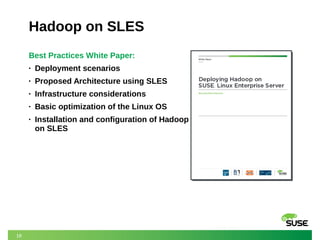
Hadoop on SLES 
Best Practices White Paper: 
• Deployment scenarios 
• Proposed Architecture using SLES 
• Infrastructure considerations 
• Basic optimization of the Linux OS 
• Installation and configuration of Hadoop 
on SLES
19 
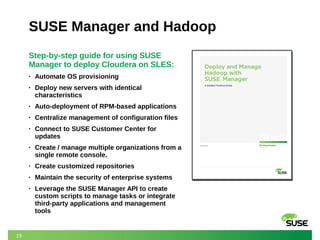
SUSE Manager and Hadoop 
Step-by-step guide for using SUSE 
Manager to deploy Cloudera on SLES: 
• Automate OS provisioning 
• Deploy new servers with identical 
characteristics 
• Auto-deployment of RPM-based applications 
• Centralize management of configuration files 
• Connect to SUSE Customer Center for 
updates 
• Create / manage multiple organizations from a 
single remote console. 
• Create customized repositories 
• Maintain the security of enterprise systems 
• Leverage the SUSE Manager API to create 
custom scripts to manage tasks or integrate 
third-party applications and management 
tools
20 
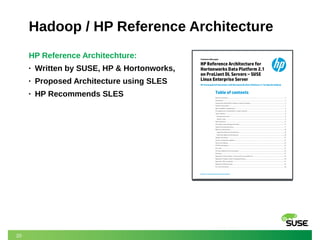
Hadoop / HP Reference Architecture 
HP Reference Architechture: 
• Written by SUSE, HP & Hortonworks, 
• Proposed Architecture using SLES 
• HP Recommends SLES
21 
SUSE Big Data Lab 
Big Data Cluster in USA for: 
• Benchmarking 
• Software certification 
• Integration / test 
• Reference architectures
Learn About: 
Register: 
22 
SUSE Linux Expert Days 
• SUSE and Big Data 
• Towards Zero Uptime with SUSE Tecnology 
• SUSE Linux Enterprise Server 
https://www.suse.com/events/slef-2014/#Liste
23 
Learn More 
Visit our web site 
www.suse.com/solutions/platform.html#big_data 
Read our whitepapers 
Deploying Hadoop on SLES 
Deploy and Manage Hadoop with SUSE Manager 
HP Reference Architecture. 
Contact us 
bigdata@suse.com
24
Unpublished Work of SUSE LLC. All Rights Reserved. 
This work is an unpublished work and contains confidential, proprietary and trade secret information of SUSE LLC. 
Access to this work is restricted to SUSE employees who have a need to know to perform tasks within the scope of 
their assignments. No part of this work may be practiced, performed, copied, distributed, revised, modified, translated, 
abridged, condensed, expanded, collected, or adapted without the prior written consent of SUSE. 
Any use or exploitation of this work without authorization could subject the perpetrator to criminal and civil liability. 
General Disclaimer 
This document is not to be construed as a promise by any participating company to develop, deliver, or market a 
product. It is not a commitment to deliver any material, code, or functionality, and should not be relied upon in making 
purchasing decisions. SUSE makes no representations or warranties with respect to the contents of this document, 
and specifically disclaims any express or implied warranties of merchantability or fitness for any particular purpose. The 
development, release, and timing of features or functionality described for SUSE products remains at the sole 
discretion of SUSE. Further, SUSE reserves the right to revise this document and to make changes to its content, at 
any time, without obligation to notify any person or entity of such revisions or changes. All SUSE marks referenced in 
this presentation are trademarks or registered trademarks of Novell, Inc. in the United States and other countries. All 
third-party trademarks are the property of their respective owners.

SUSE, Hadoop and Big Data Update. Stephen Mogg, SUSE UK

  • 1.
    SUSE for Hadoop& Big Data Stephen Mogg SUSE UK October 2014
  • 2.
    2 About SUSE • Established 1992 • Original Provider of Enterprise Linux About Me • SUSE Employee 4 years • Systems Engineer
  • 3.
    3 If youwant to know more about SUSE • New Certifications • New Resources • New Lab
  • 4.
  • 5.
    5 Big DataReference Architecture Operating System OS / Cloud Platform Source: Hortonworks Modern Data Architecture - http://hortonworks.com/partner/suse/
  • 6.
    6 SUSE BigData Reference Architecture Source: Hortonworks Modern Data Architecture - http://hortonworks.com/partner/suse/
  • 7.
    7 SUSE BigData Partners Hadoop Data Systems Applications Services
  • 8.
    8 Certified forLeading Hadoop Platforms Additional level of testing and quality assurance to make sure SUSE Linux Enterprise Server integrates with partner software, saving our customers time while providing them with an assurance of interoperability. We hereby declare that SUSE Linux Enterprise Server is officially certified for: Cloudera CDH 5 Hortonworks HDP2
  • 9.
  • 10.
    10 SUSE inHigh Performance “Teradata's extensive financial, technical, and management resources can create a unique, high-performance Hadoop appliance that few other vendors can match.” – Forrester Feb 2014 High Performance Computing ‒ Half of the world's largest super computer clusters run SUSE Linux Enterprise Server Mainframe Computing ‒ Over 80% of all Linux running on mainframe computers is SUSE Linux SAP Hana ‒ SUSE Linux Enterprise Server is the recommended OS for the market leading analytics appliance, SAP HANA. Teradata ‒ SUSE Linux Enterprise Server is the OS foundation for Hadoop in the Aster Big Analytics Appliance IBM Watson ‒ Power artificial intelligence computer runs SUSE Linux and Hadoop
  • 11.
    11 What Makesan Optimal Foundation for Hadoop? SLAs and Business Continuity Resource Utilization and Efficiency Security and Compliance Affordable, No Vendor Lock-in
  • 12.
    12 Power, Scalability Reliability, Availability,Serviceability: Swap-over NFS Built-in open source multi-path IO CPU/Memory hot-plugging Horizontal/Vertical Scalability: Large capacity and faster system interconnect (OFED, Infiniband) A rock-solid, certified foundation for deploying Hadoop clusters. Huge Data, Massive Compute: 4096 logical CPU 64 TiB RAM Supports latest Intel CPUs: Ivy Bridge v2 Haswell SUSE Linux Enterprise Server
  • 13.
    13 Flexibility, Agility Massively Scalable Private Cloud Implementations Deploy pre-configured Hadoop clusters on KVM, Xen, Hyper-V, ESXi Spin up fully configured and optimized Hadoop Cluster in minutes for dev/test Scale-out Hadoop cluster Infrastructure easily API for Cloud-aware Applications SUSE Cloud Hadoop in the Cloud: OpenStack based enterprise ready IaaS Cloud Platform.
  • 14.
    14 Improve ResourceUtilization and Efficiency Batch Command Speeds Up Cluster Implementation Centralized Server Infrastructure Management Software and Patch Management for Linux and Hadoop Batch-deploy config files to entire Hadoop cluster Asset Management and Reporting Application and Infrastructure Monitoring SUSE Manager A perfect complement to the monitoring and management capabilities provided in the Hadoop cluster management software.
  • 15.
    15 Security andCertifications 90% of companies cite data access and data protection as either extremely or very important security capabilities. - IDG Big Data Survey 2014 Security Features SUSE Linux Enterprise Server System Hardening YaST2 Security Center Application Confinement AppArmor System Confinement SE Linux (stack support) Intrusion Detection (file system) AIDE Fine-grained Access Rights File system POSIX capabilities Encryption Capabilities Three ways: Full disk, Volume, Filesystem (eCryptFS) Certifications Carrier Grade Linux (CGL) 4.0 IPv6 (refresh) Measure and Monitor System Integrity During Trusted Platform Modules (TPM)—Trusted Reboot Computing System Requirements for Cryptographic Modules FIPS 140-2 Validation for OpenSSL Common Criteria for IT Security Evaluation Common Criteria Certification for SP2 (x86 64 with KVM; IBM System z)
  • 16.
    16 Summary: KeyFeatures and Benefits Key Features Benefits Reliability, Availability, Serviceability, Scalability Swap over NFS Cut cost with less expensive diskless servers Kernel 3.0 Enhanced RAS capabilities Intel Ivy-Bridge 2 and Haswell Support Harness the latest CPU technologies and provides excellent 4096 Logical CPU, 64TiB RAM Support vertical scalability InfiniBand, iSCSI Target (LIO) and OFED Faster connectivity with networking and storage equipment Dual Hypervisor Support: Xen and KVM Cross-platform Maximum choice both as a host and as a guest Virtualization Optimized for vSphere, Hyper-V, Open Source Hypervisors Linux Containers Light weight OS level virtualization UEFI Secure Boot Less malicious attach risk in boot Security and Compliance FIPS 140-2 Validation and Common Criteria Certification Security standard compliance AppArmor Protects from external/internal threats and zero-day attacks Integrated System Management Snapper and BTRFS Snapshot and rollback for easy management YaST, AutoYaST and Zypp Integrated single system management and fast update tools Interop with Other Platforms SAMBA 3.6 Compatible with Windows IPv6 Compliance Networking with IPv6 equipment
  • 17.
    SUSE Big DataResources
  • 18.
    18 Hadoop onSLES Best Practices White Paper: • Deployment scenarios • Proposed Architecture using SLES • Infrastructure considerations • Basic optimization of the Linux OS • Installation and configuration of Hadoop on SLES
  • 19.
    19 SUSE Managerand Hadoop Step-by-step guide for using SUSE Manager to deploy Cloudera on SLES: • Automate OS provisioning • Deploy new servers with identical characteristics • Auto-deployment of RPM-based applications • Centralize management of configuration files • Connect to SUSE Customer Center for updates • Create / manage multiple organizations from a single remote console. • Create customized repositories • Maintain the security of enterprise systems • Leverage the SUSE Manager API to create custom scripts to manage tasks or integrate third-party applications and management tools
  • 20.
    20 Hadoop /HP Reference Architecture HP Reference Architechture: • Written by SUSE, HP & Hortonworks, • Proposed Architecture using SLES • HP Recommends SLES
  • 21.
    21 SUSE BigData Lab Big Data Cluster in USA for: • Benchmarking • Software certification • Integration / test • Reference architectures
  • 22.
    Learn About: Register: 22 SUSE Linux Expert Days • SUSE and Big Data • Towards Zero Uptime with SUSE Tecnology • SUSE Linux Enterprise Server https://www.suse.com/events/slef-2014/#Liste
  • 23.
    23 Learn More Visit our web site www.suse.com/solutions/platform.html#big_data Read our whitepapers Deploying Hadoop on SLES Deploy and Manage Hadoop with SUSE Manager HP Reference Architecture. Contact us bigdata@suse.com
  • 24.
  • 25.
    Unpublished Work ofSUSE LLC. All Rights Reserved. This work is an unpublished work and contains confidential, proprietary and trade secret information of SUSE LLC. Access to this work is restricted to SUSE employees who have a need to know to perform tasks within the scope of their assignments. No part of this work may be practiced, performed, copied, distributed, revised, modified, translated, abridged, condensed, expanded, collected, or adapted without the prior written consent of SUSE. Any use or exploitation of this work without authorization could subject the perpetrator to criminal and civil liability. General Disclaimer This document is not to be construed as a promise by any participating company to develop, deliver, or market a product. It is not a commitment to deliver any material, code, or functionality, and should not be relied upon in making purchasing decisions. SUSE makes no representations or warranties with respect to the contents of this document, and specifically disclaims any express or implied warranties of merchantability or fitness for any particular purpose. The development, release, and timing of features or functionality described for SUSE products remains at the sole discretion of SUSE. Further, SUSE reserves the right to revise this document and to make changes to its content, at any time, without obligation to notify any person or entity of such revisions or changes. All SUSE marks referenced in this presentation are trademarks or registered trademarks of Novell, Inc. in the United States and other countries. All third-party trademarks are the property of their respective owners.