Welcome
It used to be easy…
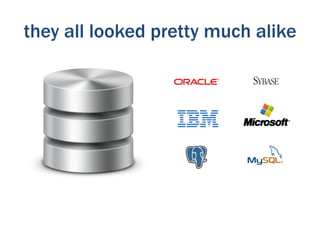
they all looked pretty much alike
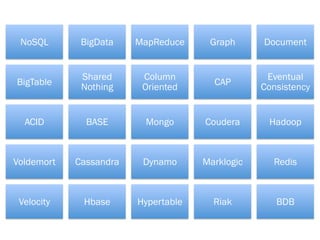
NoSQL       BigData    MapReduce     Graph      Document


             Shared      Column                   Eventual
BigTable                               CAP
             Nothing     Oriented                Consistency


  ACID        BASE       Mongo       Coudera      Hadoop


Voldemort   Cassandra    Dynamo      Marklogic     Redis


 Velocity    Hbase      Hypertable     Riak         BDB
Now it’s downright
c0nfuZ1nG!
What Happened?
we   changed scale
tack
        ge   d
we ch an
so where does


big data        meet


big database?
The world’s largest NoSQL
       database?
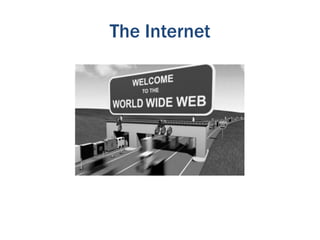
The Internet
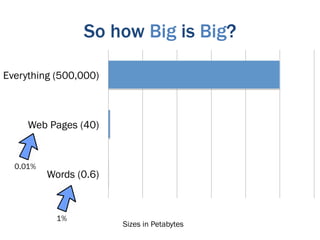
So how Big is Big?

Everything (500,000)


     Web Pages (40)


  0.01%
          Words (0.6)


            1%
                        Sizes in Petabytes
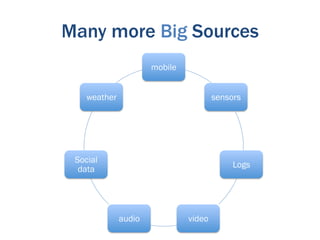
Many more Big Sources
                      mobile


    weather                            sensors


 Social
                                            Logs
  data


              audio            video
But it is pretty useful
Marketing
Fraud detection
Tax Evasion
Intelligence
Advertising
Scientific research
Gartner

80% of business is conducted on
   unstructured information
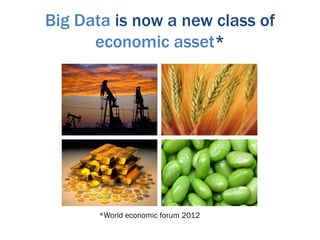
Big Data is now a new class of
      economic asset*


       *World economic forum 2012
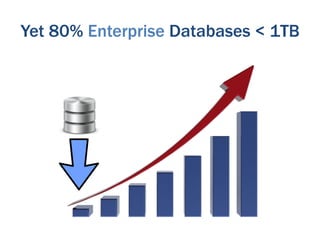
Yet 80% Enterprise Databases < 1TB
Along came the Big Data
       Movement
MapReduce (2004)
•  Large, distributed,
   ordered map
•  Fault-tolerant file
   system
•  Petabyte scaling
Disruptive
Simple

Pragmatic

Solved an insoluble problem

Unencumbered by tradition (good & bad)

Hacker rather than Enterprise culture
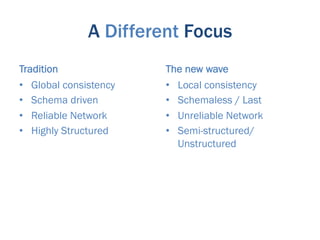
A Different Focus
Tradition               The new wave
•  Global consistency   •  Local consistency
•  Schema driven        •  Schemaless / Last
•  Reliable Network     •  Unreliable Network
•  Highly Structured    •  Semi-structured/
                           Unstructured
Novel?
Possibly better put as:
A timely and elegant combination of existing
ideas, placed together to solve a previously
unsolved problem.
Backlash (2009)
Not novel (dates back to the 80’s)

Physical level not the logical level (messy?)

Incompatible with tooling

Lack of integrity (referential) & ACID

MR is brute force ignoring indexing, scew
All points are reasonable
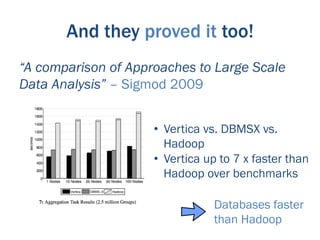
And they proved it too!
“A comparison of Approaches to Large Scale
Data Analysis” – Sigmod 2009


                     •  Vertica vs. DBMSX vs.
                        Hadoop
                     •  Vertica up to 7 x faster than
                        Hadoop over benchmarks

                                 Databases faster
                                 than Hadoop
But possibly missed the point?
MapReduce was not supposed to be
   a Data Warehousing tool?
If you need more, layer it on top

   For example Tensing & Magastore
              @ Google
So MapReduce represents a
bottom-up approach to accessing
   very large data sets that is
   unencumbered by the past.
…and the Database Field knew it
        had Problems
We Lose: Joe Hellerstein (Berkeley) 2001

 “Databases are commoditised and cornered
to slow-moving, evolving, structure intensive,
applications that require schema evolution.“ …
“The internet companies are lost and we will
remain in the doldrums of the enterprise
space.” …
“As databases are black boxes which require a
lot of coaxing to get maximum performance”
Yet they do some very cool stuff

      Statistically based optimisers,
    Compression, indexing structures,
     distributed optimisers, their own
            declarative language
They are an Awesome Tool
They Don’t talk our Language
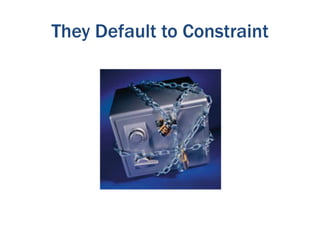
They Default to Constraint
So NoSurprise with NoSQL then
   Simpler Contract
   Shared nothing
   No joins / ACID
   No impedance mismatch
   No slow schema evolution
   Simple code paths
   Just works
The NoSQL Approach


 Simple, flexible storage
 over a diverse range of
 data structures that will
scale almost indefinitely.
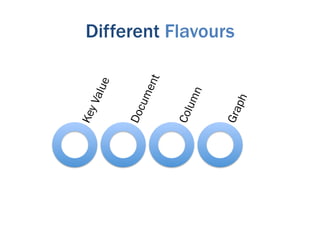
Different Flavours
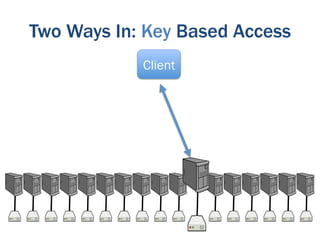
Two Ways In: Key Based Access
            Client
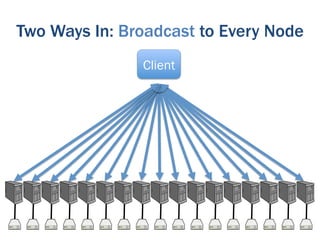
Two Ways In: Broadcast to Every Node
               Client
So..
A simple bottom up approach to data storage
that scales almost indefinitely.
•  No relations
•  No joins
•  No SQL
•  No Transactions
•  No sluggish schema evolution
The Relational Database
The ‘Relational Camp’ had
      been busy too
 Realisation that the traditional
 architecture was insufficient for
    various modern workloads
End of an Era Paper - 2007
“Because RDBMSs can be beaten by more
than an order of magnitude on the standard
OLTP benchmark, then there is no market
where they are competitive. As such, they
should be considered as legacy technology
more than a quarter of a century in age, for
which a complete redesign and re-architecting
is the appropriate next step.” – Michael
Stonebraker
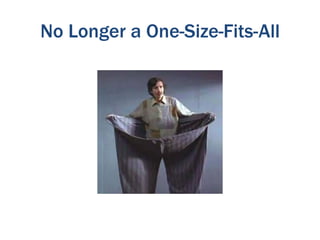
No Longer a One-Size-Fits-All
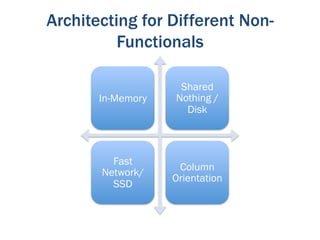
Architecting for Different Non-
          Functionals

                    Shared
       In-Memory   Nothing /
                     Disk


         Fast
                    Column
       Network/
                   Orientation
         SSD
In-Memory
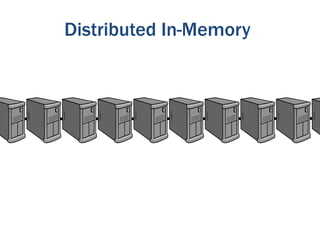
Distributed In-Memory
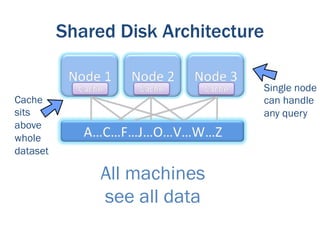
Shared Disk Architecture

                                 Single node
Cache                            can handle
sits                             any query
above
whole
dataset

               All machines
               see all data
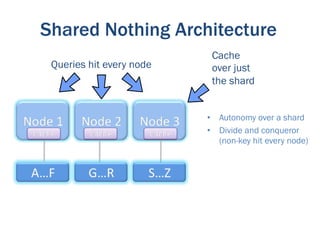
Shared Nothing Architecture
                           Cache
 Queries hit every node    over just
                           the shard


                          •  Autonomy over a shard
                          •  Divide and conqueror
                             (non-key hit every node)
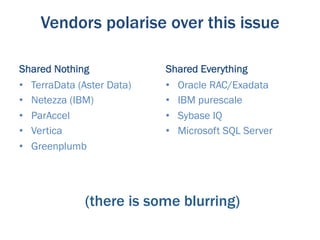
Vendors polarise over this issue

Shared Nothing              Shared Everything
•  TerraData (Aster Data)   •  Oracle RAC/Exadata
•  Netezza (IBM)            •  IBM purescale
•  ParAccel                 •  Sybase IQ
•  Vertica                  •  Microsoft SQL Server
•  Greenplumb


              (there is some blurring)
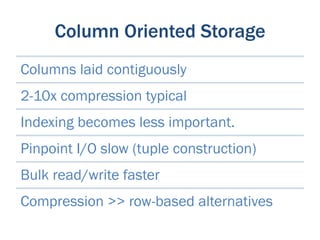
Column Oriented Storage
Columns laid contiguously
2-10x compression typical
Indexing becomes less important.
Pinpoint I/O slow (tuple construction)
Bulk read/write faster
Compression >> row-based alternatives
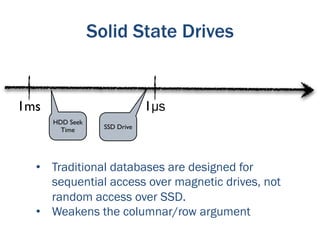
Solid State Drives

1ms                            1µs
      HDD Seek
        Time       SSD Drive


  •  Traditional databases are designed for
     sequential access over magnetic drives, not
     random access over SSD.
  •  Weakens the columnar/row argument
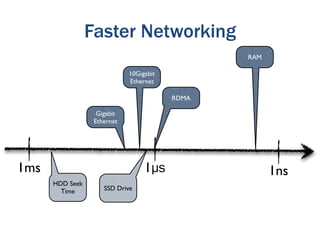
Faster Networking
                                                RAM

                             10Gigabit
                             Ethernet

                                         RDMA

                   Gigabit
                  Ethernet


1ms                               1µs                 1ns
      HDD Seek
        Time         SSD Drive
The best technologies of the moment
are leveraging many of these factors
There is a new and impressive breed
•    Products < 5 years old
•    Shared nothing with SSD’s over shards
•    Large address spaces (256GB+)
•    No indexes (column oriented)
•    No referential integrity
•    Surprisingly quick for big queries when
     compared with incumbent technologies.
TPC-H Benchmarks
Several new contenders with good scores:
  –  Exasol
  –  ParAccel
  –  Vectorwise
TPC-H Benchmarks
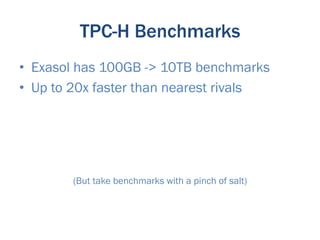
•  Exasol has 100GB -> 10TB benchmarks
•  Up to 20x faster than nearest rivals


        (But take benchmarks with a pinch of salt)
Relational Approach


Solid data from every angle,
bounded in terms of scale,
but with a boundary that is
     rapidly expanding.
Comparisons
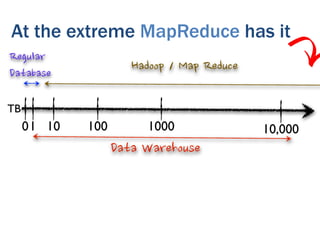
At the extreme MapReduce has it


TB
     0 1 10   100   1000   10,000
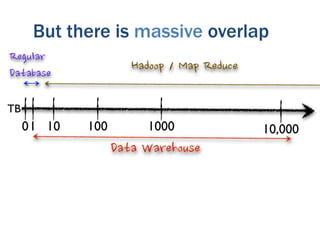
But there is massive overlap


TB
     0 1 10   100   1000         10,000
It’s not just data volume/velocity
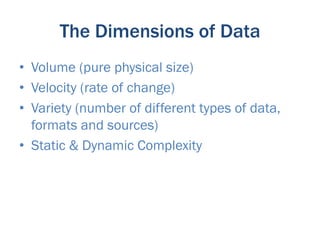
The Dimensions of Data
•  Volume (pure physical size)
•  Velocity (rate of change)
•  Variety (number of different types of data,
   formats and sources)
•  Static & Dynamic Complexity
Consider the characteristics of data to be
integrated, and how that equates to cost
Ability to model data is much more of a
gating factor than raw size, particularly
 when considering new forms of data

             Dave Campbell
       (Microsoft – VLDB Keynote)
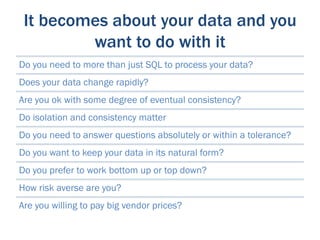
It becomes about your data and you
         want to do with it
Do you need to more than just SQL to process your data?
Does your data change rapidly?
Are you ok with some degree of eventual consistency?
Do isolation and consistency matter
Do you need to answer questions absolutely or within a tolerance?
Do you want to keep your data in its natural form?
Do you prefer to work bottom up or top down?
How risk averse are you?
Are you willing to pay big vendor prices?
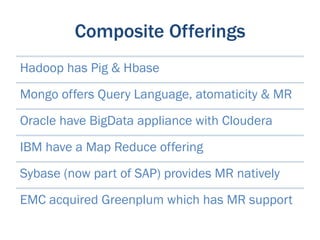
Composite Offerings
Hadoop has Pig & Hbase
Mongo offers Query Language, atomaticity & MR
Oracle have BigData appliance with Cloudera
IBM have a Map Reduce offering
Sybase (now part of SAP) provides MR natively
EMC acquired Greenplum which has MR support
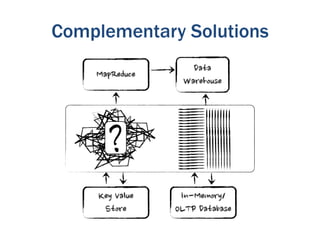
Complementary Solutions
Relational world has focused on
keeping data consistent and well
structured so it can be sliced and
           diced at will
Big data technologies focus on
executing code next to data, where
that data is held in a more natural
               form.
So
•  NoSQL has disrupted the database market,
   questioning the need for constraint and highlighting
   the power of simple solutions.
•  DB startups are providing some surprisingly fast
   solutions that drop some traditional database tenets
   and cleverly leverage new hardware advances.
•  Your problem (and budget) is likely a better guide
   than the size of the data
•  The market is converging on both sides towards a
   middle ground and integrated suites of
   complementary tools.
The right tool for the job
“Attempting to force one technology or tool to
satisfy a particular need for which another tool
is more effective and efficient is like
attempting to drive a screw into a wall with a
hammer when a screwdriver is at hand: the
screw may eventually enter the wall but at
what cost?”
                 E.F. Codd, 1993
Thanks


http://www.benstopford.com

Where Does Big Data Meet Big Database - QCon 2012

  • 1.
  • 2.
    It used tobe easy…
  • 3.
    they all lookedpretty much alike
  • 4.
    NoSQL BigData MapReduce Graph Document Shared Column Eventual BigTable CAP Nothing Oriented Consistency ACID BASE Mongo Coudera Hadoop Voldemort Cassandra Dynamo Marklogic Redis Velocity Hbase Hypertable Riak BDB
  • 5.
  • 6.
  • 7.
    we changed scale
  • 8.
    tack ge d we ch an
  • 9.
    so where does bigdata meet big database?
  • 10.
    The world’s largestNoSQL database?
  • 11.
  • 12.
    So how Bigis Big? Everything (500,000) Web Pages (40) 0.01% Words (0.6) 1% Sizes in Petabytes
  • 13.
    Many more BigSources mobile weather sensors Social Logs data audio video
  • 14.
    But it ispretty useful Marketing Fraud detection Tax Evasion Intelligence Advertising Scientific research
  • 15.
    Gartner 80% of businessis conducted on unstructured information
  • 16.
    Big Data isnow a new class of economic asset* *World economic forum 2012
  • 17.
    Yet 80% EnterpriseDatabases < 1TB
  • 18.
    Along came theBig Data Movement
  • 19.
    MapReduce (2004) •  Large,distributed, ordered map •  Fault-tolerant file system •  Petabyte scaling
  • 20.
    Disruptive Simple Pragmatic Solved an insolubleproblem Unencumbered by tradition (good & bad) Hacker rather than Enterprise culture
  • 21.
    A Different Focus Tradition The new wave •  Global consistency •  Local consistency •  Schema driven •  Schemaless / Last •  Reliable Network •  Unreliable Network •  Highly Structured •  Semi-structured/ Unstructured
  • 22.
    Novel? Possibly better putas: A timely and elegant combination of existing ideas, placed together to solve a previously unsolved problem.
  • 23.
    Backlash (2009) Not novel(dates back to the 80’s) Physical level not the logical level (messy?) Incompatible with tooling Lack of integrity (referential) & ACID MR is brute force ignoring indexing, scew
  • 24.
    All points arereasonable
  • 25.
    And they provedit too! “A comparison of Approaches to Large Scale Data Analysis” – Sigmod 2009 •  Vertica vs. DBMSX vs. Hadoop •  Vertica up to 7 x faster than Hadoop over benchmarks Databases faster than Hadoop
  • 26.
  • 27.
    MapReduce was notsupposed to be a Data Warehousing tool?
  • 28.
    If you needmore, layer it on top For example Tensing & Magastore @ Google
  • 29.
    So MapReduce representsa bottom-up approach to accessing very large data sets that is unencumbered by the past.
  • 30.
    …and the DatabaseField knew it had Problems
  • 31.
    We Lose: JoeHellerstein (Berkeley) 2001 “Databases are commoditised and cornered to slow-moving, evolving, structure intensive, applications that require schema evolution.“ … “The internet companies are lost and we will remain in the doldrums of the enterprise space.” … “As databases are black boxes which require a lot of coaxing to get maximum performance”
  • 32.
    Yet they dosome very cool stuff Statistically based optimisers, Compression, indexing structures, distributed optimisers, their own declarative language
  • 34.
    They are anAwesome Tool
  • 35.
    They Don’t talkour Language
  • 36.
    They Default toConstraint
  • 37.
    So NoSurprise withNoSQL then Simpler Contract Shared nothing No joins / ACID No impedance mismatch No slow schema evolution Simple code paths Just works
  • 38.
    The NoSQL Approach Simple, flexible storage over a diverse range of data structures that will scale almost indefinitely.
  • 39.
  • 40.
    Two Ways In:Key Based Access Client
  • 41.
    Two Ways In:Broadcast to Every Node Client
  • 42.
    So.. A simple bottomup approach to data storage that scales almost indefinitely. •  No relations •  No joins •  No SQL •  No Transactions •  No sluggish schema evolution
  • 43.
  • 44.
    The ‘Relational Camp’had been busy too Realisation that the traditional architecture was insufficient for various modern workloads
  • 45.
    End of anEra Paper - 2007 “Because RDBMSs can be beaten by more than an order of magnitude on the standard OLTP benchmark, then there is no market where they are competitive. As such, they should be considered as legacy technology more than a quarter of a century in age, for which a complete redesign and re-architecting is the appropriate next step.” – Michael Stonebraker
  • 46.
    No Longer aOne-Size-Fits-All
  • 47.
    Architecting for DifferentNon- Functionals Shared In-Memory Nothing / Disk Fast Column Network/ Orientation SSD
  • 48.
  • 49.
  • 50.
    Shared Disk Architecture Single node Cache can handle sits any query above whole dataset All machines see all data
  • 51.
    Shared Nothing Architecture Cache Queries hit every node over just the shard •  Autonomy over a shard •  Divide and conqueror (non-key hit every node)
  • 52.
    Vendors polarise overthis issue Shared Nothing Shared Everything •  TerraData (Aster Data) •  Oracle RAC/Exadata •  Netezza (IBM) •  IBM purescale •  ParAccel •  Sybase IQ •  Vertica •  Microsoft SQL Server •  Greenplumb (there is some blurring)
  • 53.
    Column Oriented Storage Columnslaid contiguously 2-10x compression typical Indexing becomes less important. Pinpoint I/O slow (tuple construction) Bulk read/write faster Compression >> row-based alternatives
  • 54.
    Solid State Drives 1ms 1µs HDD Seek Time SSD Drive •  Traditional databases are designed for sequential access over magnetic drives, not random access over SSD. •  Weakens the columnar/row argument
  • 55.
    Faster Networking RAM 10Gigabit Ethernet RDMA Gigabit Ethernet 1ms 1µs 1ns HDD Seek Time SSD Drive
  • 56.
    The best technologiesof the moment are leveraging many of these factors
  • 57.
    There is anew and impressive breed •  Products < 5 years old •  Shared nothing with SSD’s over shards •  Large address spaces (256GB+) •  No indexes (column oriented) •  No referential integrity •  Surprisingly quick for big queries when compared with incumbent technologies.
  • 58.
    TPC-H Benchmarks Several newcontenders with good scores: –  Exasol –  ParAccel –  Vectorwise
  • 59.
    TPC-H Benchmarks •  Exasolhas 100GB -> 10TB benchmarks •  Up to 20x faster than nearest rivals (But take benchmarks with a pinch of salt)
  • 60.
    Relational Approach Solid datafrom every angle, bounded in terms of scale, but with a boundary that is rapidly expanding.
  • 61.
  • 62.
    At the extremeMapReduce has it TB 0 1 10 100 1000 10,000
  • 63.
    But there ismassive overlap TB 0 1 10 100 1000 10,000
  • 64.
    It’s not justdata volume/velocity
  • 65.
    The Dimensions ofData •  Volume (pure physical size) •  Velocity (rate of change) •  Variety (number of different types of data, formats and sources) •  Static & Dynamic Complexity
  • 66.
    Consider the characteristicsof data to be integrated, and how that equates to cost
  • 67.
    Ability to modeldata is much more of a gating factor than raw size, particularly when considering new forms of data Dave Campbell (Microsoft – VLDB Keynote)
  • 68.
    It becomes aboutyour data and you want to do with it Do you need to more than just SQL to process your data? Does your data change rapidly? Are you ok with some degree of eventual consistency? Do isolation and consistency matter Do you need to answer questions absolutely or within a tolerance? Do you want to keep your data in its natural form? Do you prefer to work bottom up or top down? How risk averse are you? Are you willing to pay big vendor prices?
  • 69.
    Composite Offerings Hadoop hasPig & Hbase Mongo offers Query Language, atomaticity & MR Oracle have BigData appliance with Cloudera IBM have a Map Reduce offering Sybase (now part of SAP) provides MR natively EMC acquired Greenplum which has MR support
  • 70.
  • 71.
    Relational world hasfocused on keeping data consistent and well structured so it can be sliced and diced at will
  • 72.
    Big data technologiesfocus on executing code next to data, where that data is held in a more natural form.
  • 73.
    So •  NoSQL hasdisrupted the database market, questioning the need for constraint and highlighting the power of simple solutions. •  DB startups are providing some surprisingly fast solutions that drop some traditional database tenets and cleverly leverage new hardware advances. •  Your problem (and budget) is likely a better guide than the size of the data •  The market is converging on both sides towards a middle ground and integrated suites of complementary tools.
  • 74.
    The right toolfor the job “Attempting to force one technology or tool to satisfy a particular need for which another tool is more effective and efficient is like attempting to drive a screw into a wall with a hammer when a screwdriver is at hand: the screw may eventually enter the wall but at what cost?” E.F. Codd, 1993
  • 75.