Swiss Group for Artificial Intelligence and Cognitive Science 
Intelligent Systems and Applications Workshop 2014, University of Basel 
Watson Technical Deep Dive 
© 2013 IBM Corporation 
@RomeoKienzler, IBM Innovation Center Zurich
(part of) my role @IBM 
● Accelerate cognitive computing 
● In Switzerland 
● Through 
● Academia 
● Startups/ISV's 
● Cloud 
Watson in the cloud: bit.ly/go4bluemix 
2 © 2013 IBM Corporation
What Watson is not 
● Search Engine 
● Database System 
● HAL9000 
3 © 2013 IBM Corporation
4 © 2013 IBM Corporation
What Watson is 
● Cognitive System (Marketing) 
● Combination of 
● Information Retrieval 
● NLP 
● Structured + Unstructured Data ! 
● Runs on UIMA 
● Based on supervised learning 
5 © 2013 IBM Corporation
What is a parser? 
● Annotate sentence with 
● Tags 
● Relationships 
● Probabilistic (e.g. Stanford) 
● Rule based 
● (E) Slot Grammar 
6 © 2013 IBM Corporation
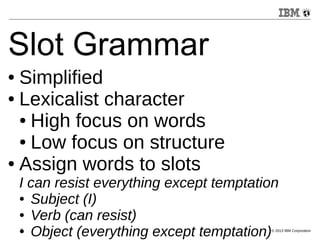
Slot Grammar 
● Simplified 
● Lexicalist character 
● High focus on words 
● Low focus on structure 
● Assign words to slots 
I can resist everything except temptation 
● Subject (I) 
● Verb (can resist) 
● Object (everything except temptation) 
7 © 2013 IBM Corporation
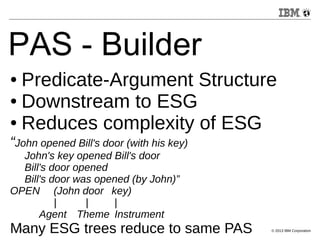
PAS - Builder 
● Predicate-Argument Structure 
● Downstream to ESG 
● Reduces complexity of ESG 
“John opened Bill's door (with his key) 
John's key opened Bill's door 
Bill's door opened 
Bill's door was opened (by John)” 
OPEN (John door key) 
| | | 
Agent Theme Instrument 
Many ESG trees reduce to same PAS 
8 © 2013 IBM Corporation
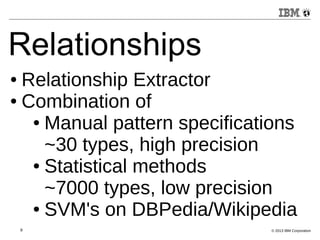
Relationships 
● Relationship Extractor 
● Combination of 
● Manual pattern specifications 
~30 types, high precision 
● Statistical methods 
~7000 types, low precision 
● SVM's on DBPedia/Wikipedia 
9 © 2013 IBM Corporation
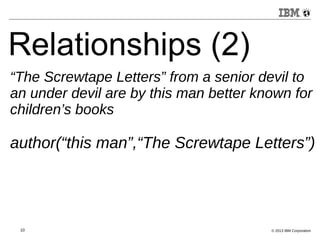
Relationships (2) 
“The Screwtape Letters” from a senior devil to 
an under devil are by this man better known for 
children’s books 
author(“this man”,“The Screwtape Letters”) 
10 © 2013 IBM Corporation
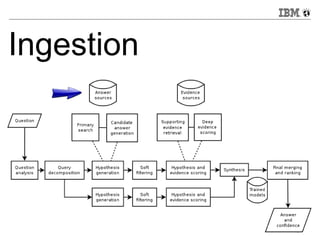
Ingestion 
11 © 2013 IBM Corporation
Ingestion 
● Corpus creation 
● Input format: TREC 
(Text Retrieval Conference) 
● Multiple HTML pages in one 
HDFS file 
● Parallel ingestion process 
(LiteScale) 
12 © 2013 IBM Corporation
Dictionary 
● started w/ Wikipedia copus 
● Keyword → Text structure 
● Transformation of free text 
● into Keyword → Text 
● optimization objective 
13 © 2013 IBM Corporation
Knowledge Expansion 
● Follow links in content 
● Identify content keywords and link 
to new content 
● → generate more content in 
Keyword → Text form 
14 © 2013 IBM Corporation
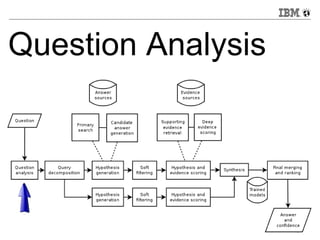
Question Analysis 
15 © 2013 IBM Corporation
Question Analysis 
● Named entity recognition 
● Type identification /Extract focus 
● ESG/PAS 
● Relationship detection 
16 © 2013 IBM Corporation
Question Analysis 
1) Extract focus 
2) Map to LAT 
3) Broad Type classification 
4) Detect if special handling is 
needed (e.g. nested question) 
17 © 2013 IBM Corporation
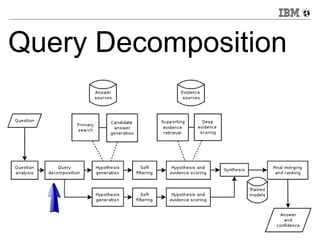
Query Decomposition 
18 © 2013 IBM Corporation
Query Decomposition 
● Keyword identification 
● LAT (Lexical Answer Type) 
● IBM Pat. US20120078890 for 
confidence estimation of LAT 
● optimization objective: choosing 
keywords out of nontrivial set of 
words based on ML 
19 © 2013 IBM Corporation
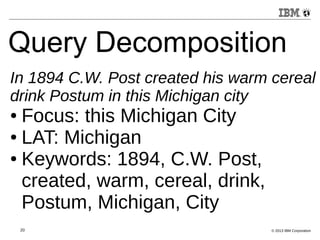
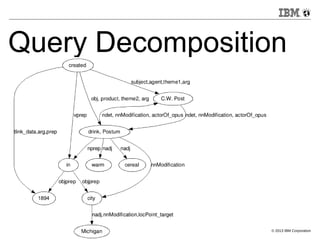
Query Decomposition 
In 1894 C.W. Post created his warm cereal 
drink Postum in this Michigan city 
● Focus: this Michigan City 
● LAT: Michigan 
● Keywords: 1894, C.W. Post, 
created, warm, cereal, drink, 
Postum, Michigan, City 
20 © 2013 IBM Corporation
Query Decomposition 
21 © 2013 IBM Corporation
Primary Search 
22 © 2013 IBM Corporation
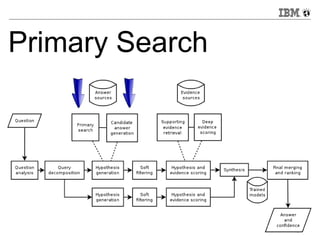
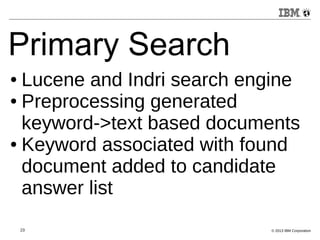
Primary Search 
● Lucene and Indri search engine 
● Preprocessing generated 
keyword->text based documents 
● Keyword associated with found 
document added to candidate 
answer list 
23 © 2013 IBM Corporation
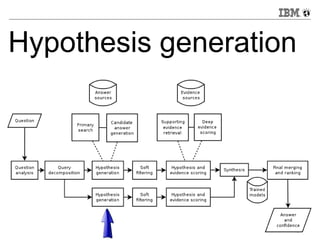
Hypothesis generation 
24 © 2013 IBM Corporation
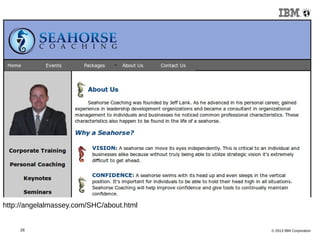
Supporting Evidence Retrieval 
Unlike most sea animals, in the sea horse this pair 
of sense organs can move independently of one 
another 
Question decomposition: 
Which [sense organ] of [Sea Horse] move independently? 
Hypothesis generation: 
A Sea Horse can move its eyes independently. 
A Sea Horse can move its ears independently. 
A Sea Horse can move its skin independently. 
A Sea Horse can move its nose independently. 
A Sea Horse can move its tung independently. 
25 © 2013 IBM Corporation
http://angelalmassey.com/SHC/about.html 
26 © 2013 IBM Corporation
Supporting Evidence 
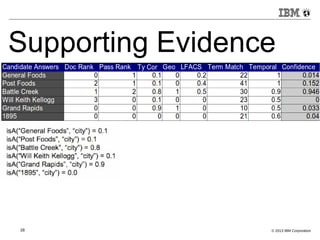
● Generated Candidate Answer is 
● ESG'd 
● PAS'd 
● searched against corpus 
● LATs used to determine whether 
a candidate answer is an 
instance of the answer types 
27 © 2013 IBM Corporation
Supporting Evidence 
28 © 2013 IBM Corporation
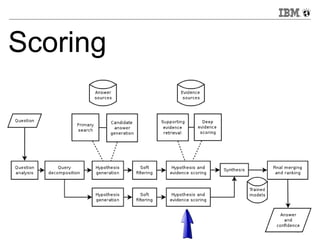
Scoring 
29 © 2013 IBM Corporation
Scoring 
● Optimization objective 
(confidence estimation framework) 
● Relational (PRISMATIC, Dbpedia) 
● Taxonomic,Geospacial 
● Temporal, Source Reliability 
● Gender, Name consistency 
● Passage Support 
● 30 Theory consistency 
© 2013 IBM Corporation
Scoring challenges 
● Feature significance different for 
● Different questions 
● Different question classes 
● Very heterogeneous features 
● Normalization problem 
● Missing features 
● Class imbalance 
31 © 2013 IBM Corporation
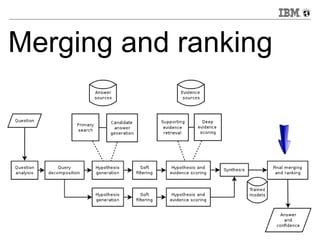
Merging and ranking 
32 © 2013 IBM Corporation
Merging and ranking 
1. John Fitzgerald Kennedy 2. Kennedy, 3. JFK 
● Different Scores 
● Merge to canonical form 
● Morphological 
● Pattern-based 
● Table Lookup 
● Partially generated from Wikipedia 
disabiguation pages 
33 © 2013 IBM Corporation
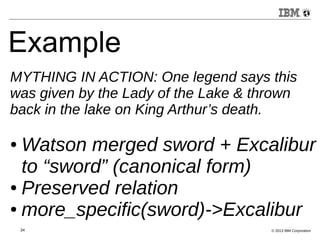
Example 
MYTHING IN ACTION: One legend says this 
was given by the Lady of the Lake & thrown 
back in the lake on King Arthur’s death. 
●Watson merged sword + Excalibur 
to “sword” (canonical form) 
● Preserved relation 
● more_specific(sword)->Excalibur 
34 © 2013 IBM Corporation
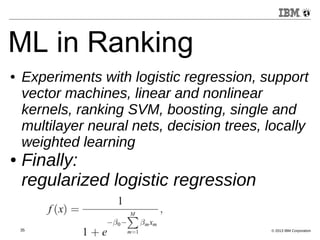
ML in Ranking 
● Experiments with logistic regression, support 
vector machines, linear and nonlinear 
kernels, ranking SVM, boosting, single and 
multilayer neural nets, decision trees, locally 
weighted learning 
● Finally: 
regularized logistic regression 
35 © 2013 IBM Corporation
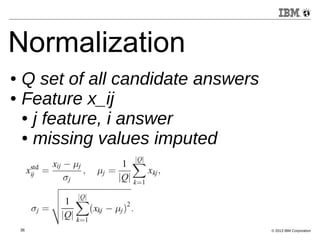
Normalization 
● Q set of all candidate answers 
● Feature x_ij 
● j feature, i answer 
● missing values imputed 
36 © 2013 IBM Corporation
Ranking 
● Based on training set n > 10K 
● IBM SPSS Modeler 
37 © 2013 IBM Corporation
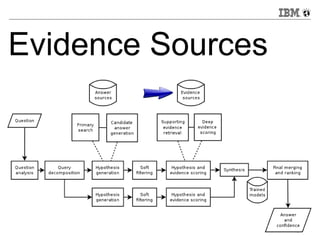
Evidence Sources 
38 © 2013 IBM Corporation
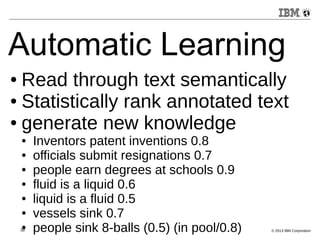
Automatic Learning 
● Read through text semantically 
● Statistically rank annotated text 
● generate new knowledge 
● Inventors patent inventions 0.8 
● officials submit resignations 0.7 
● people earn degrees at schools 0.9 
● fluid is a liquid 0.6 
● liquid is a fluid 0.5 
● vessels sink 0.7 
● people sink 8-balls (0.5) (in pool/0.8) 
39 © 2013 IBM Corporation
Next steps 
● “Jeopardy!” - Watson was 
● Open domain 
● Large training set 
● New “Watsons” are 
● Closed domain 
● Small, but growing training set 
40 © 2013 IBM Corporation
Demo 
● Bit.ly/go4bluemix 
41 © 2013 IBM Corporation
References 
[1] Jeffrey Kabot, “Deep Parsing” 
[2] Richard Nordquist, “slot and 
filler” 
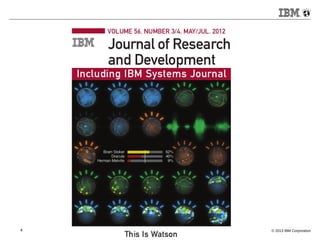
[3] The Journal of Research and 
Development, Vol 56, 2012 
42 © 2013 IBM Corporation

IBM Watson Technical Deep Dive Swiss Group for Artificial Intelligence and Cognitive Science

  • 1.
    Swiss Group forArtificial Intelligence and Cognitive Science Intelligent Systems and Applications Workshop 2014, University of Basel Watson Technical Deep Dive © 2013 IBM Corporation @RomeoKienzler, IBM Innovation Center Zurich
  • 2.
    (part of) myrole @IBM ● Accelerate cognitive computing ● In Switzerland ● Through ● Academia ● Startups/ISV's ● Cloud Watson in the cloud: bit.ly/go4bluemix 2 © 2013 IBM Corporation
  • 3.
    What Watson isnot ● Search Engine ● Database System ● HAL9000 3 © 2013 IBM Corporation
  • 4.
    4 © 2013IBM Corporation
  • 5.
    What Watson is ● Cognitive System (Marketing) ● Combination of ● Information Retrieval ● NLP ● Structured + Unstructured Data ! ● Runs on UIMA ● Based on supervised learning 5 © 2013 IBM Corporation
  • 6.
    What is aparser? ● Annotate sentence with ● Tags ● Relationships ● Probabilistic (e.g. Stanford) ● Rule based ● (E) Slot Grammar 6 © 2013 IBM Corporation
  • 7.
    Slot Grammar ●Simplified ● Lexicalist character ● High focus on words ● Low focus on structure ● Assign words to slots I can resist everything except temptation ● Subject (I) ● Verb (can resist) ● Object (everything except temptation) 7 © 2013 IBM Corporation
  • 8.
    PAS - Builder ● Predicate-Argument Structure ● Downstream to ESG ● Reduces complexity of ESG “John opened Bill's door (with his key) John's key opened Bill's door Bill's door opened Bill's door was opened (by John)” OPEN (John door key) | | | Agent Theme Instrument Many ESG trees reduce to same PAS 8 © 2013 IBM Corporation
  • 9.
    Relationships ● RelationshipExtractor ● Combination of ● Manual pattern specifications ~30 types, high precision ● Statistical methods ~7000 types, low precision ● SVM's on DBPedia/Wikipedia 9 © 2013 IBM Corporation
  • 10.
    Relationships (2) “TheScrewtape Letters” from a senior devil to an under devil are by this man better known for children’s books author(“this man”,“The Screwtape Letters”) 10 © 2013 IBM Corporation
  • 11.
    Ingestion 11 ©2013 IBM Corporation
  • 12.
    Ingestion ● Corpuscreation ● Input format: TREC (Text Retrieval Conference) ● Multiple HTML pages in one HDFS file ● Parallel ingestion process (LiteScale) 12 © 2013 IBM Corporation
  • 13.
    Dictionary ● startedw/ Wikipedia copus ● Keyword → Text structure ● Transformation of free text ● into Keyword → Text ● optimization objective 13 © 2013 IBM Corporation
  • 14.
    Knowledge Expansion ●Follow links in content ● Identify content keywords and link to new content ● → generate more content in Keyword → Text form 14 © 2013 IBM Corporation
  • 15.
    Question Analysis 15© 2013 IBM Corporation
  • 16.
    Question Analysis ●Named entity recognition ● Type identification /Extract focus ● ESG/PAS ● Relationship detection 16 © 2013 IBM Corporation
  • 17.
    Question Analysis 1)Extract focus 2) Map to LAT 3) Broad Type classification 4) Detect if special handling is needed (e.g. nested question) 17 © 2013 IBM Corporation
  • 18.
    Query Decomposition 18© 2013 IBM Corporation
  • 19.
    Query Decomposition ●Keyword identification ● LAT (Lexical Answer Type) ● IBM Pat. US20120078890 for confidence estimation of LAT ● optimization objective: choosing keywords out of nontrivial set of words based on ML 19 © 2013 IBM Corporation
  • 20.
    Query Decomposition In1894 C.W. Post created his warm cereal drink Postum in this Michigan city ● Focus: this Michigan City ● LAT: Michigan ● Keywords: 1894, C.W. Post, created, warm, cereal, drink, Postum, Michigan, City 20 © 2013 IBM Corporation
  • 21.
    Query Decomposition 21© 2013 IBM Corporation
  • 22.
    Primary Search 22© 2013 IBM Corporation
  • 23.
    Primary Search ●Lucene and Indri search engine ● Preprocessing generated keyword->text based documents ● Keyword associated with found document added to candidate answer list 23 © 2013 IBM Corporation
  • 24.
    Hypothesis generation 24© 2013 IBM Corporation
  • 25.
    Supporting Evidence Retrieval Unlike most sea animals, in the sea horse this pair of sense organs can move independently of one another Question decomposition: Which [sense organ] of [Sea Horse] move independently? Hypothesis generation: A Sea Horse can move its eyes independently. A Sea Horse can move its ears independently. A Sea Horse can move its skin independently. A Sea Horse can move its nose independently. A Sea Horse can move its tung independently. 25 © 2013 IBM Corporation
  • 26.
  • 27.
    Supporting Evidence ●Generated Candidate Answer is ● ESG'd ● PAS'd ● searched against corpus ● LATs used to determine whether a candidate answer is an instance of the answer types 27 © 2013 IBM Corporation
  • 28.
    Supporting Evidence 28© 2013 IBM Corporation
  • 29.
    Scoring 29 ©2013 IBM Corporation
  • 30.
    Scoring ● Optimizationobjective (confidence estimation framework) ● Relational (PRISMATIC, Dbpedia) ● Taxonomic,Geospacial ● Temporal, Source Reliability ● Gender, Name consistency ● Passage Support ● 30 Theory consistency © 2013 IBM Corporation
  • 31.
    Scoring challenges ●Feature significance different for ● Different questions ● Different question classes ● Very heterogeneous features ● Normalization problem ● Missing features ● Class imbalance 31 © 2013 IBM Corporation
  • 32.
    Merging and ranking 32 © 2013 IBM Corporation
  • 33.
    Merging and ranking 1. John Fitzgerald Kennedy 2. Kennedy, 3. JFK ● Different Scores ● Merge to canonical form ● Morphological ● Pattern-based ● Table Lookup ● Partially generated from Wikipedia disabiguation pages 33 © 2013 IBM Corporation
  • 34.
    Example MYTHING INACTION: One legend says this was given by the Lady of the Lake & thrown back in the lake on King Arthur’s death. ●Watson merged sword + Excalibur to “sword” (canonical form) ● Preserved relation ● more_specific(sword)->Excalibur 34 © 2013 IBM Corporation
  • 35.
    ML in Ranking ● Experiments with logistic regression, support vector machines, linear and nonlinear kernels, ranking SVM, boosting, single and multilayer neural nets, decision trees, locally weighted learning ● Finally: regularized logistic regression 35 © 2013 IBM Corporation
  • 36.
    Normalization ● Qset of all candidate answers ● Feature x_ij ● j feature, i answer ● missing values imputed 36 © 2013 IBM Corporation
  • 37.
    Ranking ● Basedon training set n > 10K ● IBM SPSS Modeler 37 © 2013 IBM Corporation
  • 38.
    Evidence Sources 38© 2013 IBM Corporation
  • 39.
    Automatic Learning ●Read through text semantically ● Statistically rank annotated text ● generate new knowledge ● Inventors patent inventions 0.8 ● officials submit resignations 0.7 ● people earn degrees at schools 0.9 ● fluid is a liquid 0.6 ● liquid is a fluid 0.5 ● vessels sink 0.7 ● people sink 8-balls (0.5) (in pool/0.8) 39 © 2013 IBM Corporation
  • 40.
    Next steps ●“Jeopardy!” - Watson was ● Open domain ● Large training set ● New “Watsons” are ● Closed domain ● Small, but growing training set 40 © 2013 IBM Corporation
  • 41.
    Demo ● Bit.ly/go4bluemix 41 © 2013 IBM Corporation
  • 42.
    References [1] JeffreyKabot, “Deep Parsing” [2] Richard Nordquist, “slot and filler” [3] The Journal of Research and Development, Vol 56, 2012 42 © 2013 IBM Corporation