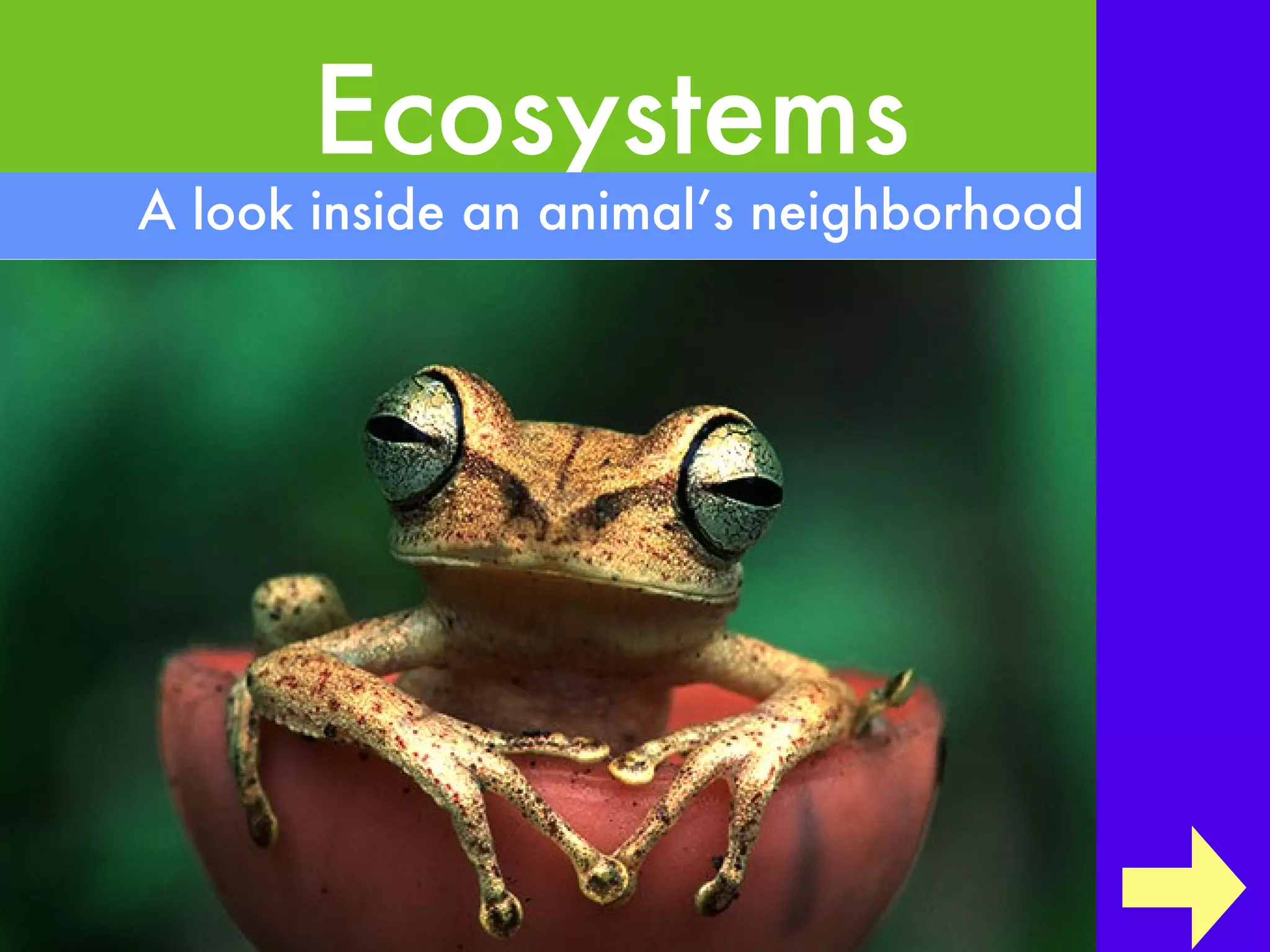
Ecosystems
A look inside an animal’s neighborhood
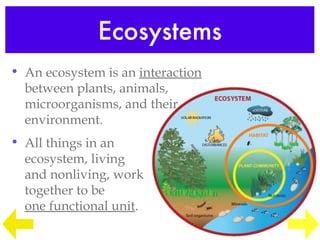
Ecosystems
• An ecosystem is an interaction
  between plants, animals,
  microorganisms, and their
  environment.
• All things in an
  ecosystem, living
  and nonliving, work
  together to be
  one functional unit.
Where are ecosystems?

• Ecosystems are everywhere!

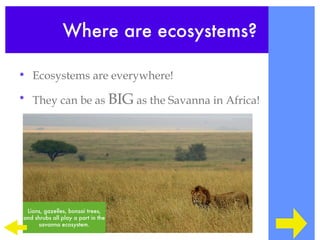
• They can be as BIG as the Savanna in Africa!


 Lions, gazelles, bonsai trees,
and shrubs all play a part in the
     savanna ecosystem.
Where are ecosystems?

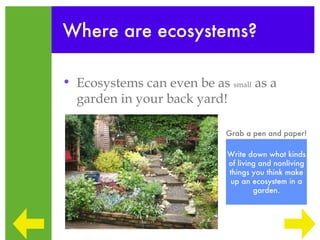
• Ecosystems can even be as small as a
  garden in your back yard!

                            Grab a pen and paper!

                             Write down what kinds
                             of living and nonliving
                             things you think make
                             up an ecosystem in a
                                     garden.
Ecosystems
                 • All living organisms in an ecosystem
                   depend on each other for survival.
                 • This means these organisms are
 Everything is
 connected in
an ecosystem.
                   interdependent.
  To find out
  more Click
    HERE!
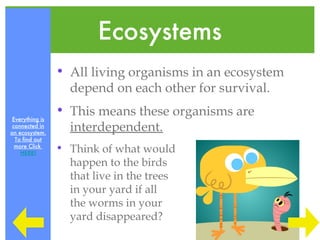
                 • Think of what would
                   happen to the birds
                   that live in the trees
                   in your yard if all
                   the worms in your
                   yard disappeared?
Ecosystem Facts
 • Each component of an ecosystem
   is a source of food for another.
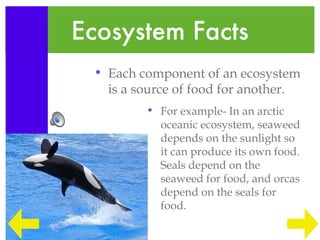
         • For example- In an arctic
           oceanic ecosystem, seaweed
           depends on the sunlight so
           it can produce its own food.
           Seals depend on the
           seaweed for food, and orcas
           depend on the seals for
           food.
What is a healthy ecosystem?
                  • Scientists will call a healthy
                    ecosystem a sustainable ecosystem.
                    • This means there is a balance
                      between each of the components
                      in an ecosystem.
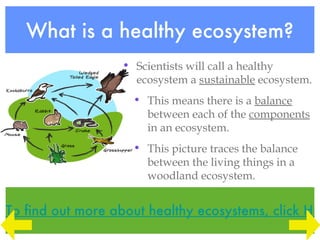
                    • This picture traces the balance
                      between the living things in a
                      woodland ecosystem.


To find out more about healthy ecosystems, click HE
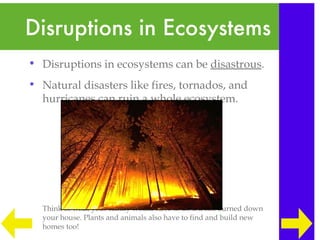
Disruptions in Ecosystems
• Disruptions in ecosystems can be disastrous.
• Natural disasters like fires, tornados, and
  hurricanes can ruin a whole ecosystem.


  Think of what your family would have to do if a fire burned down
  your house. Plants and animals also have to find and build new
  homes too!
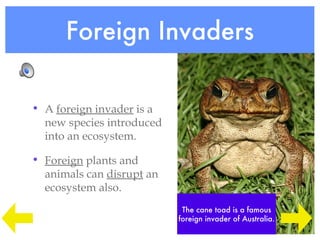
Foreign Invaders

• A foreign invader is a
  new species introduced
  into an ecosystem.

• Foreign plants and
  animals can disrupt an
  ecosystem also.
                            The cane toad is a famous
                           foreign invader of Australia.
Foreign Invaders Cont’d

                                                   • If a new species is
                                                     introduced into an
                                                     ecosystem, they can
                                                     upset the healthy
                                                     balance that
                                                     ecosystem once had.
    What if a new species of jungle cat was
introduced into the rainforest? There would be
more competition for the black panther to find
  food. This may result in the extinction of the
                black panther.
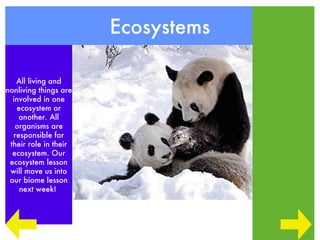
Ecosystems

   All living and
nonliving things are
  involved in one
   ecosystem or
    another. All
   organisms are
  responsible for
 their role in their
  ecosystem. Our
 ecosystem lesson
 will move us into
 our biome lesson
    next week!
GLCE’s Used
•   Ecosystems

•   K-7 Standard L.EC: Develop an understanding of the
    interdependence of the variety of populations, communities
    and ecosystems, including those in the Great Lakes region.
    Develop an understanding of different types of
    interdependence and that biotic (living) and abiotic (non-living)
    factors affect the balance of an ecosystem. Understand that all
    organisms cause changes, some detrimental and others
    beneficial, in the environment where they live.

•   L.EC.E.1 Interactions- Organisms interact in various ways
    including providing food and shelter to one another. Some
    interactions are helpful; others are harmful to the organism and
    other organisms.
Works Cited

• "Fourth Grade Science Grade Level
  Content Expectations V.1.09." Michigan
  Department of Education, 2009. Web. 14
  Mar. 2010.
Pictures Cited
FROG-
http://bealbio.wikispaces.com/file/view/frog-on-plant-fingers-bulging-eyes-swiss-photographer-thomas-marent-rainforest-foundation-amazon-a

DIAGRAM-http://www.fws.gov/invasives/volunteersTrainingModule/images/invasives/ecosystem.jpg

BIRD AND WORM-http://api.ning.com/files/3r7tiGWsPn-gVbKOiB*Ya63x84hwvi8iSWOdsxXP1Cg_/bird_and_worm.jpg

ORCA- http://www.statesymbolsusa.org/IMAGES/Washington/orca_seaworld-380.jpg

LION-http://onlynatural.files.wordpress.com/2008/09/800px-male_lion_on_savanna.jpg

GARDEN-http://i40.photobucket.com/albums/e209/ilovebugs123/25e41f81.jpg

DIAGRAM 2-http://susty.com/image/ecosystem-diagram-wedged-tailed-eagle-kookabur
ra-bird-rabbit-mouse-grass-snake-grasshopper-food-web-illustration-arrows-image.gif

FIRE-http://images.google.com/imgres?imgurl=http://gardenrain.files.wordpress.com/2009/06/forest_fi
re.png&imgrefurl=http://gardenrain.wordpress.com/2009/06/18/&usg=__fZQDReVqahE-
HS4BqnoVrpNjaSs=&h=305&w=448&sz=68&hl=en&start=1&itbs=1&tbnid=yYdoO-
YwGSZfqM:&tbnh=86&tbnw=127&prev=/images%3Fq%3Dforest%2Bfire%26hl%3Den%26sa%3DG%26gbv%3D2%26tbs%3Disch:1

CANE TOAD-http://coolthingsinrandomplaces.com/wp-content/uploads/2007/12/cane-toad-4.jpg

PANTHER-http://c2.api.ning.com/files/QymItXEcIJWAwR6Z1g1VsvE13R6*-sp7HsZG6Ee2JYTd6a0SeEftra3Q1ktHpKeg4ofdzmc
yW9sMxGqwq10ySqPLNinJ5IO-/A_Dark_Mood_Black_Panther.jpg

PANDA-http://inlinethumb40.webshots.com/3047/2757611580046091027S425x425Q85.jpg

Ecosystems and habitas

  • 1.
    Ecosystems A look insidean animal’s neighborhood
  • 2.
    Ecosystems • An ecosystemis an interaction between plants, animals, microorganisms, and their environment. • All things in an ecosystem, living and nonliving, work together to be one functional unit.
  • 3.
    Where are ecosystems? •Ecosystems are everywhere! • They can be as BIG as the Savanna in Africa! Lions, gazelles, bonsai trees, and shrubs all play a part in the savanna ecosystem.
  • 4.
    Where are ecosystems? •Ecosystems can even be as small as a garden in your back yard! Grab a pen and paper! Write down what kinds of living and nonliving things you think make up an ecosystem in a garden.
  • 5.
    Ecosystems • All living organisms in an ecosystem depend on each other for survival. • This means these organisms are Everything is connected in an ecosystem. interdependent. To find out more Click HERE! • Think of what would happen to the birds that live in the trees in your yard if all the worms in your yard disappeared?
  • 6.
    Ecosystem Facts •Each component of an ecosystem is a source of food for another. • For example- In an arctic oceanic ecosystem, seaweed depends on the sunlight so it can produce its own food. Seals depend on the seaweed for food, and orcas depend on the seals for food.
  • 7.
    What is ahealthy ecosystem? • Scientists will call a healthy ecosystem a sustainable ecosystem. • This means there is a balance between each of the components in an ecosystem. • This picture traces the balance between the living things in a woodland ecosystem. To find out more about healthy ecosystems, click HE
  • 8.
    Disruptions in Ecosystems •Disruptions in ecosystems can be disastrous. • Natural disasters like fires, tornados, and hurricanes can ruin a whole ecosystem. Think of what your family would have to do if a fire burned down your house. Plants and animals also have to find and build new homes too!
  • 9.
    Foreign Invaders • Aforeign invader is a new species introduced into an ecosystem. • Foreign plants and animals can disrupt an ecosystem also. The cane toad is a famous foreign invader of Australia.
  • 10.
    Foreign Invaders Cont’d • If a new species is introduced into an ecosystem, they can upset the healthy balance that ecosystem once had. What if a new species of jungle cat was introduced into the rainforest? There would be more competition for the black panther to find food. This may result in the extinction of the black panther.
  • 11.
    Ecosystems All living and nonliving things are involved in one ecosystem or another. All organisms are responsible for their role in their ecosystem. Our ecosystem lesson will move us into our biome lesson next week!
  • 12.
    GLCE’s Used • Ecosystems • K-7 Standard L.EC: Develop an understanding of the interdependence of the variety of populations, communities and ecosystems, including those in the Great Lakes region. Develop an understanding of different types of interdependence and that biotic (living) and abiotic (non-living) factors affect the balance of an ecosystem. Understand that all organisms cause changes, some detrimental and others beneficial, in the environment where they live. • L.EC.E.1 Interactions- Organisms interact in various ways including providing food and shelter to one another. Some interactions are helpful; others are harmful to the organism and other organisms.
  • 13.
    Works Cited • "FourthGrade Science Grade Level Content Expectations V.1.09." Michigan Department of Education, 2009. Web. 14 Mar. 2010.
  • 14.
    Pictures Cited FROG- http://bealbio.wikispaces.com/file/view/frog-on-plant-fingers-bulging-eyes-swiss-photographer-thomas-marent-rainforest-foundation-amazon-a DIAGRAM-http://www.fws.gov/invasives/volunteersTrainingModule/images/invasives/ecosystem.jpg BIRD ANDWORM-http://api.ning.com/files/3r7tiGWsPn-gVbKOiB*Ya63x84hwvi8iSWOdsxXP1Cg_/bird_and_worm.jpg ORCA- http://www.statesymbolsusa.org/IMAGES/Washington/orca_seaworld-380.jpg LION-http://onlynatural.files.wordpress.com/2008/09/800px-male_lion_on_savanna.jpg GARDEN-http://i40.photobucket.com/albums/e209/ilovebugs123/25e41f81.jpg DIAGRAM 2-http://susty.com/image/ecosystem-diagram-wedged-tailed-eagle-kookabur ra-bird-rabbit-mouse-grass-snake-grasshopper-food-web-illustration-arrows-image.gif FIRE-http://images.google.com/imgres?imgurl=http://gardenrain.files.wordpress.com/2009/06/forest_fi re.png&imgrefurl=http://gardenrain.wordpress.com/2009/06/18/&usg=__fZQDReVqahE- HS4BqnoVrpNjaSs=&h=305&w=448&sz=68&hl=en&start=1&itbs=1&tbnid=yYdoO- YwGSZfqM:&tbnh=86&tbnw=127&prev=/images%3Fq%3Dforest%2Bfire%26hl%3Den%26sa%3DG%26gbv%3D2%26tbs%3Disch:1 CANE TOAD-http://coolthingsinrandomplaces.com/wp-content/uploads/2007/12/cane-toad-4.jpg PANTHER-http://c2.api.ning.com/files/QymItXEcIJWAwR6Z1g1VsvE13R6*-sp7HsZG6Ee2JYTd6a0SeEftra3Q1ktHpKeg4ofdzmc yW9sMxGqwq10ySqPLNinJ5IO-/A_Dark_Mood_Black_Panther.jpg PANDA-http://inlinethumb40.webshots.com/3047/2757611580046091027S425x425Q85.jpg