Living and nonliving things
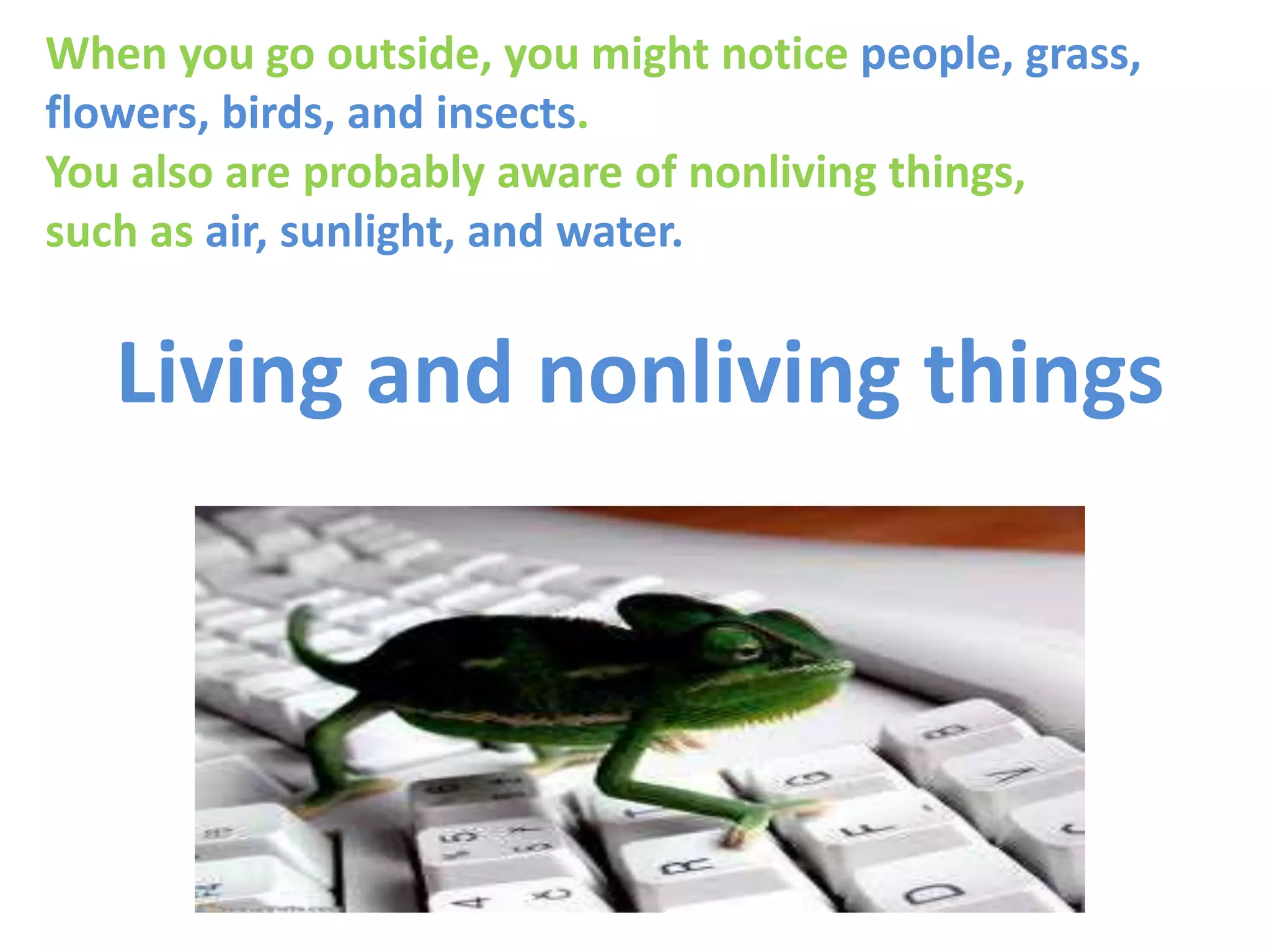
When you go outside, you might notice people, grass,
flowers, birds, and insects.
You also are probably aware of nonliving things,
such as air, sunlight, and water.
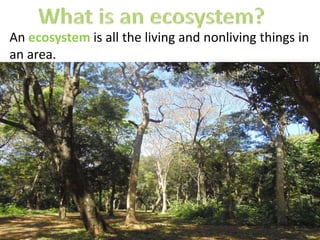
An ecosystem is all the living and nonliving things in
an area.
These systems are the plants and animals interacting with their non-living
environments (weather, Earth, Sun, soil, atmosphere). An ecosystem's development
depends on the energy that moves in and out of that system. As far as the
boundaries of an ecosystem, it depends upon how you use the term. You could have
an entire ecosystem underneath a big rock. On the other hand, you could be talking
about the overall ecosystem of the entire planet (biosphere). Animals and humans
do affect their respective ecosystems.
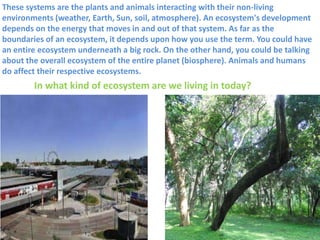
In what kind of ecosystem are we living in today?
Living and nonliving parts
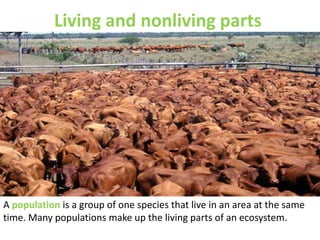
A population is a group of one species that live in an area at the same
time. Many populations make up the living parts of an ecosystem.
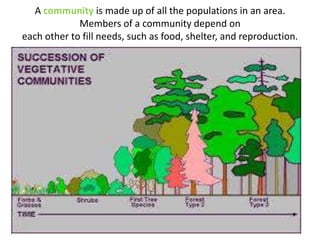
A community is made up of all the populations in an area.
Members of a community depend on
each other to fill needs, such as food, shelter, and reproduction.
How Ecosystems Change - Ecological Succession
What do you think?
Before you read, decide if you agree or disagree with each of these statements. As you read this
lesson, see if you change your mind about any of the statements.
1. An ecosystem never changes.
2. Nothing grows in the area where a volcano has
erupted.
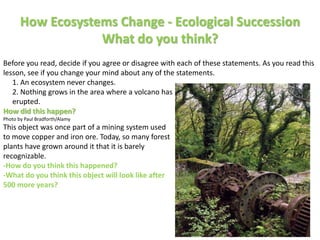
How did this happen?
Photo by Paul Bradforth/Alamy
This object was once part of a mining system used
to move copper and iron ore. Today, so many forest
plants have grown around it that it is barely
recognizable.
-How do you think this happened?
-What do you think this object will look like after
500 more years?
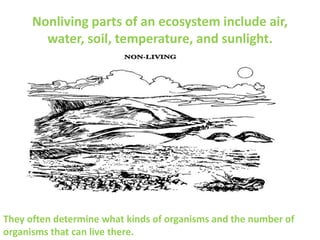
Nonliving parts of an ecosystem include air,
water, soil, temperature, and sunlight.
They often determine what kinds of organisms and the number of
organisms that can live there.
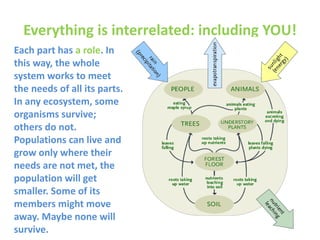
Everything is interrelated: including YOU!
Each part has a role. In
this way, the whole
system works to meet
the needs of all its parts.
In any ecosystem, some
organisms survive;
others do not.
Populations can live and
grow only where their
needs are not met, the
population will get
smaller. Some of its
members might move
away. Maybe none will
survive.
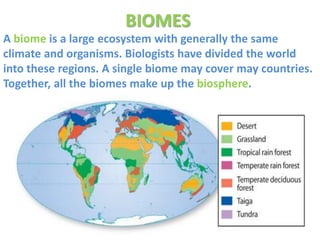
BIOMES
A biome is a large ecosystem with generally the same
climate and organisms. Biologists have divided the world
into these regions. A single biome may cover may countries.
Together, all the biomes make up the biosphere.
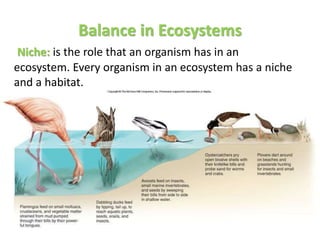
Balance in Ecosystems
Niche: is the role that an organism has in an
ecosystem. Every organism in an ecosystem has a niche
and a habitat.
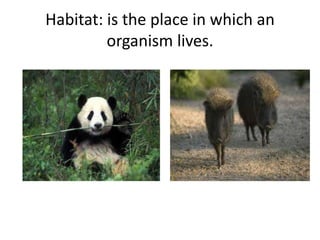
Habitat: is the place in which an
organism lives.
Excellence points:
Natural Disaster Research Project
For resources search in the following link
http://sandovalawesomescience.blogspot.com/
2013/05/natural-disasters-research-project.html

Ecosystems Science Kids

  • 1.
    Living and nonlivingthings When you go outside, you might notice people, grass, flowers, birds, and insects. You also are probably aware of nonliving things, such as air, sunlight, and water.
  • 2.
    An ecosystem isall the living and nonliving things in an area.
  • 3.
    These systems arethe plants and animals interacting with their non-living environments (weather, Earth, Sun, soil, atmosphere). An ecosystem's development depends on the energy that moves in and out of that system. As far as the boundaries of an ecosystem, it depends upon how you use the term. You could have an entire ecosystem underneath a big rock. On the other hand, you could be talking about the overall ecosystem of the entire planet (biosphere). Animals and humans do affect their respective ecosystems. In what kind of ecosystem are we living in today?
  • 4.
    Living and nonlivingparts A population is a group of one species that live in an area at the same time. Many populations make up the living parts of an ecosystem.
  • 5.
    A community ismade up of all the populations in an area. Members of a community depend on each other to fill needs, such as food, shelter, and reproduction.
  • 6.
    How Ecosystems Change- Ecological Succession What do you think? Before you read, decide if you agree or disagree with each of these statements. As you read this lesson, see if you change your mind about any of the statements. 1. An ecosystem never changes. 2. Nothing grows in the area where a volcano has erupted. How did this happen? Photo by Paul Bradforth/Alamy This object was once part of a mining system used to move copper and iron ore. Today, so many forest plants have grown around it that it is barely recognizable. -How do you think this happened? -What do you think this object will look like after 500 more years?
  • 7.
    Nonliving parts ofan ecosystem include air, water, soil, temperature, and sunlight. They often determine what kinds of organisms and the number of organisms that can live there.
  • 8.
    Everything is interrelated:including YOU! Each part has a role. In this way, the whole system works to meet the needs of all its parts. In any ecosystem, some organisms survive; others do not. Populations can live and grow only where their needs are not met, the population will get smaller. Some of its members might move away. Maybe none will survive.
  • 9.
    BIOMES A biome isa large ecosystem with generally the same climate and organisms. Biologists have divided the world into these regions. A single biome may cover may countries. Together, all the biomes make up the biosphere.
  • 10.
    Balance in Ecosystems Niche:is the role that an organism has in an ecosystem. Every organism in an ecosystem has a niche and a habitat.
  • 11.
    Habitat: is theplace in which an organism lives.
  • 12.
    Excellence points: Natural DisasterResearch Project For resources search in the following link http://sandovalawesomescience.blogspot.com/ 2013/05/natural-disasters-research-project.html