Section ObjectivesSection Objectives
• Trace the path of energy and matter in an
ecosystem.
• Compare how organisms satisfy their
nutritional needs.
The producers: Autotrophs
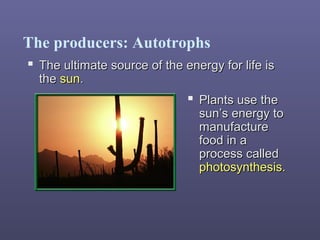
 The ultimate source of the energy for life isThe ultimate source of the energy for life is
thethe sunsun..
 Plants use thePlants use the
sun’s energy tosun’s energy to
manufacturemanufacture
food in afood in a
process calledprocess called
photosynthesis.photosynthesis.
The producers: Autotrophs
 Other organisms in the biosphere depend onOther organisms in the biosphere depend on
autotrophs for nutrients and energy. Theseautotrophs for nutrients and energy. These
dependent organisms are calleddependent organisms are called consumers.consumers.
 An organism that uses light energy or energyAn organism that uses light energy or energy
stored in chemical compounds to makestored in chemical compounds to make
energy-rich compounds is a producer, orenergy-rich compounds is a producer, or
autotrophautotroph..
The consumers: Heterotrophs
 An organism that cannot make its own foodAn organism that cannot make its own food
and feeds on other organisms is called aand feeds on other organisms is called a
heterotroph.heterotroph.
The consumers: Heterotrophs
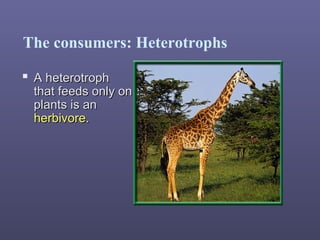
 A heterotrophA heterotroph
that feeds only onthat feeds only on
plants is anplants is an
herbivore.herbivore.
The consumers: Heterotrophs
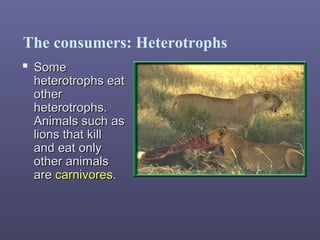
 SomeSome
heterotrophs eatheterotrophs eat
otherother
heterotrophs.heterotrophs.
Animals such asAnimals such as
lions that killlions that kill
and eat onlyand eat only
other animalsother animals
areare carnivorescarnivores..
The consumers: Heterotrophs
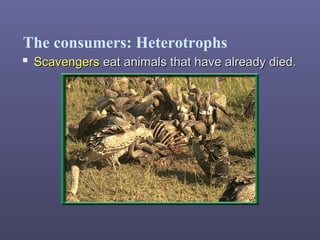
 ScavengersScavengers eat animals that have already died.eat animals that have already died.
The consumers: Heterotrophs
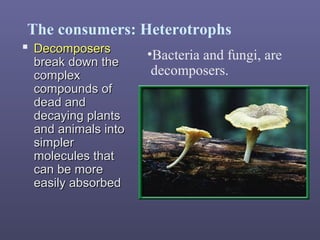
 DecomposersDecomposers
break down thebreak down the
complexcomplex
compounds ofcompounds of
dead anddead and
decaying plantsdecaying plants
and animals intoand animals into
simplersimpler
molecules thatmolecules that
can be morecan be more
easily absorbedeasily absorbed
•Bacteria and fungi, are
decomposers.
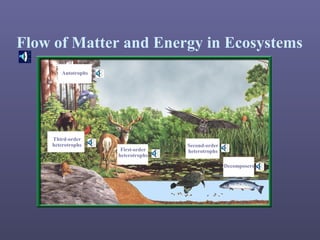
Flow of Matter and Energy in Ecosystems
Autotrophs
First-order
heterotrophs
Third-order
heterotrophs Second-order
heterotrophs
Decomposers
Food chains: Pathways for matter
and energy
 In aIn a food chainfood chain, nutrients and energy move, nutrients and energy move
from autotrophs to heterotrophs and,from autotrophs to heterotrophs and,
eventually, to decomposers.eventually, to decomposers.
Food chains: Pathways for matter
and energy
 A food chain is drawn using arrows to indicateA food chain is drawn using arrows to indicate
the direction in which energy is transferredthe direction in which energy is transferred
from one organism to the next.from one organism to the next.
berries → mice → black bear
Food chains: Pathways for matter
and energy
 A portion of the energy is given offA portion of the energy is given off as heatas heat atat
each transfer.each transfer.
 Each organism in a food chain represents aEach organism in a food chain represents a
feeding step, orfeeding step, or trophic level,trophic level, in the passage ofin the passage of
energy and materials.energy and materials.
Food webs
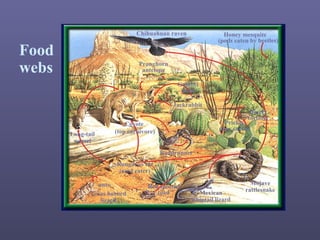
 AA food webfood web, shows all the possible feeding, shows all the possible feeding
relationships at each trophic level in arelationships at each trophic level in a
community.community.
Food
webs
Chihuahuan raven Honey mesquite
(pods eaten by beetles)
Pronghorn
antelope
Gambel
quail
Jackrabbit
Desert
tortoise
Prickly
pear cactus
Long-tail
weasel
Coyote
(top carnivore)
Roadrunner
Kangaroo rat
(seed eater)
ants
Texas horned
lizard
Red spotted
toad Mexican
whiptail lizard
Mojave
rattlesnake
Energy and trophic levels: Ecological
pyramids
 TheThe basebase of the ecological pyramid representsof the ecological pyramid represents
the autotrophs, or first trophic level. Higherthe autotrophs, or first trophic level. Higher
trophic levels are layered on top of onetrophic levels are layered on top of one
another.another.
Energy and trophic levels: Ecological
pyramids
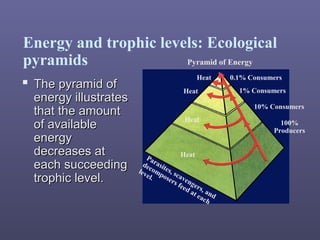
 The pyramid ofThe pyramid of
energy illustratesenergy illustrates
that the amountthat the amount
of availableof available
energyenergy
decreases atdecreases at
each succeedingeach succeeding
trophic level.trophic level.
Pyramid of Energy
Heat
Heat
Heat
Heat
0.1% Consumers
1% Consumers
10% Consumers
100%
Producers
Parasites, scavengers, and
decomposers feed at each
level.
Energy and trophic levels: Ecological
pyramids
 The total energy transfer from one trophicThe total energy transfer from one trophic
level to the next is only aboutlevel to the next is only about ten percentten percent
because organisms fail to capture and eat allbecause organisms fail to capture and eat all
the food energy available and some of thethe food energy available and some of the
energy enters the environment as heat, butenergy enters the environment as heat, but
the total amount of energy remains the same.the total amount of energy remains the same.
Energy and trophic levels: Ecological
pyramids
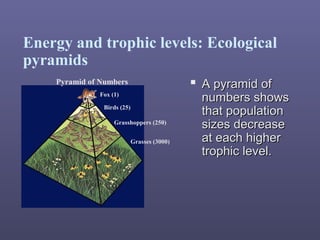
 A pyramid ofA pyramid of
numbers showsnumbers shows
that populationthat population
sizes decreasesizes decrease
at each higherat each higher
trophic level.trophic level.
Pyramid of Numbers
Fox (1)
Birds (25)
Grasshoppers (250)
Grasses (3000)
Energy and trophic levels: Ecological
pyramids
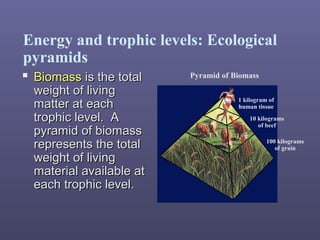
 BiomassBiomass is the totalis the total
weight of livingweight of living
matter at eachmatter at each
trophic level. Atrophic level. A
pyramid of biomasspyramid of biomass
represents the totalrepresents the total
weight of livingweight of living
material available atmaterial available at
each trophic level.each trophic level.
Pyramid of Biomass
1 kilogram of
human tissue
10 kilograms
of beef
100 kilograms
of grain
Cycles in Nature
 Matter is cycledMatter is cycled and isand is not replenishednot replenished likelike
the energy from sunlight. There is a finitethe energy from sunlight. There is a finite
amount of matter.amount of matter.
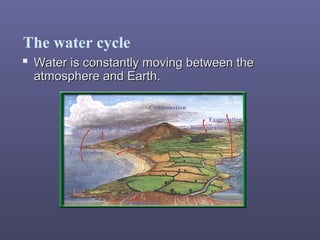
The water cycle
 Water is constantly moving between theWater is constantly moving between the
atmosphere and Earth.atmosphere and Earth.
Precipitation
Evaporation
Runoff
Groundwater
Transpiration
Evaporation
Condensation
Oceans
The carbon cycle
 Carbon is the building block of the moleculesCarbon is the building block of the molecules
of life (like proteins and sugars).of life (like proteins and sugars).
 Organisms use these carbon molecules forOrganisms use these carbon molecules for
growth and energy.growth and energy.
The nitrogen cycle
 Nitrogen is converted from a gas toNitrogen is converted from a gas to
compounds important for life and then back tocompounds important for life and then back to
a gas.a gas.
The phosphorus cycle
 In the phosphorus cycle, phosphorus movesIn the phosphorus cycle, phosphorus moves
between the living and nonliving parts of thebetween the living and nonliving parts of the
environment.environment.

Energy flow

  • 1.
    Section ObjectivesSection Objectives •Trace the path of energy and matter in an ecosystem. • Compare how organisms satisfy their nutritional needs.
  • 2.
    The producers: Autotrophs The ultimate source of the energy for life isThe ultimate source of the energy for life is thethe sunsun..  Plants use thePlants use the sun’s energy tosun’s energy to manufacturemanufacture food in afood in a process calledprocess called photosynthesis.photosynthesis.
  • 3.
    The producers: Autotrophs Other organisms in the biosphere depend onOther organisms in the biosphere depend on autotrophs for nutrients and energy. Theseautotrophs for nutrients and energy. These dependent organisms are calleddependent organisms are called consumers.consumers.  An organism that uses light energy or energyAn organism that uses light energy or energy stored in chemical compounds to makestored in chemical compounds to make energy-rich compounds is a producer, orenergy-rich compounds is a producer, or autotrophautotroph..
  • 4.
    The consumers: Heterotrophs An organism that cannot make its own foodAn organism that cannot make its own food and feeds on other organisms is called aand feeds on other organisms is called a heterotroph.heterotroph.
  • 5.
    The consumers: Heterotrophs A heterotrophA heterotroph that feeds only onthat feeds only on plants is anplants is an herbivore.herbivore.
  • 6.
    The consumers: Heterotrophs SomeSome heterotrophs eatheterotrophs eat otherother heterotrophs.heterotrophs. Animals such asAnimals such as lions that killlions that kill and eat onlyand eat only other animalsother animals areare carnivorescarnivores..
  • 7.
    The consumers: Heterotrophs ScavengersScavengers eat animals that have already died.eat animals that have already died.
  • 8.
    The consumers: Heterotrophs DecomposersDecomposers break down thebreak down the complexcomplex compounds ofcompounds of dead anddead and decaying plantsdecaying plants and animals intoand animals into simplersimpler molecules thatmolecules that can be morecan be more easily absorbedeasily absorbed •Bacteria and fungi, are decomposers.
  • 9.
    Flow of Matterand Energy in Ecosystems Autotrophs First-order heterotrophs Third-order heterotrophs Second-order heterotrophs Decomposers
  • 10.
    Food chains: Pathwaysfor matter and energy  In aIn a food chainfood chain, nutrients and energy move, nutrients and energy move from autotrophs to heterotrophs and,from autotrophs to heterotrophs and, eventually, to decomposers.eventually, to decomposers.
  • 11.
    Food chains: Pathwaysfor matter and energy  A food chain is drawn using arrows to indicateA food chain is drawn using arrows to indicate the direction in which energy is transferredthe direction in which energy is transferred from one organism to the next.from one organism to the next. berries → mice → black bear
  • 12.
    Food chains: Pathwaysfor matter and energy  A portion of the energy is given offA portion of the energy is given off as heatas heat atat each transfer.each transfer.
  • 13.
     Each organismin a food chain represents aEach organism in a food chain represents a feeding step, orfeeding step, or trophic level,trophic level, in the passage ofin the passage of energy and materials.energy and materials.
  • 14.
    Food webs  AAfood webfood web, shows all the possible feeding, shows all the possible feeding relationships at each trophic level in arelationships at each trophic level in a community.community.
  • 15.
    Food webs Chihuahuan raven Honeymesquite (pods eaten by beetles) Pronghorn antelope Gambel quail Jackrabbit Desert tortoise Prickly pear cactus Long-tail weasel Coyote (top carnivore) Roadrunner Kangaroo rat (seed eater) ants Texas horned lizard Red spotted toad Mexican whiptail lizard Mojave rattlesnake
  • 16.
    Energy and trophiclevels: Ecological pyramids  TheThe basebase of the ecological pyramid representsof the ecological pyramid represents the autotrophs, or first trophic level. Higherthe autotrophs, or first trophic level. Higher trophic levels are layered on top of onetrophic levels are layered on top of one another.another.
  • 17.
    Energy and trophiclevels: Ecological pyramids  The pyramid ofThe pyramid of energy illustratesenergy illustrates that the amountthat the amount of availableof available energyenergy decreases atdecreases at each succeedingeach succeeding trophic level.trophic level. Pyramid of Energy Heat Heat Heat Heat 0.1% Consumers 1% Consumers 10% Consumers 100% Producers Parasites, scavengers, and decomposers feed at each level.
  • 18.
    Energy and trophiclevels: Ecological pyramids  The total energy transfer from one trophicThe total energy transfer from one trophic level to the next is only aboutlevel to the next is only about ten percentten percent because organisms fail to capture and eat allbecause organisms fail to capture and eat all the food energy available and some of thethe food energy available and some of the energy enters the environment as heat, butenergy enters the environment as heat, but the total amount of energy remains the same.the total amount of energy remains the same.
  • 19.
    Energy and trophiclevels: Ecological pyramids  A pyramid ofA pyramid of numbers showsnumbers shows that populationthat population sizes decreasesizes decrease at each higherat each higher trophic level.trophic level. Pyramid of Numbers Fox (1) Birds (25) Grasshoppers (250) Grasses (3000)
  • 20.
    Energy and trophiclevels: Ecological pyramids  BiomassBiomass is the totalis the total weight of livingweight of living matter at eachmatter at each trophic level. Atrophic level. A pyramid of biomasspyramid of biomass represents the totalrepresents the total weight of livingweight of living material available atmaterial available at each trophic level.each trophic level. Pyramid of Biomass 1 kilogram of human tissue 10 kilograms of beef 100 kilograms of grain
  • 21.
    Cycles in Nature Matter is cycledMatter is cycled and isand is not replenishednot replenished likelike the energy from sunlight. There is a finitethe energy from sunlight. There is a finite amount of matter.amount of matter.
  • 22.
    The water cycle Water is constantly moving between theWater is constantly moving between the atmosphere and Earth.atmosphere and Earth. Precipitation Evaporation Runoff Groundwater Transpiration Evaporation Condensation Oceans
  • 23.
    The carbon cycle Carbon is the building block of the moleculesCarbon is the building block of the molecules of life (like proteins and sugars).of life (like proteins and sugars).  Organisms use these carbon molecules forOrganisms use these carbon molecules for growth and energy.growth and energy.
  • 24.
    The nitrogen cycle Nitrogen is converted from a gas toNitrogen is converted from a gas to compounds important for life and then back tocompounds important for life and then back to a gas.a gas.
  • 25.
    The phosphorus cycle In the phosphorus cycle, phosphorus movesIn the phosphorus cycle, phosphorus moves between the living and nonliving parts of thebetween the living and nonliving parts of the environment.environment.