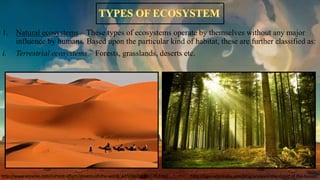
http://www.erewise.com/current-affairs/deserts-of-the-world_art569e29e395535.html http://tigersafariindia.com/blog/aranyani-the-music-of-the-forest/
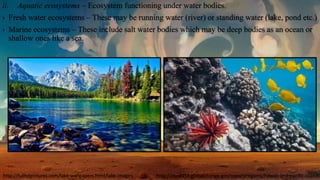
ii. Aquatic ecosystems – Ecosystem functioning under water bodies.
› Fresh water ecosystems – These may be running water (river) or standing water (lake, pond etc.)
› Marine ecosystems – These include salt water bodies which may be deep bodies as an ocean or
shallow ones like a sea.
http://nca2014.globalchange.gov/report/regions/hawaii-and-pacific-islandshttp://fullhdpictures.com/lake-wallpapers.html/lake-images
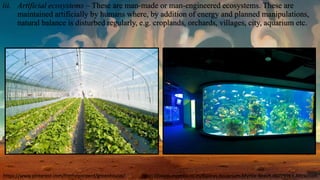
iii. Artificial ecosystems – These are man-made or man-engineered ecosystems. These are
maintained artificially by humans where, by addition of energy and planned manipulations,
natural balance is disturbed regularly, e.g. croplands, orchards, villages, city, aquarium etc.
https://www.pinterest.com/fretfulporpent/greenhouse/ https://www.expedia.co.in/Ripleys-Aquarium-Myrtle-Beach.d6079963.Attraction.
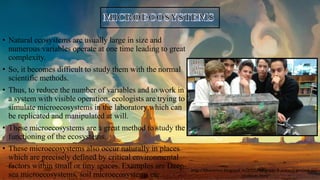
• Natural ecosystems are usually large in size and
numerous variables operate at one time leading to great
complexity.
• So, it becomes difficult to study them with the normal
scientific methods.
• Thus, to reduce the number of variables and to work in
a system with visible operation, ecologists are trying to
simulate microecosystems in the laboratory which can
be replicated and manipulated at will.
• These microecosystems are a great method to study the
functioning of the ecosystems.
• These microecosystems also occur naturally in places
which are precisely defined by critical environmental
factors within small or tiny spaces. Examples are Deep-
sea microecosystems, soil microecosystems etc.
http://fjbscience.blogspot.in/2015/10/grade-9-science-project-our-
students.html
Abiotic components Biotic components
http://kruger-nationalpark.weebly.com/abiotic-and-biotic-factors.html http://greatsmokymnts.weebly.com/whats-going-on.html
• There are many key factors that lead to variation in the physical and chemical conditions of
different habitats.
• The most important ones among them are temperature, water, light and soil.
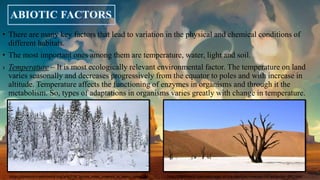
› Temperature – It is most ecologically relevant environmental factor. The temperature on land
varies seasonally and decreases progressively from the equator to poles and with increase in
altitude. Temperature affects the functioning of enzymes in organisms and through it the
metabolism. So, types of adaptations in organisms varies greatly with change in temperature.
https://commons.wikimedia.org/wiki/File:Spruce_trees_covered_in_heavy_snow.jpg http://bighdwalls.com/wallpaper-of-the-day/tree-in-desert-hd-wallpaper-646.html
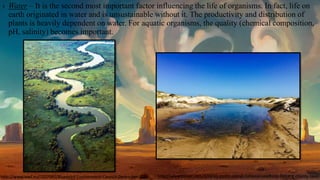
› Water – It is the second most important factor influencing the life of organisms. In fact, life on
earth originated in water and is unsustainable without it. The productivity and distribution of
plants is heavily dependent on water. For aquatic organisms, the quality (chemical composition,
pH, salinity) becomes important.
http://www.wwf.eu/?207085/Blueprint-Environment-Council-December-2012 http://www.trover.com/d/iNQG-padre-island-national-seashore-kleberg-county-texas
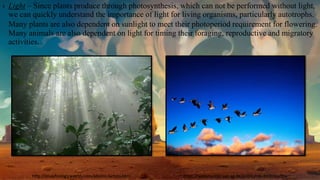
› Light – Since plants produce through photosynthesis, which can not be performed without light,
we can quickly understand the importance of light for living organisms, particularly autotrophs.
Many plants are also dependent on sunlight to meet their photoperiod requirement for flowering.
Many animals are also dependent on light for timing their foraging, reproductive and migratory
activities.
http://eisapbiology.weebly.com/abiotic-factors.html https://websmp202.sap-ag.de/public/rds-dm2cloudbw
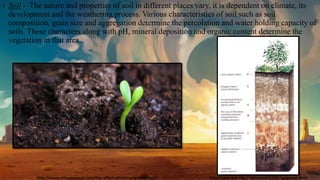
› Soil - The nature and properties of soil in different places vary, it is dependent on climate, its
development and the weathering process. Various characteristics of soil such as soil
composition, grain size and aggregation determine the percolation and water holding capacity of
soils. These characters along with pH, mineral deposition and organic content determine the
vegetation in that area.
http://spot.pcc.edu/~kleonard/G202/Lecture4.htmlhttp://www.cnhumicacid.com/the-effect-of-humic-acid-on-soil/
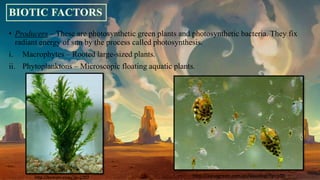
• Producers – These are photosynthetic green plants and photosynthetic bacteria. They fix
radiant energy of sun by the process called photosynthesis.
i. Macrophytes – Rooted large-sized plants.
ii. Phytoplanktons – Microscopic floating aquatic plants.
http://aquagreen.com.au/aqualog/?p=100http://bomets.com/?p=2707
• Macroconsumers – These are also called phagotrophs and includes animals which ingest other
organisms. Depending on their food habits they may be –
i. Herbivores – Plant eaters.
ii. Carnivores – Flesh eaters.
iii. Omnivores – They eat everything!
http://bomets.com/?p=2707 http://www.tigers-world.com/tiger-feeding/ http://ww.sanjivanipharmacy.co.uk/c/b9a987a
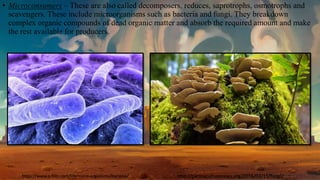
• Microconsumers – These are also called decomposers, reduces, saprotrophs, osmotrophs and
scavengers. These include microorganisms such as bacteria and fungi. They breakdown
complex organic compounds of dead organic matter and absorb the required amount and make
the rest available for producers.
https://www.q-files.com/life/micro-organisms/bacteria/ http://permaculturenews.org/2016/02/11/fungi/
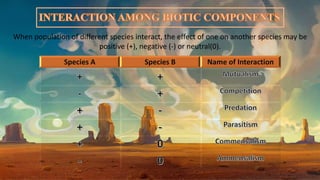
Species A Species B Name of Interaction
When population of different species interact, the effect of one on another species may be
positive (+), negative (-) or neutral(0).
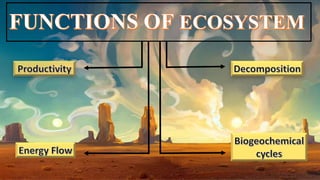
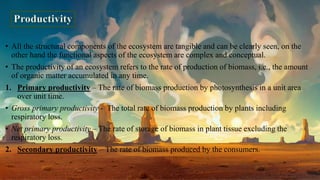
• All the structural components of the ecosystem are tangible and can be clearly seen, on the
other hand the functional aspects of the ecosystem are complex and conceptual.
• The productivity of an ecosystem refers to the rate of production of biomass, i.e., the amount
of organic matter accumulated in any time.
1. Primary productivity – The rate of biomass production by photosynthesis in a unit area
over unit time.
• Gross primary productivity - The total rate of biomass production by plants including
respiratory loss.
• Net primary productivity – The rate of storage of biomass in plant tissue excluding the
respiratory loss.
2. Secondary productivity – The rate of biomass produced by the consumers.
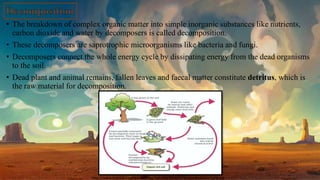
• The breakdown of complex organic matter into simple inorganic substances like nutrients,
carbon dioxide and water by decomposers is called decomposition.
• These decomposers are saprotrophic microorganisms like bacteria and fungi.
• Decomposers connect the whole energy cycle by dissipating energy from the dead organisms
to the soil.
• Dead plant and animal remains, fallen leaves and faecal matter constitute detritus, which is
the raw material for decomposition.
http://www.biotrick.com/wp-content/uploads/2016/02/Decomposition-Cycle.jpg
• The important steps in the process of decomposition are –
Fragmentation –The break down of detritus into smaller particles by detritivores (earthworm).
Catabolism – The degradation of detritus into simpler inorganic substances by the action of
bacterial and fungal enzymes.
Leaching - The wash down of water soluble inorganic nutrients into the soil horizon.
Humification – The accumulation of a dark coloured amorphous substance called humus.
Mineralisation – The further degradation of humus to release more inorganic nutrients.
• Decomposition is largely an oxygen requiring process. The rate of decomposition is controlled
by chemical composition of detritus and climatic factors.
• Decomposition rate is slower if detritus is rich in lignin and chitin and quicker if detritus is rich
in nitrogen and water soluble substances.
• Temperature, moistness and oxygen availability affect the rate of decomposition significantly.
• Biological activities require consumption of energy which ultimately comes from sun.
• Except for the deep-sea hydrothermal ecosystem, sun is only the source of energy for all
ecosystem on Earth.
• Of the total incident solar radiation less than 60% of it is photosynthetically active radiation
(PAR).
• Solar energy of sun is transformed into chemical energy(Adenosine triphosphate) by the
process of photosynthesis, then it is stored in plant tissues and then transformed into
mechanical and heat form of energy during metabolic activities this energy flows through
different trophic levels in unidirectional way.
• The energy flow in ecosystem follows the laws of thermodynamics.
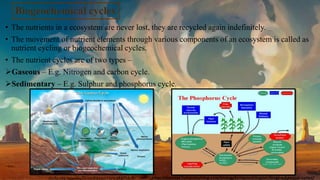
• The nutrients in a ecosystem are never lost, they are recycled again indefinitely.
• The movement of nutrient elements through various components of an ecosystem is called as
nutrient cycling or biogeochemical cycles.
• The nutrient cycles are of two types –
Gaseous – E.g. Nitrogen and carbon cycle.
Sedimentary – E.g. Sulphur and phosphorus cycle.
slc4u.org/moodle20/mod/page/view.php?id=9 https://courses.lumenlearning.com/biology2xmaster/chapter/biogeochemical-cycles/
Ecosystem

Ecosystem

  • 3.
  • 4.
    ii. Aquatic ecosystems– Ecosystem functioning under water bodies. › Fresh water ecosystems – These may be running water (river) or standing water (lake, pond etc.) › Marine ecosystems – These include salt water bodies which may be deep bodies as an ocean or shallow ones like a sea. http://nca2014.globalchange.gov/report/regions/hawaii-and-pacific-islandshttp://fullhdpictures.com/lake-wallpapers.html/lake-images
  • 5.
    iii. Artificial ecosystems– These are man-made or man-engineered ecosystems. These are maintained artificially by humans where, by addition of energy and planned manipulations, natural balance is disturbed regularly, e.g. croplands, orchards, villages, city, aquarium etc. https://www.pinterest.com/fretfulporpent/greenhouse/ https://www.expedia.co.in/Ripleys-Aquarium-Myrtle-Beach.d6079963.Attraction.
  • 6.
    • Natural ecosystemsare usually large in size and numerous variables operate at one time leading to great complexity. • So, it becomes difficult to study them with the normal scientific methods. • Thus, to reduce the number of variables and to work in a system with visible operation, ecologists are trying to simulate microecosystems in the laboratory which can be replicated and manipulated at will. • These microecosystems are a great method to study the functioning of the ecosystems. • These microecosystems also occur naturally in places which are precisely defined by critical environmental factors within small or tiny spaces. Examples are Deep- sea microecosystems, soil microecosystems etc. http://fjbscience.blogspot.in/2015/10/grade-9-science-project-our- students.html
  • 7.
    Abiotic components Bioticcomponents http://kruger-nationalpark.weebly.com/abiotic-and-biotic-factors.html http://greatsmokymnts.weebly.com/whats-going-on.html
  • 8.
    • There aremany key factors that lead to variation in the physical and chemical conditions of different habitats. • The most important ones among them are temperature, water, light and soil. › Temperature – It is most ecologically relevant environmental factor. The temperature on land varies seasonally and decreases progressively from the equator to poles and with increase in altitude. Temperature affects the functioning of enzymes in organisms and through it the metabolism. So, types of adaptations in organisms varies greatly with change in temperature. https://commons.wikimedia.org/wiki/File:Spruce_trees_covered_in_heavy_snow.jpg http://bighdwalls.com/wallpaper-of-the-day/tree-in-desert-hd-wallpaper-646.html
  • 9.
    › Water –It is the second most important factor influencing the life of organisms. In fact, life on earth originated in water and is unsustainable without it. The productivity and distribution of plants is heavily dependent on water. For aquatic organisms, the quality (chemical composition, pH, salinity) becomes important. http://www.wwf.eu/?207085/Blueprint-Environment-Council-December-2012 http://www.trover.com/d/iNQG-padre-island-national-seashore-kleberg-county-texas
  • 10.
    › Light –Since plants produce through photosynthesis, which can not be performed without light, we can quickly understand the importance of light for living organisms, particularly autotrophs. Many plants are also dependent on sunlight to meet their photoperiod requirement for flowering. Many animals are also dependent on light for timing their foraging, reproductive and migratory activities. http://eisapbiology.weebly.com/abiotic-factors.html https://websmp202.sap-ag.de/public/rds-dm2cloudbw
  • 11.
    › Soil -The nature and properties of soil in different places vary, it is dependent on climate, its development and the weathering process. Various characteristics of soil such as soil composition, grain size and aggregation determine the percolation and water holding capacity of soils. These characters along with pH, mineral deposition and organic content determine the vegetation in that area. http://spot.pcc.edu/~kleonard/G202/Lecture4.htmlhttp://www.cnhumicacid.com/the-effect-of-humic-acid-on-soil/
  • 12.
    • Producers –These are photosynthetic green plants and photosynthetic bacteria. They fix radiant energy of sun by the process called photosynthesis. i. Macrophytes – Rooted large-sized plants. ii. Phytoplanktons – Microscopic floating aquatic plants. http://aquagreen.com.au/aqualog/?p=100http://bomets.com/?p=2707
  • 13.
    • Macroconsumers –These are also called phagotrophs and includes animals which ingest other organisms. Depending on their food habits they may be – i. Herbivores – Plant eaters. ii. Carnivores – Flesh eaters. iii. Omnivores – They eat everything! http://bomets.com/?p=2707 http://www.tigers-world.com/tiger-feeding/ http://ww.sanjivanipharmacy.co.uk/c/b9a987a
  • 14.
    • Microconsumers –These are also called decomposers, reduces, saprotrophs, osmotrophs and scavengers. These include microorganisms such as bacteria and fungi. They breakdown complex organic compounds of dead organic matter and absorb the required amount and make the rest available for producers. https://www.q-files.com/life/micro-organisms/bacteria/ http://permaculturenews.org/2016/02/11/fungi/
  • 15.
    Species A SpeciesB Name of Interaction When population of different species interact, the effect of one on another species may be positive (+), negative (-) or neutral(0).
  • 17.
    • All thestructural components of the ecosystem are tangible and can be clearly seen, on the other hand the functional aspects of the ecosystem are complex and conceptual. • The productivity of an ecosystem refers to the rate of production of biomass, i.e., the amount of organic matter accumulated in any time. 1. Primary productivity – The rate of biomass production by photosynthesis in a unit area over unit time. • Gross primary productivity - The total rate of biomass production by plants including respiratory loss. • Net primary productivity – The rate of storage of biomass in plant tissue excluding the respiratory loss. 2. Secondary productivity – The rate of biomass produced by the consumers.
  • 18.
    • The breakdownof complex organic matter into simple inorganic substances like nutrients, carbon dioxide and water by decomposers is called decomposition. • These decomposers are saprotrophic microorganisms like bacteria and fungi. • Decomposers connect the whole energy cycle by dissipating energy from the dead organisms to the soil. • Dead plant and animal remains, fallen leaves and faecal matter constitute detritus, which is the raw material for decomposition. http://www.biotrick.com/wp-content/uploads/2016/02/Decomposition-Cycle.jpg
  • 19.
    • The importantsteps in the process of decomposition are – Fragmentation –The break down of detritus into smaller particles by detritivores (earthworm). Catabolism – The degradation of detritus into simpler inorganic substances by the action of bacterial and fungal enzymes. Leaching - The wash down of water soluble inorganic nutrients into the soil horizon. Humification – The accumulation of a dark coloured amorphous substance called humus. Mineralisation – The further degradation of humus to release more inorganic nutrients. • Decomposition is largely an oxygen requiring process. The rate of decomposition is controlled by chemical composition of detritus and climatic factors. • Decomposition rate is slower if detritus is rich in lignin and chitin and quicker if detritus is rich in nitrogen and water soluble substances. • Temperature, moistness and oxygen availability affect the rate of decomposition significantly.
  • 20.
    • Biological activitiesrequire consumption of energy which ultimately comes from sun. • Except for the deep-sea hydrothermal ecosystem, sun is only the source of energy for all ecosystem on Earth. • Of the total incident solar radiation less than 60% of it is photosynthetically active radiation (PAR). • Solar energy of sun is transformed into chemical energy(Adenosine triphosphate) by the process of photosynthesis, then it is stored in plant tissues and then transformed into mechanical and heat form of energy during metabolic activities this energy flows through different trophic levels in unidirectional way. • The energy flow in ecosystem follows the laws of thermodynamics.
  • 21.
    • The nutrientsin a ecosystem are never lost, they are recycled again indefinitely. • The movement of nutrient elements through various components of an ecosystem is called as nutrient cycling or biogeochemical cycles. • The nutrient cycles are of two types – Gaseous – E.g. Nitrogen and carbon cycle. Sedimentary – E.g. Sulphur and phosphorus cycle. slc4u.org/moodle20/mod/page/view.php?id=9 https://courses.lumenlearning.com/biology2xmaster/chapter/biogeochemical-cycles/