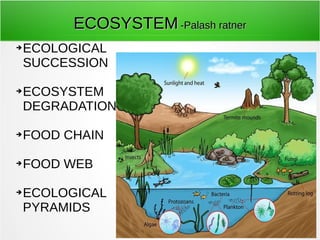
EECCOOSSYYSSTTEEMM --PPaallaasshh rraattnneerr 
➔ECOLOGICAL 
SUCCESSION 
➔ECOSYSTEM 
DEGRADATION 
➔FOOD CHAIN 
➔FOOD WEB 
➔ECOLOGICAL 
PYRAMIDS
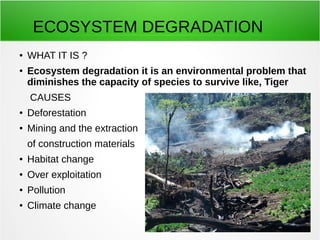
ECOSYSTEM DEGRADATION 
● WHAT IT IS ? 
● Ecosystem degradation it is an environmental problem that 
diminishes the capacity of species to survive like, Tiger 
CAUSES 
● Deforestation 
● Mining and the extraction 
of construction materials 
● Habitat change 
● Over exploitation 
● Pollution 
● Climate change
Causes 
● Deforestation- more lands deforested for 
commercial agriculture and due to more use 
of resources such as forest for wood and 
energy. 
● Habitat change- the conversion of natural 
forest into farmlands and plantations. 
● Pollution- industrialization and urbanization 
create soil,water and air polluted. 
● Climatic change- depletion of ozone layer 
because of rise in greenhouse gases.
ECOLOGICAL SUCCESSION 
● WHAT IT IS? 
● Ecological succession refers to more or less 
predictable and orderly changes in the 
composition or structure of ecological 
community. 
● For example, the growth of hardwood trees 
(such as ash and oak) within the red pine 
planting area. hardwood trees are much 
taller than red pine trees. So the hardwood 
trees growth is increased in shading but red 
pine trees need sunlight. Thus, the 
consequence of the growth of the hardwood 
is the decline of the pine forest.
Reasons 
Reasons for ecological 
succession- 
● Every species has a set 
of environmental 
conditions under which it 
will grow and reproduce 
most optimally. 
● Constant temperature. 
● Changed condition. 
● Suddenly and drastically 
change.
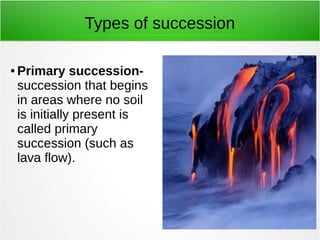
Types of succession 
● Primary succession-succession 
that begins 
in areas where no soil 
is initially present is 
called primary 
succession (such as 
lava flow).
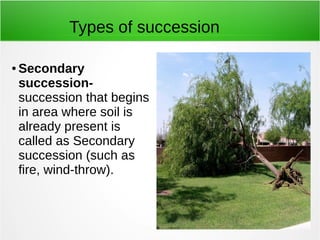
Types of succession 
● Secondary 
succession-succession 
that begins 
in area where soil is 
already present is 
called as Secondary 
succession (such as 
fire, wind-throw).
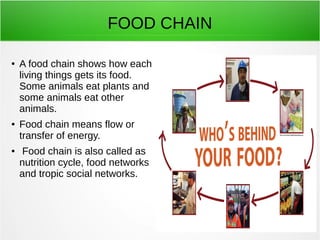
FOOD CHAIN 
● A food chain shows how each 
living things gets its food. 
Some animals eat plants and 
some animals eat other 
animals. 
● Food chain means flow or 
transfer of energy. 
● Food chain is also called as 
nutrition cycle, food networks 
and tropic social networks.
TABLE: FOOD CHAIN TROPIC CLASSIFICATION 
LEVEL NAME ENERGY SOURCE 
FIRST PRODUCER AUTOTROPHS (EX 
GRASS) 
SECOND PRIMARY CONSUMER HERBIVORES (EX 
GRASSHOPPER) 
THIRD SECONDARY, TERTIARY, 
ETC CONSUMERS 
CARNIVOROUS (EX 
TOAD,SNAKE, HAWK) 
FORTH DECOMPOSERS DECOMPOSERS(EX 
BACTERIA) 
Table:food chain
Functions of food chain 
● Represents the life 
community 
● Helps in the transfer of 
energy from one level 
to another 
● It shows energy flow 
mechanisms 
● The food chain helps in 
feeding relationship 
and interaction 
between organization.
TYPES OF FOOD CHAIN 
Grazing food chain 
● Grazing food chain : The producer/green 
plants depends upon sunlight and producer are 
consumed by herbivorous animals i.e eat plants 
and they are consumed by carnivorous . 
PLANTS 
(PRODUCER) 
GOAT 
(HERBIVORE) 
TIGER 
(CARNIVORE)
TYPES OF FOOD CHAIN 
Detritus food chain 
● Detritus Food Chain :Type of food 
chain Initiated by microorganism like 
bacteria and fungi 
Dead Bodies of animals Files Frog Snake Hawk 
● Importance : 
Interdependency within a food-chain helps to 
maintain the balance of plant and animal 
population.
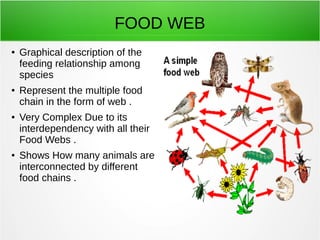
FOOD WEB 
● Graphical description of the 
feeding relationship among 
species 
● Represent the multiple food 
chain in the form of web . 
● Very Complex Due to its 
interdependency with all their 
Food Webs . 
● Shows How many animals are 
interconnected by different 
food chains .
Food web in a grassland ecosystem 
mouse snake 
Grass rabbit hawk 
grasshopper lizard
ECOLOGICAL PYRAMINDS 
● The different tropic levels in any ecosystem can 
be represented graphically and these graphic 
representations are called ecological pyramids.
Types of ecological pyramids 
1.Pyramids of 
number. 
2.Pyramids of 
biomass 
3.Pyramids of 
energy.
Pyramids of number 
● Showing the number of individual organisms at 
each level.
Pyramids of biomass 
● Showing the weight of individual organisms at 
each level.
Pyramid of energy 
● Showing the rate of energy flow of individual 
organisms at each level.

ECOSYSTEM

  • 1.
    EECCOOSSYYSSTTEEMM --PPaallaasshh rraattnneerr ➔ECOLOGICAL SUCCESSION ➔ECOSYSTEM DEGRADATION ➔FOOD CHAIN ➔FOOD WEB ➔ECOLOGICAL PYRAMIDS
  • 2.
    ECOSYSTEM DEGRADATION ●WHAT IT IS ? ● Ecosystem degradation it is an environmental problem that diminishes the capacity of species to survive like, Tiger CAUSES ● Deforestation ● Mining and the extraction of construction materials ● Habitat change ● Over exploitation ● Pollution ● Climate change
  • 3.
    Causes ● Deforestation-more lands deforested for commercial agriculture and due to more use of resources such as forest for wood and energy. ● Habitat change- the conversion of natural forest into farmlands and plantations. ● Pollution- industrialization and urbanization create soil,water and air polluted. ● Climatic change- depletion of ozone layer because of rise in greenhouse gases.
  • 4.
    ECOLOGICAL SUCCESSION ●WHAT IT IS? ● Ecological succession refers to more or less predictable and orderly changes in the composition or structure of ecological community. ● For example, the growth of hardwood trees (such as ash and oak) within the red pine planting area. hardwood trees are much taller than red pine trees. So the hardwood trees growth is increased in shading but red pine trees need sunlight. Thus, the consequence of the growth of the hardwood is the decline of the pine forest.
  • 5.
    Reasons Reasons forecological succession- ● Every species has a set of environmental conditions under which it will grow and reproduce most optimally. ● Constant temperature. ● Changed condition. ● Suddenly and drastically change.
  • 6.
    Types of succession ● Primary succession-succession that begins in areas where no soil is initially present is called primary succession (such as lava flow).
  • 7.
    Types of succession ● Secondary succession-succession that begins in area where soil is already present is called as Secondary succession (such as fire, wind-throw).
  • 8.
    FOOD CHAIN ●A food chain shows how each living things gets its food. Some animals eat plants and some animals eat other animals. ● Food chain means flow or transfer of energy. ● Food chain is also called as nutrition cycle, food networks and tropic social networks.
  • 9.
    TABLE: FOOD CHAINTROPIC CLASSIFICATION LEVEL NAME ENERGY SOURCE FIRST PRODUCER AUTOTROPHS (EX GRASS) SECOND PRIMARY CONSUMER HERBIVORES (EX GRASSHOPPER) THIRD SECONDARY, TERTIARY, ETC CONSUMERS CARNIVOROUS (EX TOAD,SNAKE, HAWK) FORTH DECOMPOSERS DECOMPOSERS(EX BACTERIA) Table:food chain
  • 10.
    Functions of foodchain ● Represents the life community ● Helps in the transfer of energy from one level to another ● It shows energy flow mechanisms ● The food chain helps in feeding relationship and interaction between organization.
  • 11.
    TYPES OF FOODCHAIN Grazing food chain ● Grazing food chain : The producer/green plants depends upon sunlight and producer are consumed by herbivorous animals i.e eat plants and they are consumed by carnivorous . PLANTS (PRODUCER) GOAT (HERBIVORE) TIGER (CARNIVORE)
  • 12.
    TYPES OF FOODCHAIN Detritus food chain ● Detritus Food Chain :Type of food chain Initiated by microorganism like bacteria and fungi Dead Bodies of animals Files Frog Snake Hawk ● Importance : Interdependency within a food-chain helps to maintain the balance of plant and animal population.
  • 13.
    FOOD WEB ●Graphical description of the feeding relationship among species ● Represent the multiple food chain in the form of web . ● Very Complex Due to its interdependency with all their Food Webs . ● Shows How many animals are interconnected by different food chains .
  • 14.
    Food web ina grassland ecosystem mouse snake Grass rabbit hawk grasshopper lizard
  • 15.
    ECOLOGICAL PYRAMINDS ●The different tropic levels in any ecosystem can be represented graphically and these graphic representations are called ecological pyramids.
  • 16.
    Types of ecologicalpyramids 1.Pyramids of number. 2.Pyramids of biomass 3.Pyramids of energy.
  • 17.
    Pyramids of number ● Showing the number of individual organisms at each level.
  • 18.
    Pyramids of biomass ● Showing the weight of individual organisms at each level.
  • 19.
    Pyramid of energy ● Showing the rate of energy flow of individual organisms at each level.