INTRODUCTION 
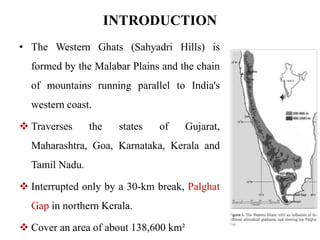
• The Western Ghats (Sahyadri Hills) is 
formed by the Malabar Plains and the chain 
of mountains running parallel to India's 
western coast. 
 Traverses the states of Gujarat, 
Maharashtra, Goa, Karnataka, Kerala and 
Tamil Nadu. 
 Interrupted only by a 30-km break, Palghat 
Gap in northern Kerala. 
 Cover an area of about 138,600 km²
• The freshwater ecosystem and all its denizens together constitute 
the rich biodiversity of one the world’s 34 hotspots. 
 The freshwater ecosystem biodiversity within the Western Ghats 
region is highly diverse, unique and of immense importance to 
livelihoods and economies. 
• The freshwater rivers and streams in the Western Ghats fall 
under 5 main ecoregions: Narmada-Tapi, the Northern Deccan 
Plateau (Godavari River system), the Southern Deccan Plateau 
(Krishna River system),the Southern Eastern Ghats (Cauvery 
River system) and TheWestern Ghats (West flowing rivers).
• The Western Ghats is part of the Western Ghats–Sri Lanka 
Biodiversity Hotspot. 
 To qualify as a hotspot, a region must meet two criteria: 
1. the area needs to contain at least 1,500 species of endemic 
vascular plants, 
2. to have lost at least 70% of its original habitat (Myers et al. 
2000). 
• Freshwater biodiversity constitutes a vitally important 
component of the planet, with a species richness relatively 
higher than that in terrestrial and marine ecosystems.
• The Western Ghats hotspot, originally designated for its plant 
species, is confirmed as a globally significant centre of diversity 
and endemism for freshwater species. 
• Within the Western Ghats, catchments in the southern part of 
the region in Kerala, Tamil Nadu and southern Karnataka have 
the highest freshwater species richness and levels of endemism. 
• But also contain the highest number of threatened species. 
• The southern Western Ghats region experiences the highest 
level of threat to freshwater species. 
• The northern WG region within Maharashtra has a lower 
recorded freshwater diversity than the southern region.
• Aquatic plants and fishes are the most heavily utilized 
freshwater groups in theWestern Ghats. 
• 28% of aquatic plants are harvested for medicinal purposes 
whereas 14% and 13% are used as food for people and animals. 
• 18 % of mollusc species are used as food for humans. 
• More than half of all fish species are harvested for human 
consumption and a growing percentage (37%) of species are 
captured for the aquarium trade. 
• The IUCN Red List reveals that 12 freshwater fishes, 6 
molluscs and 4 dragonflies are critically endangered and 53 
species of freshwater fishes and 4 molluscs are endangered.
FISH FAUNA OF WESTERN GHATS 
• The Western Ghats gifted with perennial streams outlines the 
unique habitats for the fishes. 
• The greater diversity of west and east flowing rivers and 
associated wetland ecosystems in Western Ghats coupled with 
high degree of precipitation, moderate climate and rich 
diversity of forests supports abundance of aquatic life 
including fish fauna. 
• 290 species of freshwater fishes belonging to 11 orders, 33 
families and 106 genera are recognized from the WG 
assessment region.
• Of the 290 species, atleast 35 species live in marine or 
brackishwater habitats. 
• A number of secondary freshwater fishes are found here due to 
the close proximity to Arabian Sea. 
• Cypriniformes (178 species) is the most species order followed 
by Siluriformes (50 species), while the most speciose families 
are Cyprinidae, which are the carps and true minnows (72 
species); Balitoridae, river loaches (34 species); Bagridae, 
bagrid catfish (19 species); and Sisoridae, sisorid catfish (12 
species). 
• Fish fauna of 189 species belonging to 7 orders, 23 families and 
69 genera are found endemic toWestern Ghats.
• 12 genera (Betadevario, Dayella, Horabagrus, Horalabiosa, 
Hypselobarbus, Indoreonectes, Lepidopygopsis, 
Longischistura, Mesonoemacheilus, Parapsilorhynchus, 
Rohtee and Travancoria) are endemic to theWestern Ghats. 
• The highest species richness (133-160 species per sub-basin) is 
found in the river drainages of southern Western Ghats 
including the Periyar, Chalakkudy, Bharatapuzha, Pamba and 
Chaliyar. 
• The species distribution pattern suggests that the west flowing 
rivers are richer in fish fauna, especially in the Kerala and 
(southern part of) Karnataka states.
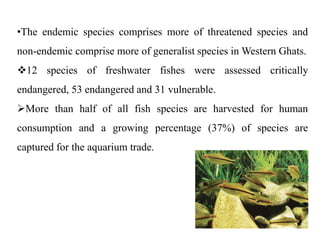
•The endemic species comprises more of threatened species and 
non-endemic comprise more of generalist species inWestern Ghats. 
12 species of freshwater fishes were assessed critically 
endangered, 53 endangered and 31 vulnerable. 
More than half of all fish species are harvested for human 
consumption and a growing percentage (37%) of species are 
captured for the aquarium trade.
FRESHWATER MOLLUSCS OF WESTERN 
GHATS 
• A total of 77 species of freshwater molluscs identified in the 
Western Ghats Hotspot assessment region includes 52 species 
of gastropods and 25 species of bivalves. 
• 7 species are assessed as Threatened. 
• Cremnochonchus syhadrensis, C. carinatus, Arcidopsis fotei 
and Pseudomulleria dalyi are assessed as Endangered. 
• Cremnochonchus conicus, Parreysia khadakuaslaensis and 
Scaphula nagarjunai are assessed as Vulnerable.
• Cremnochonchus syhadrensis, C. conicus and C. carinatus 
belong to the family Littorinidae (periwinkles) and are the only 
freshwater genus in an otherwise entirely marine family. 
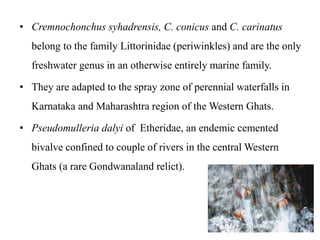
• They are adapted to the spray zone of perennial waterfalls in 
Karnataka and Maharashtra region of the Western Ghats. 
• Pseudomulleria dalyi of Etheridae, an endemic cemented 
bivalve confined to couple of rivers in the central Western 
Ghats (a rare Gondwanaland relict).
• The family Etheridae shows unique discontinuous distribution, 
with recognized genera such as Acostea (South America), 
Pseudomulleria (India) and Etheria (Africa). 
• The hill stream genus Turbinicola (Pilidae), an inhabitant of 
streams around Khandala, Maharashtra resembles the South 
American hill stream genus Asolene, suggesting convergent 
evolution. 
• Recently, two new species of freshwater molluscs belonging to 
the genus Paracostoma have been described from the Western 
Ghats.
• The Western Ghats assessment region has 28 species of 
endemic freshwater molluscs, this constitutes 36% of the 
fauna. 
• The number of endemic species is highest (between 8 and 9 
species per sub-basin) in the west flowing rivers of Manimala, 
Pambayar and Achankovil in southern Kerala. 
• 3 species are assessed as endangered and 4 species fall under 
vulnerable category.
ODONATA OF WESTERN GHATS 
• The freshwater systems of theWestern Ghats 
(forest streams, rivers, Myristica swamps, coastal marshes, 
ponds and lakes) provide a wide range of habitats for odonates. 
• The diversity of Odonata in the Western Ghats is not evenly 
distributed. 
• The odonate fauna of the region is comprised of 174 species 
with 69 endemics. 
• The suborders Zygoptera (damselflies) and Anisoptera 
(dragonflies) are represented by 8 and 6 families respectively.
• Zygoptera has 29 genera and 67 species, of which 25 are 
endemic. 
• The Anisoptera has 53 genera, 107 species with 31 endemics. 
• The families Libellulidae (49 species, Anisoptera), Gomphidae 
(26 species, Anisoptera) and Coenagrionidae (25 species, 
Zygoptera) are the most species-rich in theWestern Ghats. 
• Families such as Calopterygidae and Platycnemidae have no 
endemic species in theWestern Ghats.
• Endemic odonata of the Western Ghats are found in riverine 
habitats (montane streams and rivers) whereas non-endemics 
are found in both natural and man made lotic to lentic habitats. 
• The diversity of Odonata in the Western Ghats is not evenly 
distributed. 
• The highest levels of species richness (112-128 species per sub-basin) 
is found in the hotspot in southern Karnataka and 
northern Kerala.
AQUATIC PLANTS OF WESTERN GHATS 
• Aquatic plants (building blocks of wetland 
ecosystems) provide services such as water 
filtration and nutrient recycling. 
• Western Ghats, one of the best 
representatives of non-equatorial tropical 
evergreen forests in the world. 
• A total of 608 species of aquatic plants are 
identified (IUCN 2001). 
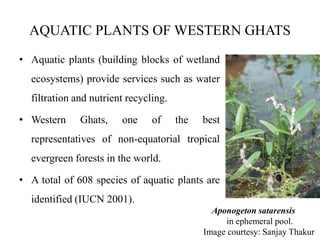
Aponogeton satarensis 
in ephemeral pool. 
Image courtesy: Sanjay Thakur
• The most speciose were the Cyperaceae (146 species), 
Gramineae (82 species), Eriocaulaceae (61 species) and 
Scrophulariaceae (42 species). 
• 54 species of aquatic plants are threatened whereas 517 species 
are assessed as least concern. 29 species of aquatic plants have 
been assessed as Data Deficient. 
• All threatened species are endemic to the Western Ghats region 
except Farmeria metzgerioides. 
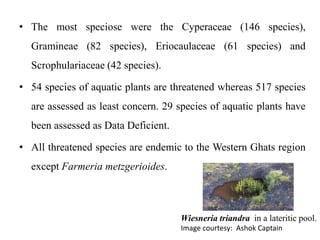
Wiesneria triandra in a lateritic pool. 
Image courtesy: Ashok Captain
THREATS TO FRESHWATER 
BIODIVERSITY OF WESTERN GHATS 
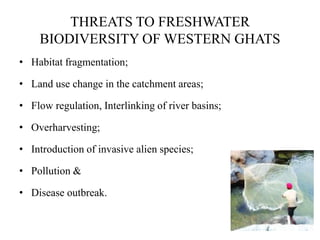
• Habitat fragmentation; 
• Land use change in the catchment areas; 
• Flow regulation, Interlinking of river basins; 
• Overharvesting; 
• Introduction of invasive alien species; 
• Pollution & 
• Disease outbreak.
CONSERVATIONS & RECOMMENDATIONS 
• Taxonomic studies, survey and monitoring. 
• Habitat restoration. 
• Riparian reforestation. 
• Control over sand mining and water pollution. 
• Management of invasive species. 
• Flagships and Conservation marketing. 
• Live gene banking, Captive breeding and Ranching. 
• Identification of KBAs, Community and Conservation 
reserves. 
• Implementation of Domestic and International legislation.
CONCLUSION 
• The Western Ghats is a unique ecoregion, which covers only 
6% of the total land area of India 
• contains more than 30% of the species of all major plant and 
animal groups of India. 
• It not only harbours a high level of species richness, but also 
contains many endemic and threatened species, at the verge of 
extinction. 
• one of the world’s most heavily populated Biodiversity 
Hotspots, supporting 400 million people and thus not so easy 
to conserve.
REFERENCES 
• Molur, S., K. G. Smith, B. A. Daniel and W. R. T. Darwall 
2011. The Status and Distribution of Freshwater Biodiversity 
in the Western Ghats, India. IUCN, Cambridge, 116pp. 
• www.internationalrivers.org 
• www.ces.iisc.ernet.in
Western ghats

Western ghats

  • 1.
    INTRODUCTION • TheWestern Ghats (Sahyadri Hills) is formed by the Malabar Plains and the chain of mountains running parallel to India's western coast.  Traverses the states of Gujarat, Maharashtra, Goa, Karnataka, Kerala and Tamil Nadu.  Interrupted only by a 30-km break, Palghat Gap in northern Kerala.  Cover an area of about 138,600 km²
  • 2.
    • The freshwaterecosystem and all its denizens together constitute the rich biodiversity of one the world’s 34 hotspots.  The freshwater ecosystem biodiversity within the Western Ghats region is highly diverse, unique and of immense importance to livelihoods and economies. • The freshwater rivers and streams in the Western Ghats fall under 5 main ecoregions: Narmada-Tapi, the Northern Deccan Plateau (Godavari River system), the Southern Deccan Plateau (Krishna River system),the Southern Eastern Ghats (Cauvery River system) and TheWestern Ghats (West flowing rivers).
  • 3.
    • The WesternGhats is part of the Western Ghats–Sri Lanka Biodiversity Hotspot.  To qualify as a hotspot, a region must meet two criteria: 1. the area needs to contain at least 1,500 species of endemic vascular plants, 2. to have lost at least 70% of its original habitat (Myers et al. 2000). • Freshwater biodiversity constitutes a vitally important component of the planet, with a species richness relatively higher than that in terrestrial and marine ecosystems.
  • 4.
    • The WesternGhats hotspot, originally designated for its plant species, is confirmed as a globally significant centre of diversity and endemism for freshwater species. • Within the Western Ghats, catchments in the southern part of the region in Kerala, Tamil Nadu and southern Karnataka have the highest freshwater species richness and levels of endemism. • But also contain the highest number of threatened species. • The southern Western Ghats region experiences the highest level of threat to freshwater species. • The northern WG region within Maharashtra has a lower recorded freshwater diversity than the southern region.
  • 5.
    • Aquatic plantsand fishes are the most heavily utilized freshwater groups in theWestern Ghats. • 28% of aquatic plants are harvested for medicinal purposes whereas 14% and 13% are used as food for people and animals. • 18 % of mollusc species are used as food for humans. • More than half of all fish species are harvested for human consumption and a growing percentage (37%) of species are captured for the aquarium trade. • The IUCN Red List reveals that 12 freshwater fishes, 6 molluscs and 4 dragonflies are critically endangered and 53 species of freshwater fishes and 4 molluscs are endangered.
  • 6.
    FISH FAUNA OFWESTERN GHATS • The Western Ghats gifted with perennial streams outlines the unique habitats for the fishes. • The greater diversity of west and east flowing rivers and associated wetland ecosystems in Western Ghats coupled with high degree of precipitation, moderate climate and rich diversity of forests supports abundance of aquatic life including fish fauna. • 290 species of freshwater fishes belonging to 11 orders, 33 families and 106 genera are recognized from the WG assessment region.
  • 7.
    • Of the290 species, atleast 35 species live in marine or brackishwater habitats. • A number of secondary freshwater fishes are found here due to the close proximity to Arabian Sea. • Cypriniformes (178 species) is the most species order followed by Siluriformes (50 species), while the most speciose families are Cyprinidae, which are the carps and true minnows (72 species); Balitoridae, river loaches (34 species); Bagridae, bagrid catfish (19 species); and Sisoridae, sisorid catfish (12 species). • Fish fauna of 189 species belonging to 7 orders, 23 families and 69 genera are found endemic toWestern Ghats.
  • 8.
    • 12 genera(Betadevario, Dayella, Horabagrus, Horalabiosa, Hypselobarbus, Indoreonectes, Lepidopygopsis, Longischistura, Mesonoemacheilus, Parapsilorhynchus, Rohtee and Travancoria) are endemic to theWestern Ghats. • The highest species richness (133-160 species per sub-basin) is found in the river drainages of southern Western Ghats including the Periyar, Chalakkudy, Bharatapuzha, Pamba and Chaliyar. • The species distribution pattern suggests that the west flowing rivers are richer in fish fauna, especially in the Kerala and (southern part of) Karnataka states.
  • 9.
    •The endemic speciescomprises more of threatened species and non-endemic comprise more of generalist species inWestern Ghats. 12 species of freshwater fishes were assessed critically endangered, 53 endangered and 31 vulnerable. More than half of all fish species are harvested for human consumption and a growing percentage (37%) of species are captured for the aquarium trade.
  • 10.
    FRESHWATER MOLLUSCS OFWESTERN GHATS • A total of 77 species of freshwater molluscs identified in the Western Ghats Hotspot assessment region includes 52 species of gastropods and 25 species of bivalves. • 7 species are assessed as Threatened. • Cremnochonchus syhadrensis, C. carinatus, Arcidopsis fotei and Pseudomulleria dalyi are assessed as Endangered. • Cremnochonchus conicus, Parreysia khadakuaslaensis and Scaphula nagarjunai are assessed as Vulnerable.
  • 11.
    • Cremnochonchus syhadrensis,C. conicus and C. carinatus belong to the family Littorinidae (periwinkles) and are the only freshwater genus in an otherwise entirely marine family. • They are adapted to the spray zone of perennial waterfalls in Karnataka and Maharashtra region of the Western Ghats. • Pseudomulleria dalyi of Etheridae, an endemic cemented bivalve confined to couple of rivers in the central Western Ghats (a rare Gondwanaland relict).
  • 12.
    • The familyEtheridae shows unique discontinuous distribution, with recognized genera such as Acostea (South America), Pseudomulleria (India) and Etheria (Africa). • The hill stream genus Turbinicola (Pilidae), an inhabitant of streams around Khandala, Maharashtra resembles the South American hill stream genus Asolene, suggesting convergent evolution. • Recently, two new species of freshwater molluscs belonging to the genus Paracostoma have been described from the Western Ghats.
  • 13.
    • The WesternGhats assessment region has 28 species of endemic freshwater molluscs, this constitutes 36% of the fauna. • The number of endemic species is highest (between 8 and 9 species per sub-basin) in the west flowing rivers of Manimala, Pambayar and Achankovil in southern Kerala. • 3 species are assessed as endangered and 4 species fall under vulnerable category.
  • 14.
    ODONATA OF WESTERNGHATS • The freshwater systems of theWestern Ghats (forest streams, rivers, Myristica swamps, coastal marshes, ponds and lakes) provide a wide range of habitats for odonates. • The diversity of Odonata in the Western Ghats is not evenly distributed. • The odonate fauna of the region is comprised of 174 species with 69 endemics. • The suborders Zygoptera (damselflies) and Anisoptera (dragonflies) are represented by 8 and 6 families respectively.
  • 15.
    • Zygoptera has29 genera and 67 species, of which 25 are endemic. • The Anisoptera has 53 genera, 107 species with 31 endemics. • The families Libellulidae (49 species, Anisoptera), Gomphidae (26 species, Anisoptera) and Coenagrionidae (25 species, Zygoptera) are the most species-rich in theWestern Ghats. • Families such as Calopterygidae and Platycnemidae have no endemic species in theWestern Ghats.
  • 16.
    • Endemic odonataof the Western Ghats are found in riverine habitats (montane streams and rivers) whereas non-endemics are found in both natural and man made lotic to lentic habitats. • The diversity of Odonata in the Western Ghats is not evenly distributed. • The highest levels of species richness (112-128 species per sub-basin) is found in the hotspot in southern Karnataka and northern Kerala.
  • 17.
    AQUATIC PLANTS OFWESTERN GHATS • Aquatic plants (building blocks of wetland ecosystems) provide services such as water filtration and nutrient recycling. • Western Ghats, one of the best representatives of non-equatorial tropical evergreen forests in the world. • A total of 608 species of aquatic plants are identified (IUCN 2001). Aponogeton satarensis in ephemeral pool. Image courtesy: Sanjay Thakur
  • 18.
    • The mostspeciose were the Cyperaceae (146 species), Gramineae (82 species), Eriocaulaceae (61 species) and Scrophulariaceae (42 species). • 54 species of aquatic plants are threatened whereas 517 species are assessed as least concern. 29 species of aquatic plants have been assessed as Data Deficient. • All threatened species are endemic to the Western Ghats region except Farmeria metzgerioides. Wiesneria triandra in a lateritic pool. Image courtesy: Ashok Captain
  • 19.
    THREATS TO FRESHWATER BIODIVERSITY OF WESTERN GHATS • Habitat fragmentation; • Land use change in the catchment areas; • Flow regulation, Interlinking of river basins; • Overharvesting; • Introduction of invasive alien species; • Pollution & • Disease outbreak.
  • 20.
    CONSERVATIONS & RECOMMENDATIONS • Taxonomic studies, survey and monitoring. • Habitat restoration. • Riparian reforestation. • Control over sand mining and water pollution. • Management of invasive species. • Flagships and Conservation marketing. • Live gene banking, Captive breeding and Ranching. • Identification of KBAs, Community and Conservation reserves. • Implementation of Domestic and International legislation.
  • 21.
    CONCLUSION • TheWestern Ghats is a unique ecoregion, which covers only 6% of the total land area of India • contains more than 30% of the species of all major plant and animal groups of India. • It not only harbours a high level of species richness, but also contains many endemic and threatened species, at the verge of extinction. • one of the world’s most heavily populated Biodiversity Hotspots, supporting 400 million people and thus not so easy to conserve.
  • 22.
    REFERENCES • Molur,S., K. G. Smith, B. A. Daniel and W. R. T. Darwall 2011. The Status and Distribution of Freshwater Biodiversity in the Western Ghats, India. IUCN, Cambridge, 116pp. • www.internationalrivers.org • www.ces.iisc.ernet.in