Bottle it up! We can use it!
Scientific studies on Human Urine
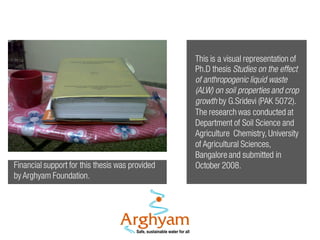
Financial support for this thesis was provided
by Arghyam Foundation.

This is a visual representation of
Ph.D thesis Studies on the effect
of anthropogenic liquid waste
(ALW) on soil properties and crop
growth by G.Sridevi (PAK 5072).
The research was conducted at
Department of Soil Science and
Agriculture Chemistry, University
of Agricultural Sciences,
Bangalore and submitted in
October 2008.
ALW = Anthropogenic Liquid Waste = Human Urine
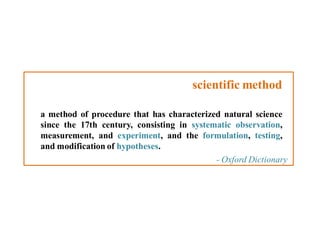
scientific method
a method of procedure that has characterized natural science
since the 17th century, consisting in systematic observation,
measurement, and experiment, and the formulation, testing,
and modification of hypotheses.
- Oxford Dictionary
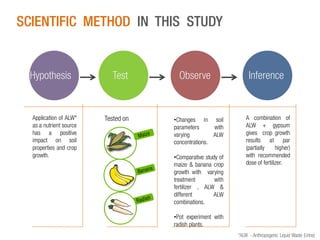
SCIENTIFIC METHOD IN THIS STUDY

Hypothesis

Application of ALW*
as a nutrient source
has a positive
impact on soil
properties and crop
growth.

Test

Tested on

Observe

•Changes in soil
parameters
with
varying
ALW
concentrations.

•Comparative study of
maize & banana crop
growth with varying
treatment
with
fertilizer , ALW &
different
ALW
combinations.

Inference

A combination of
ALW + gypsum
gives crop growth
results at par
(partially
higher)
with recommended
dose of fertilizer.

•Pot experiment with
radish plants.
*ALW - Anthropogenic Liquid Waste (Urine)
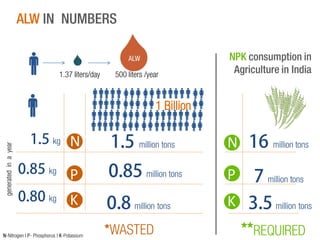
ALW IN NUMBERS
ALW

1.37 liters/day

500 liters /year

NPK consumption in
Agriculture in India

generated in a year

1 Billion
kg

N

kg

P

kg

K

N-Nitrogen | P- Phosphorus | K-Potassium

million tons
million tons

million tons

*WASTED

N
P
K

million tons

million tons
million tons

**REQUIRED
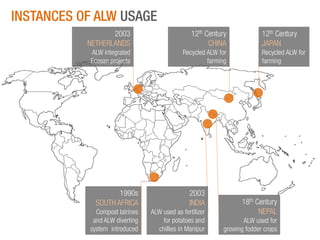
INSTANCES OF ALW USAGE
2003
NETHERLANDS

12th Century
CHINA

ALW integrated
Ecosan projects

Recycled ALW for
farming

1990s
SOUTH AFRICA

2003
INDIA

Compost latrines
and ALW diverting
system introduced

ALW used as fertilizer
for potatoes and
chillies in Manipur

12th Century
JAPAN
Recycled ALW for
farming

18th Century
NEPAL
ALW used for
growing fodder crops
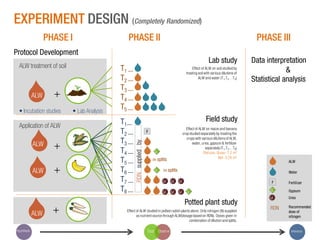
EXPERIMENT DESIGN (Completely Randomized)
PHASE I

PHASE II

PHASE III

Protocol Development

ALW

+

• Incubation studies

Application of ALW

ALW

ALW

ALW
Hypothesis

+

+

+

• Lab Analysis

Lab study

T1 —
T2 —
T3 —
T4 —
T5 —

T1—
T2 —
T3 —
T4 —
T5 —
T6 —
T7 —
T8 —

Effect of ALW on soil studied by
treating soil with various dilutions of
ALW and water (T 1,T 2…T 5)

Data interpretation
&
Statistical analysis

Field study
Effect of ALW on maize and banana
crop studied separately by treating the
crops with various dilutions of ALW,
water, urea, gypsum & fertilizer
separately (T 1,T 2…T8)
Plot size: Gross- 7.2 m2
Net- 3.24 m2

F

RDN supplied by

ALW treatment of soil

G

in splits
G

ALW

in splits

Water

U

U

U

U

U

U

F
G

Potted plant study
Effect of ALW studied in potted radish plants alone. Only nitrogen (N) supplied
as nutrient source through ALW(dosage based on RDN). Doses given in
combination of dilution and splits.

Test Observe

Fertilizer

G

Gypsum

U

Urea

RDN

Recommended
dose of
nitrogen

Inference
Hypothesis

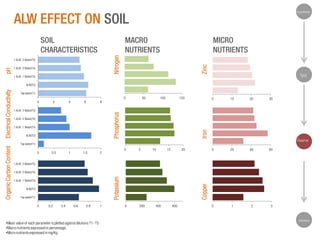
ALW EFFECT ON SOIL
MACRO
NUTRIENTS

1 ALW :2 Water(T4)

Zinc

1 ALW: 3 Water(T5)

pH

MICRO
NUTRIENTS

Nitrogen

SOIL
CHARACTERISTICS

Test

1 ALW :1 Water(T3)

Tap water(T1)

0
0

2

4

6

50

100

150

0

8

1 ALW: 3 Water(T5)
1 ALW :2 Water(T4)
1 ALW :1 Water(T3)
ALW(T2)

10

20

30

Iron

Phosphorus

Electrical Conductivity

ALW(T2)

Observe
0

0.5

1

1.5

0

2

5

0

200

10

15

20

0

20

40

60

0

1

2

3

1 ALW: 3 Water(T5)
1 ALW :2 Water(T4)

1 ALW :1 Water(T3)
ALW(T2)
Tap water(T1)

0

0.2

0.4

0.6

0.8

•Mean value of each parameter is plotted against dilutions T1- T5
•Macro nutrients expressed in percentage.
•Micro nutrients expressed in mg/Kg

1

Copper

Potassium

Organic Carbon Content

Tap water(T1)

400

600

Inference
Hypothesis

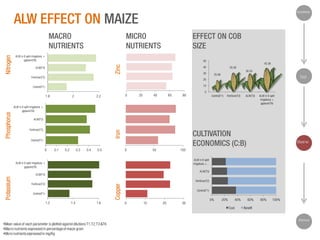
ALW EFFECT ON MAIZE
MICRO
NUTRIENTS

EFFECT ON COB
SIZE

ALW in 6 split irrigations +
gypsum(T6)

50

Zinc

Nitrogen

MACRO
NUTRIENTS
ALW(T3)

43.36

40

35.58
30.55

30

Fertilizer(T2)

25.66

Test

20
10

Control(T1)

0

2

0

2.2

20

40

60

80

Control(T1)

Fertilizer(T2)

ALW(T3)

ALW in 6 split
irrigations +
gypsum(T6)

ALW in 6 split irrigations +
gypsum(T6)
ALW(T3)
Fertilizer(T2)

Iron

Phosphorus

1.8

CULTIVATION
ECONOMICS (C:B)

Control(T1)

0

0.1

0.2

0.3

0.4

0.5

0

50

Observe

100
ALW in 6 split
irrigations + …

ALW in 6 split irrigations +
gypsum(T6)

ALW(T3)
Fertilizer(T2)
Fertilizer(T2)

Copper

Potassium

ALW(T3)

Control(T1)

1.2

1.4

1.6

Control(T1)

0

10

20

30

0%

20%

40%
Cost

•Mean value of each parameter is plotted against dilutions T1,T2,T3 &T6
•Macro nutrients expressed in percentage of maize grain
•Micro nutrients expressed in mg/Kg

60%

80%

100%

Benefit
Inference
Hypothesis

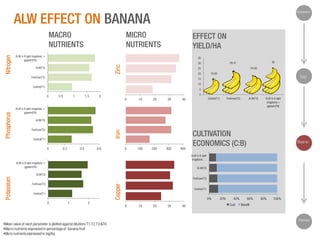
ALW EFFECT ON BANANA
MICRO
NUTRIENTS

EFFECT ON
YIELD/HA

ALW in 8 split irrigations +
gypsum(T6)

35

ALW(T3)

24.92

25
20

Fertilizer(T2)

19.93

Test

15
10

Control(T1)

5

0

0.5

1

1.5

0

2

0

10

20

30

Control(T1)

40

Fertilizer(T2)

ALW(T3)

ALW in 8 split irrigations +
gypsum(T6)

ALW in 6 split
irrigations +
gypsum(T6)

ALW(T3)
Fertilizer(T2)

Iron

Phosphorus

30

28.41

30

Zinc

Nitrogen

MACRO
NUTRIENTS

Control(T1)

0

0.2

0.4

0.6

0

100

200

300

400

CULTIVATION
ECONOMICS (C:B)

Observe

ALW in 6 split
irrigations …
ALW in 8 split irrigations +
gypsum(T6)

ALW(T3)
Fertilizer(T2)

Fertilizer(T2)

Copper

Potassium

ALW(T3)

Control(T1)

0

1

2

•Mean value of each parameter is plotted against dilutions T1,T2,T3 &T6
•Macro nutrients expressed in percentage of banana fruit
•Micro nutrients expressed in mg/Kg

Control(T1)

0%
0

10

20

30

40

20%

40%
Cost

60%

80%

100%

Benefit

Inference
Hypothesis

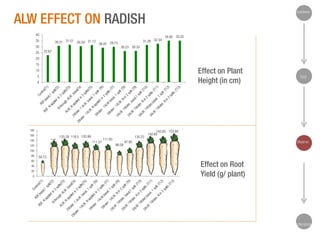
ALW EFFECT ON RADISH
40
35

30.51 31.51 30.29 31.12
28.97 29.73

30
25

31.28 32.34

34.92 35.02

26.23 26.33

22.67

20
15

Effect on Plant
Height (in cm)

10
5
0

180
160

126

140
120

125.28 118.5 120.99
111.27

130.23

111.93

86.58

Test

142.83 153.84
142.65

Observe

97.95

100
80
60
40
20
0

59.73

Effect on Root
Yield (g/ plant)

Inference
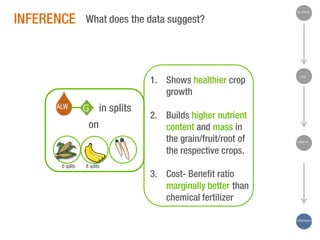
INFERENCE

Hypothesis

What does the data suggest?

1. Shows healthier crop
growth
ALW

G in splits
on

6 splits

2. Builds higher nutrient
content and mass in
the grain/fruit/root of
the respective crops.

Test

Observe

8 splits

3. Cost- Benefit ratio
marginally better than
chemical fertilizer
Inference

Ecosan Visualization

  • 1.
    Bottle it up!We can use it! Scientific studies on Human Urine
  • 2.
    Financial support forthis thesis was provided by Arghyam Foundation. This is a visual representation of Ph.D thesis Studies on the effect of anthropogenic liquid waste (ALW) on soil properties and crop growth by G.Sridevi (PAK 5072). The research was conducted at Department of Soil Science and Agriculture Chemistry, University of Agricultural Sciences, Bangalore and submitted in October 2008.
  • 3.
    ALW = AnthropogenicLiquid Waste = Human Urine
  • 4.
    scientific method a methodof procedure that has characterized natural science since the 17th century, consisting in systematic observation, measurement, and experiment, and the formulation, testing, and modification of hypotheses. - Oxford Dictionary
  • 5.
    SCIENTIFIC METHOD INTHIS STUDY Hypothesis Application of ALW* as a nutrient source has a positive impact on soil properties and crop growth. Test Tested on Observe •Changes in soil parameters with varying ALW concentrations. •Comparative study of maize & banana crop growth with varying treatment with fertilizer , ALW & different ALW combinations. Inference A combination of ALW + gypsum gives crop growth results at par (partially higher) with recommended dose of fertilizer. •Pot experiment with radish plants. *ALW - Anthropogenic Liquid Waste (Urine)
  • 6.
    ALW IN NUMBERS ALW 1.37liters/day 500 liters /year NPK consumption in Agriculture in India generated in a year 1 Billion kg N kg P kg K N-Nitrogen | P- Phosphorus | K-Potassium million tons million tons million tons *WASTED N P K million tons million tons million tons **REQUIRED
  • 7.
    INSTANCES OF ALWUSAGE 2003 NETHERLANDS 12th Century CHINA ALW integrated Ecosan projects Recycled ALW for farming 1990s SOUTH AFRICA 2003 INDIA Compost latrines and ALW diverting system introduced ALW used as fertilizer for potatoes and chillies in Manipur 12th Century JAPAN Recycled ALW for farming 18th Century NEPAL ALW used for growing fodder crops
  • 8.
    EXPERIMENT DESIGN (CompletelyRandomized) PHASE I PHASE II PHASE III Protocol Development ALW + • Incubation studies Application of ALW ALW ALW ALW Hypothesis + + + • Lab Analysis Lab study T1 — T2 — T3 — T4 — T5 — T1— T2 — T3 — T4 — T5 — T6 — T7 — T8 — Effect of ALW on soil studied by treating soil with various dilutions of ALW and water (T 1,T 2…T 5) Data interpretation & Statistical analysis Field study Effect of ALW on maize and banana crop studied separately by treating the crops with various dilutions of ALW, water, urea, gypsum & fertilizer separately (T 1,T 2…T8) Plot size: Gross- 7.2 m2 Net- 3.24 m2 F RDN supplied by ALW treatment of soil G in splits G ALW in splits Water U U U U U U F G Potted plant study Effect of ALW studied in potted radish plants alone. Only nitrogen (N) supplied as nutrient source through ALW(dosage based on RDN). Doses given in combination of dilution and splits. Test Observe Fertilizer G Gypsum U Urea RDN Recommended dose of nitrogen Inference
  • 9.
    Hypothesis ALW EFFECT ONSOIL MACRO NUTRIENTS 1 ALW :2 Water(T4) Zinc 1 ALW: 3 Water(T5) pH MICRO NUTRIENTS Nitrogen SOIL CHARACTERISTICS Test 1 ALW :1 Water(T3) Tap water(T1) 0 0 2 4 6 50 100 150 0 8 1 ALW: 3 Water(T5) 1 ALW :2 Water(T4) 1 ALW :1 Water(T3) ALW(T2) 10 20 30 Iron Phosphorus Electrical Conductivity ALW(T2) Observe 0 0.5 1 1.5 0 2 5 0 200 10 15 20 0 20 40 60 0 1 2 3 1 ALW: 3 Water(T5) 1 ALW :2 Water(T4) 1 ALW :1 Water(T3) ALW(T2) Tap water(T1) 0 0.2 0.4 0.6 0.8 •Mean value of each parameter is plotted against dilutions T1- T5 •Macro nutrients expressed in percentage. •Micro nutrients expressed in mg/Kg 1 Copper Potassium Organic Carbon Content Tap water(T1) 400 600 Inference
  • 10.
    Hypothesis ALW EFFECT ONMAIZE MICRO NUTRIENTS EFFECT ON COB SIZE ALW in 6 split irrigations + gypsum(T6) 50 Zinc Nitrogen MACRO NUTRIENTS ALW(T3) 43.36 40 35.58 30.55 30 Fertilizer(T2) 25.66 Test 20 10 Control(T1) 0 2 0 2.2 20 40 60 80 Control(T1) Fertilizer(T2) ALW(T3) ALW in 6 split irrigations + gypsum(T6) ALW in 6 split irrigations + gypsum(T6) ALW(T3) Fertilizer(T2) Iron Phosphorus 1.8 CULTIVATION ECONOMICS (C:B) Control(T1) 0 0.1 0.2 0.3 0.4 0.5 0 50 Observe 100 ALW in 6 split irrigations + … ALW in 6 split irrigations + gypsum(T6) ALW(T3) Fertilizer(T2) Fertilizer(T2) Copper Potassium ALW(T3) Control(T1) 1.2 1.4 1.6 Control(T1) 0 10 20 30 0% 20% 40% Cost •Mean value of each parameter is plotted against dilutions T1,T2,T3 &T6 •Macro nutrients expressed in percentage of maize grain •Micro nutrients expressed in mg/Kg 60% 80% 100% Benefit Inference
  • 11.
    Hypothesis ALW EFFECT ONBANANA MICRO NUTRIENTS EFFECT ON YIELD/HA ALW in 8 split irrigations + gypsum(T6) 35 ALW(T3) 24.92 25 20 Fertilizer(T2) 19.93 Test 15 10 Control(T1) 5 0 0.5 1 1.5 0 2 0 10 20 30 Control(T1) 40 Fertilizer(T2) ALW(T3) ALW in 8 split irrigations + gypsum(T6) ALW in 6 split irrigations + gypsum(T6) ALW(T3) Fertilizer(T2) Iron Phosphorus 30 28.41 30 Zinc Nitrogen MACRO NUTRIENTS Control(T1) 0 0.2 0.4 0.6 0 100 200 300 400 CULTIVATION ECONOMICS (C:B) Observe ALW in 6 split irrigations … ALW in 8 split irrigations + gypsum(T6) ALW(T3) Fertilizer(T2) Fertilizer(T2) Copper Potassium ALW(T3) Control(T1) 0 1 2 •Mean value of each parameter is plotted against dilutions T1,T2,T3 &T6 •Macro nutrients expressed in percentage of banana fruit •Micro nutrients expressed in mg/Kg Control(T1) 0% 0 10 20 30 40 20% 40% Cost 60% 80% 100% Benefit Inference
  • 12.
    Hypothesis ALW EFFECT ONRADISH 40 35 30.51 31.51 30.29 31.12 28.97 29.73 30 25 31.28 32.34 34.92 35.02 26.23 26.33 22.67 20 15 Effect on Plant Height (in cm) 10 5 0 180 160 126 140 120 125.28 118.5 120.99 111.27 130.23 111.93 86.58 Test 142.83 153.84 142.65 Observe 97.95 100 80 60 40 20 0 59.73 Effect on Root Yield (g/ plant) Inference
  • 13.
    INFERENCE Hypothesis What does thedata suggest? 1. Shows healthier crop growth ALW G in splits on 6 splits 2. Builds higher nutrient content and mass in the grain/fruit/root of the respective crops. Test Observe 8 splits 3. Cost- Benefit ratio marginally better than chemical fertilizer Inference