Opening Data, Information 
and Knowledge for 
Agricultural Development 
Ajit Maru 
GFAR Secretariat, Rome
Global Forum on Agricultural Research (GFAR) 
http:/www.egfar.org
Agenda 
• India’s Agricultural Development Challenges 
• India’s choices for agricultural information 
and knowledge services 
• Challenges of Agricultural Information and 
Knowledge Management in India 
• The Global Movement in Open Agricultural 
Data, Information and Knowledge 
• Benefits of Open Data and Information 
• CIARD and GODAN 
• CIARD Sevices 
• ICAR and CIARD
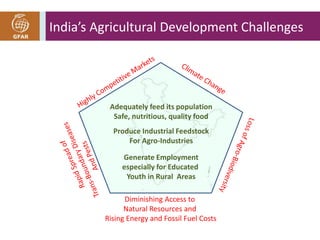
India’s Agricultural Development Challenges 
Adequately feed its population 
Safe, nutritious, quality food 
Produce Industrial Feedstock 
For Agro-Industries 
Generate Employment 
especially for Educated 
Youth in Rural Areas 
Diminishing Access to 
Natural Resources and 
Rising Energy and Fossil Fuel Costs
India’s Agricultural Development Challenges 
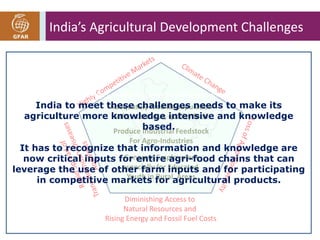
India to meet these challenges needs to make its agriculture more knowledge intensive and 
India to meet these challenges needs to make its 
Adequately feed its population 
Safe, nutritious, quality food 
Produce Industrial Feedstock 
agriculture more knowledge intensive and knowledge 
based. 
For Agro-Industries 
It has to recognize that information and knowledge are 
now critical inputs for entire agri-food chains that can 
leverage the use of other farm inputs and for participating 
Generate Employment 
especially for Educated 
Youth in Rural Areas 
in competitive markets for agricultural products. 
Diminishing Access to 
Natural Resources and 
Rising Energy and Fossil Fuel Costs
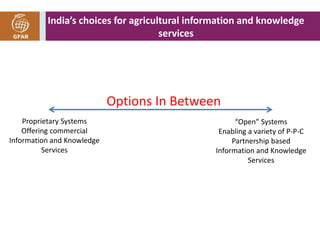
India’s choices for agricultural information and knowledge 
services 
Proprietary Systems 
Offering commercial 
Information and Knowledge 
Services 
“Open” Systems 
Enabling a variety of P-P-C 
Partnership based 
Information and Knowledge 
Services 
Options In Between
India’s choices for agricultural information and 
knowledge services 
• For various reasons, India cannot afford purely 
proprietary and for profit information and 
knowledge services. 
• India has to opt for systems that are a 
continuation of the current trajectory of 
“open” information and knowledge systems.
Challenges of Agricultural Information and Knowledge 
Management in India 
• India already has many of the fundamental 
requirements for “Open” Information Systems such as 
policies and infrastructure. 
• India agricultural information systems face challenges 
in: 
– Generating useful, relevant, timely, trustworthy content 
for its agricultural systems that are smallholder based 
– Integration of Information and Information Systems 
– Security of Information Systems 
– Property rights for data and information 
– Enabling effective use of data and information in the entire 
agri-food chain and especially in farming communities
Challenges of Agricultural Information and Knowledge 
Management in India 
• India faces critical challenges for content in: 
– Availability, 
– Accessibility 
– Applicability 
– Affordability 
– Appropriation of information content by user 
communities
The Global Movement in Open Agricultural 
Data, Information and Knowledge 
• Growing Global movement for “Open 
Governments” which includes India 
• Open availability and access to government and 
publicly funded programs data and information is 
a basic tenet of the open government model 
• Open availability and access enables rapid 
innovation and development and creates huge 
potential for knowledge services that can 
generate employment and livelihoods
The Global Movement in Open Agricultural 
Data, Information and Knowledge 
Major International Actors in Agricultural 
Development, World Bank, UNO including FAO, 
CGIAR and GFAR follow open data and 
information policies and open data models for 
their data and information management
Benefits of Open Data and Information 
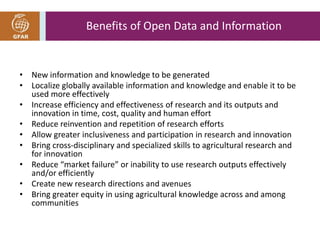
• New information and knowledge to be generated 
• Localize globally available information and knowledge and enable it to be 
used more effectively 
• Increase efficiency and effectiveness of research and its outputs and 
innovation in time, cost, quality and human effort 
• Reduce reinvention and repetition of research efforts 
• Allow greater inclusiveness and participation in research and innovation 
• Bring cross-disciplinary and specialized skills to agricultural research and 
for innovation 
• Reduce “market failure” or inability to use research outputs effectively 
and/or efficiently 
• Create new research directions and avenues 
• Bring greater equity in using agricultural knowledge across and among 
communities
Benefits of Open Data and Information 
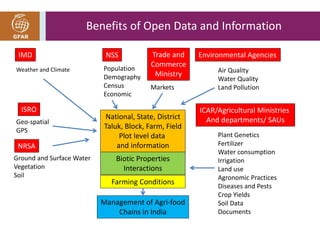
IMD 
Weather and Climate 
ISRO 
Geo-spatial 
GPS 
NRSA 
Ground and Surface Water 
Vegetation 
Soil 
NSS 
Population 
Demography 
Census 
Economic 
Environmental Agencies 
Air Quality 
Water Quality 
Land Pollution 
ICAR/Agricultural Ministries 
And departments/ SAUs 
Plant Genetics 
Fertilizer 
Water consumption 
Irrigation 
Land use 
Agronomic Practices 
Diseases and Pests 
Crop Yields 
Soil Data 
Documents 
Trade and 
Commerce 
Ministry 
Markets 
National, State, District 
Taluk, Block, Farm, Field 
Plot level data 
and information 
Biotic Properties 
Interactions 
Farming Conditions 
Management of Agri-food 
Chains in India
CIARD and GODAN 
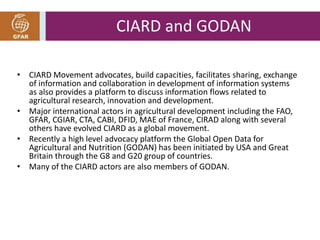
• CIARD Movement advocates, build capacities, facilitates sharing, exchange 
of information and collaboration in development of information systems 
as also provides a platform to discuss information flows related to 
agricultural research, innovation and development. 
• Major international actors in agricultural development including the FAO, 
GFAR, CGIAR, CTA, CABI, DFID, MAE of France, CIRAD along with several 
others have evolved CIARD as a global movement. 
• Recently a high level advocacy platform the Global Open Data for 
Agricultural and Nutrition (GODAN) has been initiated by USA and Great 
Britain through the G8 and G20 group of countries. 
• Many of the CIARD actors are also members of GODAN.
CIARD SERVICES 
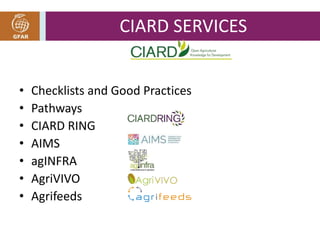
• Checklists and Good Practices 
• Pathways 
• CIARD RING 
• AIMS 
• agINFRA 
• AgriVIVO 
• Agrifeeds
CIARD RING 
• The CIARD Routemap to Information Nodes and 
Gateways (RING) is a global directory of web-based 
services that will give access to any kind of information 
sources pertaining to agricultural research for 
development (ARD). 
• The RING aims to provide an infrastructure to improve 
the accessibility of the outputs of agricultural research 
and of information relevant to ARD management. 
• There are more than 490 Institutional members 
providing more than 1000 information services and 
290 data sets of the CIARD.RING.
ICAR and CIARD 
• The ICAR has officially permitted its Institutions 
and Programs to be part of the CIARD movement 
• At the Institution level, the partnership with 
CIARD is not well demonstrated. It is below par 
compared to other major national and 
International agricultural research and 
development systems 
• India can both benefit and contribute to the 
CIARD movement 
• The global community waits eagerly in 
anticipation for India to be a leader in this area.
Thank You 
ajit.maru@fao.org

Opening Data, Information and Knowledge for Agriculture Development

  • 1.
    Opening Data, Information and Knowledge for Agricultural Development Ajit Maru GFAR Secretariat, Rome
  • 2.
    Global Forum onAgricultural Research (GFAR) http:/www.egfar.org
  • 3.
    Agenda • India’sAgricultural Development Challenges • India’s choices for agricultural information and knowledge services • Challenges of Agricultural Information and Knowledge Management in India • The Global Movement in Open Agricultural Data, Information and Knowledge • Benefits of Open Data and Information • CIARD and GODAN • CIARD Sevices • ICAR and CIARD
  • 4.
    India’s Agricultural DevelopmentChallenges Adequately feed its population Safe, nutritious, quality food Produce Industrial Feedstock For Agro-Industries Generate Employment especially for Educated Youth in Rural Areas Diminishing Access to Natural Resources and Rising Energy and Fossil Fuel Costs
  • 5.
    India’s Agricultural DevelopmentChallenges India to meet these challenges needs to make its agriculture more knowledge intensive and India to meet these challenges needs to make its Adequately feed its population Safe, nutritious, quality food Produce Industrial Feedstock agriculture more knowledge intensive and knowledge based. For Agro-Industries It has to recognize that information and knowledge are now critical inputs for entire agri-food chains that can leverage the use of other farm inputs and for participating Generate Employment especially for Educated Youth in Rural Areas in competitive markets for agricultural products. Diminishing Access to Natural Resources and Rising Energy and Fossil Fuel Costs
  • 6.
    India’s choices foragricultural information and knowledge services Proprietary Systems Offering commercial Information and Knowledge Services “Open” Systems Enabling a variety of P-P-C Partnership based Information and Knowledge Services Options In Between
  • 7.
    India’s choices foragricultural information and knowledge services • For various reasons, India cannot afford purely proprietary and for profit information and knowledge services. • India has to opt for systems that are a continuation of the current trajectory of “open” information and knowledge systems.
  • 8.
    Challenges of AgriculturalInformation and Knowledge Management in India • India already has many of the fundamental requirements for “Open” Information Systems such as policies and infrastructure. • India agricultural information systems face challenges in: – Generating useful, relevant, timely, trustworthy content for its agricultural systems that are smallholder based – Integration of Information and Information Systems – Security of Information Systems – Property rights for data and information – Enabling effective use of data and information in the entire agri-food chain and especially in farming communities
  • 9.
    Challenges of AgriculturalInformation and Knowledge Management in India • India faces critical challenges for content in: – Availability, – Accessibility – Applicability – Affordability – Appropriation of information content by user communities
  • 10.
    The Global Movementin Open Agricultural Data, Information and Knowledge • Growing Global movement for “Open Governments” which includes India • Open availability and access to government and publicly funded programs data and information is a basic tenet of the open government model • Open availability and access enables rapid innovation and development and creates huge potential for knowledge services that can generate employment and livelihoods
  • 11.
    The Global Movementin Open Agricultural Data, Information and Knowledge Major International Actors in Agricultural Development, World Bank, UNO including FAO, CGIAR and GFAR follow open data and information policies and open data models for their data and information management
  • 12.
    Benefits of OpenData and Information • New information and knowledge to be generated • Localize globally available information and knowledge and enable it to be used more effectively • Increase efficiency and effectiveness of research and its outputs and innovation in time, cost, quality and human effort • Reduce reinvention and repetition of research efforts • Allow greater inclusiveness and participation in research and innovation • Bring cross-disciplinary and specialized skills to agricultural research and for innovation • Reduce “market failure” or inability to use research outputs effectively and/or efficiently • Create new research directions and avenues • Bring greater equity in using agricultural knowledge across and among communities
  • 13.
    Benefits of OpenData and Information IMD Weather and Climate ISRO Geo-spatial GPS NRSA Ground and Surface Water Vegetation Soil NSS Population Demography Census Economic Environmental Agencies Air Quality Water Quality Land Pollution ICAR/Agricultural Ministries And departments/ SAUs Plant Genetics Fertilizer Water consumption Irrigation Land use Agronomic Practices Diseases and Pests Crop Yields Soil Data Documents Trade and Commerce Ministry Markets National, State, District Taluk, Block, Farm, Field Plot level data and information Biotic Properties Interactions Farming Conditions Management of Agri-food Chains in India
  • 14.
    CIARD and GODAN • CIARD Movement advocates, build capacities, facilitates sharing, exchange of information and collaboration in development of information systems as also provides a platform to discuss information flows related to agricultural research, innovation and development. • Major international actors in agricultural development including the FAO, GFAR, CGIAR, CTA, CABI, DFID, MAE of France, CIRAD along with several others have evolved CIARD as a global movement. • Recently a high level advocacy platform the Global Open Data for Agricultural and Nutrition (GODAN) has been initiated by USA and Great Britain through the G8 and G20 group of countries. • Many of the CIARD actors are also members of GODAN.
  • 15.
    CIARD SERVICES •Checklists and Good Practices • Pathways • CIARD RING • AIMS • agINFRA • AgriVIVO • Agrifeeds
  • 16.
    CIARD RING •The CIARD Routemap to Information Nodes and Gateways (RING) is a global directory of web-based services that will give access to any kind of information sources pertaining to agricultural research for development (ARD). • The RING aims to provide an infrastructure to improve the accessibility of the outputs of agricultural research and of information relevant to ARD management. • There are more than 490 Institutional members providing more than 1000 information services and 290 data sets of the CIARD.RING.
  • 17.
    ICAR and CIARD • The ICAR has officially permitted its Institutions and Programs to be part of the CIARD movement • At the Institution level, the partnership with CIARD is not well demonstrated. It is below par compared to other major national and International agricultural research and development systems • India can both benefit and contribute to the CIARD movement • The global community waits eagerly in anticipation for India to be a leader in this area.
  • 18.