Open Access to Data & Knowledge: 
A CGIAR Center Perspective 
Workshop on 
“Open Access to Agricultural Knowledge 
for Inclusive Growth and Development” 
29-30 October 2014, NAARM, Hyderabad 
Guntuku Dileepkumar 
Global Leader, Knowledge Sharing and Innovation, ICRISAT 
Director, Center of Excellcence in ICT Innovations for Agriculture 
Coordinator, ICRISAT South-South Initiative 
Email: g.dileepkumar@icrisat.org
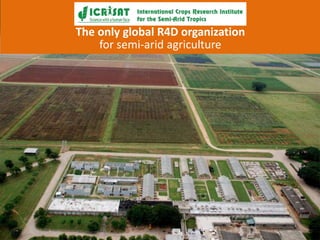
The only global R4D organization 
for semi-arid agriculture
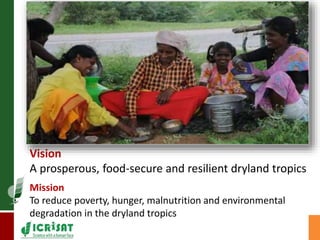
Vision 
A prosperous, food-secure and resilient dryland tropics 
Mission 
To reduce poverty, hunger, malnutrition and environmental 
degradation in the dryland tropics
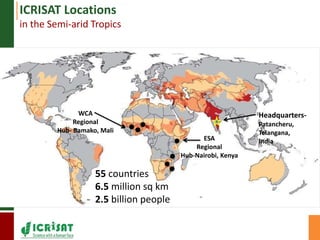
ICRISAT Locations 
in the Semi-arid Tropics 
55 countries 
6.5 million sq km 
2.5 billion people 
Headquarters- 
Patancheru, 
Telangana, 
ESA India 
Regional 
Hub-Nairobi, Kenya 
WCA 
Regional 
Hub- Bamako, Mali
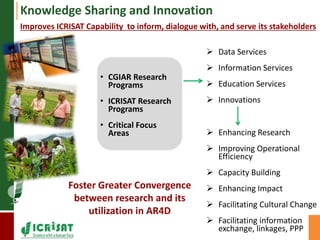
Knowledge Sharing and Innovation 
Improves ICRISAT Capability to inform, dialogue with, and serve its stakeholders 
• CGIAR Research 
Programs 
• ICRISAT Research 
Programs 
• Critical Focus 
Areas 
 Data Services 
 Information Services 
 Education Services 
 Innovations 
Foster Greater Convergence 
between research and its 
utilization in AR4D 
 Enhancing Research 
 Improving Operational 
Efficiency 
 Capacity Building 
 Enhancing Impact 
 Facilitating Cultural Change 
 Facilitating information 
exchange, linkages, PPP
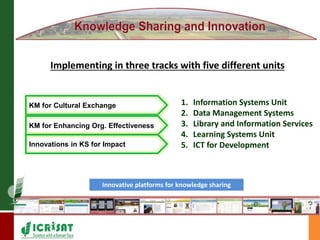
Implementing in three tracks with five different units 
KM for Cultural Exchange 
KM for Enhancing Org. Effectiveness 
Innovations in KS for Impact 
1. Information Systems Unit 
2. Data Management Systems 
3. Library and Information Services 
4. Learning Systems Unit 
5. ICT for Development 
Innovative platforms for knowledge sharing
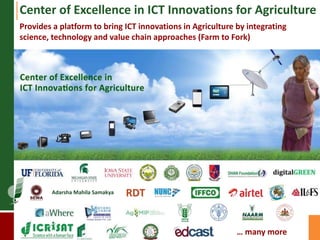
Center of Excellence in ICT Innovations for Agriculture 
Provides a platform to bring ICT innovations in Agriculture by integrating 
science, technology and value chain approaches (Farm to Fork) 
… many more
Why Open Access? 
 Research data and knowledge outputs are very 
valuable as International Public Goods (IPGs) 
 Data generated in agricultural research laboratories 
became private preserve and inaccessible 
 Knowledge Outputs in peer-reviewed journals remains 
inaccessible behind toll-based access or subscription 
fees 
 Contemporary digital opportunities for collecting, 
storing, manipulating and transmitting data and 
knowledge outputs have opened up new avenues 
 One such digital opportunity is the Open Access (OA) 
platform
Why Open Access? 
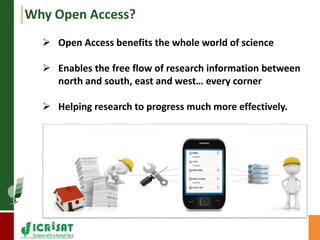
 Open Access benefits the whole world of science 
 Enables the free flow of research information between 
north and south, east and west… every corner 
 Helping research to progress much more effectively.
Why Open Access in Agriculture? 
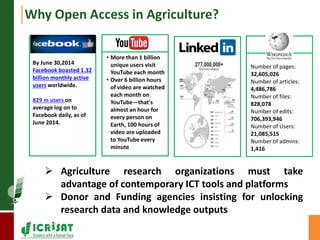
By June 30,2014 
Facebook boasted 1.32 
billion monthly active 
users worldwide. 
829 m users on 
average log on to 
Facebook daily, as of 
June 2014. 
• More than 1 billion 
unique users visit 
YouTube each month 
• Over 6 billion hours 
of video are watched 
each month on 
YouTube—that's 
almost an hour for 
every person on 
Earth, 100 hours of 
video are uploaded 
to YouTube every 
minute 
Number of pages: 
32,605,026 
Number of articles: 
4,486,786 
Number of files: 
828,078 
Number of edits: 
706,393,946 
Number of Users: 
21,085,515 
Number of admins: 
1,416 
 Agriculture research organizations must take 
advantage of contemporary ICT tools and platforms 
 Donor and Funding agencies insisting for unlocking 
research data and knowledge outputs
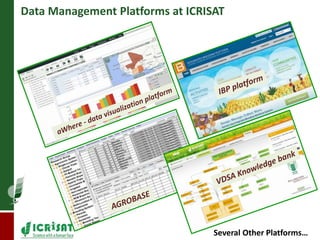
Data Management Platforms at ICRISAT 
Several Other Platforms…
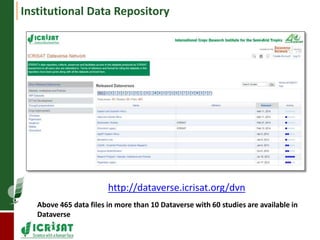
Institutional Data Repository 
http://dataverse.icrisat.org/dvn 
Above 465 data files in more than 10 Dataverse with 60 studies are available in 
Dataverse
Challenges 
• Data confidentiality and data standards 
• Recognition and data ownership 
• Data preservation beyond project life cycle 
• Cultural change 
Efforts 
• Open Access Week - 24 October 2013, 27 October 2014 
– > 50 participants attended and uploaded more than 100 data files in Dataverse 
• Capacity development workshops ( 2013-2014) 
– Data curation and breeding data management – 25 to 29 Nov 2013 
– ‘Orientation to innovative agriculture data management platforms and data 
management policy’ – 5 to 6 Dec 2013 
– ‘Appropriate Technologies and Innovative Approaches for Agriculture Knowledge 
Sharing’ – 9 to 14 Dec 2013 
– ‘Open data solutions’ – 1-4 Sept 2014 
– ‘aWhere platform’ for HOPE scientists - 1st Sept 2014
Data management Policy and 
Implementation guidelines 
• Approved on 5th March 2014 
• Applies to all scientists and research staff of ICRISAT 
• Data generated or collected through ICRISAT research - 
owned by ICRISAT 
• Data sharing – within 24 months from the completion date of 
data collection 
• Planning data management activities at the beginning of the 
project 
 Timelines , Data manager, Data curator, Data generators, 
Project coordinators 
• Recognition and Incentives
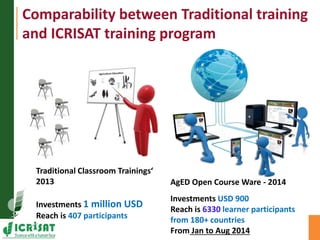
Comparability between Traditional training 
and ICRISAT training program 
Traditional Classroom Trainings‘ 
2013 
Investments 1 million USD 
Reach is 407 participants 
AgED Open Course Ware - 2014 
Investments USD 900 
Reach is 6330 learner participants 
from 180+ countries 
From Jan to Aug 2014
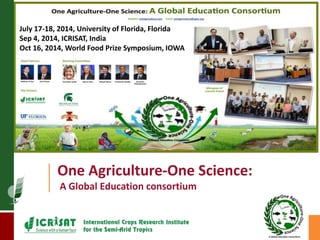
July 17-18, 2014, University of Florida, Florida 
Sep 4, 2014, ICRISAT, India 
Oct 16, 2014, World Food Prize Symposium, IOWA 
One Agriculture-One Science: 
A Global Education consortium
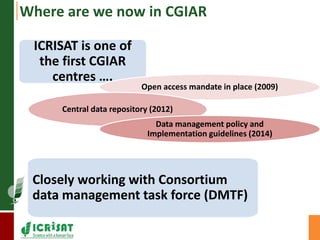
Where are we now in CGIAR 
ICRISAT is one of 
the first CGIAR 
centres …. 
Open access mandate in place (2009) 
Central data repository (2012) 
Data management policy and 
Implementation guidelines (2014) 
Closely working with Consortium 
data management task force (DMTF)
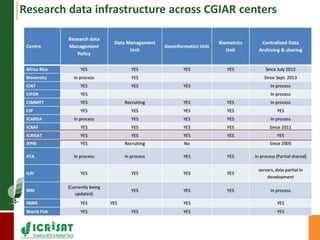
Research data infrastructure across CGIAR centers
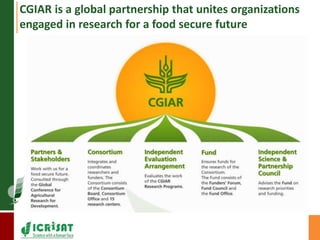
CGIAR is a global partnership that unites organizations 
engaged in research for a food secure future
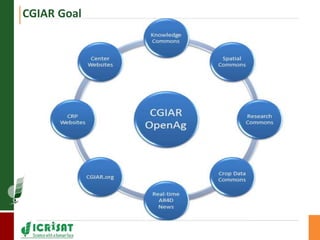
CGIAR Goal
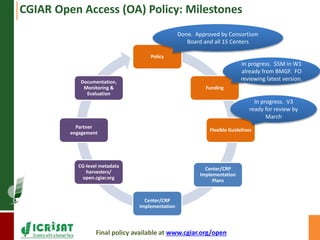
CGIAR Open Access (OA) Policy: Milestones 
Policy 
Funding 
Flexible Guidelines 
Center/CRP 
Implementation 
Plans 
Center/CRP 
Implementation 
Documentation, 
Monitoring & 
Evaluation 
Partner 
engagement 
CG-level metadata 
harvesters/ 
open.cgiar.org 
Done. Approved by Consortium 
Board and all 15 Centers 
In progress. $5M in W1 
already from BMGF. FO 
reviewing latest version. 
In progress. V3 
ready for review by 
March 
Final policy available at www.cgiar.org/open
IMPACTS 
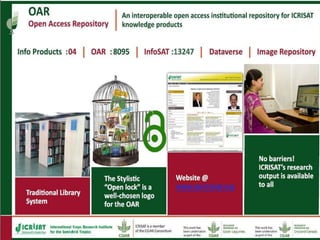
 Open Access Repository http://oar.icrisat.org - holds more 
than 8,329 records with 630,427 downloads from 125 
countries 
 Open Data Repositories http://dataverse.icrisat.org/dvn/ – 
holds more than 465 data files in 10 Dataverse with 60 studies 
 AgEd Open Courseware platform (virtual learning platform) 
http://www.aged.icrisat.org/moodle23/ - has more than 12 
courses; 6330 Learner Participants from around 180 Countries 
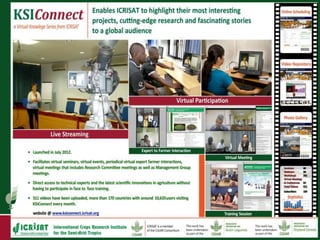
 KSIConnect (virtual knowledge series) 
http://ksiconnect.icrisat.org/ - more than 511 videos; 10,635 
unique users from around 170 countries
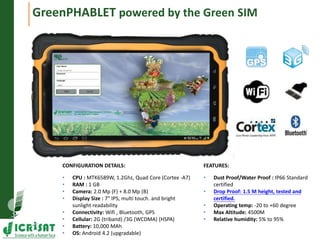
GreenPHABLET powered by the Green SIM 
CONFIGURATION DETAILS: 
• CPU : MTK6589W, 1.2Ghz, Quad Core (Cortex -A7) 
• RAM : 1 GB 
• Camera: 2.0 Mp (F) + 8.0 Mp (B) 
• Display Size : 7" IPS, multi touch. and bright 
sunlight readability 
• Connectivity: Wifi , Bluetooth, GPS 
• Cellular: 2G (triband) /3G (WCDMA) (HSPA) 
• Battery: 10,000 MAh 
• OS: Android 4.2 (upgradable) 
FEATURES: 
• Dust Proof/Water Proof : IP66 Standard 
certified 
• Drop Proof: 1.5 M height, tested and 
certified. 
• Operating temp: -20 to +60 degree 
• Max Altitude: 4500M 
• Relative humidity: 5% to 95%
Open data & knowledge solutions - a cgiar perspective dileep

Open data & knowledge solutions - a cgiar perspective dileep

  • 1.
    Open Access toData & Knowledge: A CGIAR Center Perspective Workshop on “Open Access to Agricultural Knowledge for Inclusive Growth and Development” 29-30 October 2014, NAARM, Hyderabad Guntuku Dileepkumar Global Leader, Knowledge Sharing and Innovation, ICRISAT Director, Center of Excellcence in ICT Innovations for Agriculture Coordinator, ICRISAT South-South Initiative Email: g.dileepkumar@icrisat.org
  • 2.
    The only globalR4D organization for semi-arid agriculture
  • 3.
    Vision A prosperous,food-secure and resilient dryland tropics Mission To reduce poverty, hunger, malnutrition and environmental degradation in the dryland tropics
  • 4.
    ICRISAT Locations inthe Semi-arid Tropics 55 countries 6.5 million sq km 2.5 billion people Headquarters- Patancheru, Telangana, ESA India Regional Hub-Nairobi, Kenya WCA Regional Hub- Bamako, Mali
  • 5.
    Knowledge Sharing andInnovation Improves ICRISAT Capability to inform, dialogue with, and serve its stakeholders • CGIAR Research Programs • ICRISAT Research Programs • Critical Focus Areas  Data Services  Information Services  Education Services  Innovations Foster Greater Convergence between research and its utilization in AR4D  Enhancing Research  Improving Operational Efficiency  Capacity Building  Enhancing Impact  Facilitating Cultural Change  Facilitating information exchange, linkages, PPP
  • 6.
    Implementing in threetracks with five different units KM for Cultural Exchange KM for Enhancing Org. Effectiveness Innovations in KS for Impact 1. Information Systems Unit 2. Data Management Systems 3. Library and Information Services 4. Learning Systems Unit 5. ICT for Development Innovative platforms for knowledge sharing
  • 7.
    Center of Excellencein ICT Innovations for Agriculture Provides a platform to bring ICT innovations in Agriculture by integrating science, technology and value chain approaches (Farm to Fork) … many more
  • 8.
    Why Open Access?  Research data and knowledge outputs are very valuable as International Public Goods (IPGs)  Data generated in agricultural research laboratories became private preserve and inaccessible  Knowledge Outputs in peer-reviewed journals remains inaccessible behind toll-based access or subscription fees  Contemporary digital opportunities for collecting, storing, manipulating and transmitting data and knowledge outputs have opened up new avenues  One such digital opportunity is the Open Access (OA) platform
  • 9.
    Why Open Access?  Open Access benefits the whole world of science  Enables the free flow of research information between north and south, east and west… every corner  Helping research to progress much more effectively.
  • 10.
    Why Open Accessin Agriculture? By June 30,2014 Facebook boasted 1.32 billion monthly active users worldwide. 829 m users on average log on to Facebook daily, as of June 2014. • More than 1 billion unique users visit YouTube each month • Over 6 billion hours of video are watched each month on YouTube—that's almost an hour for every person on Earth, 100 hours of video are uploaded to YouTube every minute Number of pages: 32,605,026 Number of articles: 4,486,786 Number of files: 828,078 Number of edits: 706,393,946 Number of Users: 21,085,515 Number of admins: 1,416  Agriculture research organizations must take advantage of contemporary ICT tools and platforms  Donor and Funding agencies insisting for unlocking research data and knowledge outputs
  • 12.
    Data Management Platformsat ICRISAT Several Other Platforms…
  • 13.
    Institutional Data Repository http://dataverse.icrisat.org/dvn Above 465 data files in more than 10 Dataverse with 60 studies are available in Dataverse
  • 14.
    Challenges • Dataconfidentiality and data standards • Recognition and data ownership • Data preservation beyond project life cycle • Cultural change Efforts • Open Access Week - 24 October 2013, 27 October 2014 – > 50 participants attended and uploaded more than 100 data files in Dataverse • Capacity development workshops ( 2013-2014) – Data curation and breeding data management – 25 to 29 Nov 2013 – ‘Orientation to innovative agriculture data management platforms and data management policy’ – 5 to 6 Dec 2013 – ‘Appropriate Technologies and Innovative Approaches for Agriculture Knowledge Sharing’ – 9 to 14 Dec 2013 – ‘Open data solutions’ – 1-4 Sept 2014 – ‘aWhere platform’ for HOPE scientists - 1st Sept 2014
  • 15.
    Data management Policyand Implementation guidelines • Approved on 5th March 2014 • Applies to all scientists and research staff of ICRISAT • Data generated or collected through ICRISAT research - owned by ICRISAT • Data sharing – within 24 months from the completion date of data collection • Planning data management activities at the beginning of the project  Timelines , Data manager, Data curator, Data generators, Project coordinators • Recognition and Incentives
  • 17.
    Comparability between Traditionaltraining and ICRISAT training program Traditional Classroom Trainings‘ 2013 Investments 1 million USD Reach is 407 participants AgED Open Course Ware - 2014 Investments USD 900 Reach is 6330 learner participants from 180+ countries From Jan to Aug 2014
  • 18.
    July 17-18, 2014,University of Florida, Florida Sep 4, 2014, ICRISAT, India Oct 16, 2014, World Food Prize Symposium, IOWA One Agriculture-One Science: A Global Education consortium
  • 19.
    Where are wenow in CGIAR ICRISAT is one of the first CGIAR centres …. Open access mandate in place (2009) Central data repository (2012) Data management policy and Implementation guidelines (2014) Closely working with Consortium data management task force (DMTF)
  • 20.
    Research data infrastructureacross CGIAR centers
  • 21.
    CGIAR is aglobal partnership that unites organizations engaged in research for a food secure future
  • 22.
  • 23.
    CGIAR Open Access(OA) Policy: Milestones Policy Funding Flexible Guidelines Center/CRP Implementation Plans Center/CRP Implementation Documentation, Monitoring & Evaluation Partner engagement CG-level metadata harvesters/ open.cgiar.org Done. Approved by Consortium Board and all 15 Centers In progress. $5M in W1 already from BMGF. FO reviewing latest version. In progress. V3 ready for review by March Final policy available at www.cgiar.org/open
  • 24.
    IMPACTS  OpenAccess Repository http://oar.icrisat.org - holds more than 8,329 records with 630,427 downloads from 125 countries  Open Data Repositories http://dataverse.icrisat.org/dvn/ – holds more than 465 data files in 10 Dataverse with 60 studies  AgEd Open Courseware platform (virtual learning platform) http://www.aged.icrisat.org/moodle23/ - has more than 12 courses; 6330 Learner Participants from around 180 Countries  KSIConnect (virtual knowledge series) http://ksiconnect.icrisat.org/ - more than 511 videos; 10,635 unique users from around 170 countries
  • 25.
    GreenPHABLET powered bythe Green SIM CONFIGURATION DETAILS: • CPU : MTK6589W, 1.2Ghz, Quad Core (Cortex -A7) • RAM : 1 GB • Camera: 2.0 Mp (F) + 8.0 Mp (B) • Display Size : 7" IPS, multi touch. and bright sunlight readability • Connectivity: Wifi , Bluetooth, GPS • Cellular: 2G (triband) /3G (WCDMA) (HSPA) • Battery: 10,000 MAh • OS: Android 4.2 (upgradable) FEATURES: • Dust Proof/Water Proof : IP66 Standard certified • Drop Proof: 1.5 M height, tested and certified. • Operating temp: -20 to +60 degree • Max Altitude: 4500M • Relative humidity: 5% to 95%