Dependency	
  Injec+on	
  on	
  
Android	
  
By	
  Joan	
  Puig	
  Sanz	
  
About	
  Joan	
  Puig	
  Sanz	
  
•  Electrical	
  Engineer	
  
•  So<ware/hardware	
  fan	
  :)	
  
•  Open	
  Source	
  Projects:	
  
–  ServDroid:	
  Simple	
  web	
  Server	
  
–  BeyondAR	
  Framework:	
  Augmented	
  Reality	
  framework	
  

beyondar.com	
  

1	
  
//TODO:	
  
1.  What	
  is	
  Dependency	
  Injec+on?	
  
2.  Simple	
  Example:	
  Factory	
  PaPern	
  
3.  Android	
  and	
  Dependency	
  Injec+on	
  
–  KitKatMachine	
  example	
  with	
  RoboGuice	
  and	
  
Dagger	
  
–  Compare	
  RoboGuice	
  and	
  Dagger	
  

4.  Conclusions	
  

2	
  
What	
  is	
  Dependency	
  Injec+on?	
  
“Dependency	
  injec+on	
  is	
  a	
  so<ware	
  design	
  paPern	
  
that	
  allows	
  the	
  removal	
  of	
  hard-­‐coded	
  dependencies	
  
and	
  makes	
  it	
  possible	
  to	
  change	
  them,	
  whether	
  at	
  
run-­‐+me	
  or	
  compile-­‐+me”	


Dependency	
  Injec+on	
  is	
  like	
  ordering	
  a	
  hawaiian	
  
pizza	
  but	
  specifying	
  the	
  ingredients,	
  for	
  instance,	
  
instead	
  of	
  ham	
  we	
  want	
  	
  pepperoni.	


3	
  
What	
  does	
  Dependency	
  Injec+on	
  do?	
  
•  It	
  improves	
  the	
  code:	
  reusable,	
  modulable	
  and	
  
testability	
  
•  It	
  allows	
  the	
  developer	
  to	
  focus	
  on	
  the	
  code	
  
that	
  adds	
  a	
  plus	
  value	
  to	
  the	
  app:	
  
–  No	
  need	
  to	
  worry	
  about	
  Singletons,	
  Factories	
  and	
  
others.	
  

4	
  
Factory	
  paPern	
  

SIMPLE	
  EXAMPLE	
  

5	
  
The	
  Factory	
  PaPern	
  
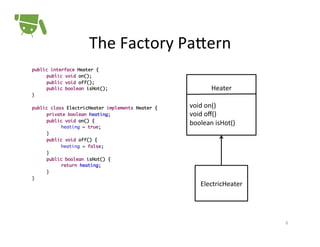
public interface Heater {	
	public void on();	
	public void off();	
	public boolean isHot();	
}	
	
public class ElectricHeater implements Heater {	
	private boolean heating;	
	public void on() {	
	
	heating = true;	
	}	
	public void off() {	
	
	heating = false;	
	}	
	public boolean isHot() {	
	
	return heating;	
	}	
}!

Heater	


void	
  on()	
  
void	
  off()	
  
boolean	
  isHot()	
  

ElectricHeater	
  

6	
  
The	
  Factory	
  PaPern	
  –	
  wri+ng	
  it	
  
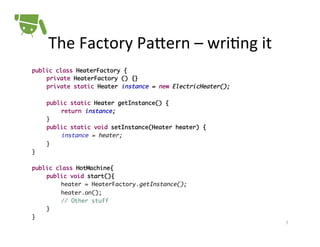
public class HeaterFactory {	
	private HeaterFactory () {}	
	private static Heater instance = new ElectricHeater();	
		
	public static Heater getInstance() {	
	
	return instance;	
	}	
	public static void setInstance(Heater heater) {	
	
	instance = heater;	
	}	
}	
	
public class HotMachine{	
	public void start(){	
	
	heater = HeaterFactory.getInstance();	
	
	heater.on();	
	
	// Other stuff	
	}	
}!

7	
  
The	
  Factory	
  PaPern	
  –	
  Unit	
  Test	
  
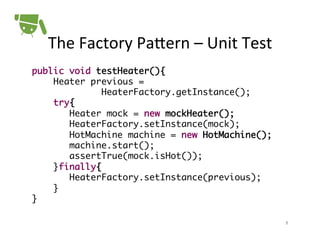
public void testHeater(){	
Heater previous = 	
HeaterFactory.getInstance();	
try{	
Heater mock = new mockHeater();	
HeaterFactory.setInstance(mock);	
HotMachine machine = new HotMachine();	
machine.start();	
assertTrue(mock.isHot());	
}finally{	
HeaterFactory.setInstance(previous);	
}	
}	
8	
  
Implementa+on	
  drawbacks	
  
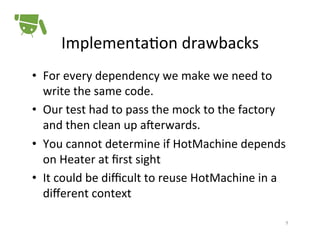
•  For	
  every	
  dependency	
  we	
  make	
  we	
  need	
  to	
  
write	
  the	
  same	
  code.	
  
•  Our	
  test	
  had	
  to	
  pass	
  the	
  mock	
  to	
  the	
  factory	
  
and	
  then	
  clean	
  up	
  a<erwards.	
  
•  You	
  cannot	
  determine	
  if	
  HotMachine	
  depends	
  
on	
  Heater	
  at	
  first	
  sight	
  
•  It	
  could	
  be	
  difficult	
  to	
  reuse	
  HotMachine	
  in	
  a	
  
different	
  context	
  	
  
9	
  
Implementa+on	
  drawbacks	
  
•  For	
  every	
  dependency	
  we	
  make	
  we	
  need	
  to	
  
write	
  the	
  same	
  code.	
  
•  Our	
  test	
  had	
  to	
  pass	
  the	
  mock	
  to	
  the	
  factory	
  
and	
  then	
  clean	
  up	
  a<erwards.	
  
•  You	
  cannot	
  determine	
  if	
  Machine	
  depends	
  on	
  
Heater	
  at	
  first	
  sight	
  
•  It	
  could	
  be	
  difficult	
  to	
  reuse	
  Machine	
  in	
  a	
  
different	
  context	
  	
  
10	
  
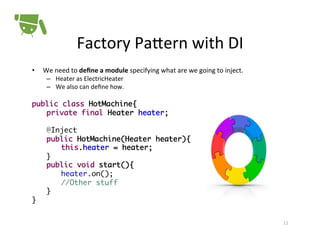
Factory	
  PaPern	
  with	
  DI	
  
• 

We	
  need	
  to	
  define	
  a	
  module	
  specifying	
  what	
  are	
  we	
  going	
  to	
  inject.	
  
–  Heater	
  as	
  ElectricHeater	
  
–  We	
  also	
  can	
  define	
  how.	
  

public class HotMachine{	
	private final Heater heater;	
	
	@Inject	
	public HotMachine(Heater heater){	
	 	this.heater = heater;	
	}	
	public void start(){	
	 	heater.on();	
	 	//Other stuff	
	}	
}!
11	
  
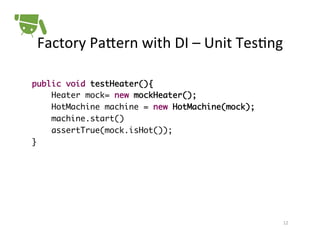
Factory	
  PaPern	
  with	
  DI	
  –	
  Unit	
  Tes+ng	
  
!
public void testHeater(){	
Heater mock= new mockHeater();	
HotMachine machine = new HotMachine(mock);	
machine.start()	
assertTrue(mock.isHot());	
}!

12	
  
RoboGuice	
  and	
  Dagger	
  

ANDROID	
  AND	
  DEPENDENCY	
  
INJECTION	
  
13	
  
Android	
  
•  We	
  can	
  create	
  one	
  ourselves…	
  but	
  it	
  is	
  not	
  
needed	
  and	
  it	
  is	
  a	
  lot	
  of	
  work	
  
•  The	
  best	
  ones	
  are	
  RoboGuice	
  and	
  Dagger	
  
–  RoboGuice	
  does	
  injec+on	
  during	
  run+me	
  
•  hPps://github.com/roboguice/roboguice	
  

–  Dagger	
  Generates	
  code	
  
•  hPps://github.com/square/dagger/	
  

14	
  
Example	
  -­‐	
  KitKat	
  Machine	
  
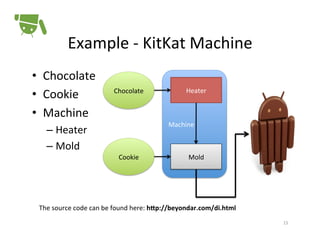
•  Chocolate	
  
•  Cookie	
  
•  Machine	
  

Chocolate	
  

Heater	
  

Machine	
  

–  Heater	
  
–  Mold	
  
Cookie	
  

Mold	
  

The	
  source	
  code	
  can	
  be	
  found	
  here:	
  hEp://beyondar.com/di.html	
  
15	
  
Example	
  -­‐	
  KitKat	
  Machine:	
  
Steps	
  
1. 
2. 
3. 
4. 

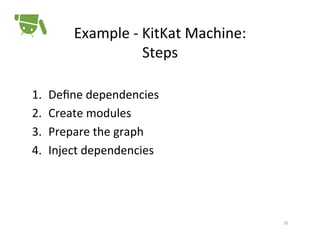
Define	
  dependencies	
  
Create	
  modules	
  
Prepare	
  the	
  graph	
  
Inject	
  dependencies	
  

16	
  
Example	
  –	
  KitKat	
  Machine:	
  
Dependencies	
  

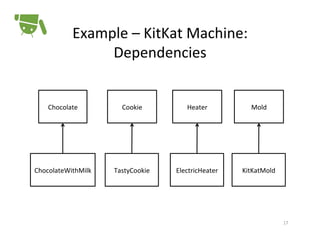
Chocolate	
  

Cookie	
  

Heater	
  

Mold	
  

ChocolateWithMilk	
  

TastyCookie	
  

ElectricHeater	
  

KitKatMold	
  

17	
  
Example	
  –	
  KitKat	
  Machine:	
  
Dependencies	
  
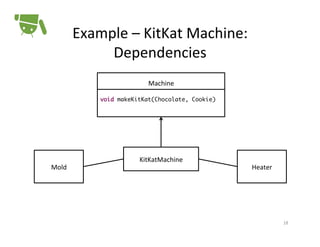
Machine	


void makeKitKat(Chocolate, Cookie)	


Mold	
  

KitKatMachine	
  

Heater	
  

18	
  
Example	
  –	
  KitKat	
  Machine:	
  
Dependencies	
  
!

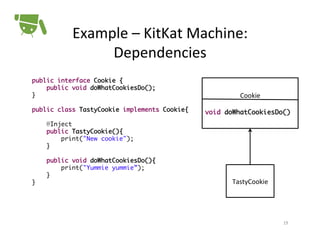
public interface Cookie {	
	public void doWhatCookiesDo();	
}	
	
public class TastyCookie implements Cookie{	
		
	@Inject	
	public TastyCookie(){	
	
	print("New cookie");	
	}	
	
	public void doWhatCookiesDo(){	
	
	print("Yummie yummie”);	
	}	
}!

Cookie	


void doWhatCookiesDo()	

TastyCookie	
  

19	
  
Example	
  –	
  KitKat	
  Machine:	
  
Dependencies	
  
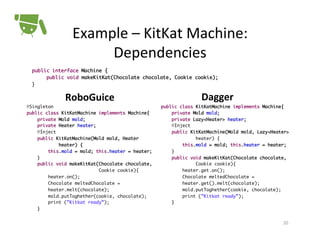
public interface Machine {	
	public void makeKitKat(Chocolate chocolate, Cookie cookie);	
}!

RoboGuice	
  
@Singleton	
public class KitKatMachine implements Machine{	
private Mold mold;	
private Heater heater;	
@Inject	
public KitKatMachine(Mold mold, Heater	
heater) {	
this.mold = mold; this.heater = heater;	
}	
public void makeKitKat(Chocolate chocolate,	
Cookie cookie){	
heater.on();	
Chocolate meltedChocolate =	
heater.melt(chocolate);	
mold.putToghether(cookie, chocolate);	
print (”Kitkat ready”);	
}	
	

Dagger	
  
public class KitKatMachine implements Machine{	
private Mold mold;	
private Lazy<Heater> heater;	
@Inject	
public KitKatMachine(Mold mold, Lazy<Heater>	
heater) {	
this.mold = mold; this.heater = heater;	
}	
public void makeKitKat(Chocolate chocolate,	
Cookie cookie){	
heater.get.on();	
Chocolate meltedChocolate =	
heater.get().melt(chocolate);	
mold.putToghether(cookie, chocolate);	
print (”Kitkat ready”);	
}	
	

20	
  
Example	
  -­‐	
  KitKat	
  Machine:	
  
Modules	
  
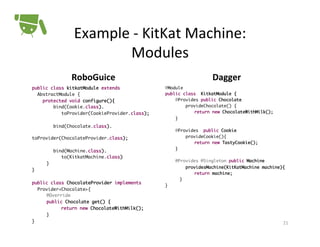
RoboGuice	
  
public class kitkatModule extends 	
AbstractModule {	
protected void configure(){	
bind(Cookie.class).	
toProvider(CookieProvider.class);	
	
bind(Chocolate.class).	
toProvider(ChocolateProvider.class);	
	
bind(Machine.class).	
to(KitkatMachine.class)	
	}	
}	
	
public class ChocolateProvider implements 	
Provider<Chocolate>{	
	@Override	
	public Chocolate get() {	
	
	return new ChocolateWithMilk();	
	}	
}	

Dagger	
  
@Module	
public class KitkatModule {	
@Provides public Chocolate	
provideChocolate() {	
	
	return new ChocolateWithMilk();	
}	
	
@Provides public Cookie	
provideCookie(){	
	
	return new TastyCookie();	
}	
	
@Provides @Singleton public Machine
	
	}	


providesMachine(KitKatMachine machine){	
	return machine;	

}	

21	
  
Example	
  -­‐	
  KitKat	
  Machine:	
  
Preparing	
  the	
  Graph	
  
RoboGuice	
  
public class KitKatMachineApplication extends 	
Application {	
public void onCreate() {	
super.onCreate();	
RoboGuice.setBaseApplicationInjector	
(this, Stage.PRODUCTION, 	
getModules());	
}	
	
protected Module[] getModules() {	
List<Module> modules = 	
new ArrayList<Module>();	
modules.add(	
RoboGuice.newDefaultRoboModule(this));	
modules.add(new IngredientsModule());	
modules.add(new MachineModule());	
	
return (Module[]) modules.toArray(new	
Module[modules.size()]);	
}	
}	

Dagger	
  
public class KitKatMachineApplication extends
Application{	
private ObjectGraph graph;	
public void onCreate() {	
super.onCreate();a	
graph = ObjectGraph.create( 	
getModules().toArray());	
}	
protected List<Object> getModules() {	
ArrayList<Object> modules =	
new ArrayList<Object>();	
modules.add(new AndroidModule(this));	
modules.add(new IngredientsModule());	
modules.add(new MachineModule());	
return modules;	
}	
public void inject(Object object) {	
graph.inject(object);	
}	
public ObjectGraph getApplicationGraph() {	
return graph;	
}	
	
22	
  
Example	
  -­‐	
  KitKat	
  Machine:	
  
Injec+ng	
  dependencies	
  
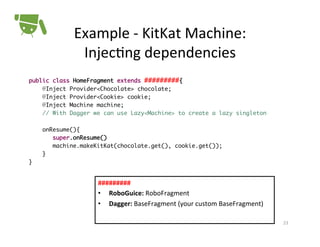
public class HomeFragment extends #########{	
@Inject Provider<Chocolate> chocolate;	
@Inject Provider<Cookie> cookie;	
@Inject Machine machine;	
// With Dagger we can use Lazy<Machine> to create a lazy singleton	
	
onResume(){	
super.onResume()	
machine.makeKitKat(chocolate.get(), cookie.get());	
}	
}	

#########	
  
•  RoboGuice:	
  RoboFragment	
  
•  Dagger:	
  BaseFragment	
  (your	
  custom	
  BaseFragment)


23	
  
Example	
  -­‐	
  KitKat	
  Machine:	
  
Injec+ng	
  dependencies	
  -­‐	
  Dagger	
  
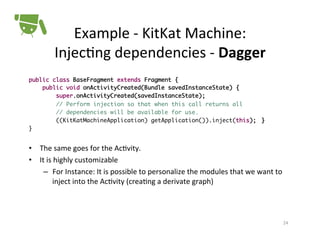
public class BaseFragment extends Fragment {	
public void onActivityCreated(Bundle savedInstanceState) {	
super.onActivityCreated(savedInstanceState);	
// Perform injection so that when this call returns all	
// dependencies will be available for use.	
((KitKatMachineApplication) getApplication()).inject(this); 	}	
}!

•  The	
  same	
  goes	
  for	
  the	
  Ac+vity.	
  
•  It	
  is	
  highly	
  customizable	
  
–  For	
  Instance:	
  It	
  is	
  possible	
  to	
  personalize	
  the	
  modules	
  that	
  we	
  want	
  to	
  
inject	
  into	
  the	
  Ac+vity	
  (crea+ng	
  a	
  derivate	
  graph)	
  

24	
  
Inject	
  inject	
  inject…	
  

OTHER	
  STUFF	
  TO	
  INJECT	
  

25	
  
Injec+ng	
  other	
  stuff	
  -­‐	
  Qualifiers	
  
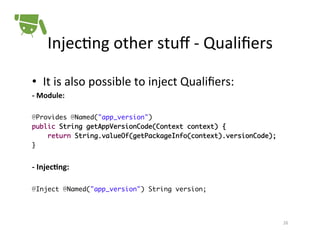
•  It	
  is	
  also	
  possible	
  to	
  inject	
  Qualifiers:	
  
-­‐	
  Module:	


@Provides @Named("app_version")	
public String getAppVersionCode(Context context) {	
return String.valueOf(getPackageInfo(context).versionCode);	
}!


-­‐	
  InjecSng:	
  
!
@Inject @Named("app_version") String version;!

!
26	
  
Injec+ng	
  other	
  stuff	
  -­‐	
  RoboGuice	
  
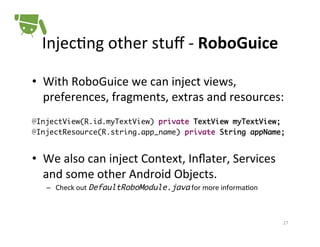
•  With	
  RoboGuice	
  we	
  can	
  inject	
  views,	
  
preferences,	
  fragments,	
  extras	
  and	
  resources:	


@InjectView(R.id.myTextView) private TextView myTextView;	
@InjectResource(R.string.app_name) private String appName;!
!

•  We	
  also	
  can	
  inject	
  Context,	
  Inflater,	
  Services	
  
and	
  some	
  other	
  Android	
  Objects.	
  
–  Check	
  out	
  DefaultRoboModule.java	
  for	
  more	
  informa+on	
  

27	
  
Go!	
  

SIDE	
  BY	
  SIDE	
  

28	
  
Side	
  by	
  side	
  
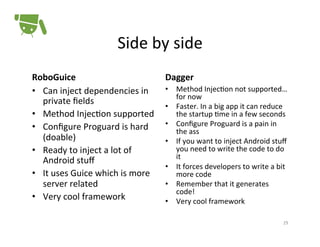
RoboGuice	
  
•  Can	
  inject	
  dependencies	
  in	
  
private	
  fields	
  
•  Method	
  Injec+on	
  supported	
  
•  Configure	
  Proguard	
  is	
  hard	
  
(doable)	
  
•  Ready	
  to	
  inject	
  a	
  lot	
  of	
  
Android	
  stuff	
  
•  It	
  uses	
  Guice	
  which	
  is	
  more	
  
server	
  related	
  
•  Very	
  cool	
  framework	
  

Dagger	
  
•  Method	
  Injec+on	
  not	
  supported…	
  
for	
  now	
  
•  Faster.	
  In	
  a	
  big	
  app	
  it	
  can	
  reduce	
  
the	
  startup	
  +me	
  in	
  a	
  few	
  seconds	
  
•  Configure	
  Proguard	
  is	
  a	
  pain	
  in	
  
the	
  ass	
  
•  If	
  you	
  want	
  to	
  inject	
  Android	
  stuff	
  
you	
  need	
  to	
  write	
  the	
  code	
  to	
  do	
  
it	
  
•  It	
  forces	
  developers	
  to	
  write	
  a	
  bit	
  
more	
  code	
  
•  Remember	
  that	
  it	
  generates	
  
code!	
  
•  Very	
  cool	
  framework	
  
29	
  
Conclusions	
  
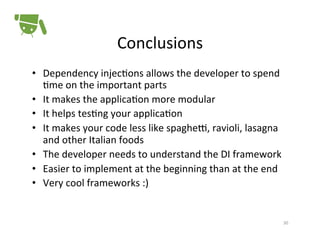
•  Dependency	
  injec+ons	
  allows	
  the	
  developer	
  to	
  spend	
  
+me	
  on	
  the	
  important	
  parts	
  
•  It	
  makes	
  the	
  applica+on	
  more	
  modular	
  
•  It	
  helps	
  tes+ng	
  your	
  applica+on	
  
•  It	
  makes	
  your	
  code	
  less	
  like	
  spagheq,	
  ravioli,	
  lasagna	
  
and	
  other	
  Italian	
  foods	
  
•  The	
  developer	
  needs	
  to	
  understand	
  the	
  DI	
  framework	
  
•  Easier	
  to	
  implement	
  at	
  the	
  beginning	
  than	
  at	
  the	
  end	
  
•  Very	
  cool	
  frameworks	
  :)	
  

30	
  
beyondar.com	
  

@joanpuigsanz	
  

/joanpuigsanz	
  

31	
  

Dependency Injection on Android

  • 1.
    Dependency  Injec+on  on   Android   By  Joan  Puig  Sanz  
  • 2.
    About  Joan  Puig  Sanz   •  Electrical  Engineer   •  So<ware/hardware  fan  :)   •  Open  Source  Projects:   –  ServDroid:  Simple  web  Server   –  BeyondAR  Framework:  Augmented  Reality  framework   beyondar.com   1  
  • 3.
    //TODO:   1.  What  is  Dependency  Injec+on?   2.  Simple  Example:  Factory  PaPern   3.  Android  and  Dependency  Injec+on   –  KitKatMachine  example  with  RoboGuice  and   Dagger   –  Compare  RoboGuice  and  Dagger   4.  Conclusions   2  
  • 4.
    What  is  Dependency  Injec+on?   “Dependency  injec+on  is  a  so<ware  design  paPern   that  allows  the  removal  of  hard-­‐coded  dependencies   and  makes  it  possible  to  change  them,  whether  at   run-­‐+me  or  compile-­‐+me”     Dependency  Injec+on  is  like  ordering  a  hawaiian   pizza  but  specifying  the  ingredients,  for  instance,   instead  of  ham  we  want    pepperoni.       3  
  • 5.
    What  does  Dependency  Injec+on  do?   •  It  improves  the  code:  reusable,  modulable  and   testability   •  It  allows  the  developer  to  focus  on  the  code   that  adds  a  plus  value  to  the  app:   –  No  need  to  worry  about  Singletons,  Factories  and   others.   4  
  • 6.
    Factory  paPern   SIMPLE  EXAMPLE   5  
  • 7.
    The  Factory  PaPern   public interface Heater { public void on(); public void off(); public boolean isHot(); } public class ElectricHeater implements Heater { private boolean heating; public void on() { heating = true; } public void off() { heating = false; } public boolean isHot() { return heating; } }! Heater     void  on()   void  off()   boolean  isHot()   ElectricHeater   6  
  • 8.
    The  Factory  PaPern  –  wri+ng  it   public class HeaterFactory { private HeaterFactory () {} private static Heater instance = new ElectricHeater(); public static Heater getInstance() { return instance; } public static void setInstance(Heater heater) { instance = heater; } } public class HotMachine{ public void start(){ heater = HeaterFactory.getInstance(); heater.on(); // Other stuff } }! 7  
  • 9.
    The  Factory  PaPern  –  Unit  Test   public void testHeater(){ Heater previous = HeaterFactory.getInstance(); try{ Heater mock = new mockHeater(); HeaterFactory.setInstance(mock); HotMachine machine = new HotMachine(); machine.start(); assertTrue(mock.isHot()); }finally{ HeaterFactory.setInstance(previous); } } 8  
  • 10.
    Implementa+on  drawbacks   • For  every  dependency  we  make  we  need  to   write  the  same  code.   •  Our  test  had  to  pass  the  mock  to  the  factory   and  then  clean  up  a<erwards.   •  You  cannot  determine  if  HotMachine  depends   on  Heater  at  first  sight   •  It  could  be  difficult  to  reuse  HotMachine  in  a   different  context     9  
  • 11.
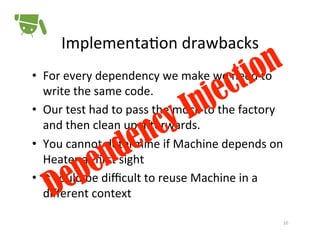
    Implementa+on  drawbacks   • For  every  dependency  we  make  we  need  to   write  the  same  code.   •  Our  test  had  to  pass  the  mock  to  the  factory   and  then  clean  up  a<erwards.   •  You  cannot  determine  if  Machine  depends  on   Heater  at  first  sight   •  It  could  be  difficult  to  reuse  Machine  in  a   different  context     10  
  • 12.
    Factory  PaPern  with  DI   •  We  need  to  define  a  module  specifying  what  are  we  going  to  inject.   –  Heater  as  ElectricHeater   –  We  also  can  define  how.   public class HotMachine{ private final Heater heater; @Inject public HotMachine(Heater heater){ this.heater = heater; } public void start(){ heater.on(); //Other stuff } }! 11  
  • 13.
    Factory  PaPern  with  DI  –  Unit  Tes+ng   ! public void testHeater(){ Heater mock= new mockHeater(); HotMachine machine = new HotMachine(mock); machine.start() assertTrue(mock.isHot()); }! 12  
  • 14.
    RoboGuice  and  Dagger   ANDROID  AND  DEPENDENCY   INJECTION   13  
  • 15.
    Android   •  We  can  create  one  ourselves…  but  it  is  not   needed  and  it  is  a  lot  of  work   •  The  best  ones  are  RoboGuice  and  Dagger   –  RoboGuice  does  injec+on  during  run+me   •  hPps://github.com/roboguice/roboguice   –  Dagger  Generates  code   •  hPps://github.com/square/dagger/   14  
  • 16.
    Example  -­‐  KitKat  Machine   •  Chocolate   •  Cookie   •  Machine   Chocolate   Heater   Machine   –  Heater   –  Mold   Cookie   Mold   The  source  code  can  be  found  here:  hEp://beyondar.com/di.html   15  
  • 17.
    Example  -­‐  KitKat  Machine:   Steps   1.  2.  3.  4.  Define  dependencies   Create  modules   Prepare  the  graph   Inject  dependencies   16  
  • 18.
    Example  –  KitKat  Machine:   Dependencies   Chocolate   Cookie   Heater   Mold   ChocolateWithMilk   TastyCookie   ElectricHeater   KitKatMold   17  
  • 19.
    Example  –  KitKat  Machine:   Dependencies   Machine     void makeKitKat(Chocolate, Cookie)   Mold   KitKatMachine   Heater   18  
  • 20.
    Example  –  KitKat  Machine:   Dependencies   ! public interface Cookie { public void doWhatCookiesDo(); } public class TastyCookie implements Cookie{ @Inject public TastyCookie(){ print("New cookie"); } public void doWhatCookiesDo(){ print("Yummie yummie”); } }! Cookie     void doWhatCookiesDo() TastyCookie   19  
  • 21.
    Example  –  KitKat  Machine:   Dependencies   public interface Machine { public void makeKitKat(Chocolate chocolate, Cookie cookie); }! RoboGuice   @Singleton public class KitKatMachine implements Machine{ private Mold mold; private Heater heater; @Inject public KitKatMachine(Mold mold, Heater heater) { this.mold = mold; this.heater = heater; } public void makeKitKat(Chocolate chocolate, Cookie cookie){ heater.on(); Chocolate meltedChocolate = heater.melt(chocolate); mold.putToghether(cookie, chocolate); print (”Kitkat ready”); } Dagger   public class KitKatMachine implements Machine{ private Mold mold; private Lazy<Heater> heater; @Inject public KitKatMachine(Mold mold, Lazy<Heater> heater) { this.mold = mold; this.heater = heater; } public void makeKitKat(Chocolate chocolate, Cookie cookie){ heater.get.on(); Chocolate meltedChocolate = heater.get().melt(chocolate); mold.putToghether(cookie, chocolate); print (”Kitkat ready”); } 20  
  • 22.
    Example  -­‐  KitKat  Machine:   Modules   RoboGuice   public class kitkatModule extends AbstractModule { protected void configure(){ bind(Cookie.class). toProvider(CookieProvider.class); bind(Chocolate.class). toProvider(ChocolateProvider.class); bind(Machine.class). to(KitkatMachine.class) } } public class ChocolateProvider implements Provider<Chocolate>{ @Override public Chocolate get() { return new ChocolateWithMilk(); } } Dagger   @Module public class KitkatModule { @Provides public Chocolate provideChocolate() { return new ChocolateWithMilk(); } @Provides public Cookie provideCookie(){ return new TastyCookie(); } @Provides @Singleton public Machine } providesMachine(KitKatMachine machine){ return machine; } 21  
  • 23.
    Example  -­‐  KitKat  Machine:   Preparing  the  Graph   RoboGuice   public class KitKatMachineApplication extends Application { public void onCreate() { super.onCreate(); RoboGuice.setBaseApplicationInjector (this, Stage.PRODUCTION, getModules()); } protected Module[] getModules() { List<Module> modules = new ArrayList<Module>(); modules.add( RoboGuice.newDefaultRoboModule(this)); modules.add(new IngredientsModule()); modules.add(new MachineModule()); return (Module[]) modules.toArray(new Module[modules.size()]); } } Dagger   public class KitKatMachineApplication extends Application{ private ObjectGraph graph; public void onCreate() { super.onCreate();a graph = ObjectGraph.create( getModules().toArray()); } protected List<Object> getModules() { ArrayList<Object> modules = new ArrayList<Object>(); modules.add(new AndroidModule(this)); modules.add(new IngredientsModule()); modules.add(new MachineModule()); return modules; } public void inject(Object object) { graph.inject(object); } public ObjectGraph getApplicationGraph() { return graph; } 22  
  • 24.
    Example  -­‐  KitKat  Machine:   Injec+ng  dependencies   public class HomeFragment extends #########{ @Inject Provider<Chocolate> chocolate; @Inject Provider<Cookie> cookie; @Inject Machine machine; // With Dagger we can use Lazy<Machine> to create a lazy singleton onResume(){ super.onResume() machine.makeKitKat(chocolate.get(), cookie.get()); } } #########   •  RoboGuice:  RoboFragment   •  Dagger:  BaseFragment  (your  custom  BaseFragment)   23  
  • 25.
    Example  -­‐  KitKat  Machine:   Injec+ng  dependencies  -­‐  Dagger   public class BaseFragment extends Fragment { public void onActivityCreated(Bundle savedInstanceState) { super.onActivityCreated(savedInstanceState); // Perform injection so that when this call returns all // dependencies will be available for use. ((KitKatMachineApplication) getApplication()).inject(this); } }! •  The  same  goes  for  the  Ac+vity.   •  It  is  highly  customizable   –  For  Instance:  It  is  possible  to  personalize  the  modules  that  we  want  to   inject  into  the  Ac+vity  (crea+ng  a  derivate  graph)   24  
  • 26.
    Inject  inject  inject…   OTHER  STUFF  TO  INJECT   25  
  • 27.
    Injec+ng  other  stuff  -­‐  Qualifiers   •  It  is  also  possible  to  inject  Qualifiers:   -­‐  Module:     @Provides @Named("app_version") public String getAppVersionCode(Context context) { return String.valueOf(getPackageInfo(context).versionCode); }!   -­‐  InjecSng:   ! @Inject @Named("app_version") String version;! ! 26  
  • 28.
    Injec+ng  other  stuff  -­‐  RoboGuice   •  With  RoboGuice  we  can  inject  views,   preferences,  fragments,  extras  and  resources:     @InjectView(R.id.myTextView) private TextView myTextView; @InjectResource(R.string.app_name) private String appName;! ! •  We  also  can  inject  Context,  Inflater,  Services   and  some  other  Android  Objects.   –  Check  out  DefaultRoboModule.java  for  more  informa+on   27  
  • 29.
    Go!   SIDE  BY  SIDE   28  
  • 30.
    Side  by  side   RoboGuice   •  Can  inject  dependencies  in   private  fields   •  Method  Injec+on  supported   •  Configure  Proguard  is  hard   (doable)   •  Ready  to  inject  a  lot  of   Android  stuff   •  It  uses  Guice  which  is  more   server  related   •  Very  cool  framework   Dagger   •  Method  Injec+on  not  supported…   for  now   •  Faster.  In  a  big  app  it  can  reduce   the  startup  +me  in  a  few  seconds   •  Configure  Proguard  is  a  pain  in   the  ass   •  If  you  want  to  inject  Android  stuff   you  need  to  write  the  code  to  do   it   •  It  forces  developers  to  write  a  bit   more  code   •  Remember  that  it  generates   code!   •  Very  cool  framework   29  
  • 31.
    Conclusions   •  Dependency  injec+ons  allows  the  developer  to  spend   +me  on  the  important  parts   •  It  makes  the  applica+on  more  modular   •  It  helps  tes+ng  your  applica+on   •  It  makes  your  code  less  like  spagheq,  ravioli,  lasagna   and  other  Italian  foods   •  The  developer  needs  to  understand  the  DI  framework   •  Easier  to  implement  at  the  beginning  than  at  the  end   •  Very  cool  frameworks  :)   30  
  • 32.