Agriculture Content Development for 
Inclusive Development: eSagu and 
eAgromet experiences 
P. Krishna Reddy 
Program Director, ITRA-Agriculture and Food 
Professor, IIIT Hyderabad India 
E-mail: pkreddy@iiit.ac.in
Outline 
• About ITRA 
• Open access to agricultural 
knowledge 
• Content development in eSagu 
• Content development in eAgromet 
• Content development for enhancing 
practical agriculture skills 
• Conclusions
IT for Agriculture and Food Research Program 
INFORMATION TECHNOLOGY 
RESEARCH ACADEMY 
Media Lab Asia, Department of Electronics and 
Information Technology, Govt of India 
and 
Indian Council of Agricultural Research
OBJECTIVE 
1 Strengthen the academic institutions 
2. Specifically, Enhance Quality and Quantity of 
a. IT [Information, Communication, 
Electronics] Research and Development 
b. IT Applications
Ecosystem’s Central Traits 
1. Form Large Groups 
2. With R&D focused on Societal Challenges 
3. By Increasing Societal Sensitivity 
4. And Support of Entrepreneurship 
5. Enabled by engagement with National and 
5 
International Experts
A Pyramidal Model of Growth 
Mentor-Mentees form 
Adjacent Layers in a Hierarchy 
Example: 
Each partner institution 
adds 
two (or three) partners 
every two years 
6
1 
… 
… 
5 
… 
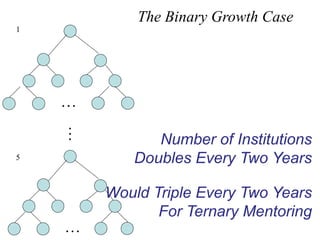
The Binary Growth Case 
Number of Institutions 
Doubles Every Two Years 
Would Triple Every Two Years 
For Ternary Mentoring
Focus Area Pyramids Selected 
1. ITRA-Mobile: Mobile Computing, Networking and 
Applications 
2. ITRA-Water: IT in Sustainability of Water 
Resources 
= 
Two-Level Pyramids
ITRA-Mobile 
APPROVED PROJECTS 
1. HumanSense: Towards context aware sensing, inference and actuation for 
applications in Energy and Healthcare 
2. Post-Disaster Situation Analysis and Resource Management Using Delay- 
Tolerant Peer-to-Peer Wireless Networks (DISARM) 
3. Remote Health: A Framework for Healthcare Services using Mobile and 
Sensor-Cloud Technologies 
4. De-congesting India's transportation networks using mobile devices 
5. CARTS: Communication Assisted Road Transportation Systems 
6. Virtual Assistant for Mobile Devices using Voice and Gesture Technologies 
7. Mobile Broadband Service Support over Cognitive Radio Networks 
8. Uncoordinated, Secure and Energy Aware Access in Distributed Wireless 
Networks 
9. Micronet - Mobile Infrastructure for Coastal Region Offshore 
Communications & Networks
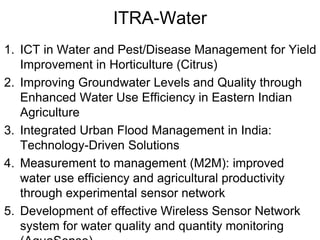
ITRA-Water 
1. ICT in Water and Pest/Disease Management for Yield 
Improvement in Horticulture (Citrus) 
2. Improving Groundwater Levels and Quality through 
Enhanced Water Use Efficiency in Eastern Indian 
Agriculture 
3. Integrated Urban Flood Management in India: 
Technology-Driven Solutions 
4. Measurement to management (M2M): improved 
water use efficiency and agricultural productivity 
through experimental sensor network 
5. Development of effective Wireless Sensor Network 
system for water quality and quantity monitoring 
(AquaSense)
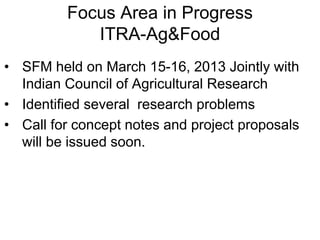
Focus Area in Progress 
ITRA-Ag&Food 
• SFM held on March 15-16, 2013 Jointly with 
Indian Council of Agricultural Research 
• Identified several research problems 
• Call for concept notes and project proposals 
will be issued soon.
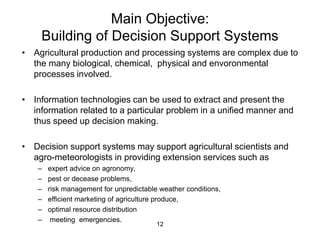
Main Objective: 
Building of Decision Support Systems 
• Agricultural production and processing systems are complex due to 
the many biological, chemical, physical and envoronmental 
processes involved. 
• Information technologies can be used to extract and present the 
information related to a particular problem in a unified manner and 
thus speed up decision making. 
• Decision support systems may support agricultural scientists and 
agro-meteorologists in providing extension services such as 
– expert advice on agronomy, 
– pest or decease problems, 
– risk management for unpredictable weather conditions, 
– efficient marketing of agriculture produce, 
– optimal resource distribution 
– meeting emergencies. 
12
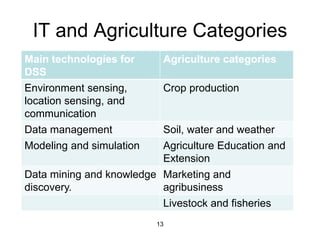
IT and Agriculture Categories 
Main technologies for 
DSS 
Agriculture categories 
Environment sensing, 
location sensing, and 
communication 
Crop production 
Data management Soil, water and weather 
Modeling and simulation Agriculture Education and 
Extension 
Data mining and knowledge 
discovery. 
Marketing and 
agribusiness 
Livestock and fisheries 
13
Examples of DSS 
• Pest surveillance systems 
• Online disease diagnosis 
• Online monitoring of pesticide sales/usage 
• Service delivery platform to deliver 
personalized advice and customized agriculture 
• Location and time specific plant disease 
forecasting using Wireless Sensor Network 
(WSN) and with farmer’s participation 
• Potential fishing zone and weather alert 
services to fisherman 
• Characterization of soils with Gamma Radiation 
detection (Sensor based soil nutrient scanning) 
• ICT platform based end-to-end Procurement 
Services 
• ICT Platform to introduce good global 
agriculture practices in Indian agriculture 
• Intelligent agriculture ontology tools 
• Use of ICT to improve agriculture supply chain 
efficiency 
• Use of ICT platform to improve efficiency of artificial 
insemination operation and, offer veterinary and nutrient 
services 
• Animal management in the Indian production system 
with different breeds of animals, based on the analysis 
of data from different animal production systems 
• Diseases diagnosis for animals under different 
management conditions 
• Developing market intelligence systems 
• IT-enabled logistics and supply chain management 
• DSS to support marketing and production decisions 
• Interactive DSS (expert systems) to know the 
availability of inputs 
• Interactive DSS on source and technical details of 
available hybrids, HYV, seed and planting material 
• Development of artificially intelligent agricultural 
machines, to help reduce drudgery and improve health 
and safety. This may attract rural youth to work with 
agricultural machines. 
14
Outline 
• About ITRA 
• Open access to agricultural 
knowledge 
• Content development in eSagu 
• Content development in eAgromet 
• Content development for enhancing 
practical agriculture skills 
• Conclusions
Examples of Open Access 
Knowledge/Information and Tools 
• Search Engines 
– Google 
• Social network sites 
– Facebook, Twitter 
• Journals 
– IEEE, ACM, Springer,.., 
• Content 
– Wikipedia, You tube 
• Tools 
– Linux, Adroid, MYSQL, OpenOffice, …
Agriculture 
• Journals and magazines 
• MSc/PhD Dissertations 
• Booklets 
• Simulation tools 
– InfoCrop 
• Best agriculture practices 
• Output of research experiments and projects at 
SAUs
Stakeholders 
• Farmers 
• Consumers 
• Extension personnel 
• NGOs, Trusts, Civil Society Organizations 
• Students 
• Teachers/Scientists 
• Researchers 
• Corporate Companies 
• Buyers/Exporters
Open Access Knowledge 
Characteristics 
• Relevant to stakeholder 
– Focus, modular, cohesive 
• Consumable 
– Language, text, audio, video 
• Computer readable 
• Scope for self-sustainability 
• Progress 
– Updated with latest advances in agriculture 
technology
My Experience 
• Content development in eSagu 
• Content development in eAgromet 
• Virtual Crop Labs to enhance 
practical learning
eSagu is a Personal Information 
System for farmers 
• eSagu is an IT-based Personalized agro-advisory 
system 
– Personalized 
• Provides Personalized agro-advice to farmer’s door-step. 
– Timely: 
• Provides the advice within 24 to 36 hours 
– Regular 
• Advice is provided regularly (once in a week) 
– Feedback: two way communication 
– Query-less: Farmer need not ask a question 
– Cost-effective: Can be made sustainable with a nominal 
subscription fee 
– Powered by IT: Record keeping, availability, reliability 
– Scalable and can be developed on the existing infrastructure 
• Started in 2004 and the system is evolving
eSagu: basic idea 
• Extend developments in IT to agriculture 
– Agriculture scientist does not visit the 
crop. 
– Crop photos are brought to agriculture 
expert. 
• As a result, the agricultural expert 
– can utilize the time efficiently 
– spends less time to provide the advice 
– can work during the night 
• Reference 
– P.Krishna Reddy and R.Ankaiah, A framework of information technology-based agriculture 
information dissemination system to improve crop productivity, Current Science, vol. 88, 
Num.12 pp. 1905-1913, June 2005.
Operational Procedure 
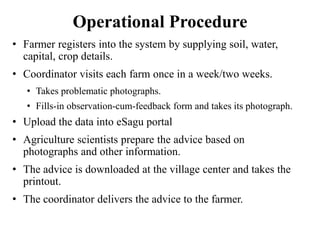
• Farmer registers into the system by supplying soil, water, 
capital, crop details. 
• Coordinator visits each farm once in a week/two weeks. 
• Takes problematic photographs. 
• Fills-in observation-cum-feedback form and takes its photograph. 
• Upload the data into eSagu portal 
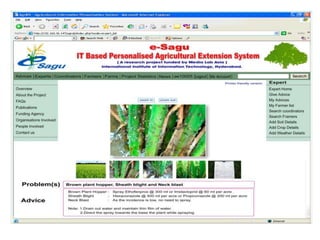
• Agriculture scientists prepare the advice based on 
photographs and other information. 
• The advice is downloaded at the village center and takes the 
printout. 
• The coordinator delivers the advice to the farmer.
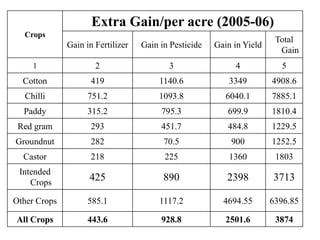
Crops 
Extra Gain/per acre (2005-06) 
Gain in Fertilizer Gain in Pesticide Gain in Yield 
Total 
Gain 
1 2 3 4 5 
Cotton 419 1140.6 3349 4908.6 
Chilli 751.2 1093.8 6040.1 7885.1 
Paddy 315.2 795.3 699.9 1810.4 
Red gram 293 451.7 484.8 1229.5 
Groundnut 282 70.5 900 1252.5 
Castor 218 225 1360 1803 
Intended 
Crops 
425 890 2398 3713 
Other Crops 585.1 1117.2 4694.55 6396.85 
All Crops 443.6 928.8 2501.6 3874
Information Needs of Farmers 
• Agricultural expert advice 
– Crop protection related information 
• Decease and pest problem 
– Crop production related information 
• Spacing, timing of sowing, planning and so on
Issues: Capacity Building Problems 
Agriculture Scientists 
• In eSagu, AE must have location specific knowledge 
and experience 
– Has to be expert regarding diverse crop problems that occur in 
several agro-climatic situations. 
• However, AEs differ in education levels, experience, local 
exposure, farm exposure, and know-how regarding agro-climatic 
variations. 
– New paradigm for agriculture scientists 
– The system makes them accountable 
• So, new kind of content is required such 
that AE can grasp the problem as much as 
by going through the content.
What should be the nature of new 
Content ? 
• Relevant, adoptable and actionable. 
• Should meet the day-to-day information / operation 
requirement of the farmers. 
• Due consideration of farmers’ traditional wisdom. 
• Should be feedback based for continual improvement. 
• Adoptable to the changing needs of the farmers 
• In tune with the latest technological developments. 
• In close liaison with research institutes, industry and 
the farmers.
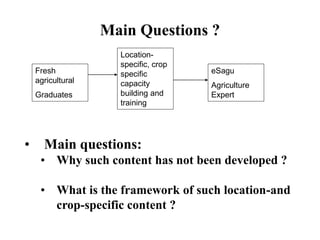
Main Questions ? 
Fresh 
agricultural 
Graduates 
Location-specific, 
crop 
specific 
capacity 
building and 
training 
eSagu 
Agriculture 
Expert 
• Main questions: 
• Why such content has not been developed ? 
• What is the framework of such location-and 
crop-specific content ?
Why such content is not available 
or not developed ? 
• The content is not available in the ready-made form. 
– because such kind of knowledge was not compulsory to operate traditional 
extension systems. 
• Existing content 
– Mostly consisting of text in generic manner. 
– Only few crops are covered. 
– Advice is not based on resource potential, biotic and abiotic factors. 
– Crop specific but not soil, area and variety specific. 
– No updated information with developments in science & technology. 
– Farmer’s traditional wisdom is not documented. 
– Difficult to compare actual farm situation from the content. 
– Developed content is not based on farmer’s feedback. 
– No due consideration regarding agro ecosystem analysis. 
– Lack of understanding of local demand.
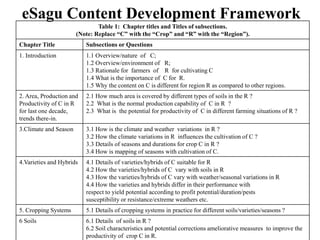
eSagu Content Development Framework 
Table 1: Chapter titles and Titles of subsections. 
(Note: Replace “C” with the “Crop” and “R” with the “Region”). 
Chapter Title Subsections or Questions 
1. Introduction 1.1 Overview/nature of C; 
1.2 Overview/environment of R; 
1.3 Rationale for farmers of R for cultivating C 
1.4 What is the importance of C for R. 
1.5 Why the content on C is different for region R as compared to other regions. 
2. Area, Production and 
Productivity of C in R 
for last one decade, 
trends there-in. 
2.1 How much area is covered by different types of soils in the R ? 
2.2 What is the normal production capability of C in R ? 
2.3 What is the potential for productivity of C in different farming situations of R ? 
3.Climate and Season 3.1 How is the climate and weather variations in R ? 
3.2 How the climate variations in R influences the cultivation of C ? 
3.3 Details of seasons and durations for crop C in R ? 
3.4 How is mapping of seasons with cultivation of C. 
4.Varieties and Hybrids 4.1 Details of varieties/hybrids of C suitable for R 
4.2 How the varieties/hybrids of C vary with soils in R 
4.3 How the varieties/hybrids of C vary with weather/seasonal variations in R 
4.4 How the varieties and hybrids differ in their performance with 
respect to yield potential according to profit potential/duration/pests 
susceptibility or resistance/extreme weathers etc. 
5. Cropping Systems 5.1 Details of cropping systems in practice for different soils/varieties/seasons ? 
6 Soils 6.1 Details of soils in R ? 
6.2 Soil characteristics and potential corrections ameliorative measures to improve the 
productivity of crop C in R.
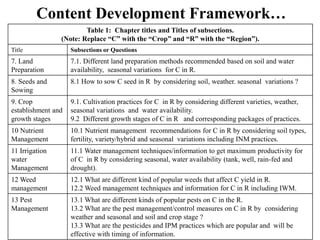
Content Development Framework… 
Table 1: Chapter titles and Titles of subsections. 
(Note: Replace “C” with the “Crop” and “R” with the “Region”). 
Title Subsections or Questions 
7. Land 
Preparation 
7.1. Different land preparation methods recommended based on soil and water 
availability, seasonal variations for C in R. 
8. Seeds and 
Sowing 
8.1 How to sow C seed in R by considering soil, weather. seasonal variations ? 
9. Crop 
establishment and 
growth stages 
9.1. Cultivation practices for C in R by considering different varieties, weather, 
seasonal variations and water availability. 
9.2 Different growth stages of C in R and corresponding packages of practices. 
10 Nutrient 
Management 
10.1 Nutrient management recommendations for C in R by considering soil types, 
fertility, variety/hybrid and seasonal variations including INM practices. 
11 Irrigation 
water 
Management 
11.1 Water management techniques/information to get maximum productivity for 
of C in R by considering seasonal, water availability (tank, well, rain-fed and 
drought). 
12 Weed 
management 
12.1 What are different kind of popular weeds that affect C yield in R. 
12.2 Weed management techniques and information for C in R including IWM. 
13 Pest 
Management 
13.1 What are different kinds of popular pests on C in the R. 
13.2 What are the pest management/control measures on C in R by considering 
weather and seasonal and soil and crop stage ? 
13.3 What are the pesticides and IPM practices which are popular and will be 
effective with timing of information.
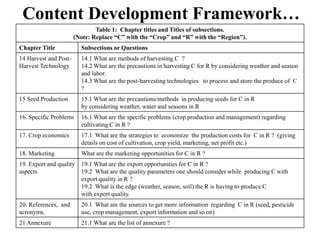
Content Development Framework… 
Table 1: Chapter titles and Titles of subsections. 
(Note: Replace “C” with the “Crop” and “R” with the “Region”). 
Chapter Title Subsections or Questions 
14 Harvest and Post- 
Harvest Technology 
14.1 What are methods of harvesting C ? 
14.2 What are the precautions in harvesting C for R by considering weather and season 
and labor. 
14.3 What are the post-harvesting technologies to process and store the produce of C 
? 
15 Seed Production 15.1 What are the precautions/methods in producing seeds for C in R 
by considering weather, water and seasons in R 
16. Specific Problems 16.1 What are the specific problems (crop production and management) regarding 
cultivating C in R ? 
17. Crop economics 17.1 What are the strategies to economize the production costs for C in R ? (giving 
details on cost of cultivation, crop yield, marketing, net profit etc.) 
18. Marketing What are the marketing opportunities for C in R ? 
19. Export and quality 
aspects 
19.1 What are the export opportunities for C in R ? 
19.2 What are the quality parameters one should consider while producing C with 
export quality in R ? 
19.2 What is the edge (weather, season, soil) the R is having to produce C 
with export quality. 
20. References, and 
acronyms. 
20.1 What are the sources to get more information regarding C in R (seed, pesticide 
use, crop management, export information and so on) 
21 Annexure 21.1 What are the list of annexure ?
Content development challenge ? 
• For each country and given a crop we have to 
identify agro-eco situations and build content (multi 
media) ? 
• For example, take rice crop 
– At least each state will have 10 agro-eco situations 
– So, we have to develop at least 20*10=200 content books. 
• For all the crops, it will be a huge task 
• Updating and validating will be a huge task. 
• But, we need such content to benefit farmers. 
• GENERIC information is not sufficient.
However to develop the relevant 
information ? 
• Follow location-specific crop practices and 
– If available, suggest location-specific scientific alternatives 
for risk management. 
– If not available, investigate and develop the relevant 
information 
• How to follow/understand location-specific crop 
practices ? 
– Follow eSagu and deliver advices to sample number of 
farms of each crop and deliver the advisories for risks 
management. See the farmers’ reaction. 
– Based on the advice delivery, develop the relevant content. 
– Keep updating the information regularly.
eAgromet: ICT-enabled Agro- 
Meteorological Advisory System
Efforts by India Mateorological 
Department 
• India meteorological department (IMD) is 
providing “Integrated Agromet Advisory 
Service”. 
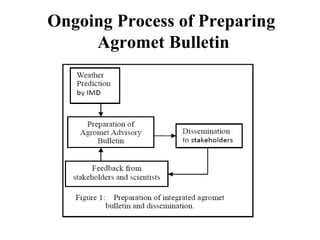
– IMD is issuing agromet bulletins, which contain 
• risk management steps for crop and livestock management, 
based on the weather forecast twice in a week (Tuesday and 
Friday) up to 5 days. 
– About 130 Agro-Mateorological Field Units (AMFUs) 
– Extending to block level 
• The agromet advisory bulletins are unique and 
complements other efforts of improved 
agriculture technology transfer methods.
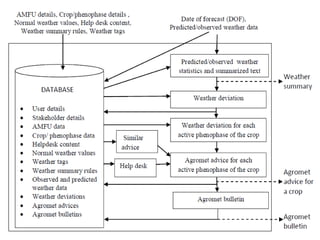
Ongoing Process of Preparing 
Agromet Bulletin
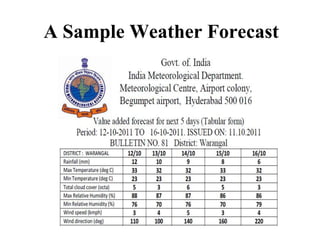
A Sample Weather Forecast
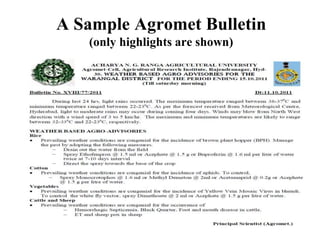
A Sample Agromet Bulletin 
(only highlights are shown)
About eAgromet 
• Issues 
– The preparation of agromet bulletins is a manual process. 
• Problem 
– Improve the efficiency of preparation and dissemination of agromet 
bulletins 
• IMD has initiated a research project of an IT-based agro-meteorological 
advisory system, called eAgromet in 
collaboration with 
– IIIT, Hyderabad, India and 
– Agromet Cell, Achraya NG Ranga Agricultural University, Hyderabad, 
• The effort has started in the year 2011. 
• A basic model of eAgromet has been developed.
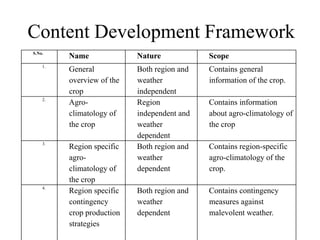
Content Development Framework 
S.No. Name Nature Scope 
1. General 
overview of the 
crop 
Both region and 
weather 
independent 
Contains general 
information of the crop. 
2. Agro-climatology 
of 
the crop 
Region 
independent and 
weather 
dependent 
Contains information 
about agro-climatology of 
the crop 
3. Region specific 
agro-climatology 
of 
the crop 
Both region and 
weather 
dependent 
Contains region-specific 
agro-climatology of the 
crop. 
4. Region specific 
contingency 
crop production 
strategies 
Both region and 
weather 
dependent 
Contains contingency 
measures against 
malevolent weather.
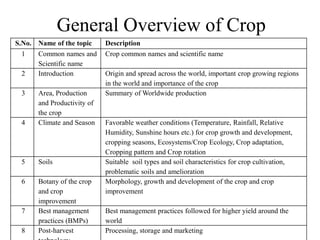
General Overview of Crop 
S.No. Name of the topic Description 
1 Common names and 
Scientific name 
Crop common names and scientific name 
2 Introduction Origin and spread across the world, important crop growing regions 
in the world and importance of the crop 
3 Area, Production 
and Productivity of 
the crop 
Summary of Worldwide production 
4 Climate and Season Favorable weather conditions (Temperature, Rainfall, Relative 
Humidity, Sunshine hours etc.) for crop growth and development, 
cropping seasons, Ecosystems/Crop Ecology, Crop adaptation, 
Cropping pattern and Crop rotation 
5 Soils Suitable soil types and soil characteristics for crop cultivation, 
problematic soils and amelioration 
6 Botany of the crop 
and crop 
improvement 
Morphology, growth and development of the crop and crop 
improvement 
7 Best management 
practices (BMPs) 
Best management practices followed for higher yield around the 
world 
8 Post-harvest 
technology 
Processing, storage and marketing
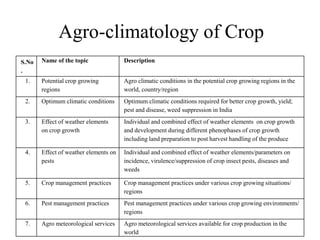
Agro-climatology of Crop 
S.No 
. 
Name of the topic Description 
1. Potential crop growing 
regions 
Agro climatic conditions in the potential crop growing regions in the 
world, country/region 
2. Optimum climatic conditions Optimum climatic conditions required for better crop growth, yield; 
pest and disease, weed suppression in India 
3. Effect of weather elements 
on crop growth 
Individual and combined effect of weather elements on crop growth 
and development during different phenophases of crop growth 
including land preparation to post harvest handling of the produce 
4. Effect of weather elements on 
pests 
Individual and combined effect of weather elements/parameters on 
incidence, virulence/suppression of crop insect pests, diseases and 
weeds 
5. Crop management practices Crop management practices under various crop growing situations/ 
regions 
6. Pest management practices Pest management practices under various crop growing environments/ 
regions 
7. Agro meteorological services Agro meteorological services available for crop production in the 
world
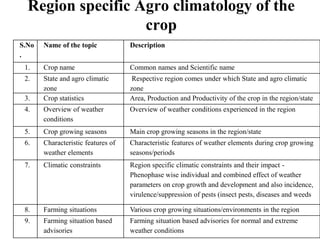
Region specific Agro climatology of the 
crop 
S.No 
. 
Name of the topic Description 
1. Crop name Common names and Scientific name 
2. State and agro climatic 
zone 
Respective region comes under which State and agro climatic 
zone 
3. Crop statistics Area, Production and Productivity of the crop in the region/state 
4. Overview of weather 
conditions 
Overview of weather conditions experienced in the region 
5. Crop growing seasons Main crop growing seasons in the region/state 
6. Characteristic features of 
weather elements 
Characteristic features of weather elements during crop growing 
seasons/periods 
7. Climatic constraints Region specific climatic constraints and their impact - 
Phenophase wise individual and combined effect of weather 
parameters on crop growth and development and also incidence, 
virulence/suppression of pests (insect pests, diseases and weeds 
8. Farming situations Various crop growing situations/environments in the region 
9. Farming situation based 
advisories 
Farming situation based advisories for normal and extreme 
weather conditions
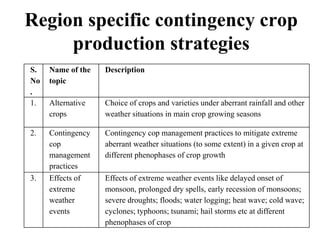
Region specific contingency crop 
production strategies 
S. 
No 
. 
Name of the 
topic 
Description 
1. Alternative 
crops 
Choice of crops and varieties under aberrant rainfall and other 
weather situations in main crop growing seasons 
2. Contingency 
cop 
management 
practices 
Contingency cop management practices to mitigate extreme 
aberrant weather situations (to some extent) in a given crop at 
different phenophases of crop growth 
3. Effects of 
extreme 
weather 
events 
Effects of extreme weather events like delayed onset of 
monsoon, prolonged dry spells, early recession of monsoons; 
severe droughts; floods; water logging; heat wave; cold wave; 
cyclones; typhoons; tsunami; hail storms etc at different 
phenophases of crop
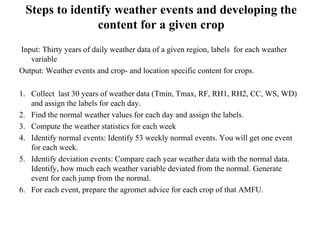
Steps to identify weather events and developing the 
content for a given crop 
Input: Thirty years of daily weather data of a given region, labels for each weather 
variable 
Output: Weather events and crop- and location specific content for crops. 
1. Collect last 30 years of weather data (Tmin, Tmax, RF, RH1, RH2, CC, WS, WD) 
and assign the labels for each day. 
2. Find the normal weather values for each day and assign the labels. 
3. Compute the weather statistics for each week 
4. Identify normal events: Identify 53 weekly normal events. You will get one event 
for each week. 
5. Identify deviation events: Compare each year weather data with the normal data. 
Identify, how much each weather variable deviated from the normal. Generate 
event for each jump from the normal. 
6. For each event, prepare the agromet advice for each crop of that AMFU.
A Model of Virtual Crop Labs as a Cloud 
Computing Application for Enhancing 
Practical Agricultural Education
Importance of Practical Education 
• The agriculture graduates should posses 
expertise and confidence to give the agro-advice 
to the farmer for curing the aliment in 
the cropped field. 
• Making the correct decision at field level is 
much more difficult for fresh graduates who 
have least practical field exposure.
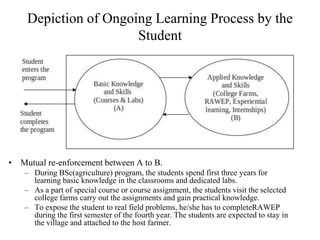
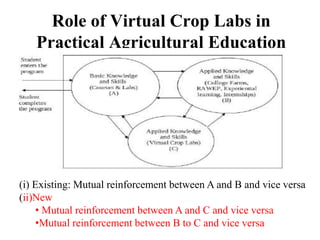
Depiction of Ongoing Learning Process by the 
Student 
• Mutual re-enforcement between A to B. 
– During BSc(agriculture) program, the students spend first three years for 
learning basic knowledge in the classrooms and dedicated labs. 
– As a part of special course or course assignment, the students visit the selected 
college farms carry out the assignments and gain practical knowledge. 
– To expose the student to real field problems, he/she has to completeRAWEP 
during the first semester of the fourth year. The students are expected to stay in 
the village and attached to the host farmer.
Proposed Approach: 
Basic Idea 
• It is possible to improve the practical knowledge of 
students, if we systematically expose them to well 
organized, indexed and summarized digital data (text, 
photos and video) of diverse farm situations. 
– The crop growth situation under different agro-climatic 
situations is captured from seed-to-seed throughout crop growing 
season at regular intervals covering all the crop husbandry 
activities. 
– The captured situations are labelled and described by subject-matter 
specialists (agriculture scientists). 
– The labelled content is exposed to the students of under-graduate 
programs as a part of learning framework. 
– As a result, a student gets an opportunity to examine the 
thousands of crop production problem dynamics of each crop 
and learn the practical knowledge.
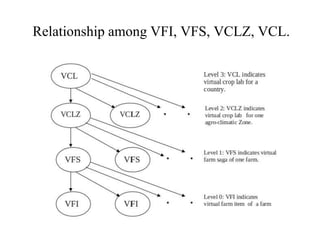
Virtual Crop Labs 
• The virtual crop lab constitutes 
– Each lab constitutes virtual crop 
lab of zones (VCLZ). 
• each VCLZ constitutes several 
virtual farm sagas (VFS). 
– each VFS constitutes virtual farm 
items.
Virtual Farm Item 
• Suppose a particular crop (c) is cultivated in the farm (f). We capture the crop 
situation or activity carried out in the farm at particular instant (or stage) through 
virtual farm item (VFI). 
• VFI: < f, c, d, t, td, p, v, s, q/a, i >. 
– f: indicates the details of farm; c: indicates the details of crop 
– d: indicates the date of sowing of crop c; t: indicates the time (day) of VFI. 
– td: indicates description of crop status through text. 
– p: indicates the set of photographs 
– v: indicates the set of video clips through which the crop status is captured. 
– s: indicates the summary text written by subject matter specialists for the given VFI. It 
contains the detailed description of the corresponding problem or activity by referring 
individual photographs or videos. By reading the description, the student or professor can 
understand the problem or activity captured through VFI. 
– q/a: indicates questions & answers. The subject matter specialist prepares the questions 
related to VFI based on the field problems at t and provides the answers. These questions 
are prepared to help the student to get more insights about field problems. 
– i: indicates the index terms. The index terms will help the information retrieval engine to 
retrieve the corresponding VFI.
More about VFI 
• The VFI captures enough information so that the agriculture student/ 
professor can understand the farm situation or farm activity by going 
through it in a virtual manner (without visiting the crop field). 
• Photographs/video clips: 
– The situation can be understood through text photograhs/video clips. 
Based on the crop details and farm location, the student can grasp the 
problem. 
• Text written by scientist 
– To enhance the understanding of crop situation, the student can go 
through the text written by scientist. 
• Q/A: 
– The questions (and answers) should be such that it should enable the 
student/teacher to understand the background and other influencing 
factors for that farm situation. 
– Questions are aimed to understand what, how and why aspects of 
situation/activity, such as the reasons for the given farm situation or 
importance of such activity.
Virtual Farm Saga 
• For the given farm, the VFS is the collection of virtual farm items 
which are being captured at the regular intervals from pre-sowing to 
post-harvesting covering all crop-husbandry activities. 
• The structure of VFS <f, c, d, Set of VFIs, Summary of VFS, q/a, 
i>. 
– Set of VFIs: 
• Collection VFIs captured at regular intervals from sowing to post-harvesting 
by covering the crop cycle. 
– Summary of VFS: 
• The summary is written by considering overall farm situation by considering 
the corresponding VFIs throughout crop life cycle, i.e., from pre-sowing to 
post-harvesting. Reasons for the problems should be mentioned. Best 
agriculture practices should be highlighted. The negative aspects of crop 
production practices carried out should be explained. Mistakes identified 
should be described. Missed opportunities for a better crop growth, if any, 
should be given. 
– q/a: 
• The subject matter specialist should form appropriate questions and give 
answers regarding dynamics of VFS. 
– Questions can be about the factors about the crop growth, linking activities the problems 
occurred to the crop to the activities carried out at different stages, weather situation, soil, 
farm practices, etc.
More About VFS 
• The VFS captures enough information so that the agriculture student/ 
professor can understand the growth of the given farm in a virtual manner 
without visiting the crop field. 
• Set of VFI 
– The student can go through each VFI and understand the crop growth. 
• Summary: 
– Overall farm growth phenomena 
• Q/A 
– The questions (and answers) enable the student/teacher to understand 
the background and other influencing factors for that crop growth. 
– Questions are aimed to understand what influenced the crop growth and 
corresponding corrective factors that would have been taken, if any.
Virtual Crop Lab of a Zone 
(VCLZ) 
• The VCLZ captures the crop dynamics for a given micro agro-climatic zone. 
• Let crop c is cultivated in n number of sample farms (in different farming 
situations) in a given micro agro-climatic zone. 
– The value of n is chosen such that all farming situations of the zone for a given crop are 
captured. 
• The collection of VFS of n farms (in different farming situations) constitute VCLZ. 
• The elements of VCLZ are as follows: <c, Set of VFSs, Summary of VCLZ, q/a, i >. 
– c, i: the meaning of these notations is similar as in VFI. 
– Set of VFSs: 
• Indicates a collection of VFSs on n number of sample farms of crop c. For a given agro-climatic zone, 
the number of sample farms will be selected to capture all the variability (soil, variety, water source and 
so on) of the crop c. 
– Summary of VCLZ: 
• The summary for VCLZ is written by considering overall situation of farms in VCLZ. The summary 
includes reasons for the success of some farms including best agriculture practices, and failure of some 
other farms which should be mentioned linking to the agro-climatic conditions, good/bad farm 
practices, crop protection measures, untimely application of inputs, soil type and so on. 
– q/a: 
• The questions and answers are formed by subject matter specialists by considering the VFSs of all 
sample farms. So, there is a scope for several innovative questions and answers which can be given by 
providing the references to corresponding VFSs and VFIs. 
• Questions can be framed following the processes of contrasting VFSs and VFIs, comparing VFSs and 
VFIs by identifying unique/special VFSs and VFIs with reference to soil, variety, weather and so on. 
Questions can also be about the reasons for success of some farms and failure of some other farms 
linking to seed variety, soil, date of sowing, weather factors and farming practices.
More About VCLZ 
• The VCLZ captures enough information so that the 
agriculture student/ professor can understand the growth of 
crop dynamics in a virtual manner in the zone under 
different farming situations. 
• Set of VFS 
– The students compare VFS of several farms and understand the 
differences in the crop performance under various soils and 
practices. 
• Summary of VCLZ 
– By going through the summary of VCLZ, the student gets the 
new insights about the influence of various factors on different 
types of farms of the same crop in the given zone. 
• Q/A 
– The questions (and answers) helps the student to explore the 
issues in different dimensions.
Virtual Crop Lab 
• The virtual crop lab captures all the problems and activities of the crop for 
all agro-climatic zones of the country. Let crop c is cultivated in m micro 
agro-climatic zones in the country. The collection of VCLZs of m zones 
constitute VCL. The elements of VCL is as follows: < c, Set of VCLZ, 
Summary of VCL, q/a, i >. 
– Set of VCLZs: 
• Indicates VCLZs on m agro-climatic zones. 
– Summary of VCL: 
• The summary of VCL of a country is written by comparing and contrasting crop 
growth/farm practices based on the VCLZ of several zones of a country. Reasons 
for the difference in crop practices by linking to weather and soil should be 
highlighted. 
– q/a: 
• The questions and answers are formed by subject matter specialists by considering the VCLZs 
of several zones. 
• Questions can be formed following the processes of contrasting VCLZs, VFSs and VFIs, 
comparing VCLZs, VFSs and VFIs by identifying unique/special VCLZs, VFSs and VFIs with 
reference to soil, variety, weather and so on. 
• Questions can also be framed about the reasons for the differences in farming practices, crop 
problems, and protection measures.
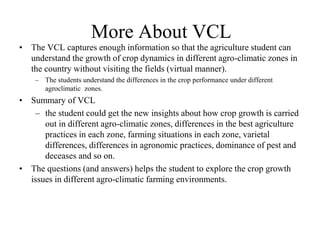
More About VCL 
• The VCL captures enough information so that the agriculture student can 
understand the growth of crop dynamics in different agro-climatic zones in 
the country without visiting the fields (virtual manner). 
– The students understand the differences in the crop performance under different 
agroclimatic zones. 
• Summary of VCL 
– the student could get the new insights about how crop growth is carried 
out in different agro-climatic zones, differences in the best agriculture 
practices in each zone, farming situations in each zone, varietal 
differences, differences in agronomic practices, dominance of pest and 
deceases and so on. 
• The questions (and answers) helps the student to explore the crop growth 
issues in different agro-climatic farming environments.
Relationship among VFI, VFS, VCLZ, VCL.
Role of Virtual Crop Labs in 
Practical Agricultural Education 
(i) Existing: Mutual reinforcement between A and B and vice versa 
(ii)New 
• Mutual reinforcement between A and C and vice versa 
•Mutual reinforcement between B to C and vice versa
Issues of Open Access to 
Agricultural Knowledge 
• Creation of different agricultural knowledge 
repositories/tools relevant to stakeholders. 
– Standard formats/services 
• How to enable open access in a sustainable manner ? 
• Impact of such knowledge depends on the services 
which depends on the data relevant to stakeholders, 
including poor and marginal farmers. 
• Examples: eSagu, eAgromet, Virtual Crop Labs, 
InfoCrop

Pk reddy open accessnaarm oct2014

  • 1.
    Agriculture Content Developmentfor Inclusive Development: eSagu and eAgromet experiences P. Krishna Reddy Program Director, ITRA-Agriculture and Food Professor, IIIT Hyderabad India E-mail: pkreddy@iiit.ac.in
  • 2.
    Outline • AboutITRA • Open access to agricultural knowledge • Content development in eSagu • Content development in eAgromet • Content development for enhancing practical agriculture skills • Conclusions
  • 3.
    IT for Agricultureand Food Research Program INFORMATION TECHNOLOGY RESEARCH ACADEMY Media Lab Asia, Department of Electronics and Information Technology, Govt of India and Indian Council of Agricultural Research
  • 4.
    OBJECTIVE 1 Strengthenthe academic institutions 2. Specifically, Enhance Quality and Quantity of a. IT [Information, Communication, Electronics] Research and Development b. IT Applications
  • 5.
    Ecosystem’s Central Traits 1. Form Large Groups 2. With R&D focused on Societal Challenges 3. By Increasing Societal Sensitivity 4. And Support of Entrepreneurship 5. Enabled by engagement with National and 5 International Experts
  • 6.
    A Pyramidal Modelof Growth Mentor-Mentees form Adjacent Layers in a Hierarchy Example: Each partner institution adds two (or three) partners every two years 6
  • 7.
    1 … … 5 … The Binary Growth Case Number of Institutions Doubles Every Two Years Would Triple Every Two Years For Ternary Mentoring
  • 8.
    Focus Area PyramidsSelected 1. ITRA-Mobile: Mobile Computing, Networking and Applications 2. ITRA-Water: IT in Sustainability of Water Resources = Two-Level Pyramids
  • 9.
    ITRA-Mobile APPROVED PROJECTS 1. HumanSense: Towards context aware sensing, inference and actuation for applications in Energy and Healthcare 2. Post-Disaster Situation Analysis and Resource Management Using Delay- Tolerant Peer-to-Peer Wireless Networks (DISARM) 3. Remote Health: A Framework for Healthcare Services using Mobile and Sensor-Cloud Technologies 4. De-congesting India's transportation networks using mobile devices 5. CARTS: Communication Assisted Road Transportation Systems 6. Virtual Assistant for Mobile Devices using Voice and Gesture Technologies 7. Mobile Broadband Service Support over Cognitive Radio Networks 8. Uncoordinated, Secure and Energy Aware Access in Distributed Wireless Networks 9. Micronet - Mobile Infrastructure for Coastal Region Offshore Communications & Networks
  • 10.
    ITRA-Water 1. ICTin Water and Pest/Disease Management for Yield Improvement in Horticulture (Citrus) 2. Improving Groundwater Levels and Quality through Enhanced Water Use Efficiency in Eastern Indian Agriculture 3. Integrated Urban Flood Management in India: Technology-Driven Solutions 4. Measurement to management (M2M): improved water use efficiency and agricultural productivity through experimental sensor network 5. Development of effective Wireless Sensor Network system for water quality and quantity monitoring (AquaSense)
  • 11.
    Focus Area inProgress ITRA-Ag&Food • SFM held on March 15-16, 2013 Jointly with Indian Council of Agricultural Research • Identified several research problems • Call for concept notes and project proposals will be issued soon.
  • 12.
    Main Objective: Buildingof Decision Support Systems • Agricultural production and processing systems are complex due to the many biological, chemical, physical and envoronmental processes involved. • Information technologies can be used to extract and present the information related to a particular problem in a unified manner and thus speed up decision making. • Decision support systems may support agricultural scientists and agro-meteorologists in providing extension services such as – expert advice on agronomy, – pest or decease problems, – risk management for unpredictable weather conditions, – efficient marketing of agriculture produce, – optimal resource distribution – meeting emergencies. 12
  • 13.
    IT and AgricultureCategories Main technologies for DSS Agriculture categories Environment sensing, location sensing, and communication Crop production Data management Soil, water and weather Modeling and simulation Agriculture Education and Extension Data mining and knowledge discovery. Marketing and agribusiness Livestock and fisheries 13
  • 14.
    Examples of DSS • Pest surveillance systems • Online disease diagnosis • Online monitoring of pesticide sales/usage • Service delivery platform to deliver personalized advice and customized agriculture • Location and time specific plant disease forecasting using Wireless Sensor Network (WSN) and with farmer’s participation • Potential fishing zone and weather alert services to fisherman • Characterization of soils with Gamma Radiation detection (Sensor based soil nutrient scanning) • ICT platform based end-to-end Procurement Services • ICT Platform to introduce good global agriculture practices in Indian agriculture • Intelligent agriculture ontology tools • Use of ICT to improve agriculture supply chain efficiency • Use of ICT platform to improve efficiency of artificial insemination operation and, offer veterinary and nutrient services • Animal management in the Indian production system with different breeds of animals, based on the analysis of data from different animal production systems • Diseases diagnosis for animals under different management conditions • Developing market intelligence systems • IT-enabled logistics and supply chain management • DSS to support marketing and production decisions • Interactive DSS (expert systems) to know the availability of inputs • Interactive DSS on source and technical details of available hybrids, HYV, seed and planting material • Development of artificially intelligent agricultural machines, to help reduce drudgery and improve health and safety. This may attract rural youth to work with agricultural machines. 14
  • 15.
    Outline • AboutITRA • Open access to agricultural knowledge • Content development in eSagu • Content development in eAgromet • Content development for enhancing practical agriculture skills • Conclusions
  • 16.
    Examples of OpenAccess Knowledge/Information and Tools • Search Engines – Google • Social network sites – Facebook, Twitter • Journals – IEEE, ACM, Springer,.., • Content – Wikipedia, You tube • Tools – Linux, Adroid, MYSQL, OpenOffice, …
  • 17.
    Agriculture • Journalsand magazines • MSc/PhD Dissertations • Booklets • Simulation tools – InfoCrop • Best agriculture practices • Output of research experiments and projects at SAUs
  • 18.
    Stakeholders • Farmers • Consumers • Extension personnel • NGOs, Trusts, Civil Society Organizations • Students • Teachers/Scientists • Researchers • Corporate Companies • Buyers/Exporters
  • 19.
    Open Access Knowledge Characteristics • Relevant to stakeholder – Focus, modular, cohesive • Consumable – Language, text, audio, video • Computer readable • Scope for self-sustainability • Progress – Updated with latest advances in agriculture technology
  • 20.
    My Experience •Content development in eSagu • Content development in eAgromet • Virtual Crop Labs to enhance practical learning
  • 21.
    eSagu is aPersonal Information System for farmers • eSagu is an IT-based Personalized agro-advisory system – Personalized • Provides Personalized agro-advice to farmer’s door-step. – Timely: • Provides the advice within 24 to 36 hours – Regular • Advice is provided regularly (once in a week) – Feedback: two way communication – Query-less: Farmer need not ask a question – Cost-effective: Can be made sustainable with a nominal subscription fee – Powered by IT: Record keeping, availability, reliability – Scalable and can be developed on the existing infrastructure • Started in 2004 and the system is evolving
  • 22.
    eSagu: basic idea • Extend developments in IT to agriculture – Agriculture scientist does not visit the crop. – Crop photos are brought to agriculture expert. • As a result, the agricultural expert – can utilize the time efficiently – spends less time to provide the advice – can work during the night • Reference – P.Krishna Reddy and R.Ankaiah, A framework of information technology-based agriculture information dissemination system to improve crop productivity, Current Science, vol. 88, Num.12 pp. 1905-1913, June 2005.
  • 23.
    Operational Procedure •Farmer registers into the system by supplying soil, water, capital, crop details. • Coordinator visits each farm once in a week/two weeks. • Takes problematic photographs. • Fills-in observation-cum-feedback form and takes its photograph. • Upload the data into eSagu portal • Agriculture scientists prepare the advice based on photographs and other information. • The advice is downloaded at the village center and takes the printout. • The coordinator delivers the advice to the farmer.
  • 25.
    Crops Extra Gain/peracre (2005-06) Gain in Fertilizer Gain in Pesticide Gain in Yield Total Gain 1 2 3 4 5 Cotton 419 1140.6 3349 4908.6 Chilli 751.2 1093.8 6040.1 7885.1 Paddy 315.2 795.3 699.9 1810.4 Red gram 293 451.7 484.8 1229.5 Groundnut 282 70.5 900 1252.5 Castor 218 225 1360 1803 Intended Crops 425 890 2398 3713 Other Crops 585.1 1117.2 4694.55 6396.85 All Crops 443.6 928.8 2501.6 3874
  • 26.
    Information Needs ofFarmers • Agricultural expert advice – Crop protection related information • Decease and pest problem – Crop production related information • Spacing, timing of sowing, planning and so on
  • 27.
    Issues: Capacity BuildingProblems Agriculture Scientists • In eSagu, AE must have location specific knowledge and experience – Has to be expert regarding diverse crop problems that occur in several agro-climatic situations. • However, AEs differ in education levels, experience, local exposure, farm exposure, and know-how regarding agro-climatic variations. – New paradigm for agriculture scientists – The system makes them accountable • So, new kind of content is required such that AE can grasp the problem as much as by going through the content.
  • 28.
    What should bethe nature of new Content ? • Relevant, adoptable and actionable. • Should meet the day-to-day information / operation requirement of the farmers. • Due consideration of farmers’ traditional wisdom. • Should be feedback based for continual improvement. • Adoptable to the changing needs of the farmers • In tune with the latest technological developments. • In close liaison with research institutes, industry and the farmers.
  • 29.
    Main Questions ? Fresh agricultural Graduates Location-specific, crop specific capacity building and training eSagu Agriculture Expert • Main questions: • Why such content has not been developed ? • What is the framework of such location-and crop-specific content ?
  • 30.
    Why such contentis not available or not developed ? • The content is not available in the ready-made form. – because such kind of knowledge was not compulsory to operate traditional extension systems. • Existing content – Mostly consisting of text in generic manner. – Only few crops are covered. – Advice is not based on resource potential, biotic and abiotic factors. – Crop specific but not soil, area and variety specific. – No updated information with developments in science & technology. – Farmer’s traditional wisdom is not documented. – Difficult to compare actual farm situation from the content. – Developed content is not based on farmer’s feedback. – No due consideration regarding agro ecosystem analysis. – Lack of understanding of local demand.
  • 31.
    eSagu Content DevelopmentFramework Table 1: Chapter titles and Titles of subsections. (Note: Replace “C” with the “Crop” and “R” with the “Region”). Chapter Title Subsections or Questions 1. Introduction 1.1 Overview/nature of C; 1.2 Overview/environment of R; 1.3 Rationale for farmers of R for cultivating C 1.4 What is the importance of C for R. 1.5 Why the content on C is different for region R as compared to other regions. 2. Area, Production and Productivity of C in R for last one decade, trends there-in. 2.1 How much area is covered by different types of soils in the R ? 2.2 What is the normal production capability of C in R ? 2.3 What is the potential for productivity of C in different farming situations of R ? 3.Climate and Season 3.1 How is the climate and weather variations in R ? 3.2 How the climate variations in R influences the cultivation of C ? 3.3 Details of seasons and durations for crop C in R ? 3.4 How is mapping of seasons with cultivation of C. 4.Varieties and Hybrids 4.1 Details of varieties/hybrids of C suitable for R 4.2 How the varieties/hybrids of C vary with soils in R 4.3 How the varieties/hybrids of C vary with weather/seasonal variations in R 4.4 How the varieties and hybrids differ in their performance with respect to yield potential according to profit potential/duration/pests susceptibility or resistance/extreme weathers etc. 5. Cropping Systems 5.1 Details of cropping systems in practice for different soils/varieties/seasons ? 6 Soils 6.1 Details of soils in R ? 6.2 Soil characteristics and potential corrections ameliorative measures to improve the productivity of crop C in R.
  • 32.
    Content Development Framework… Table 1: Chapter titles and Titles of subsections. (Note: Replace “C” with the “Crop” and “R” with the “Region”). Title Subsections or Questions 7. Land Preparation 7.1. Different land preparation methods recommended based on soil and water availability, seasonal variations for C in R. 8. Seeds and Sowing 8.1 How to sow C seed in R by considering soil, weather. seasonal variations ? 9. Crop establishment and growth stages 9.1. Cultivation practices for C in R by considering different varieties, weather, seasonal variations and water availability. 9.2 Different growth stages of C in R and corresponding packages of practices. 10 Nutrient Management 10.1 Nutrient management recommendations for C in R by considering soil types, fertility, variety/hybrid and seasonal variations including INM practices. 11 Irrigation water Management 11.1 Water management techniques/information to get maximum productivity for of C in R by considering seasonal, water availability (tank, well, rain-fed and drought). 12 Weed management 12.1 What are different kind of popular weeds that affect C yield in R. 12.2 Weed management techniques and information for C in R including IWM. 13 Pest Management 13.1 What are different kinds of popular pests on C in the R. 13.2 What are the pest management/control measures on C in R by considering weather and seasonal and soil and crop stage ? 13.3 What are the pesticides and IPM practices which are popular and will be effective with timing of information.
  • 33.
    Content Development Framework… Table 1: Chapter titles and Titles of subsections. (Note: Replace “C” with the “Crop” and “R” with the “Region”). Chapter Title Subsections or Questions 14 Harvest and Post- Harvest Technology 14.1 What are methods of harvesting C ? 14.2 What are the precautions in harvesting C for R by considering weather and season and labor. 14.3 What are the post-harvesting technologies to process and store the produce of C ? 15 Seed Production 15.1 What are the precautions/methods in producing seeds for C in R by considering weather, water and seasons in R 16. Specific Problems 16.1 What are the specific problems (crop production and management) regarding cultivating C in R ? 17. Crop economics 17.1 What are the strategies to economize the production costs for C in R ? (giving details on cost of cultivation, crop yield, marketing, net profit etc.) 18. Marketing What are the marketing opportunities for C in R ? 19. Export and quality aspects 19.1 What are the export opportunities for C in R ? 19.2 What are the quality parameters one should consider while producing C with export quality in R ? 19.2 What is the edge (weather, season, soil) the R is having to produce C with export quality. 20. References, and acronyms. 20.1 What are the sources to get more information regarding C in R (seed, pesticide use, crop management, export information and so on) 21 Annexure 21.1 What are the list of annexure ?
  • 34.
    Content development challenge? • For each country and given a crop we have to identify agro-eco situations and build content (multi media) ? • For example, take rice crop – At least each state will have 10 agro-eco situations – So, we have to develop at least 20*10=200 content books. • For all the crops, it will be a huge task • Updating and validating will be a huge task. • But, we need such content to benefit farmers. • GENERIC information is not sufficient.
  • 35.
    However to developthe relevant information ? • Follow location-specific crop practices and – If available, suggest location-specific scientific alternatives for risk management. – If not available, investigate and develop the relevant information • How to follow/understand location-specific crop practices ? – Follow eSagu and deliver advices to sample number of farms of each crop and deliver the advisories for risks management. See the farmers’ reaction. – Based on the advice delivery, develop the relevant content. – Keep updating the information regularly.
  • 36.
    eAgromet: ICT-enabled Agro- Meteorological Advisory System
  • 37.
    Efforts by IndiaMateorological Department • India meteorological department (IMD) is providing “Integrated Agromet Advisory Service”. – IMD is issuing agromet bulletins, which contain • risk management steps for crop and livestock management, based on the weather forecast twice in a week (Tuesday and Friday) up to 5 days. – About 130 Agro-Mateorological Field Units (AMFUs) – Extending to block level • The agromet advisory bulletins are unique and complements other efforts of improved agriculture technology transfer methods.
  • 38.
    Ongoing Process ofPreparing Agromet Bulletin
  • 39.
  • 40.
    A Sample AgrometBulletin (only highlights are shown)
  • 41.
    About eAgromet •Issues – The preparation of agromet bulletins is a manual process. • Problem – Improve the efficiency of preparation and dissemination of agromet bulletins • IMD has initiated a research project of an IT-based agro-meteorological advisory system, called eAgromet in collaboration with – IIIT, Hyderabad, India and – Agromet Cell, Achraya NG Ranga Agricultural University, Hyderabad, • The effort has started in the year 2011. • A basic model of eAgromet has been developed.
  • 43.
    Content Development Framework S.No. Name Nature Scope 1. General overview of the crop Both region and weather independent Contains general information of the crop. 2. Agro-climatology of the crop Region independent and weather dependent Contains information about agro-climatology of the crop 3. Region specific agro-climatology of the crop Both region and weather dependent Contains region-specific agro-climatology of the crop. 4. Region specific contingency crop production strategies Both region and weather dependent Contains contingency measures against malevolent weather.
  • 44.
    General Overview ofCrop S.No. Name of the topic Description 1 Common names and Scientific name Crop common names and scientific name 2 Introduction Origin and spread across the world, important crop growing regions in the world and importance of the crop 3 Area, Production and Productivity of the crop Summary of Worldwide production 4 Climate and Season Favorable weather conditions (Temperature, Rainfall, Relative Humidity, Sunshine hours etc.) for crop growth and development, cropping seasons, Ecosystems/Crop Ecology, Crop adaptation, Cropping pattern and Crop rotation 5 Soils Suitable soil types and soil characteristics for crop cultivation, problematic soils and amelioration 6 Botany of the crop and crop improvement Morphology, growth and development of the crop and crop improvement 7 Best management practices (BMPs) Best management practices followed for higher yield around the world 8 Post-harvest technology Processing, storage and marketing
  • 45.
    Agro-climatology of Crop S.No . Name of the topic Description 1. Potential crop growing regions Agro climatic conditions in the potential crop growing regions in the world, country/region 2. Optimum climatic conditions Optimum climatic conditions required for better crop growth, yield; pest and disease, weed suppression in India 3. Effect of weather elements on crop growth Individual and combined effect of weather elements on crop growth and development during different phenophases of crop growth including land preparation to post harvest handling of the produce 4. Effect of weather elements on pests Individual and combined effect of weather elements/parameters on incidence, virulence/suppression of crop insect pests, diseases and weeds 5. Crop management practices Crop management practices under various crop growing situations/ regions 6. Pest management practices Pest management practices under various crop growing environments/ regions 7. Agro meteorological services Agro meteorological services available for crop production in the world
  • 46.
    Region specific Agroclimatology of the crop S.No . Name of the topic Description 1. Crop name Common names and Scientific name 2. State and agro climatic zone Respective region comes under which State and agro climatic zone 3. Crop statistics Area, Production and Productivity of the crop in the region/state 4. Overview of weather conditions Overview of weather conditions experienced in the region 5. Crop growing seasons Main crop growing seasons in the region/state 6. Characteristic features of weather elements Characteristic features of weather elements during crop growing seasons/periods 7. Climatic constraints Region specific climatic constraints and their impact - Phenophase wise individual and combined effect of weather parameters on crop growth and development and also incidence, virulence/suppression of pests (insect pests, diseases and weeds 8. Farming situations Various crop growing situations/environments in the region 9. Farming situation based advisories Farming situation based advisories for normal and extreme weather conditions
  • 47.
    Region specific contingencycrop production strategies S. No . Name of the topic Description 1. Alternative crops Choice of crops and varieties under aberrant rainfall and other weather situations in main crop growing seasons 2. Contingency cop management practices Contingency cop management practices to mitigate extreme aberrant weather situations (to some extent) in a given crop at different phenophases of crop growth 3. Effects of extreme weather events Effects of extreme weather events like delayed onset of monsoon, prolonged dry spells, early recession of monsoons; severe droughts; floods; water logging; heat wave; cold wave; cyclones; typhoons; tsunami; hail storms etc at different phenophases of crop
  • 48.
    Steps to identifyweather events and developing the content for a given crop Input: Thirty years of daily weather data of a given region, labels for each weather variable Output: Weather events and crop- and location specific content for crops. 1. Collect last 30 years of weather data (Tmin, Tmax, RF, RH1, RH2, CC, WS, WD) and assign the labels for each day. 2. Find the normal weather values for each day and assign the labels. 3. Compute the weather statistics for each week 4. Identify normal events: Identify 53 weekly normal events. You will get one event for each week. 5. Identify deviation events: Compare each year weather data with the normal data. Identify, how much each weather variable deviated from the normal. Generate event for each jump from the normal. 6. For each event, prepare the agromet advice for each crop of that AMFU.
  • 49.
    A Model ofVirtual Crop Labs as a Cloud Computing Application for Enhancing Practical Agricultural Education
  • 50.
    Importance of PracticalEducation • The agriculture graduates should posses expertise and confidence to give the agro-advice to the farmer for curing the aliment in the cropped field. • Making the correct decision at field level is much more difficult for fresh graduates who have least practical field exposure.
  • 51.
    Depiction of OngoingLearning Process by the Student • Mutual re-enforcement between A to B. – During BSc(agriculture) program, the students spend first three years for learning basic knowledge in the classrooms and dedicated labs. – As a part of special course or course assignment, the students visit the selected college farms carry out the assignments and gain practical knowledge. – To expose the student to real field problems, he/she has to completeRAWEP during the first semester of the fourth year. The students are expected to stay in the village and attached to the host farmer.
  • 52.
    Proposed Approach: BasicIdea • It is possible to improve the practical knowledge of students, if we systematically expose them to well organized, indexed and summarized digital data (text, photos and video) of diverse farm situations. – The crop growth situation under different agro-climatic situations is captured from seed-to-seed throughout crop growing season at regular intervals covering all the crop husbandry activities. – The captured situations are labelled and described by subject-matter specialists (agriculture scientists). – The labelled content is exposed to the students of under-graduate programs as a part of learning framework. – As a result, a student gets an opportunity to examine the thousands of crop production problem dynamics of each crop and learn the practical knowledge.
  • 53.
    Virtual Crop Labs • The virtual crop lab constitutes – Each lab constitutes virtual crop lab of zones (VCLZ). • each VCLZ constitutes several virtual farm sagas (VFS). – each VFS constitutes virtual farm items.
  • 54.
    Virtual Farm Item • Suppose a particular crop (c) is cultivated in the farm (f). We capture the crop situation or activity carried out in the farm at particular instant (or stage) through virtual farm item (VFI). • VFI: < f, c, d, t, td, p, v, s, q/a, i >. – f: indicates the details of farm; c: indicates the details of crop – d: indicates the date of sowing of crop c; t: indicates the time (day) of VFI. – td: indicates description of crop status through text. – p: indicates the set of photographs – v: indicates the set of video clips through which the crop status is captured. – s: indicates the summary text written by subject matter specialists for the given VFI. It contains the detailed description of the corresponding problem or activity by referring individual photographs or videos. By reading the description, the student or professor can understand the problem or activity captured through VFI. – q/a: indicates questions & answers. The subject matter specialist prepares the questions related to VFI based on the field problems at t and provides the answers. These questions are prepared to help the student to get more insights about field problems. – i: indicates the index terms. The index terms will help the information retrieval engine to retrieve the corresponding VFI.
  • 55.
    More about VFI • The VFI captures enough information so that the agriculture student/ professor can understand the farm situation or farm activity by going through it in a virtual manner (without visiting the crop field). • Photographs/video clips: – The situation can be understood through text photograhs/video clips. Based on the crop details and farm location, the student can grasp the problem. • Text written by scientist – To enhance the understanding of crop situation, the student can go through the text written by scientist. • Q/A: – The questions (and answers) should be such that it should enable the student/teacher to understand the background and other influencing factors for that farm situation. – Questions are aimed to understand what, how and why aspects of situation/activity, such as the reasons for the given farm situation or importance of such activity.
  • 56.
    Virtual Farm Saga • For the given farm, the VFS is the collection of virtual farm items which are being captured at the regular intervals from pre-sowing to post-harvesting covering all crop-husbandry activities. • The structure of VFS <f, c, d, Set of VFIs, Summary of VFS, q/a, i>. – Set of VFIs: • Collection VFIs captured at regular intervals from sowing to post-harvesting by covering the crop cycle. – Summary of VFS: • The summary is written by considering overall farm situation by considering the corresponding VFIs throughout crop life cycle, i.e., from pre-sowing to post-harvesting. Reasons for the problems should be mentioned. Best agriculture practices should be highlighted. The negative aspects of crop production practices carried out should be explained. Mistakes identified should be described. Missed opportunities for a better crop growth, if any, should be given. – q/a: • The subject matter specialist should form appropriate questions and give answers regarding dynamics of VFS. – Questions can be about the factors about the crop growth, linking activities the problems occurred to the crop to the activities carried out at different stages, weather situation, soil, farm practices, etc.
  • 57.
    More About VFS • The VFS captures enough information so that the agriculture student/ professor can understand the growth of the given farm in a virtual manner without visiting the crop field. • Set of VFI – The student can go through each VFI and understand the crop growth. • Summary: – Overall farm growth phenomena • Q/A – The questions (and answers) enable the student/teacher to understand the background and other influencing factors for that crop growth. – Questions are aimed to understand what influenced the crop growth and corresponding corrective factors that would have been taken, if any.
  • 58.
    Virtual Crop Labof a Zone (VCLZ) • The VCLZ captures the crop dynamics for a given micro agro-climatic zone. • Let crop c is cultivated in n number of sample farms (in different farming situations) in a given micro agro-climatic zone. – The value of n is chosen such that all farming situations of the zone for a given crop are captured. • The collection of VFS of n farms (in different farming situations) constitute VCLZ. • The elements of VCLZ are as follows: <c, Set of VFSs, Summary of VCLZ, q/a, i >. – c, i: the meaning of these notations is similar as in VFI. – Set of VFSs: • Indicates a collection of VFSs on n number of sample farms of crop c. For a given agro-climatic zone, the number of sample farms will be selected to capture all the variability (soil, variety, water source and so on) of the crop c. – Summary of VCLZ: • The summary for VCLZ is written by considering overall situation of farms in VCLZ. The summary includes reasons for the success of some farms including best agriculture practices, and failure of some other farms which should be mentioned linking to the agro-climatic conditions, good/bad farm practices, crop protection measures, untimely application of inputs, soil type and so on. – q/a: • The questions and answers are formed by subject matter specialists by considering the VFSs of all sample farms. So, there is a scope for several innovative questions and answers which can be given by providing the references to corresponding VFSs and VFIs. • Questions can be framed following the processes of contrasting VFSs and VFIs, comparing VFSs and VFIs by identifying unique/special VFSs and VFIs with reference to soil, variety, weather and so on. Questions can also be about the reasons for success of some farms and failure of some other farms linking to seed variety, soil, date of sowing, weather factors and farming practices.
  • 59.
    More About VCLZ • The VCLZ captures enough information so that the agriculture student/ professor can understand the growth of crop dynamics in a virtual manner in the zone under different farming situations. • Set of VFS – The students compare VFS of several farms and understand the differences in the crop performance under various soils and practices. • Summary of VCLZ – By going through the summary of VCLZ, the student gets the new insights about the influence of various factors on different types of farms of the same crop in the given zone. • Q/A – The questions (and answers) helps the student to explore the issues in different dimensions.
  • 60.
    Virtual Crop Lab • The virtual crop lab captures all the problems and activities of the crop for all agro-climatic zones of the country. Let crop c is cultivated in m micro agro-climatic zones in the country. The collection of VCLZs of m zones constitute VCL. The elements of VCL is as follows: < c, Set of VCLZ, Summary of VCL, q/a, i >. – Set of VCLZs: • Indicates VCLZs on m agro-climatic zones. – Summary of VCL: • The summary of VCL of a country is written by comparing and contrasting crop growth/farm practices based on the VCLZ of several zones of a country. Reasons for the difference in crop practices by linking to weather and soil should be highlighted. – q/a: • The questions and answers are formed by subject matter specialists by considering the VCLZs of several zones. • Questions can be formed following the processes of contrasting VCLZs, VFSs and VFIs, comparing VCLZs, VFSs and VFIs by identifying unique/special VCLZs, VFSs and VFIs with reference to soil, variety, weather and so on. • Questions can also be framed about the reasons for the differences in farming practices, crop problems, and protection measures.
  • 61.
    More About VCL • The VCL captures enough information so that the agriculture student can understand the growth of crop dynamics in different agro-climatic zones in the country without visiting the fields (virtual manner). – The students understand the differences in the crop performance under different agroclimatic zones. • Summary of VCL – the student could get the new insights about how crop growth is carried out in different agro-climatic zones, differences in the best agriculture practices in each zone, farming situations in each zone, varietal differences, differences in agronomic practices, dominance of pest and deceases and so on. • The questions (and answers) helps the student to explore the crop growth issues in different agro-climatic farming environments.
  • 62.
    Relationship among VFI,VFS, VCLZ, VCL.
  • 63.
    Role of VirtualCrop Labs in Practical Agricultural Education (i) Existing: Mutual reinforcement between A and B and vice versa (ii)New • Mutual reinforcement between A and C and vice versa •Mutual reinforcement between B to C and vice versa
  • 64.
    Issues of OpenAccess to Agricultural Knowledge • Creation of different agricultural knowledge repositories/tools relevant to stakeholders. – Standard formats/services • How to enable open access in a sustainable manner ? • Impact of such knowledge depends on the services which depends on the data relevant to stakeholders, including poor and marginal farmers. • Examples: eSagu, eAgromet, Virtual Crop Labs, InfoCrop