The
Allocation of
Resources
Unit-2
Chapter 5: Microeconomics and macroeconomics
Chapter 6: The role of markets in allocating resources
Chapter 7: Demand
Chapter 8: Supply
Chapter 9: Price determination
Chapter 10: Price changes
Chapter 11: Price elasticity of demand
Chapter 12: Price elasticity of supply
Chapter 13: Market economic system
Chapter 14: Market failure
Chapter 15: Mixed economic system
Contents of this unit
The role of markets
in allocating
resources
06
► AO1 Understand the meaning of the market
system and the price mechanism
► A02 Be able to determine how the price
mechanism is able to allocate resources efficiently
► A03 Be able to evaluate instances where the price
mechanism fails to allocate resources efficiently
Objectives
Key resource allocation decisions
WHAT TO
PRODUCE?
FOR WHOM TO
PRODUCE?
HOW TO
PRODUCE?
ECONOMIC SYSTEM
Institution
Organisation
Mechanism
(they influence the economic behaviour &
determine how resources are allocated)
PLANNED
ECONOMY
1.MEANING
2.EXAMPLE
3.CHARACTERISTICS
4.PROS AND CONS
MIXED ECONOMY
1.MEANING
2.EXAMPLE
3.CHARACTERISTICS
4.PROS AND CONS
MARKET
ECONOMY
1.MEANING
2.EXAMPLE
3.CHARACTERISTICS
4.PROS AND CONS
RESEARCH
PLANNED ECONOMY
An economy which operates a planned economic system is called
a planned, centrally planned, command or collectivist
economy.
It is an economy in which the state (government) makes the
decisions about what to produce, how to produce it and who
receives it.
The state owns all, or at least most, of the land and capital, and
employs workers
TYPES OF ECONOMIC SYSTEM
An economy which operates a market economic system is known as a market
economy or a free enterprise economy.
It is one in which buyers, also known as consumers, determine what is produced.
They signal their preferences to sellers through the price mechanism.
In a market economic system, government intervention is minimal. Land and capital
are privately owned.
Private sector firms decide how to produce the products consumers want to buy
MARKET ECONOMY
MIXED ECONOMY
An economy in
which both the
private and public
sectors play an
important role. I.e.
both are involved.
Price mechanism
Provides an incentive to the producer to
respond to changes in the market
conditions.
CAPITAL INTENSIVE
When firm uses more capital
than labor
LABOR INTENSIVE
When firm uses more
labor than capital.
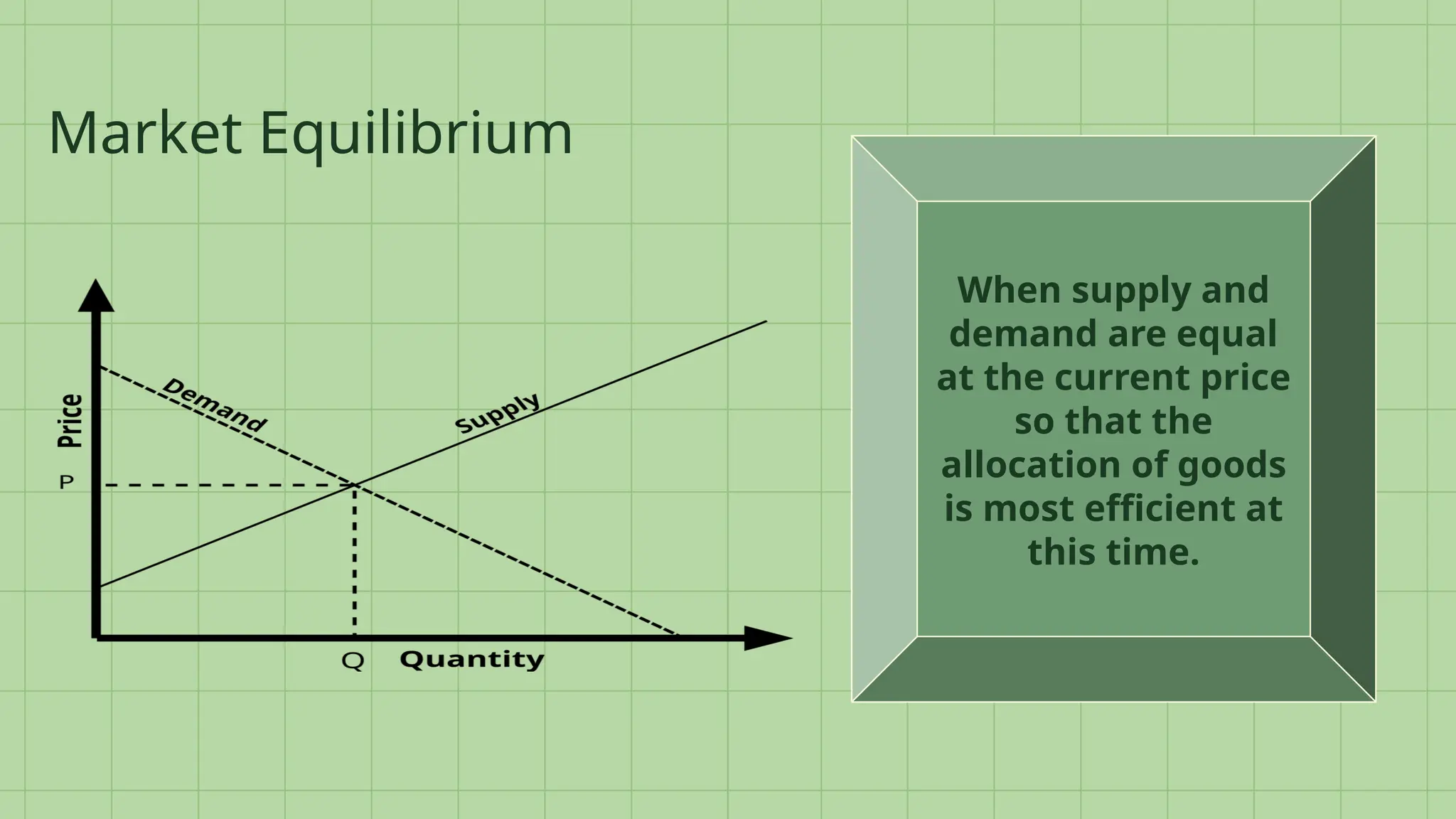
Market Equilibrium
When supply and
demand are equal
at the current price
so that the
allocation of goods
is most efficient at
this time.
Market
Disequilibrium
When supply and
demand are not
equal at the
current price .
Shortage is when
there is excess
demand and
surplus is when
there is excess
supply
Disequilibrium
Demand > supply
- Price is below equilibrium
- Consumers are demanding more than firm is able/willing to produce at
current price level
- Firms increase price
- At higher prices consumers demand less
- Prices will increase until equilibrium is reached where supply = demand
A market may be in disequilibrium in the short-term but will always be in
equilibrium in the long-term.
Key terms
► Price mechanism - the means by which millions of decisions taken by
consumers and businesses interact to determine the allocation of scarce
resources between competing uses (Invisible Hand – Adam Smith)
► Supply – goods/services being sold by the firm
► Demand – goods/services bought by the consumer
► Equilibrium – market clearing. The price and quantity where supply =
demand
► Disequilibrium – market does not clear.
► Short-term – all factors of production are variable except capital
► Long-term – all factors of production are variable
► Capital - all those man-made goods which are used in further
production of wealth
What to produce?
► The commodities which do not command positive prices in the
market would not be produced. Therefore only those
commodities with positive prices are to be produced and in such
a way that would clear the markets.
► The quantity in which a commodity is to be produced is set at
that level where demand equals supply.
► Firms will produce the product which offers them the biggest
potential of profit. A firm will always seek to cover its opportunity
cost
► The price mechanism determines what and how much firms will
supply and what and how much individuals will consume.
How to produce?
► Technology means the correct proportion in which the
different factors of production are to be employed. There
are two types of techniques. A labour-intensive technique
would employ relatively more labour and less capital. On
the other hand, capital- intensive technique means more
capital and less labour.
► The price mechanism will determine the firm's’ production
mix between labour and capital
► If labour (wage) is cheap relative to capital then the firm will
be labour intensive (developing economies)
► If capital is cheap relative to labour then the firm will be
capital intensive (developed economies)
For whom to produce?
► A commodity can be consumed only by people who
have more purchasing power.
► Price mechanism determines the income of the workers,
i.e. purchasing power.
► The price mechanism means that if you cannot afford to
pay the price then you cannot buy the good/service.
► Some goods/services are considered essential for all of
society. Education, healthcare, infrastructure, parks are such
examples. Should only the wealthy be able to afford to
consume these?

Chpt 6_ The role of markets in allocating resources.pptx

  • 1.
  • 2.
    Chapter 5: Microeconomicsand macroeconomics Chapter 6: The role of markets in allocating resources Chapter 7: Demand Chapter 8: Supply Chapter 9: Price determination Chapter 10: Price changes Chapter 11: Price elasticity of demand Chapter 12: Price elasticity of supply Chapter 13: Market economic system Chapter 14: Market failure Chapter 15: Mixed economic system Contents of this unit
  • 3.
    The role ofmarkets in allocating resources 06
  • 4.
    ► AO1 Understandthe meaning of the market system and the price mechanism ► A02 Be able to determine how the price mechanism is able to allocate resources efficiently ► A03 Be able to evaluate instances where the price mechanism fails to allocate resources efficiently Objectives
  • 5.
    Key resource allocationdecisions WHAT TO PRODUCE? FOR WHOM TO PRODUCE? HOW TO PRODUCE?
  • 7.
    ECONOMIC SYSTEM Institution Organisation Mechanism (they influencethe economic behaviour & determine how resources are allocated)
  • 9.
    PLANNED ECONOMY 1.MEANING 2.EXAMPLE 3.CHARACTERISTICS 4.PROS AND CONS MIXEDECONOMY 1.MEANING 2.EXAMPLE 3.CHARACTERISTICS 4.PROS AND CONS MARKET ECONOMY 1.MEANING 2.EXAMPLE 3.CHARACTERISTICS 4.PROS AND CONS RESEARCH
  • 10.
    PLANNED ECONOMY An economywhich operates a planned economic system is called a planned, centrally planned, command or collectivist economy. It is an economy in which the state (government) makes the decisions about what to produce, how to produce it and who receives it. The state owns all, or at least most, of the land and capital, and employs workers TYPES OF ECONOMIC SYSTEM
  • 11.
    An economy whichoperates a market economic system is known as a market economy or a free enterprise economy. It is one in which buyers, also known as consumers, determine what is produced. They signal their preferences to sellers through the price mechanism. In a market economic system, government intervention is minimal. Land and capital are privately owned. Private sector firms decide how to produce the products consumers want to buy MARKET ECONOMY
  • 12.
    MIXED ECONOMY An economyin which both the private and public sectors play an important role. I.e. both are involved.
  • 13.
    Price mechanism Provides anincentive to the producer to respond to changes in the market conditions.
  • 14.
    CAPITAL INTENSIVE When firmuses more capital than labor LABOR INTENSIVE When firm uses more labor than capital.
  • 15.
    Market Equilibrium When supplyand demand are equal at the current price so that the allocation of goods is most efficient at this time.
  • 16.
    Market Disequilibrium When supply and demandare not equal at the current price . Shortage is when there is excess demand and surplus is when there is excess supply
  • 17.
    Disequilibrium Demand > supply -Price is below equilibrium - Consumers are demanding more than firm is able/willing to produce at current price level - Firms increase price - At higher prices consumers demand less - Prices will increase until equilibrium is reached where supply = demand A market may be in disequilibrium in the short-term but will always be in equilibrium in the long-term.
  • 18.
    Key terms ► Pricemechanism - the means by which millions of decisions taken by consumers and businesses interact to determine the allocation of scarce resources between competing uses (Invisible Hand – Adam Smith) ► Supply – goods/services being sold by the firm ► Demand – goods/services bought by the consumer ► Equilibrium – market clearing. The price and quantity where supply = demand ► Disequilibrium – market does not clear. ► Short-term – all factors of production are variable except capital ► Long-term – all factors of production are variable ► Capital - all those man-made goods which are used in further production of wealth
  • 19.
    What to produce? ►The commodities which do not command positive prices in the market would not be produced. Therefore only those commodities with positive prices are to be produced and in such a way that would clear the markets. ► The quantity in which a commodity is to be produced is set at that level where demand equals supply. ► Firms will produce the product which offers them the biggest potential of profit. A firm will always seek to cover its opportunity cost ► The price mechanism determines what and how much firms will supply and what and how much individuals will consume.
  • 20.
    How to produce? ►Technology means the correct proportion in which the different factors of production are to be employed. There are two types of techniques. A labour-intensive technique would employ relatively more labour and less capital. On the other hand, capital- intensive technique means more capital and less labour. ► The price mechanism will determine the firm's’ production mix between labour and capital ► If labour (wage) is cheap relative to capital then the firm will be labour intensive (developing economies) ► If capital is cheap relative to labour then the firm will be capital intensive (developed economies)
  • 21.
    For whom toproduce? ► A commodity can be consumed only by people who have more purchasing power. ► Price mechanism determines the income of the workers, i.e. purchasing power. ► The price mechanism means that if you cannot afford to pay the price then you cannot buy the good/service. ► Some goods/services are considered essential for all of society. Education, healthcare, infrastructure, parks are such examples. Should only the wealthy be able to afford to consume these?