Supply
What is Supply? What is the difference between supply and demand? How do we graph supply? What is the supply curve?
Supply Quantity of a product that is offered for sale. Law of Supply is the idea that more of a product will be sold for a high price and less will be offered for a low price.
Individual and Market Supply Curves The curves follow the same concepts that the demand curves follow. Individual Supply involves the quantities provided by only one firm. Market curves are the sum of more than one firm and the quantities.
Changes in Supply Changes in quantity of supply move up and down the curve.  Changes in supply are the movement of the curve within the graph.
Factors that affect supply Costs of inputs Productivity Technology Taxes Expectations Govt. Regulation Number of sellers.
Costs of inputs and Productivity Costs of inputs can change supply. An example would be the cut in production costs or labor cost.  This is inversely related. Productivity will allow for companies to manufacture at a more efficient rate. If efficiency goes up so will supply.
Technology and Taxes New technology will lead to an increase in supply.  Taxes have an inverse effect on the supply curve.  If taxes go up, supply goes down and vice versa. Subsidies will lower the cost of production and will force supply up, when they are removed, supply goes down.
Expectations, Govt. Regs, and Sellers Firms gamble with the price and quantity of a product.  If they expect price to go up, they will hold some inventory. Govt. regulation can affect the cost of production. Numbers of producers affect the market because when there are more to produce the product, there will be a higher supply of that product.
Elasticity of Supply Responsiveness Elastic supply occurs when the change in P causes a relatively large change in Q. Inelastic supply occurs when the change in P causes little change in Q. Unit elasticity of supply happens when proportional change occurs.
Determinants If a firm can adjust to the changes in price, then there will be a more likely chance for elasticity to occur. Some commodities have an inelastic effect because of the production costs.
Demand vs. Supply elasticity The two differ for the following reasons Substitution has no real effect on supply. The delay to purchase has no real effect either. Only production variables play a role in the elasticity of supply.
The Theory of Production What is the theory of production? What are the three stages of production? What is diminishing return?
Theory of Production Explains the relationship between land, labor, capital, and the output of goods and services. Deals with the short run, which calls for change in production and its relation to labor.
Short run vs. Long run Short run deals with just labor, while long run allows for a firm to adjust over an extended period of time.
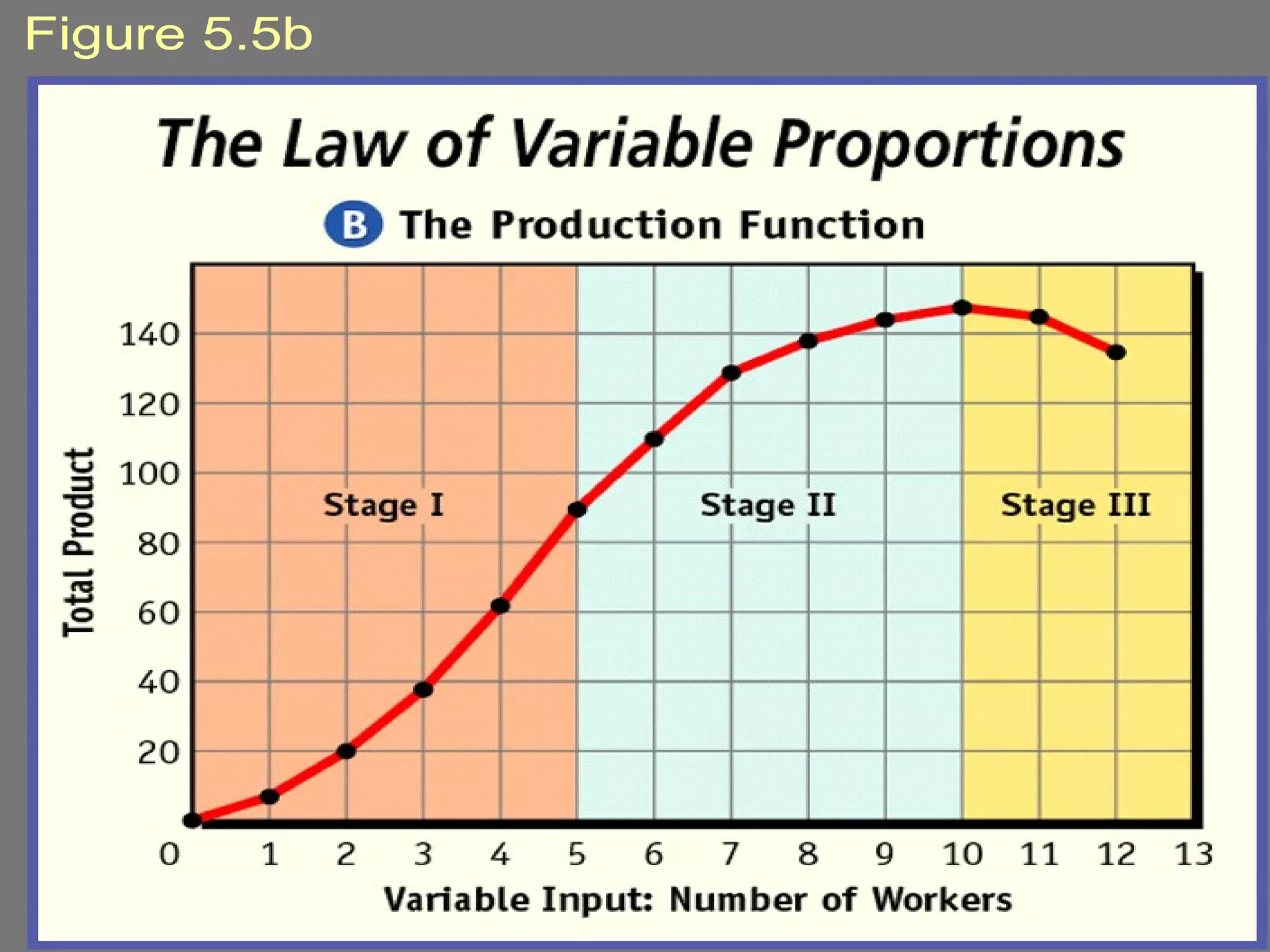
The Law of Variable Proportions The Law of Variable Proportions is an extension of the theory of production.  It says that changes will occur in the short run if you adjust just one factor. It answers the question: How will the final product turn out if I adjust an input or variable?
Production function Illustrates the Law of Variable Proportions. Relationship between production variables and output. Usually graphed as a production schedule.
Three stages of Production Stage 1- As the number of workers increases, they make better use of machinery and resources. Known as stage of increasing returns. Stage 2- Output increases at a decreasing rate.  This is known as diminishing returns. Stage 3- Marginal product occurs and the firm produces at a negative rate.
Section 2-8  Click the mouse button or press the Space Bar to display the information.
Section 2-9
Costs, Revenue, and Profit Maximization What are the four types of cost? What are the two types of revenue? How do we apply cost principals?
Costs (4 types) Fixed cost- business incurs no matter what.  Ex. Salaries, interest payments, rent, taxes, machinery. Remains the same no matter what.
More costs Variable costs- costs change with the rate of production, usually represents labor and raw materials. Total Cost-Variable costs + Fixed Costs. Marginal Costs- extra costs (variables) that come with an adjustment to production.
Section 3-7
Applying Cost Principals Combination of costs and inputs affect the way businesses produce. Gas stations have high fixed costs due to equipment and taxes, but have a low amount of variable costs. E-commerce is the exact opposite. It has a low overhead, but high ratio of variable costs.
Revenue Total revenue is number of units sold multiplied by the price of product. Marginal revenue is extra revenue.
Marginal Analysis Cost benefit analysis used to measure profit maximizing potential. Companies will either hit the break-even point. Certain scenarios call for certain measures.
Profit maximizing qty. of output is reached when Marginal revenue (MR)=Marginal Cost (MC).

Supply

  • 1.
  • 2.
    What is Supply?What is the difference between supply and demand? How do we graph supply? What is the supply curve?
  • 3.
    Supply Quantity ofa product that is offered for sale. Law of Supply is the idea that more of a product will be sold for a high price and less will be offered for a low price.
  • 4.
    Individual and MarketSupply Curves The curves follow the same concepts that the demand curves follow. Individual Supply involves the quantities provided by only one firm. Market curves are the sum of more than one firm and the quantities.
  • 5.
    Changes in SupplyChanges in quantity of supply move up and down the curve. Changes in supply are the movement of the curve within the graph.
  • 6.
    Factors that affectsupply Costs of inputs Productivity Technology Taxes Expectations Govt. Regulation Number of sellers.
  • 7.
    Costs of inputsand Productivity Costs of inputs can change supply. An example would be the cut in production costs or labor cost. This is inversely related. Productivity will allow for companies to manufacture at a more efficient rate. If efficiency goes up so will supply.
  • 8.
    Technology and TaxesNew technology will lead to an increase in supply. Taxes have an inverse effect on the supply curve. If taxes go up, supply goes down and vice versa. Subsidies will lower the cost of production and will force supply up, when they are removed, supply goes down.
  • 9.
    Expectations, Govt. Regs,and Sellers Firms gamble with the price and quantity of a product. If they expect price to go up, they will hold some inventory. Govt. regulation can affect the cost of production. Numbers of producers affect the market because when there are more to produce the product, there will be a higher supply of that product.
  • 10.
    Elasticity of SupplyResponsiveness Elastic supply occurs when the change in P causes a relatively large change in Q. Inelastic supply occurs when the change in P causes little change in Q. Unit elasticity of supply happens when proportional change occurs.
  • 11.
    Determinants If afirm can adjust to the changes in price, then there will be a more likely chance for elasticity to occur. Some commodities have an inelastic effect because of the production costs.
  • 12.
    Demand vs. Supplyelasticity The two differ for the following reasons Substitution has no real effect on supply. The delay to purchase has no real effect either. Only production variables play a role in the elasticity of supply.
  • 13.
    The Theory ofProduction What is the theory of production? What are the three stages of production? What is diminishing return?
  • 14.
    Theory of ProductionExplains the relationship between land, labor, capital, and the output of goods and services. Deals with the short run, which calls for change in production and its relation to labor.
  • 15.
    Short run vs.Long run Short run deals with just labor, while long run allows for a firm to adjust over an extended period of time.
  • 16.
    The Law ofVariable Proportions The Law of Variable Proportions is an extension of the theory of production. It says that changes will occur in the short run if you adjust just one factor. It answers the question: How will the final product turn out if I adjust an input or variable?
  • 17.
    Production function Illustratesthe Law of Variable Proportions. Relationship between production variables and output. Usually graphed as a production schedule.
  • 18.
    Three stages ofProduction Stage 1- As the number of workers increases, they make better use of machinery and resources. Known as stage of increasing returns. Stage 2- Output increases at a decreasing rate. This is known as diminishing returns. Stage 3- Marginal product occurs and the firm produces at a negative rate.
  • 19.
    Section 2-8 Click the mouse button or press the Space Bar to display the information.
  • 20.
  • 21.
    Costs, Revenue, andProfit Maximization What are the four types of cost? What are the two types of revenue? How do we apply cost principals?
  • 22.
    Costs (4 types)Fixed cost- business incurs no matter what. Ex. Salaries, interest payments, rent, taxes, machinery. Remains the same no matter what.
  • 23.
    More costs Variablecosts- costs change with the rate of production, usually represents labor and raw materials. Total Cost-Variable costs + Fixed Costs. Marginal Costs- extra costs (variables) that come with an adjustment to production.
  • 24.
  • 25.
    Applying Cost PrincipalsCombination of costs and inputs affect the way businesses produce. Gas stations have high fixed costs due to equipment and taxes, but have a low amount of variable costs. E-commerce is the exact opposite. It has a low overhead, but high ratio of variable costs.
  • 26.
    Revenue Total revenueis number of units sold multiplied by the price of product. Marginal revenue is extra revenue.
  • 27.
    Marginal Analysis Costbenefit analysis used to measure profit maximizing potential. Companies will either hit the break-even point. Certain scenarios call for certain measures.
  • 28.
    Profit maximizing qty.of output is reached when Marginal revenue (MR)=Marginal Cost (MC).