Our country – tradition and special events
Christmas In Greece
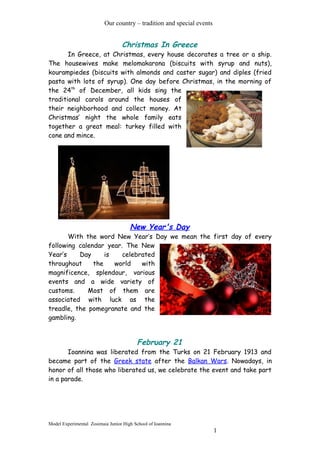
In Greece, at Christmas, every house decorates a tree or a ship.
The housewives make melomakarona (biscuits with syrup and nuts),
kourampiedes (biscuits with almonds and caster sugar) and diples (fried
pasta with lots of syrup). One day before Christmas, in the morning of
the 24th
of December, all kids sing the
traditional carols around the houses of
their neighborhood and collect money. At
Christmas’ night the whole family eats
together a great meal: turkey filled with
cone and mince.
New Year's Day
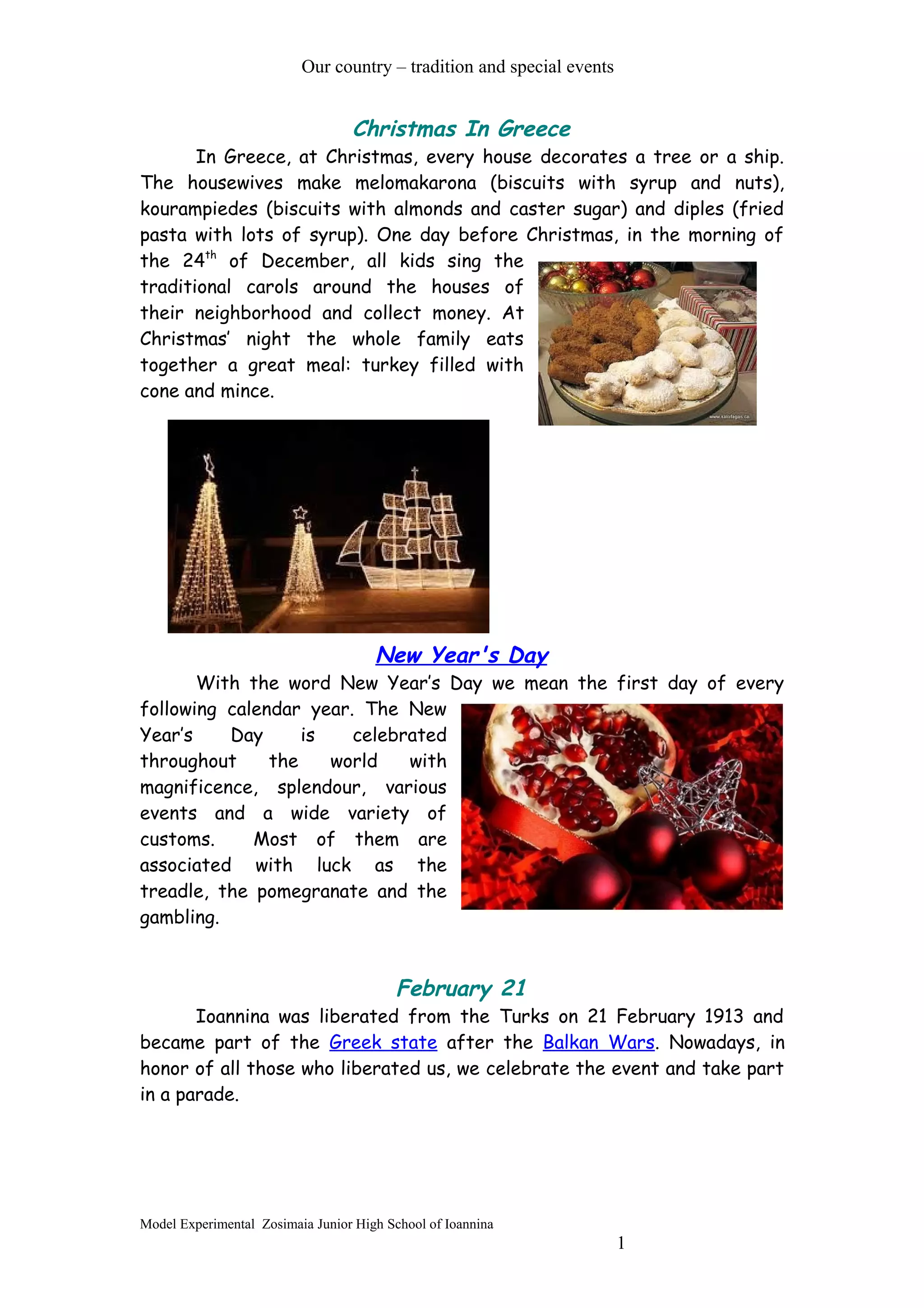
With the word New Year’s Day we mean the first day of every
following calendar year. The New
Year’s Day is celebrated
throughout the world with
magnificence, splendour, various
events and a wide variety of
customs. Most of them are
associated with luck as the
treadle, the pomegranate and the
gambling.
February 21
Ioannina was liberated from the Turks on 21 February 1913 and
became part of the Greek state after the Balkan Wars. Νowadays, in
honor of all those who liberated us, we celebrate the event and take part
in a parade.
Model Experimental Zosimaia Junior High School of Ioannina
1
Our country – tradition and special events
Apokries (Greek carnival)
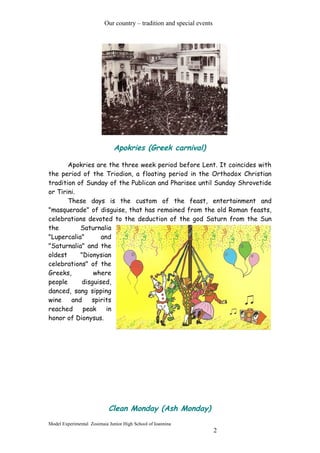
Apokries are the three week period before Lent. It coincides with
the period of the Triodion, a floating period in the Orthodox Christian
tradition of Sunday of the Publican and Pharisee until Sunday Shrovetide
or Tirini.
These days is the custom of the feast, entertainment and
"masquerade" of disguise, that has remained from the old Roman feasts,
celebrations devoted to the deduction of the god Saturn from the Sun
the Saturnalia
"Lupercalia" and
"Saturnalia" and the
oldest "Dionysian
celebrations" of the
Greeks, where
people disguised,
danced, sang sipping
wine and spirits
reached peak in
honor of Dionysus.
Clean Monday (Ash Monday)
Model Experimental Zosimaia Junior High School of Ioannina
2
Our country – tradition and special events
Clean Monday is the firsτ day of the 40 days of fasting before
Easter. In Greece we celebrate it by flying a kite and by having a meal
which consists of lagana ( a type of bread), halva, olives, picles, taramas (a
dip made up of fish’s eggs), skordalia (a dip made up of garlic and bread)
and haddock. Also, in some places of Epirus, the housewives clean the pots
with hot water with ash and paint their yards with whitewash. Finally, in
some other places, they burn an effigy of Karnavalos and they play many
games (e.g. donkey rides, the marriage and the funeral etc).
Holy Week
In Christianity it is the week immediately before Easter. It is
followed by Easter Week, but it doesn’t include Easter Sunday. During
the Holy Week, people tend to “fast”, which means they don’t eat meat,
cheese, olive oil or sweets, until Easter Sunday.
All the days of Holy Week are important, but there are some
specific customs that take place
on a few days. On Holy Thursday,
Christians paint eggs in red
colour. Red symbolizes the colour
of Jesus’s blood. On Holy Friday,
the bells ring all day and people
mustn’t go to work. Finally, on
Holy Saturday, people go to
church to celebrate the
Resurrection of Jesus Christ.
Easter Sunday
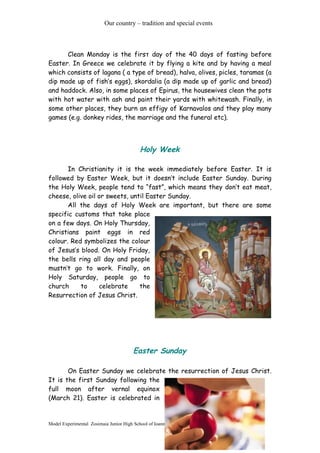
On Easter Sunday we celebrate the resurrection of Jesus Christ.
It is the first Sunday following the
full moon after vernal equinox
(March 21). Easter is celebrated in
Model Experimental Zosimaia Junior High School of Ioannina
3
Our country – tradition and special events
all corners of Greece with a Greek roast lamb, breaking of red eggs,
songs and dances.
AUGUST 15
The celebration of the Dormition of the Virgin Mary is on August
15. In Greece it is celebrated in many parts of the country and it is called
"Easter summer." It is one of the biggest religious celebrations in Greece
after Easter and Christmas, and also a national holiday
There is a customary fasting period, which was established in the
7th century. Initially it was divided into two periods - one before the
feast of the Transfiguration of the Savior and one before the feast of
the Assumption. In the 10th century, they merged into a fasting including
14 days beginning on August 1. During this period, people do not consume
oil except Saturday and Sunday.
Model Experimental Zosimaia Junior High School of Ioannina
4

Tradition

  • 1.
    Our country –tradition and special events Christmas In Greece In Greece, at Christmas, every house decorates a tree or a ship. The housewives make melomakarona (biscuits with syrup and nuts), kourampiedes (biscuits with almonds and caster sugar) and diples (fried pasta with lots of syrup). One day before Christmas, in the morning of the 24th of December, all kids sing the traditional carols around the houses of their neighborhood and collect money. At Christmas’ night the whole family eats together a great meal: turkey filled with cone and mince. New Year's Day With the word New Year’s Day we mean the first day of every following calendar year. The New Year’s Day is celebrated throughout the world with magnificence, splendour, various events and a wide variety of customs. Most of them are associated with luck as the treadle, the pomegranate and the gambling. February 21 Ioannina was liberated from the Turks on 21 February 1913 and became part of the Greek state after the Balkan Wars. Νowadays, in honor of all those who liberated us, we celebrate the event and take part in a parade. Model Experimental Zosimaia Junior High School of Ioannina 1
  • 2.
    Our country –tradition and special events Apokries (Greek carnival) Apokries are the three week period before Lent. It coincides with the period of the Triodion, a floating period in the Orthodox Christian tradition of Sunday of the Publican and Pharisee until Sunday Shrovetide or Tirini. These days is the custom of the feast, entertainment and "masquerade" of disguise, that has remained from the old Roman feasts, celebrations devoted to the deduction of the god Saturn from the Sun the Saturnalia "Lupercalia" and "Saturnalia" and the oldest "Dionysian celebrations" of the Greeks, where people disguised, danced, sang sipping wine and spirits reached peak in honor of Dionysus. Clean Monday (Ash Monday) Model Experimental Zosimaia Junior High School of Ioannina 2
  • 3.
    Our country –tradition and special events Clean Monday is the firsτ day of the 40 days of fasting before Easter. In Greece we celebrate it by flying a kite and by having a meal which consists of lagana ( a type of bread), halva, olives, picles, taramas (a dip made up of fish’s eggs), skordalia (a dip made up of garlic and bread) and haddock. Also, in some places of Epirus, the housewives clean the pots with hot water with ash and paint their yards with whitewash. Finally, in some other places, they burn an effigy of Karnavalos and they play many games (e.g. donkey rides, the marriage and the funeral etc). Holy Week In Christianity it is the week immediately before Easter. It is followed by Easter Week, but it doesn’t include Easter Sunday. During the Holy Week, people tend to “fast”, which means they don’t eat meat, cheese, olive oil or sweets, until Easter Sunday. All the days of Holy Week are important, but there are some specific customs that take place on a few days. On Holy Thursday, Christians paint eggs in red colour. Red symbolizes the colour of Jesus’s blood. On Holy Friday, the bells ring all day and people mustn’t go to work. Finally, on Holy Saturday, people go to church to celebrate the Resurrection of Jesus Christ. Easter Sunday On Easter Sunday we celebrate the resurrection of Jesus Christ. It is the first Sunday following the full moon after vernal equinox (March 21). Easter is celebrated in Model Experimental Zosimaia Junior High School of Ioannina 3
  • 4.
    Our country –tradition and special events all corners of Greece with a Greek roast lamb, breaking of red eggs, songs and dances. AUGUST 15 The celebration of the Dormition of the Virgin Mary is on August 15. In Greece it is celebrated in many parts of the country and it is called "Easter summer." It is one of the biggest religious celebrations in Greece after Easter and Christmas, and also a national holiday There is a customary fasting period, which was established in the 7th century. Initially it was divided into two periods - one before the feast of the Transfiguration of the Savior and one before the feast of the Assumption. In the 10th century, they merged into a fasting including 14 days beginning on August 1. During this period, people do not consume oil except Saturday and Sunday. Model Experimental Zosimaia Junior High School of Ioannina 4