Economic
 Systems
Economic Systems

 ď‚§ An economic system describes how a
   country’s economy is organized
   ď‚§ Because of the problem of scarcity, every
     country needs a system to determine how to use
     its productive resources
     ď‚§ Scarcity = not having enough of something
 ď‚§ An economic system must answer 3
   questions…
The 3 Economic Questions (3E?’s)
1. WHAT TO PRODUCE? (What kinds of goods and
   services should be produced?)

2. HOW TO PRODUCE? (What productive resources are
   used to produce goods and services?)

3. FOR WHOM TO PRODUCE? (Who gets to have the
   goods and services?
Three Types of Economic
Systems:
 ď‚§ 1. Traditional Economy

 ď‚§ 2. Command Economy

 ď‚§ 3. Market Economy

  * Most countries are… Mixed Economies!
   (Market + Command)
Traditional Economy
ď‚§ An economic system in which economic
  decisions are based on customs and beliefs
ď‚§ People will make what they always made &
  will do the same work their parents did
ď‚§ Exchange of goods is done through
  Bartering: trading without using money
How a Traditional Economy
  answers the 3E?’s
ď‚§ Who decides what to produce?
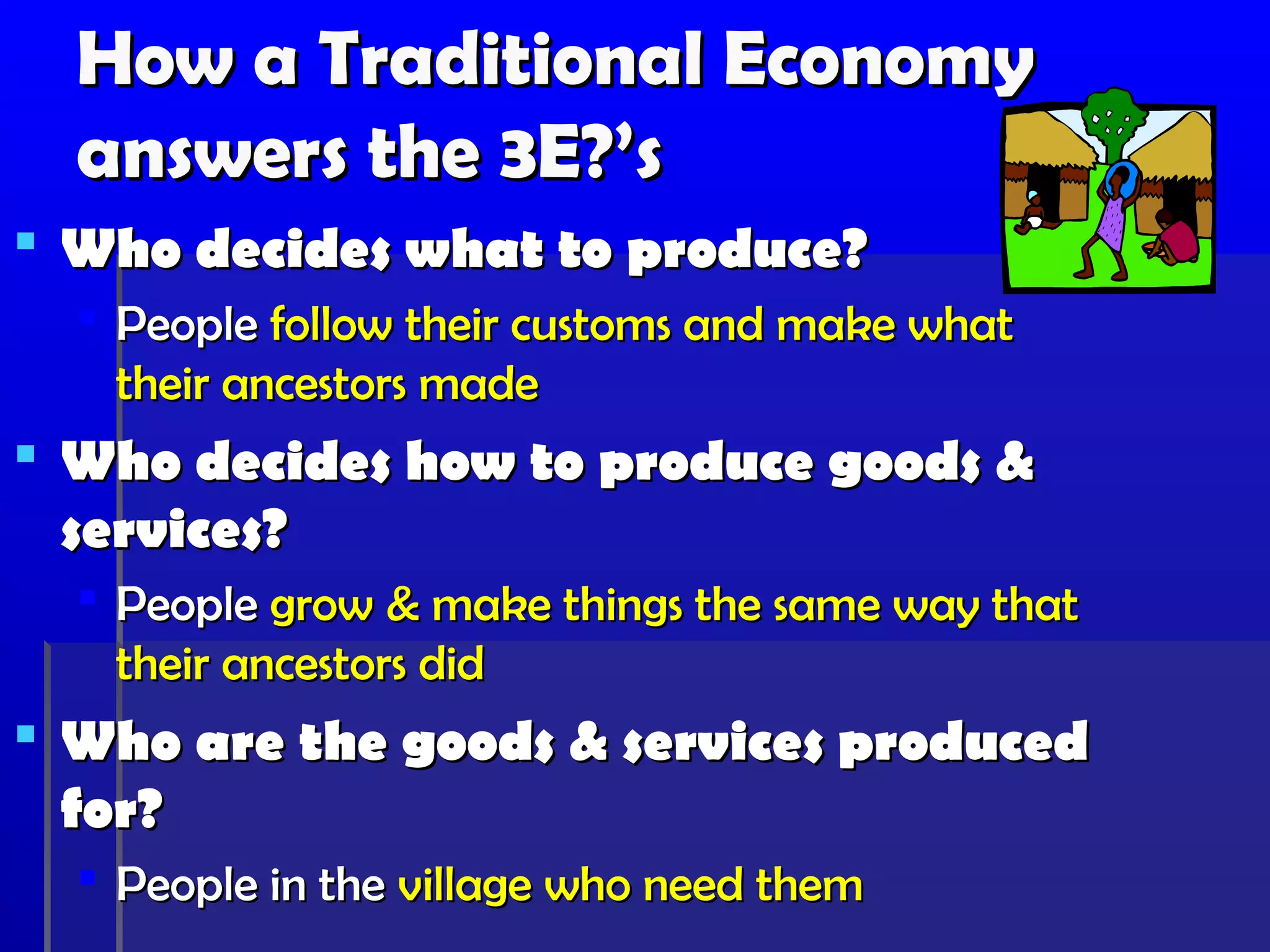
  ď‚§ People follow their customs and make what
    their ancestors made
ď‚§ Who decides how to produce goods &
  services?
  ď‚§ People grow & make things the same way that
    their ancestors did
ď‚§ Who are the goods & services produced
  for?
  ď‚§ People in the village who need them
Traditional Economy

 ď‚§ Examples:
   ď‚§   Villages in Africa and South America
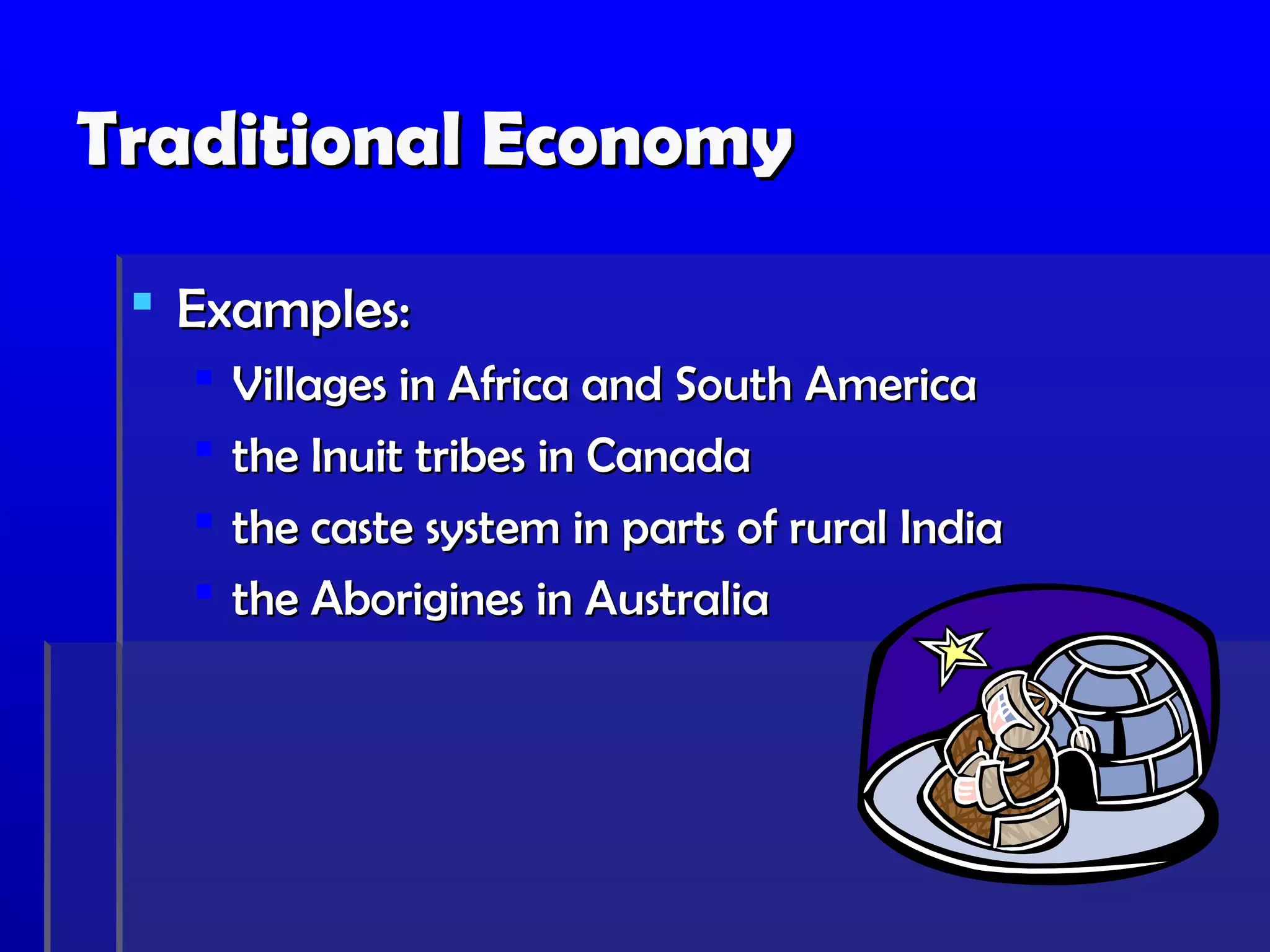
   ď‚§   the Inuit tribes in Canada
   ď‚§   the caste system in parts of rural India
   ď‚§   the Aborigines in Australia
Positives of a
 traditional economy
ď‚§ Predictable
 ď‚§ Knowing what your job will
   be
 ď‚§ Knowing the way you will
   live
Problems with a
  traditional economy
ď‚§Lack many resources
ď‚§Only produce enough to
 live on
Command System
ď‚§ Government makes all economic decisions &
  owns most of the property
ď‚§ Governmental planning groups determine such
  things as the prices of goods/services & the wages
  of workers

ď‚§ This system has not been very successful & more
  and more countries are abandoning it
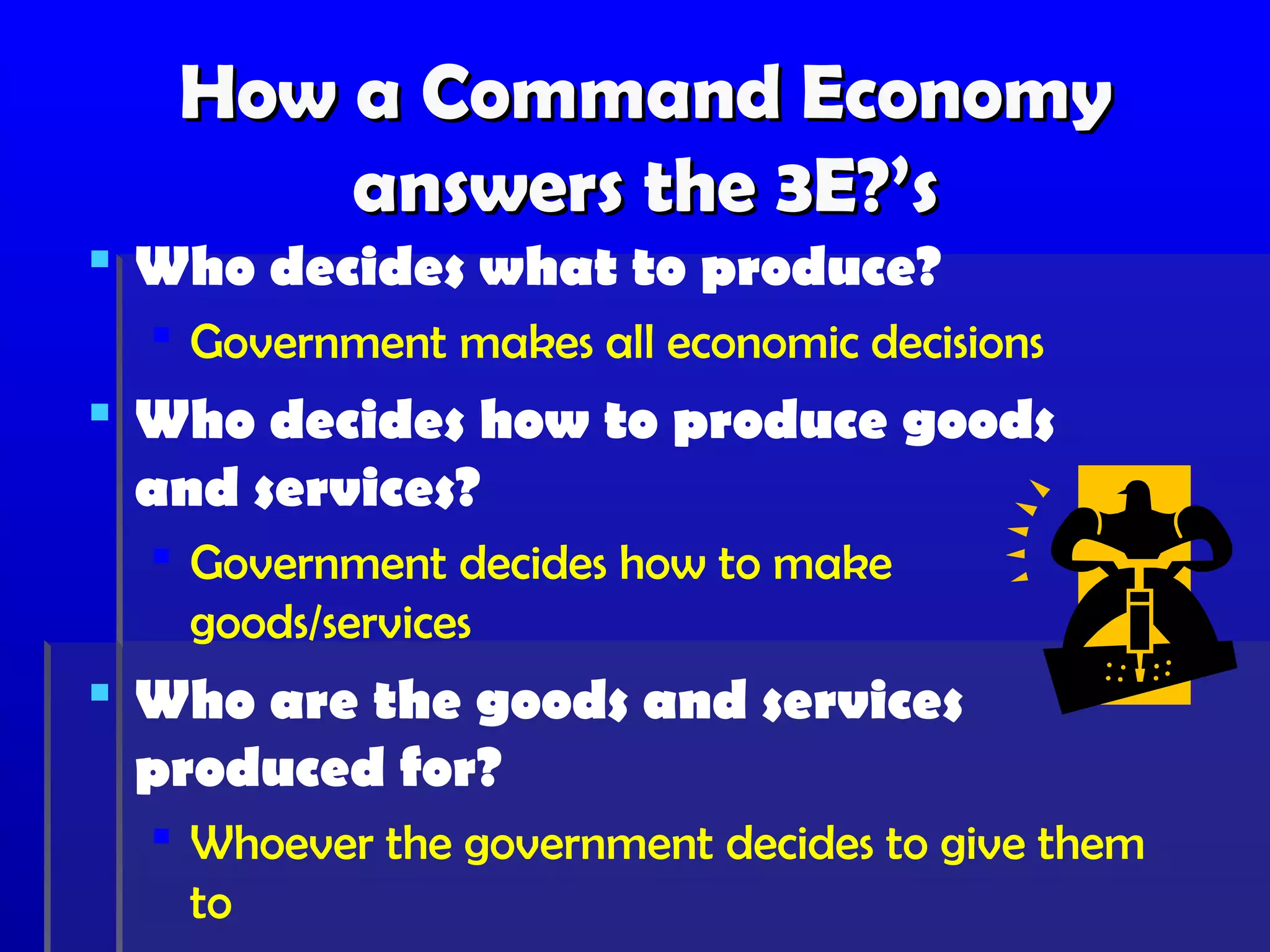
How a Command Economy
       answers the 3E?’s
ď‚§ Who decides what to produce?
  ď‚§ Government makes all economic decisions
ď‚§ Who decides how to produce goods
  and services?
  ď‚§ Government decides how to make
    goods/services
ď‚§ Who are the goods and services
  produced for?
  ď‚§ Whoever the government decides to give them
    to
Command System
 ď‚§ Countries with communist governments have
   Command economies

 ď‚§ Examples: There are no truly pure command
   economic systems, but close countries are:
   North Korea, former Soviet Union, Cuba

   *Germany and Russia have moved away from
   having a Command economy since 1991. Now they
   have a Mixed economy.
Positives of a
  command economy
ď‚§ Because the government
  makes the decisions, people
  don’t have to worry about
  employment, housing,
  education, and healthcare
Problems with a
   command economy
ď‚§ Consumers get low
  priority
ď‚§ Little freedom of choice
ď‚§ All resources are owned
  by the government
Market Economy
 ď‚§ An economic system in which production
   and distribution questions are answered by
   prices and profits (supply and demand)
 ď‚§ Most of the resources are owned by private
   citizens
 ď‚§ Economic decisions are based on Free
   Enterprise (competition between
   companies)
   ď‚§ Important economic questions are not answered
     by gov. but by individuals
   ď‚§ Gov. does not tell a business what goods to
     produce or what price to charge
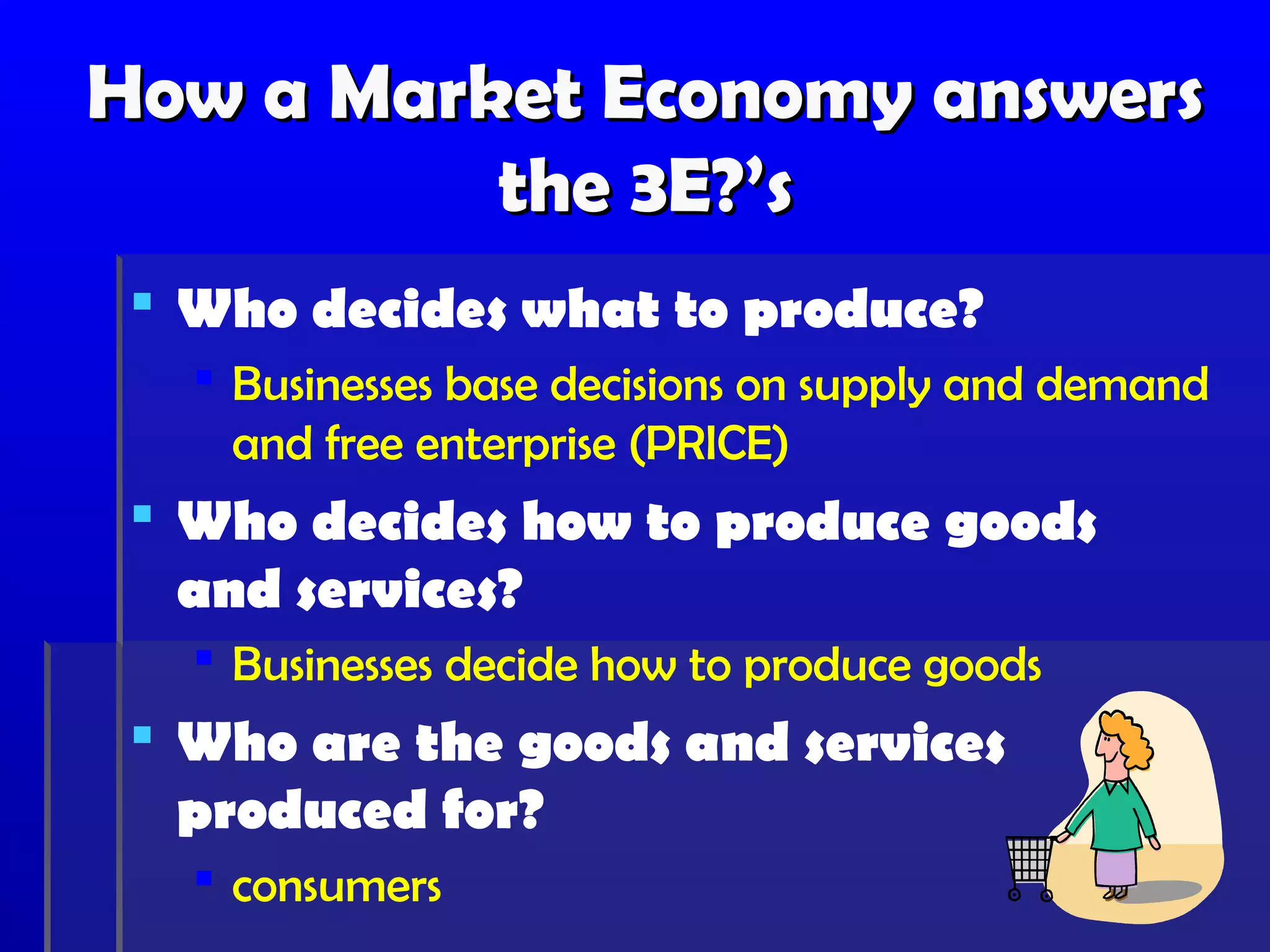
How a Market Economy answers
          the 3E?’s
 ď‚§ Who decides what to produce?
   ď‚§ Businesses base decisions on supply and demand
     and free enterprise (PRICE)
 ď‚§ Who decides how to produce goods
   and services?
   ď‚§ Businesses decide how to produce goods
 ď‚§ Who are the goods and services
   produced for?
   ď‚§ consumers
Market Economy

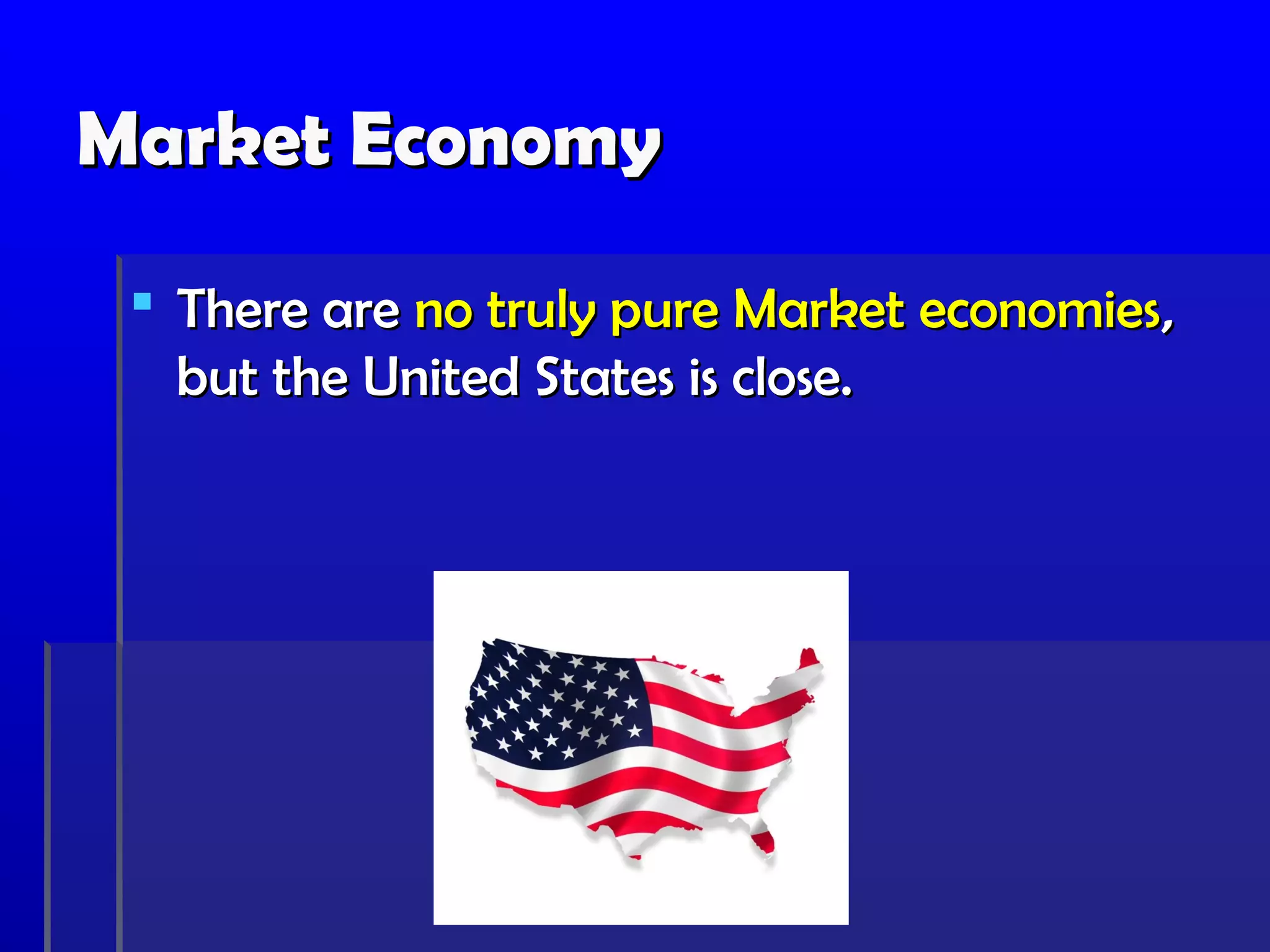
 ď‚§ There are no truly pure Market economies,
   but the United States is close.
ď‚§ In a truly free market economy, the
  government would not be involved at all
  ď‚§ There would be no laws to protect workers form
    unfair bosses
  ď‚§ There would be no rules to make sure that
    credit cards were properly protected

ď‚§ Many societies have chosen to have some
  rules to protect consumers, workers, and
  businesses (MIXED)
  ď‚§ These rules reduce the freedoms that businesses
    have, but they also protect the workers and
    consumers
Positives of a
    market economy
ď‚§ People can start their own
  businesses
ď‚§ People have choice
Problems with a
       market economy
ď‚§ The desire for money may
  lead to poor quality of
  goods and services
ď‚§ Business owners have to
  risk losing money
Mixed Economy
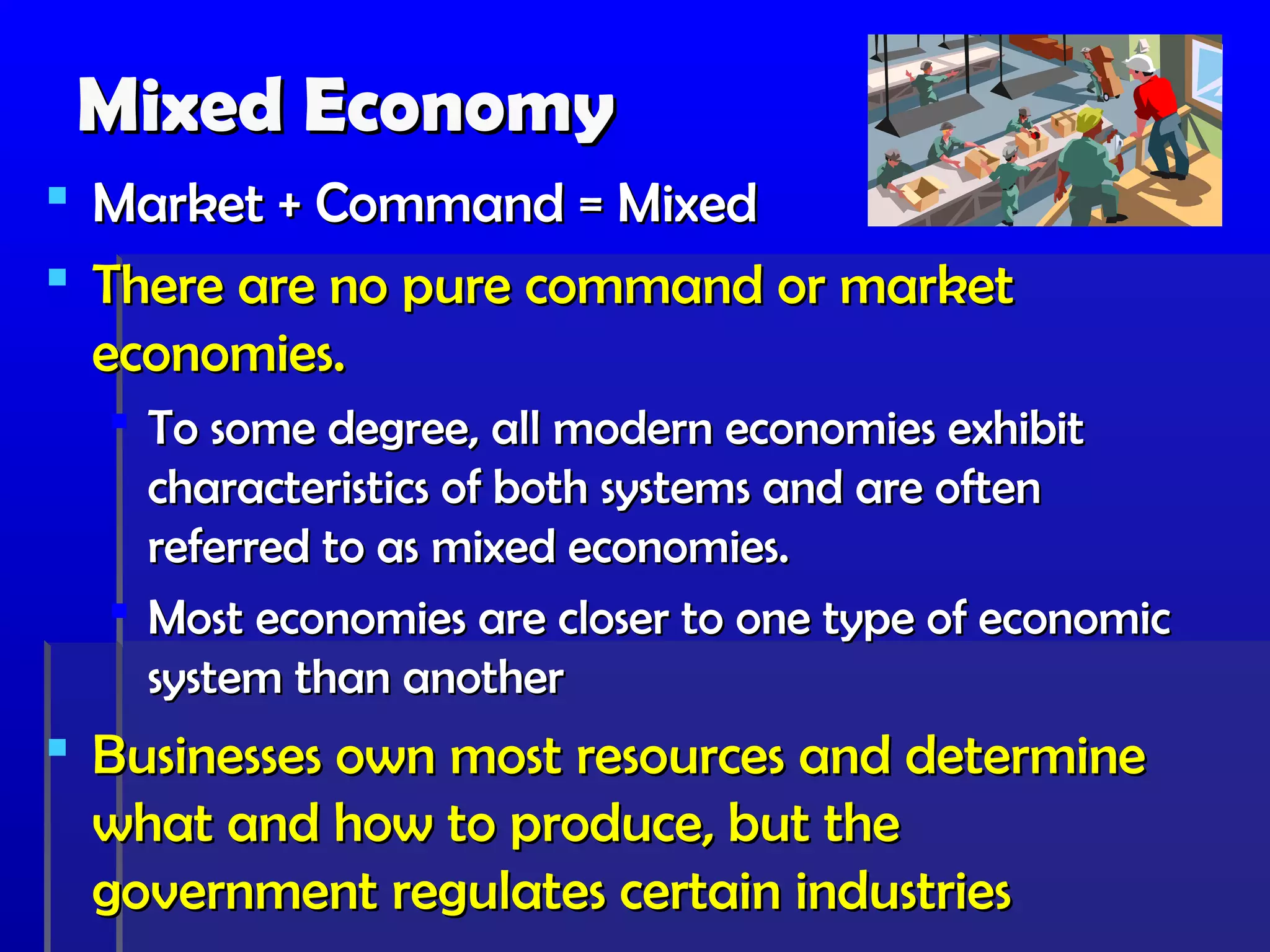
ď‚§ Market + Command = Mixed
ď‚§ There are no pure command or market
  economies.
  ď‚§ To some degree, all modern economies exhibit
    characteristics of both systems and are often
    referred to as mixed economies.
  ď‚§ Most economies are closer to one type of economic
    system than another
ď‚§ Businesses own most resources and determine
  what and how to produce, but the
  government regulates certain industries
How a Mixed Economy answers
          the 3E?’s
ď‚§ Who decides what to produce?
  ď‚§ businesses
ď‚§ Who decides how to produce goods and
  services?
  ď‚§ Businesses, but the government regulates
    certain industries
ď‚§ Who are the goods and services produced
  for?
  ď‚§ consumers
Mixed Economies
 ď‚§ Most democratic countries fall in this
   category (there are no truly pure Market or
   Command economies).
   ď‚§ Examples: Brazil, Mexico, Canada, UK, US,
     Germany, Russia, Australia, etc.
Positives of a Mixed
       economy
ď‚§ Private Ownership of businesses
ď‚§ Protects citizens/workers with
  government regulations
ď‚§ Protects environment
Problems with a Mixed
        economy
ď‚§Government intervention
 can prevent profit for
 companies
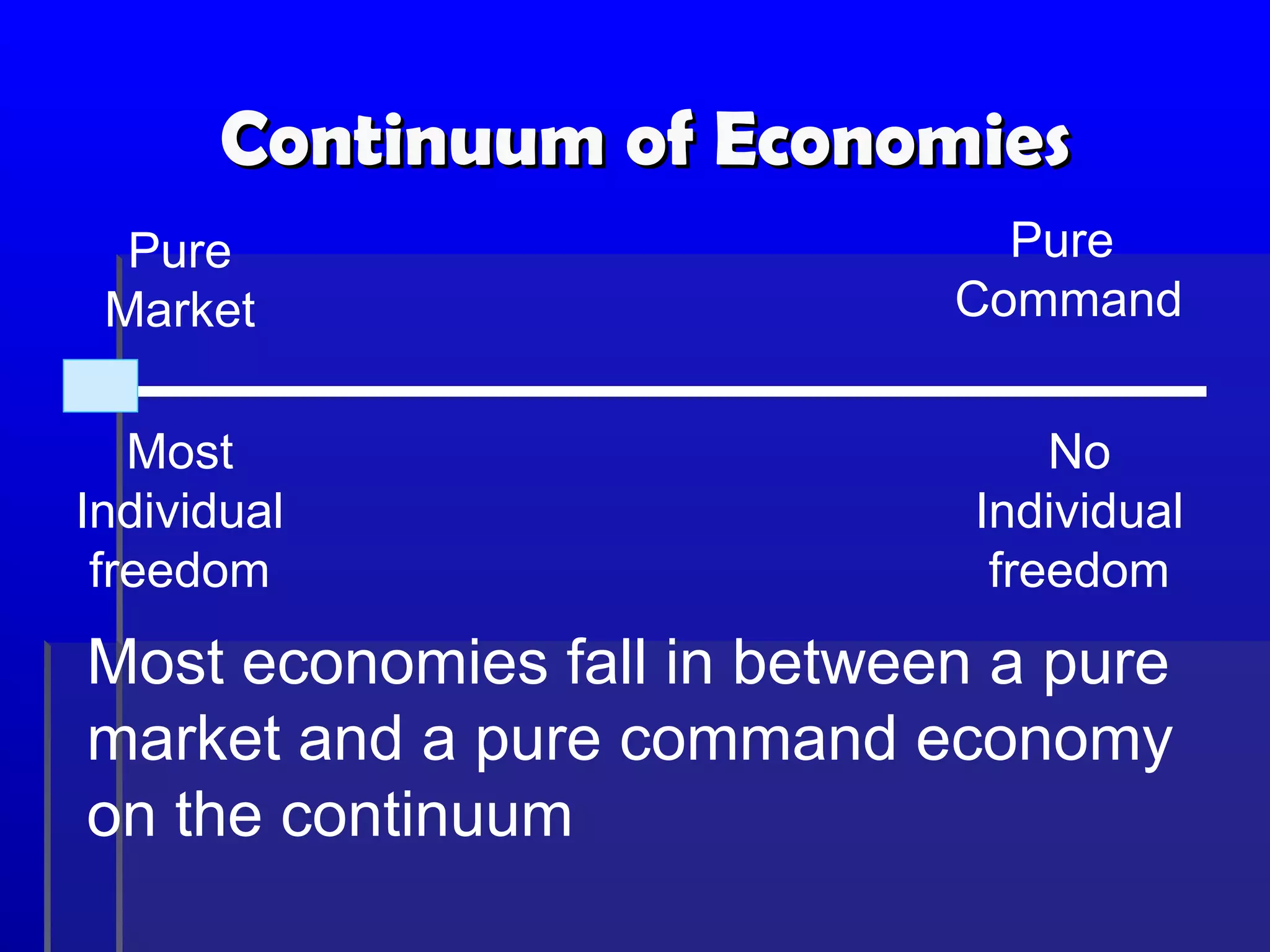
Continuum of Economies
  Pure                         Pure
 Market                      Command


   Most                           No
Individual                    Individual
 freedom                       freedom
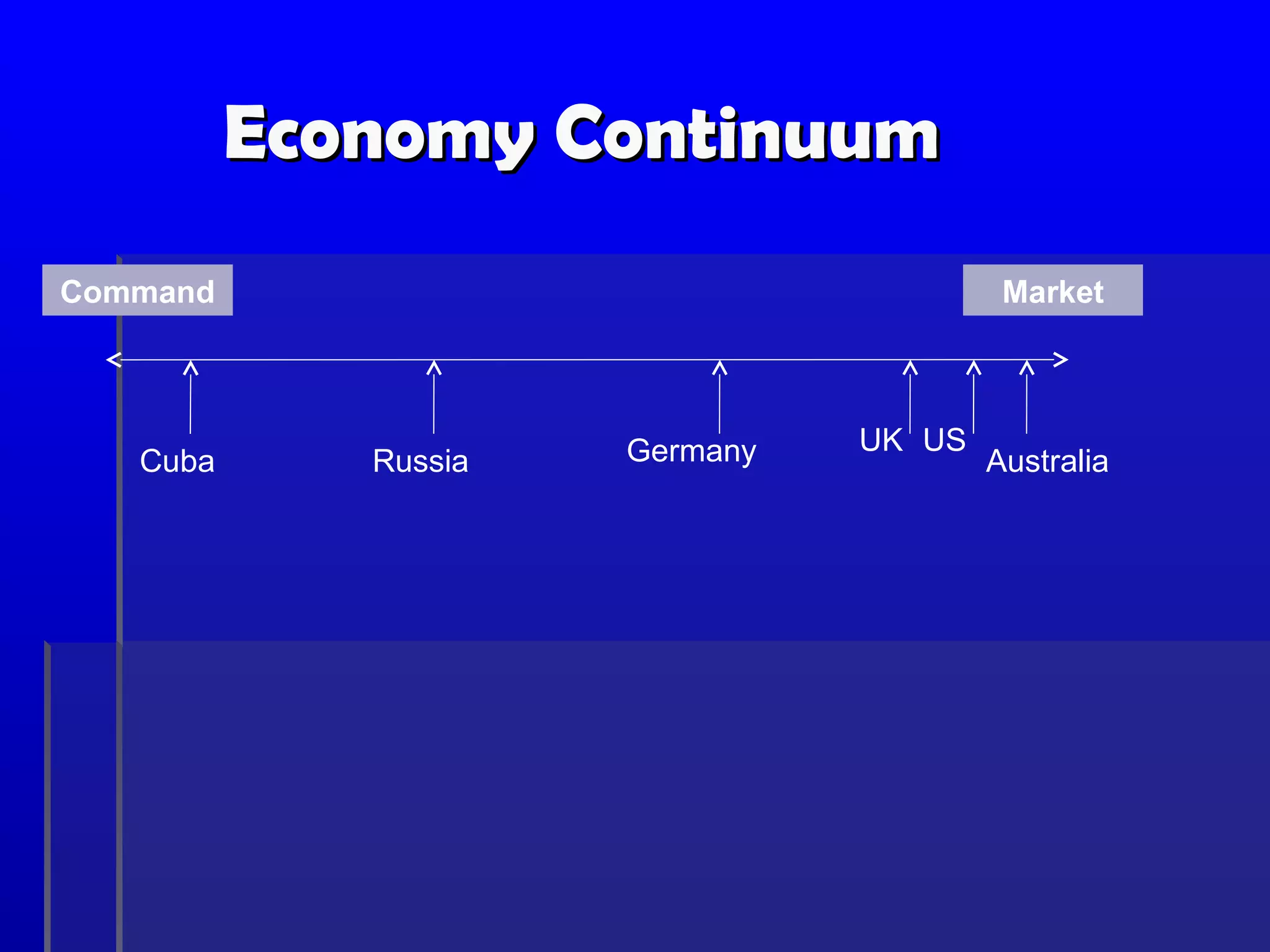
Most economies fall in between a pure
market and a pure command economy
on the continuum
Economy Continuum
Command                                  Market


                      Germany   UK US
   Cuba      Russia                     Australia
Which Economic System Is Best?
 ď‚§ Market system has proven to be best
   because it promotes the goals of growth,
   freedom, & efficiency
   ď‚§ Citizens are free to own their own property and
     use it in the most efficient and profitable way
 ď‚§ Command and Traditional systems
   sometimes offer more security, but are not
   nearly as strong in efficiency, growth,
   freedom, and environmental quality

Week 17 day 4- econ systems and 3 econ questions- computer lab

  • 1.
  • 2.
    Economic Systems An economic system describes how a country’s economy is organized  Because of the problem of scarcity, every country needs a system to determine how to use its productive resources  Scarcity = not having enough of something  An economic system must answer 3 questions…
  • 3.
    The 3 EconomicQuestions (3E?’s) 1. WHAT TO PRODUCE? (What kinds of goods and services should be produced?) 2. HOW TO PRODUCE? (What productive resources are used to produce goods and services?) 3. FOR WHOM TO PRODUCE? (Who gets to have the goods and services?
  • 4.
    Three Types ofEconomic Systems:  1. Traditional Economy  2. Command Economy  3. Market Economy  * Most countries are… Mixed Economies! (Market + Command)
  • 5.
    Traditional Economy ď‚§ Aneconomic system in which economic decisions are based on customs and beliefs ď‚§ People will make what they always made & will do the same work their parents did ď‚§ Exchange of goods is done through Bartering: trading without using money
  • 6.
    How a TraditionalEconomy answers the 3E?’s  Who decides what to produce?  People follow their customs and make what their ancestors made  Who decides how to produce goods & services?  People grow & make things the same way that their ancestors did  Who are the goods & services produced for?  People in the village who need them
  • 7.
    Traditional Economy ď‚§Examples: ď‚§ Villages in Africa and South America ď‚§ the Inuit tribes in Canada ď‚§ the caste system in parts of rural India ď‚§ the Aborigines in Australia
  • 8.
    Positives of a traditional economy ď‚§ Predictable ď‚§ Knowing what your job will be ď‚§ Knowing the way you will live
  • 9.
    Problems with a traditional economy ď‚§Lack many resources ď‚§Only produce enough to live on
  • 10.
    Command System ď‚§ Governmentmakes all economic decisions & owns most of the property ď‚§ Governmental planning groups determine such things as the prices of goods/services & the wages of workers ď‚§ This system has not been very successful & more and more countries are abandoning it
  • 11.
    How a CommandEconomy answers the 3E?’s  Who decides what to produce?  Government makes all economic decisions  Who decides how to produce goods and services?  Government decides how to make goods/services  Who are the goods and services produced for?  Whoever the government decides to give them to
  • 12.
    Command System ď‚§Countries with communist governments have Command economies ď‚§ Examples: There are no truly pure command economic systems, but close countries are: North Korea, former Soviet Union, Cuba *Germany and Russia have moved away from having a Command economy since 1991. Now they have a Mixed economy.
  • 13.
    Positives of a command economy  Because the government makes the decisions, people don’t have to worry about employment, housing, education, and healthcare
  • 14.
    Problems with a command economy ď‚§ Consumers get low priority ď‚§ Little freedom of choice ď‚§ All resources are owned by the government
  • 15.
    Market Economy ď‚§An economic system in which production and distribution questions are answered by prices and profits (supply and demand) ď‚§ Most of the resources are owned by private citizens ď‚§ Economic decisions are based on Free Enterprise (competition between companies) ď‚§ Important economic questions are not answered by gov. but by individuals ď‚§ Gov. does not tell a business what goods to produce or what price to charge
  • 16.
    How a MarketEconomy answers the 3E?’s  Who decides what to produce?  Businesses base decisions on supply and demand and free enterprise (PRICE)  Who decides how to produce goods and services?  Businesses decide how to produce goods  Who are the goods and services produced for?  consumers
  • 17.
    Market Economy ď‚§There are no truly pure Market economies, but the United States is close.
  • 18.
    ď‚§ In atruly free market economy, the government would not be involved at all ď‚§ There would be no laws to protect workers form unfair bosses ď‚§ There would be no rules to make sure that credit cards were properly protected ď‚§ Many societies have chosen to have some rules to protect consumers, workers, and businesses (MIXED) ď‚§ These rules reduce the freedoms that businesses have, but they also protect the workers and consumers
  • 19.
    Positives of a market economy ď‚§ People can start their own businesses ď‚§ People have choice
  • 20.
    Problems with a market economy ď‚§ The desire for money may lead to poor quality of goods and services ď‚§ Business owners have to risk losing money
  • 21.
    Mixed Economy ď‚§ Market+ Command = Mixed ď‚§ There are no pure command or market economies. ď‚§ To some degree, all modern economies exhibit characteristics of both systems and are often referred to as mixed economies. ď‚§ Most economies are closer to one type of economic system than another ď‚§ Businesses own most resources and determine what and how to produce, but the government regulates certain industries
  • 22.
    How a MixedEconomy answers the 3E?’s  Who decides what to produce?  businesses  Who decides how to produce goods and services?  Businesses, but the government regulates certain industries  Who are the goods and services produced for?  consumers
  • 23.
    Mixed Economies ď‚§Most democratic countries fall in this category (there are no truly pure Market or Command economies). ď‚§ Examples: Brazil, Mexico, Canada, UK, US, Germany, Russia, Australia, etc.
  • 24.
    Positives of aMixed economy ď‚§ Private Ownership of businesses ď‚§ Protects citizens/workers with government regulations ď‚§ Protects environment
  • 25.
    Problems with aMixed economy ď‚§Government intervention can prevent profit for companies
  • 26.
    Continuum of Economies Pure Pure Market Command Most No Individual Individual freedom freedom Most economies fall in between a pure market and a pure command economy on the continuum
  • 27.
    Economy Continuum Command Market Germany UK US Cuba Russia Australia
  • 28.
    Which Economic SystemIs Best? ď‚§ Market system has proven to be best because it promotes the goals of growth, freedom, & efficiency ď‚§ Citizens are free to own their own property and use it in the most efficient and profitable way ď‚§ Command and Traditional systems sometimes offer more security, but are not nearly as strong in efficiency, growth, freedom, and environmental quality