Economic Systems
    Unit 12 Notes
Different Economic Systems
• Scarcity refers to the limited supply of
  something
  – Every country must deal with the problem of
    scarcity since no country has everything that
    its people need/want
• Every country must develop an economic
  system to determine how to use its limited
  resources to answer the three basic
  economic questions:
  – What goods/services will be produced?
  – How will goods/services be produced?
  – Who will consume the goods/services?
• The way a country answers these
  questions determines its economic system
Traditional Economy
 • An economic system in which
   economic decisions are based on
   customs and beliefs
 • People will make what they always
   made & will do the same work their
   parents did
 • Exchange of goods is done through
   Bartering: trading without using
   money
Traditional Economy

• Who decides what to produce?
  – People follow their customs and make what
    their ancestors made
• Who decides how to produce goods &
  services?
  – People grow & make things the same way that
    their ancestors did
• Who are the goods & services produced
  for?
  – People in the village who need them
Traditional Economies


• Examples:
  –   Villages in Africa and South America
  –   the Inuit tribes in Canada
  –   the caste system in parts of rural India
  –   the Aborigines in Australia
Command System


• Government makes all economic decisions
  & owns most of the property
• Governmental planning groups determine
  such things as the prices of goods/services
  & the wages of workers

• This system has not been very successful
  & more and more countries are
  abandoning it
Command Economy


• Who decides what to produce?
  – Government makes all economic decisions
• Who decides how to produce goods and
  services?
  – Government decides how to make
    goods/services
• Who are the goods and services
  produced for?
  – Whoever the government decides to give
    them to
Command System
  Countries with communist
  governments have command economies
  – Examples: Cuba, former Soviet Union, North
    Korea
• The government of Australia controlled
  one part of the economy in the past --
  government-owned companies
  controlled telecommunications
  – Government set the price for having a
    phone, the cost of calls, and wages were
    the same in all parts of the country
  – In 1989, the company was made into a
    private business with stockholders owning
    the company
Market Economy
 • An economic system in which economic
   decisions are guided by the changes in
   prices that occur as individual buyers and
   sellers interact in the market place
   – Most of the resources are owned by private
     citizens
 • Economic decisions are based on Free
   Enterprise (competition between
   companies)
   – Important economic questions are not
     answered by government but by individuals
   – Government does not tell a business what
     goods to produce or what price to charge
Market Economy

• Who decides what to produce?
  – Businesses base decisions on supply and
    demand and free enterprise (PRICE)
• Who decides how to produce goods and
  services?
  – Businesses decide how to produce goods
• Who are the goods and services
  produced for?
  – consumers
Market Economy

• There are no truly pure Market
  economies, but Australia’s is close:
  – It is considered one of the most free
    economies in the world
  – Businesses operate without too many rules
    form the government
  – People are free to start a business and can
    do so quickly
  – Courts use the laws of Australia to protect
    the property rights of citizens
• In a truly free market economy, the
  government would not be involved at all
  – There would be no laws to protect workers
    form unfair bosses
  – There would be no rules to make sure that
    credit cards were properly protected


• Many societies have chosen to have
  some rules to protect consumers,
  workers, and businesses (MIXED)
  – These rules reduce the freedoms that
    businesses have, but they also protect the
    workers and consumers
Mixed Economy

• Market + Command = Mixed
• There are no pure command or market
  economies. To some degree, all modern
  economies exhibit characteristics of both
  systems and are often referred to as
  mixed economies.
  – Most economies are closer to one type of
    economic system than another
• Businesses own most resources and
  determine what and how to produce, but
  the government regulates certain
  industries
Mixed Economy

• Who decides what to produce?
  – businesses
• Who decides how to produce goods
  and services?
  – Businesses, but the government regulates
    certain industries
• Who are the goods and services
  produced for?
  – consumers
Mixed Economies

• Most democratic countries fall in this
  category (there are no truly pure Market
  or Command economies).
  – Examples:
    Brazil, Mexico, Canada, UK, US, Germany, R
    ussia, Australia, etc.
Australia’s Economy

• One of the freest economies in the
  world
• It is technically a mixed economy, but
  it’s close to market because there are
  very few rules to restrict the market
• Government does not own major
  industry or business
  – Prices are set by the agreement of buyers
    and sellers rather than by government rules
Australia’s Economy

• People are free to own their own
  businesses and property
  – They decide what they want to produce
• Buyers and sellers are able to agree on
  prices, and competition between sellers
  helps to keep the prices good for buyers
• Business owners and consumers can
  depend on good laws to protect them
  – Courts are considered fair and honest
• It is very easy to start a business in
  Australia – the paperwork usually takes
  less than a week!
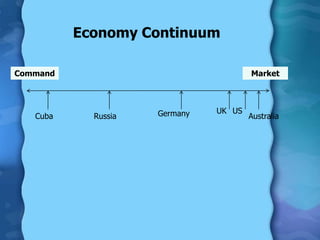
Economy Continuum

Command                                Market


                     Germany   UK US
   Cuba     Russia                     Australia

Economic Systems A B

  • 1.
    Economic Systems Unit 12 Notes
  • 2.
    Different Economic Systems •Scarcity refers to the limited supply of something – Every country must deal with the problem of scarcity since no country has everything that its people need/want • Every country must develop an economic system to determine how to use its limited resources to answer the three basic economic questions: – What goods/services will be produced? – How will goods/services be produced? – Who will consume the goods/services? • The way a country answers these questions determines its economic system
  • 3.
    Traditional Economy •An economic system in which economic decisions are based on customs and beliefs • People will make what they always made & will do the same work their parents did • Exchange of goods is done through Bartering: trading without using money
  • 4.
    Traditional Economy • Whodecides what to produce? – People follow their customs and make what their ancestors made • Who decides how to produce goods & services? – People grow & make things the same way that their ancestors did • Who are the goods & services produced for? – People in the village who need them
  • 5.
    Traditional Economies • Examples: – Villages in Africa and South America – the Inuit tribes in Canada – the caste system in parts of rural India – the Aborigines in Australia
  • 6.
    Command System • Governmentmakes all economic decisions & owns most of the property • Governmental planning groups determine such things as the prices of goods/services & the wages of workers • This system has not been very successful & more and more countries are abandoning it
  • 7.
    Command Economy • Whodecides what to produce? – Government makes all economic decisions • Who decides how to produce goods and services? – Government decides how to make goods/services • Who are the goods and services produced for? – Whoever the government decides to give them to
  • 8.
    Command System Countries with communist governments have command economies – Examples: Cuba, former Soviet Union, North Korea • The government of Australia controlled one part of the economy in the past -- government-owned companies controlled telecommunications – Government set the price for having a phone, the cost of calls, and wages were the same in all parts of the country – In 1989, the company was made into a private business with stockholders owning the company
  • 9.
    Market Economy •An economic system in which economic decisions are guided by the changes in prices that occur as individual buyers and sellers interact in the market place – Most of the resources are owned by private citizens • Economic decisions are based on Free Enterprise (competition between companies) – Important economic questions are not answered by government but by individuals – Government does not tell a business what goods to produce or what price to charge
  • 10.
    Market Economy • Whodecides what to produce? – Businesses base decisions on supply and demand and free enterprise (PRICE) • Who decides how to produce goods and services? – Businesses decide how to produce goods • Who are the goods and services produced for? – consumers
  • 11.
    Market Economy • Thereare no truly pure Market economies, but Australia’s is close: – It is considered one of the most free economies in the world – Businesses operate without too many rules form the government – People are free to start a business and can do so quickly – Courts use the laws of Australia to protect the property rights of citizens
  • 12.
    • In atruly free market economy, the government would not be involved at all – There would be no laws to protect workers form unfair bosses – There would be no rules to make sure that credit cards were properly protected • Many societies have chosen to have some rules to protect consumers, workers, and businesses (MIXED) – These rules reduce the freedoms that businesses have, but they also protect the workers and consumers
  • 13.
    Mixed Economy • Market+ Command = Mixed • There are no pure command or market economies. To some degree, all modern economies exhibit characteristics of both systems and are often referred to as mixed economies. – Most economies are closer to one type of economic system than another • Businesses own most resources and determine what and how to produce, but the government regulates certain industries
  • 14.
    Mixed Economy • Whodecides what to produce? – businesses • Who decides how to produce goods and services? – Businesses, but the government regulates certain industries • Who are the goods and services produced for? – consumers
  • 15.
    Mixed Economies • Mostdemocratic countries fall in this category (there are no truly pure Market or Command economies). – Examples: Brazil, Mexico, Canada, UK, US, Germany, R ussia, Australia, etc.
  • 16.
    Australia’s Economy • Oneof the freest economies in the world • It is technically a mixed economy, but it’s close to market because there are very few rules to restrict the market • Government does not own major industry or business – Prices are set by the agreement of buyers and sellers rather than by government rules
  • 17.
    Australia’s Economy • Peopleare free to own their own businesses and property – They decide what they want to produce • Buyers and sellers are able to agree on prices, and competition between sellers helps to keep the prices good for buyers • Business owners and consumers can depend on good laws to protect them – Courts are considered fair and honest • It is very easy to start a business in Australia – the paperwork usually takes less than a week!
  • 18.
    Economy Continuum Command Market Germany UK US Cuba Russia Australia