2.01 Economic Systems
Objective 2.01 Compare
different types of economic
systems: traditional, free
enterprise, command and
mixed.
mixed.
What is Economics?
What is Economics?
 Economics studies how individuals
Economics studies how individuals
and societies seek to satisfy needs
and wants through incentives,
choices, and allocation of scarce
resources.
resources.
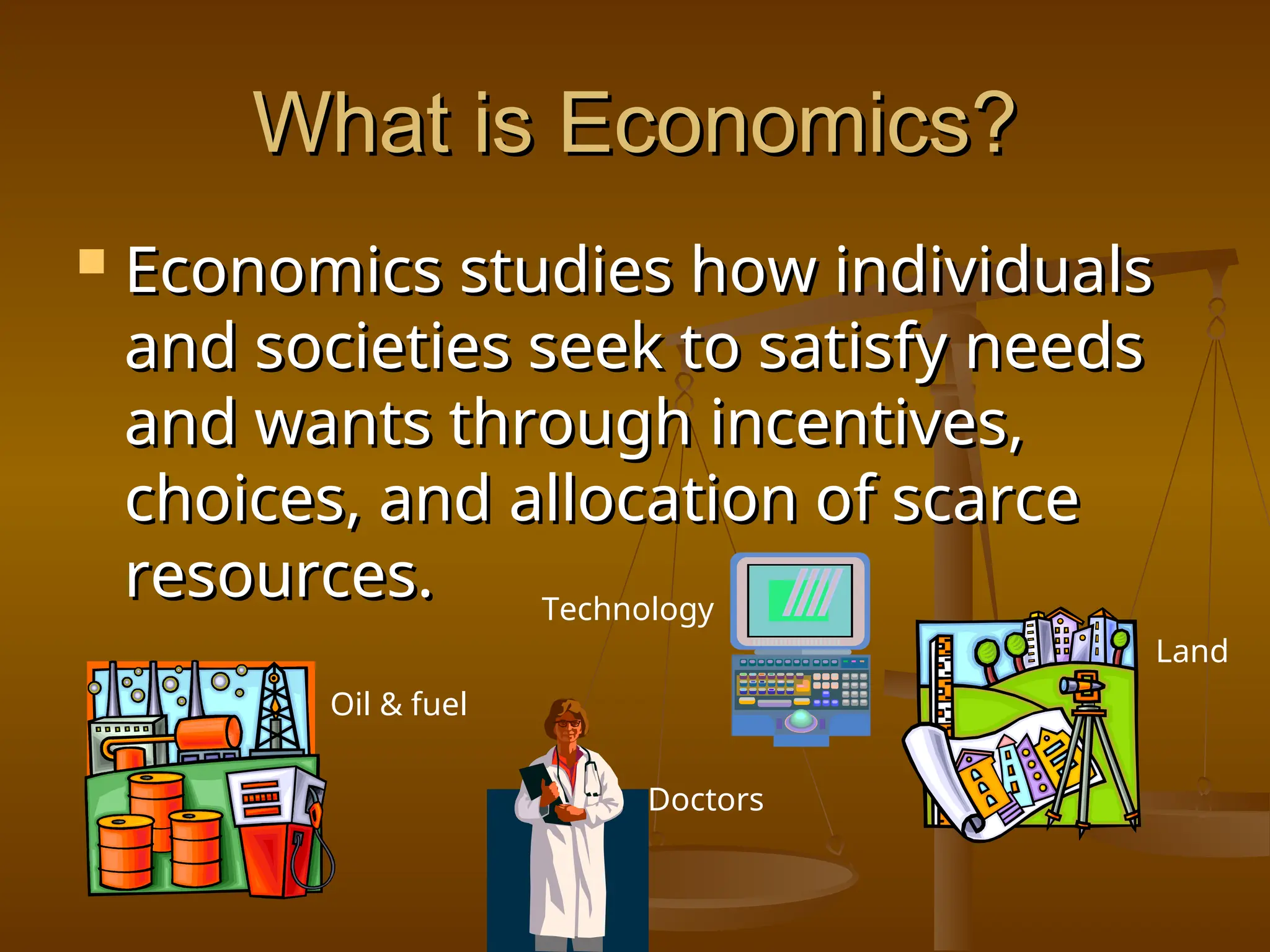
Oil & fuel
Land
Doctors
Technology
Factors of Production
 Economic Resources
Economic Resources
 Natural Resources
Natural Resources – raw materials found in
– raw materials found in
nature that are used to produce goods
 Human Resources
Human Resources – people’s knowledge,
– people’s knowledge,
efforts, and skills used in their work
 Capital Resources
Capital Resources – used to produce goods
– used to produce goods
and services (buildings, materials, and
equipment)
equipment)
 Entrepreneurial Resources
Entrepreneurial Resources - recognize the
- recognize the
need for new goods or service
 Scarcity – shortage of resources
Scarcity – shortage of resources
Why Economic Systems?
 Nations use economic systems to
Nations use economic systems to
determine how to use their limited
resources effectively.
 Primary goal of an economic system is
Primary goal of an economic system is
to provide people with a minimum
standard of living, or quality of life.
 Different types of Economic Systems
Different types of Economic Systems
 Traditional Economy
Traditional Economy
 Market Economy (free enterprise)
Market Economy (free enterprise)
 Command Economy
Command Economy
 Mixed Economy
Mixed Economy
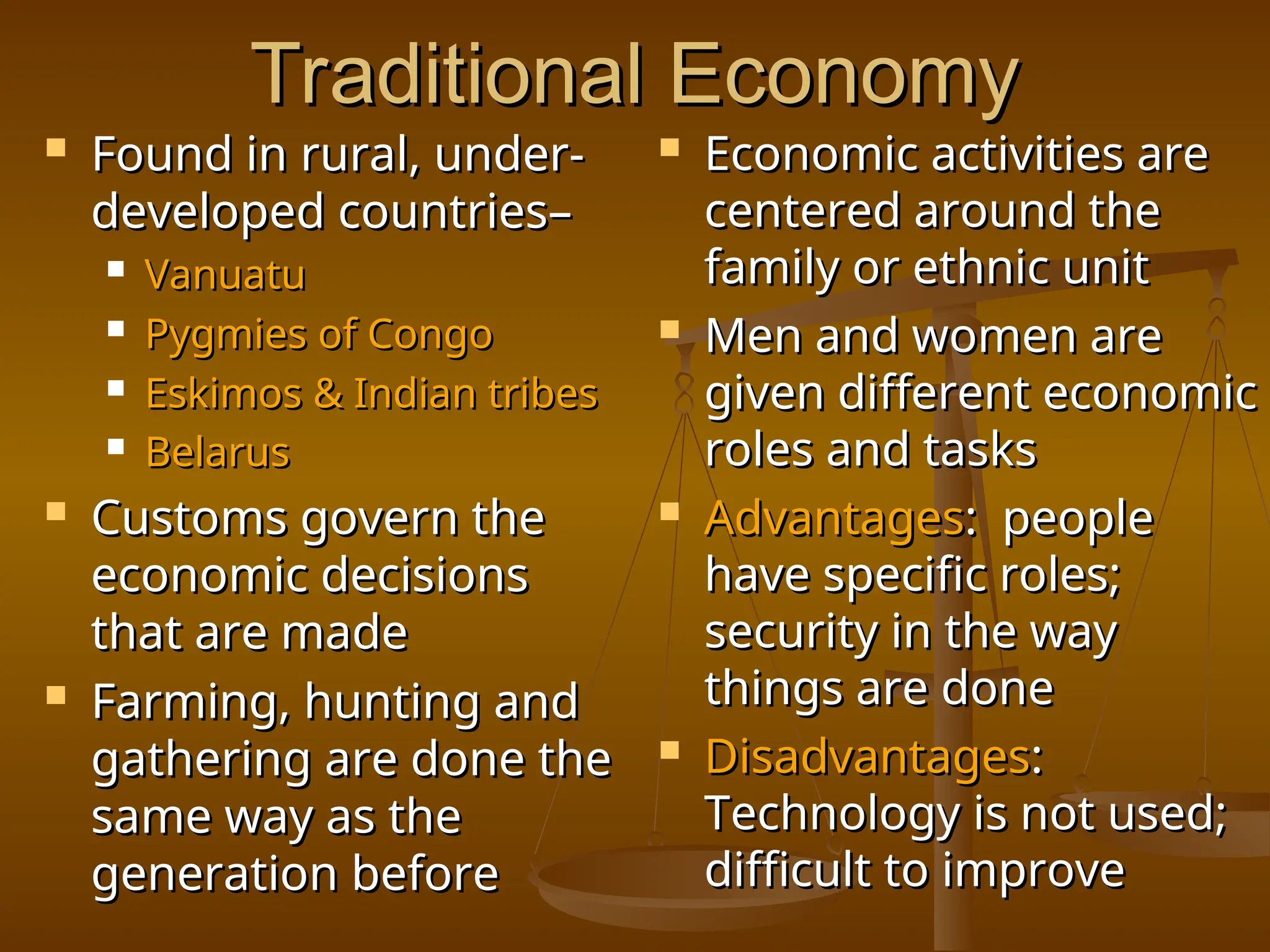
Traditional Economy
Traditional Economy
 Found in rural, under-
Found in rural, under-
developed countries–
 Vanuatu
Vanuatu
 Pygmies of Congo
Pygmies of Congo
 Eskimos & Indian tribes
Eskimos & Indian tribes
 Belarus
Belarus
 Customs govern the
Customs govern the
economic decisions
economic decisions
that are made
that are made
 Farming, hunting and
Farming, hunting and
gathering are done the
same way as the
same way as the
generation before
generation before
 Economic activities are
Economic activities are
centered around the
centered around the
family or ethnic unit
 Men and women are
Men and women are
given different economic
roles and tasks
roles and tasks
 Advantages
Advantages: people
: people
have specific roles;
security in the way
security in the way
things are done
things are done
 Disadvantages
Disadvantages:
:
Technology is not used;
difficult to improve
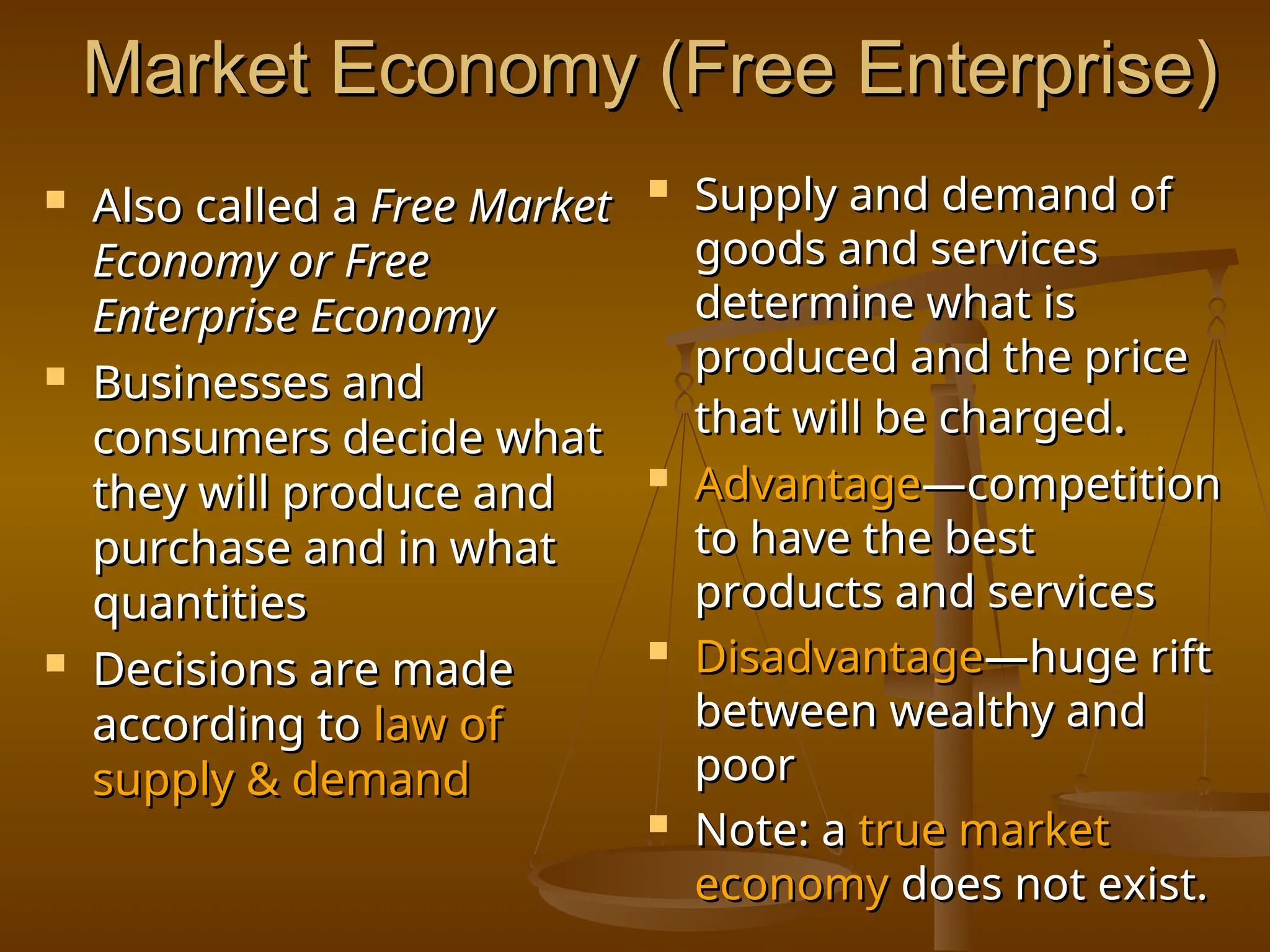
Market Economy (Free Enterprise)
 Also called a
Also called a Free Market
Free Market
Economy or Free
Economy or Free
Enterprise Economy
Enterprise Economy
 Businesses and
Businesses and
consumers decide what
they will produce and
purchase and in what
quantities
quantities
 Decisions are made
Decisions are made
according to
according to law of
law of
supply & demand
supply & demand
 Supply and demand of
Supply and demand of
goods and services
goods and services
determine what is
determine what is
produced and the price
that will be charged
that will be charged.
.
 Advantage
Advantage—competition
—competition
to have the best
to have the best
products and services
 Disadvantage
Disadvantage—huge rift
—huge rift
between wealthy and
between wealthy and
poor
poor
 Note: a
Note: a true market
true market
economy
economy does not exist.
does not exist.
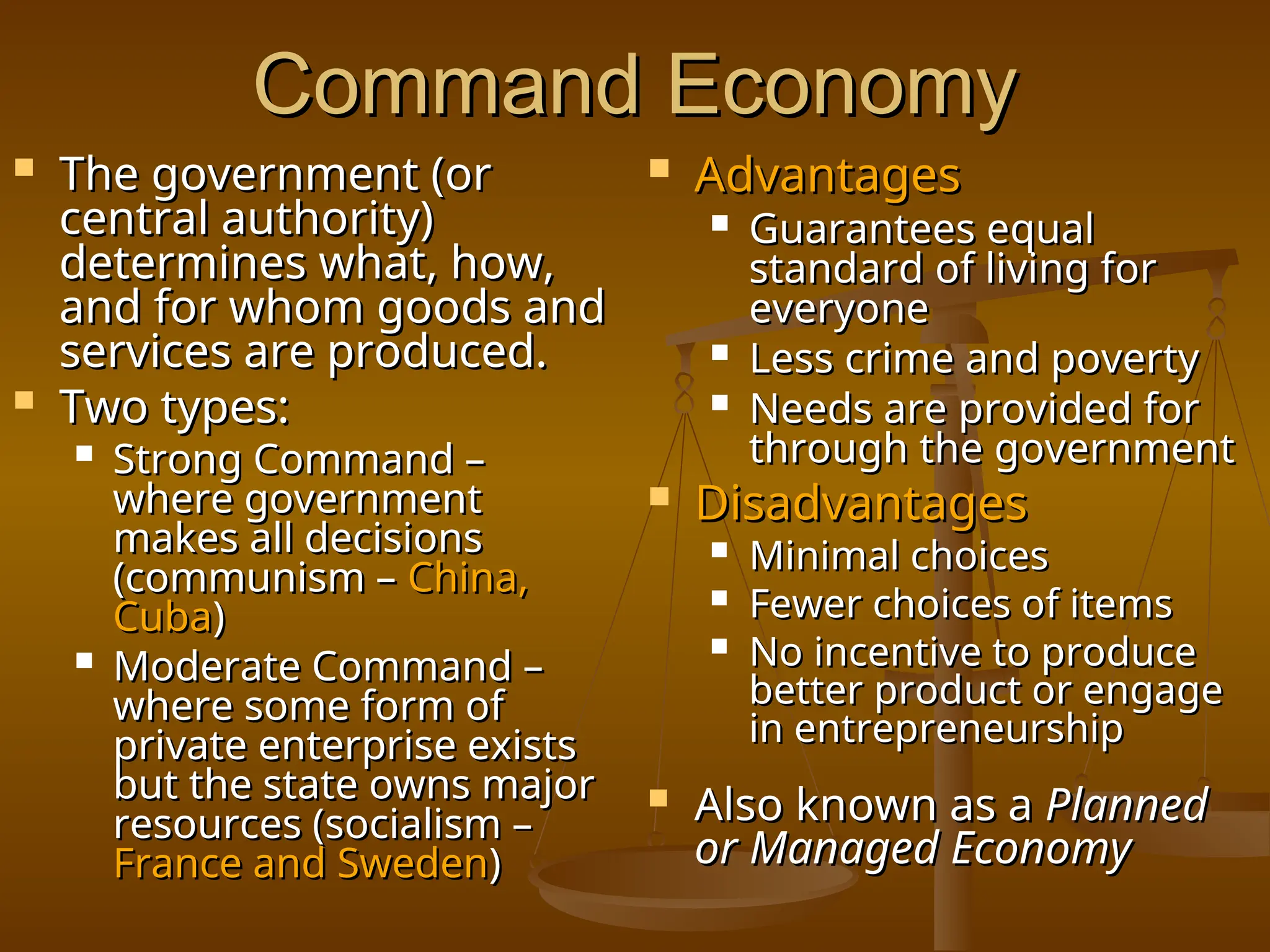
Command Economy
Command Economy
 The government (or
The government (or
central authority)
central authority)
determines what, how,
and for whom goods and
services are produced.
 Two types:
Two types:
 Strong Command –
Strong Command –
where government
where government
makes all decisions
makes all decisions
(communism –
(communism – China,
China,
Cuba
Cuba)
)
 Moderate Command –
Moderate Command –
where some form of
where some form of
private enterprise exists
but the state owns major
resources (socialism –
France and Sweden
France and Sweden)
)
 Advantages
Advantages
 Guarantees equal
Guarantees equal
standard of living for
everyone
everyone
 Less crime and poverty
Less crime and poverty
 Needs are provided for
Needs are provided for
through the government
 Disadvantages
Disadvantages
 Minimal choices
Minimal choices
 Fewer choices of items
Fewer choices of items
 No incentive to produce
No incentive to produce
better product or engage
in entrepreneurship
in entrepreneurship
 Also known as a
Also known as a Planned
Planned
or Managed Economy
or Managed Economy
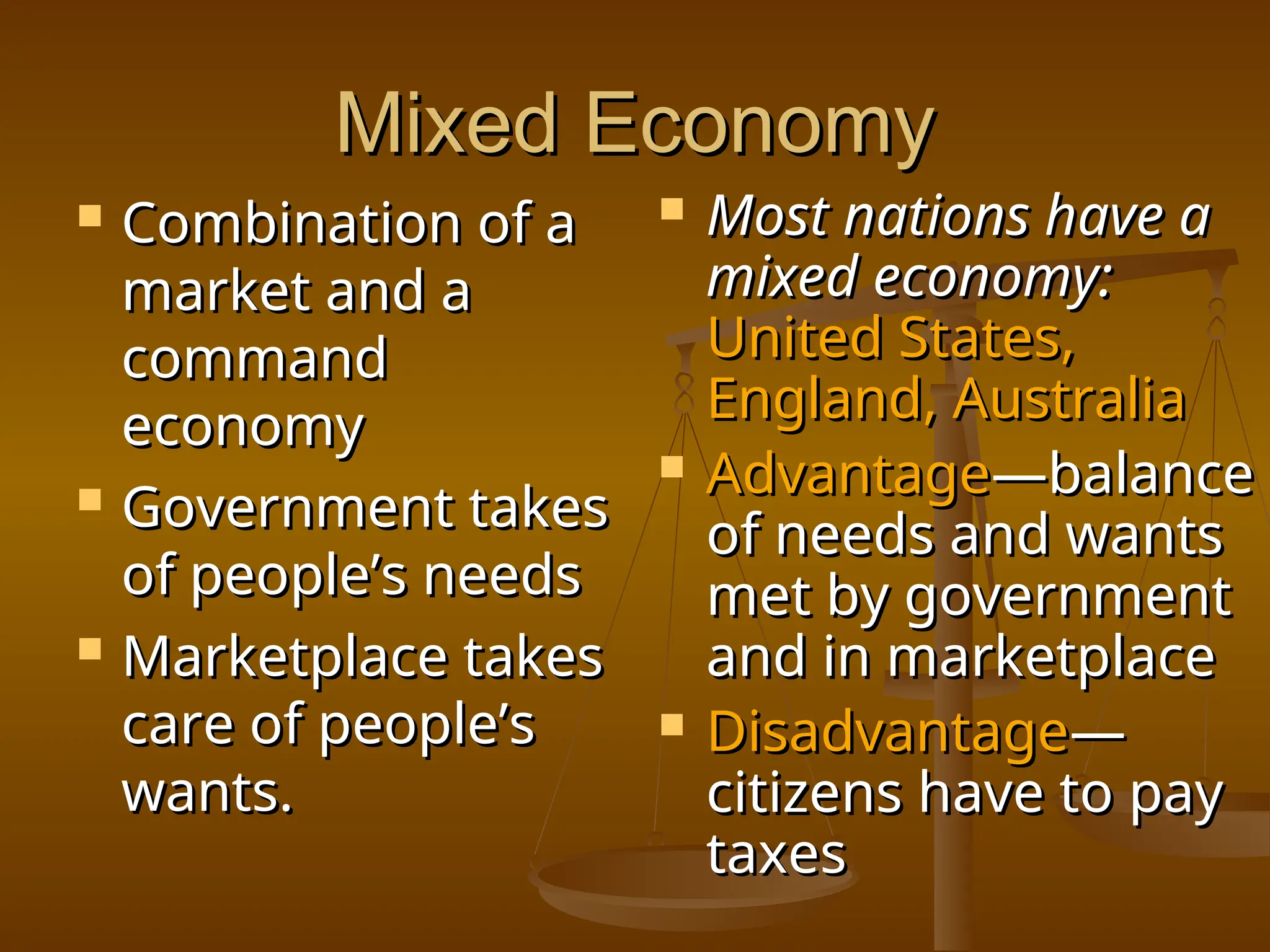
Mixed Economy
Mixed Economy
 Combination of a
Combination of a
market and a
market and a
command
command
economy
economy
 Government takes
Government takes
of people’s needs
of people’s needs
 Marketplace takes
Marketplace takes
care of people’s
care of people’s
wants.
wants.
 Most nations have a
Most nations have a
mixed economy:
mixed economy:
United States,
United States,
England, Australia
England, Australia
 Advantage
Advantage—balance
—balance
of needs and wants
of needs and wants
met by government
met by government
and in marketplace
and in marketplace
 Disadvantage
Disadvantage—
—
citizens have to pay
taxes
taxes

Economic Systems Comparison Basics .ppt

  • 1.
    2.01 Economic Systems 2.01Economic Systems Objective 2.01 Compare Objective 2.01 Compare different types of economic different types of economic systems: traditional, free systems: traditional, free enterprise, command and enterprise, command and mixed. mixed.
  • 2.
    What is Economics? Whatis Economics?  Economics studies how individuals Economics studies how individuals and societies seek to satisfy needs and societies seek to satisfy needs and wants through incentives, and wants through incentives, choices, and allocation of scarce choices, and allocation of scarce resources. resources. Oil & fuel Land Doctors Technology
  • 3.
    Factors of Production Factorsof Production  Economic Resources Economic Resources  Natural Resources Natural Resources – raw materials found in – raw materials found in nature that are used to produce goods nature that are used to produce goods  Human Resources Human Resources – people’s knowledge, – people’s knowledge, efforts, and skills used in their work efforts, and skills used in their work  Capital Resources Capital Resources – used to produce goods – used to produce goods and services (buildings, materials, and and services (buildings, materials, and equipment) equipment)  Entrepreneurial Resources Entrepreneurial Resources - recognize the - recognize the need for new goods or service need for new goods or service  Scarcity – shortage of resources Scarcity – shortage of resources
  • 4.
    Why Economic Systems? WhyEconomic Systems?  Nations use economic systems to Nations use economic systems to determine how to use their limited determine how to use their limited resources effectively. resources effectively.  Primary goal of an economic system is Primary goal of an economic system is to provide people with a minimum to provide people with a minimum standard of living, or quality of life. standard of living, or quality of life.  Different types of Economic Systems Different types of Economic Systems  Traditional Economy Traditional Economy  Market Economy (free enterprise) Market Economy (free enterprise)  Command Economy Command Economy  Mixed Economy Mixed Economy
  • 5.
    Traditional Economy Traditional Economy Found in rural, under- Found in rural, under- developed countries– developed countries–  Vanuatu Vanuatu  Pygmies of Congo Pygmies of Congo  Eskimos & Indian tribes Eskimos & Indian tribes  Belarus Belarus  Customs govern the Customs govern the economic decisions economic decisions that are made that are made  Farming, hunting and Farming, hunting and gathering are done the gathering are done the same way as the same way as the generation before generation before  Economic activities are Economic activities are centered around the centered around the family or ethnic unit family or ethnic unit  Men and women are Men and women are given different economic given different economic roles and tasks roles and tasks  Advantages Advantages: people : people have specific roles; have specific roles; security in the way security in the way things are done things are done  Disadvantages Disadvantages: : Technology is not used; Technology is not used; difficult to improve difficult to improve
  • 6.
    Market Economy (FreeEnterprise) Market Economy (Free Enterprise)  Also called a Also called a Free Market Free Market Economy or Free Economy or Free Enterprise Economy Enterprise Economy  Businesses and Businesses and consumers decide what consumers decide what they will produce and they will produce and purchase and in what purchase and in what quantities quantities  Decisions are made Decisions are made according to according to law of law of supply & demand supply & demand  Supply and demand of Supply and demand of goods and services goods and services determine what is determine what is produced and the price produced and the price that will be charged that will be charged. .  Advantage Advantage—competition —competition to have the best to have the best products and services products and services  Disadvantage Disadvantage—huge rift —huge rift between wealthy and between wealthy and poor poor  Note: a Note: a true market true market economy economy does not exist. does not exist.
  • 7.
    Command Economy Command Economy The government (or The government (or central authority) central authority) determines what, how, determines what, how, and for whom goods and and for whom goods and services are produced. services are produced.  Two types: Two types:  Strong Command – Strong Command – where government where government makes all decisions makes all decisions (communism – (communism – China, China, Cuba Cuba) )  Moderate Command – Moderate Command – where some form of where some form of private enterprise exists private enterprise exists but the state owns major but the state owns major resources (socialism – resources (socialism – France and Sweden France and Sweden) )  Advantages Advantages  Guarantees equal Guarantees equal standard of living for standard of living for everyone everyone  Less crime and poverty Less crime and poverty  Needs are provided for Needs are provided for through the government through the government  Disadvantages Disadvantages  Minimal choices Minimal choices  Fewer choices of items Fewer choices of items  No incentive to produce No incentive to produce better product or engage better product or engage in entrepreneurship in entrepreneurship  Also known as a Also known as a Planned Planned or Managed Economy or Managed Economy
  • 8.
    Mixed Economy Mixed Economy Combination of a Combination of a market and a market and a command command economy economy  Government takes Government takes of people’s needs of people’s needs  Marketplace takes Marketplace takes care of people’s care of people’s wants. wants.  Most nations have a Most nations have a mixed economy: mixed economy: United States, United States, England, Australia England, Australia  Advantage Advantage—balance —balance of needs and wants of needs and wants met by government met by government and in marketplace and in marketplace  Disadvantage Disadvantage— — citizens have to pay citizens have to pay taxes taxes