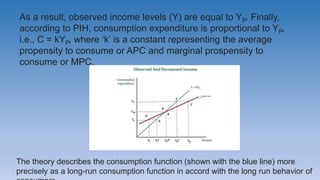
- The permanent income hypothesis (PIH) states that consumption is based on long-term "permanent" income rather than current income. It is based on the idea that individuals smooth their consumption over time based on their estimated permanent income.
- Milton Friedman developed PIH in 1957 and divided current income into two parts: transitory income (short-term fluctuations) and permanent income (long-term average). Consumption is determined by permanent income rather than total current income.
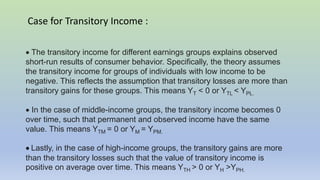
- The theory helps explain differences in consumption behaviors between low, middle, and high income groups based on whether their transitory income components are negative, zero, or positive on average. It provides a framework for understanding how households may react to changes in